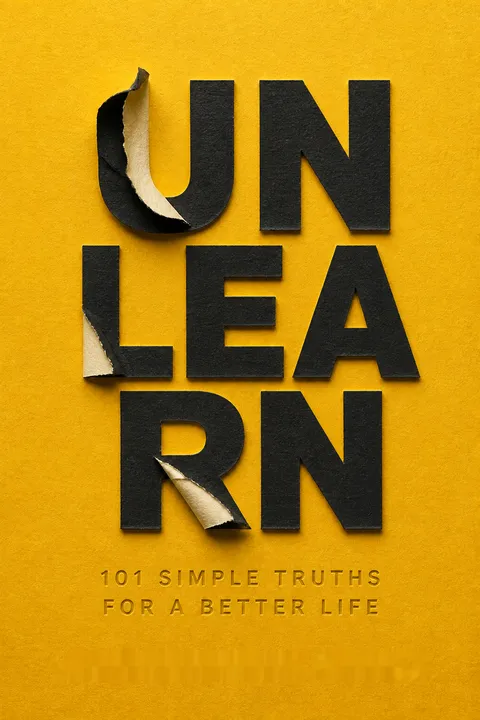


Key Takeaways
Audit the life script you inherited before mistaking it for your own.
Old instructions linger. Humble the Poet opens with a classroom lesson: children may follow directions in the wrong order unless an adult explains them clearly. Adults, he argues, also absorb rules without noticing: be good and life will reward you, give love and it will come back, fit in to be safe. He began writing these reflections while heartbroken and feeling powerless, then discovered that sharing his private self-talk connected him to others facing similar struggles.
Unlearning clears space. The book does not offer a secret formula so much as invite readers to question stale beliefs and recover preferences buried under expectation. Its 101 short, repeating reflections are meant to be revisited, since the same idea can land differently at different stages of life.
What's useful here is the distinction between a belief that was chosen and one that was merely absorbed. Developmental psychology shows how family, school, and culture shape assumptions before people can examine them; those assumptions can feel like facts precisely because they are familiar. A practical audit asks who taught a rule, what it protects, and what it costs now. Still, inherited norms are not automatically wrong: some preserve hard-won knowledge or protect people from risk. The task is not reflexive rebellion, but deliberate ownership.
Close the gap between the life you expect and the one you have.
Happiness is a mismatch. The book describes unhappiness as the distance between an imagined life and present circumstances. Sometimes the useful move is changing the circumstances; sometimes it is questioning the expectation. A desired achievement can disappoint when the mind has inflated the happiness it promises. The author recommends noticing what is already worth appreciating, rather than treating the present as merely a waiting room for a better future.
Gratitude redirects attention. He suggests listing things one appreciates as a simple way to shift focus, while rejecting the idea that anyone should feel happy all the time. Ambition can coexist with gratitude, and painful emotions belong in a full emotional life. He also cautions that a short reflection may not be enough when distress becomes overwhelming, and encourages seeking professional help.
This account fits research on hedonic adaptation: people often return toward a familiar emotional baseline after desirable changes, so acquiring the next goal may not deliver lasting satisfaction. Cognitive reappraisal, the practice of reconsidering what a situation means, can also reduce distress without pretending the situation is good. The balance matters. Gratitude can widen attention, but it must not become a demand to feel thankful in the face of deprivation, discrimination, or illness. Some gaps call for acceptance; others require material change and support.
Treat emotions as information, not instructions to obey or erase.
Feelings have context. Anxiety may be tied to a feared future, while regret may keep attention fixed on an unchangeable past. The author encourages asking what may be underneath a feeling instead of accepting its first interpretation as the whole truth. A mood can describe an experience without defining a person or proving that the feared outcome will happen.
Choose what receives attention. Humble describes attention as a kind of nourishment: repeatedly rehearsing worry can deepen a downward spiral, while noticing gratitude or engaging in a task can help return attention to the present. This is not a promise of instant control. He acknowledges that everyone has difficult emotions and that serious or persistent distress may require professional care, not another motivational slogan.
Naming a feeling and examining its trigger resembles affect labeling, a psychological practice in which putting an emotion into words can make it easier to observe and regulate. The distinction between feeling and command also echoes cognitive behavioral approaches, which test interpretations rather than treating every thought as fact. Yet attention is not a remote control. Trauma, depression, and chronic stress can narrow a person's capacity to redirect focus. The humane reading is to build agency where possible, while refusing to turn emotional difficulty into evidence of personal failure.
Name the fear, then take one step into the unfamiliar.
Fear can clarify. Immediate fear can alert a person to danger; imagined fears, such as rejection or embarrassment, can instead keep life small. The author recommends identifying the specific feared outcome, then moving forward in manageable steps rather than waiting to feel fearless. A refusal may hurt, but it does not have to become a verdict on a person's future.
Work with reality. The Sikh concept of Hukam is presented as the nature or order of things, which should be understood and navigated rather than denied. This means learning the conditions of a situation before deciding how to act. The book also draws on the idea of adapting like water: flexibility can be more useful than insisting that the world conform to a preferred plan.
This is close to exposure-based learning: approaching a feared but manageable situation can teach the nervous system that anticipated catastrophe is not inevitable. The emphasis on small steps makes courage a practice rather than a personality trait. The idea of adapting to conditions also resembles ecological thinking, where successful action depends on reading an environment accurately. A necessary distinction is that not every fear is irrational. Fear can signal genuine danger, and adaptation should not become an excuse to tolerate abuse or avoid changing harmful systems.
Build identity from examined values, not applause, labels, or inherited beliefs.
Beliefs are not the self. The author argues that people often attach identity to opinions they have never seriously tested. When a belief becomes part of the self-image, disagreement can feel like a personal attack, closing off learning. He invites readers to ask where their convictions came from and whether they can imagine revising them.
Labels flatten people. Nationality, religion, politics, and other categories can make complex individuals seem like a single type. The book distinguishes ignorance, not knowing, from apathy, not caring to know. A child once greeted the author with a religious greeting that did not precisely match his background; the gesture mattered more as an attempt to connect than as a display of knowledge. Actions and curiosity offer better clues to character than labels alone.
Social identity helps people find belonging and coordinate with others, but it can also turn criticism of an idea into perceived rejection of a group. That is why intellectual humility is more than a polite posture: it protects the ability to update beliefs when evidence changes. Labels are not simply useless, however. They can name shared histories, discrimination, and political interests that would otherwise disappear from view. The challenge is to use categories as partial maps, not complete portraits, and to preserve room for individuals to surprise them.
Give love freely, but stop financing relationships that drain you.
Care is not a debt. Love becomes a source of bitterness when it is offered as an investment that must be repaid in identical form. The author encourages readers to give affection because they choose to, not to secure another person's approval. At the same time, he warns against making another person responsible for one's self-worth or happiness.
Boundaries protect generosity. A relationship that repeatedly ignores a person's needs may call for distance, not endless extra effort. The book also notes that people sometimes ask for advice mainly to receive agreement, so helpers should notice whether support is actually wanted. This is not a call to become isolated or indifferent. It is a case for directing limited time and energy toward relationships where care and respect can exist.
The distinction between generous care and covert exchange is important: unspoken contracts often create disappointment because each person assumes a different definition of reciprocity. Healthy relationships still need mutuality, though not a perfect ledger. Boundaries make care sustainable by clarifying what help is available and what behavior is unacceptable. The advice to leave draining relationships can be liberating, but real ties may involve children, caregiving, financial dependence, or safety risks. In those cases, planning and outside support matter more than a simple command to walk away.
Let mortality decide what deserves space on today's schedule.
Time is visible in action. The author argues that stated priorities mean little if daily behavior never makes room for them. A calendar can reveal whether a person is actually spending time on relationships, creative work, health, or goals, rather than merely saying those things matter.
Death sharpens choice. Remembering that life is temporary is presented not as a reason for despair, but as a way to reduce the power of trivial worries and stop postponing meaningful choices. In one conversation, a friend asked the author what he wanted life to contain; he answered with ordinary pleasures and the chance to create. The exchange helped him see which commitments moved him toward that vision and which merely filled his days.
Mortality can function as a prioritization tool: finite time makes trade-offs concrete and exposes the difference between a socially admired goal and a personally meaningful one. This connects with values-based approaches in psychology, which ask people to organize behavior around chosen values rather than transient moods. Still, death awareness does not affect everyone in the same way; it can clarify priorities, but it can also intensify anxiety or encourage reckless choices. A useful test is whether the reminder produces considered commitment, not urgency for its own sake.
Trade grand plans for small actions, preparation, and repeated learning.
Starting breaks the freeze. When a task feels enormous, anxiety can lead to avoidance, which leaves more work to do and increases the anxiety. The author recommends beginning with one manageable action, then building momentum. He traces his music career to repeated work, including releasing his first tape in 2009, rather than to a single brilliant idea or lucky break.
Preparation meets opportunity. The book presents luck as partly shaped by readiness: skills, practice, and attention make it more likely a person can use an opening when it appears. It also encourages learning from unexpected setbacks instead of sorting every event into a simple good or bad category. Small steps do not guarantee success, but they produce information and options that waiting cannot.
The account captures the behavioral advantage of reducing a task to a next action: beginning can lower the psychological barrier and generate feedback that improves the plan. It also connects preparation with opportunity recognition, a useful corrective to stories that portray achievement as effortless. But luck is not just preparation. Wealth, health, social networks, discrimination, and timing shape which opportunities appear and who can take them. The strongest version of the advice combines personal readiness with an honest account of external constraints, rather than turning every unequal outcome into a verdict on effort.
Let pain teach you, but never confuse suffering with a cure.
Hard feelings are human. The author rejects the promise of constant positivity and argues that heartbreak, fear, and disappointment can reveal needs, mismatches, and mistaken expectations. A breakup, for instance, should not be treated as proof that a person's worth has disappeared. Healing takes time, and trying to numb pain with alcohol can create further harm.
Growth is not automatic. The book encourages readers to learn from difficult experiences, but it also tells people who feel helpless or overwhelmed to seek professional help. That qualification matters: struggle may become a source of insight, yet no one needs to endure avoidable harm to prove resilience. The practical aim is to care for the body, accept the pace of recovery, and use support when private effort is not enough.
The distinction between meaning made from adversity and adversity itself is crucial. Post-traumatic growth research describes some people reporting changed priorities or relationships after trauma, but growth is neither universal nor proof that the trauma was beneficial. The book's advice is strongest when it treats pain as something to tend, not a test that must be passed alone. Its warnings about alcohol and encouragement to seek professional care help counter the more romantic notion that every wound improves its bearer.
Help within reach, without turning compassion into control.
Small acts count. The author describes helping as more than donating money or founding an organization. Listening, opening a door, joining a protest, or offering practical support can all matter. He recounts meeting a photographer who gave a substantial share of his income to people in need rather than waiting for a perfect financial moment, while making clear that people can contribute in different ways.
Understand before acting. The book warns that public causes can be more complicated than their slogans suggest, and that awareness campaigns do not help if audiences are unwilling to learn. It distinguishes wanting to support others from imposing a preferred solution on them. Effective help begins with attention to the people affected, a willingness to investigate, and respect for what they say they need.
This section usefully joins compassion with epistemic humility. In public health and community work, interventions are more likely to fit real needs when affected people help define the problem and evaluate the response. Small, local actions can build trust and make care tangible, while research and accountability help prevent well-intentioned efforts from causing harm. The limit is that individual kindness cannot substitute for institutions, policy, or material resources. Good help can be immediate and personal while also recognizing when the problem demands collective solutions.
Analysis
Unlearn is a personal-growth book built as 101 brief reflections rather than a linear argument. Its governing idea is that people often do not need more advice so much as permission to inspect and discard ideas absorbed from family, media, institutions, and social expectations. The author's route into this project is personal: after heartbreak and a period of feeling powerless, he turns private self-talk into public writing and finds connection in shared vulnerability. That origin gives the book a conversational intimacy, while the recurring examples make its central themes easy to revisit.
Three practices organize the reflections. First, examine inherited scripts and beliefs rather than confusing familiarity with truth. Second, redirect attention from comparison, regret, and imagined futures toward present choices and appreciation. Third, act through discomfort: take small steps, adapt to conditions, and learn from outcomes instead of waiting for certainty. Relationships, mortality, work, identity, and social responsibility all appear through this lens. Sikh concepts such as Hukam provide a vocabulary for accepting reality without surrendering agency.
The book's repetition is both its form and its limitation. Returning to themes of expectation, self-worth, and letting go can reinforce them, much as a memorable refrain does. Yet the same recurrence can make distinct problems sound alike, as if attention alone could solve them. The author's sharp emphasis on responsibility is energizing when it interrupts helplessness, but it needs qualification: mental illness, trauma, poverty, and discrimination cannot always be changed by mindset or individual effort. The book is most persuasive when it pairs agency with compassion, acknowledges professional help, and treats adaptation as a choice among tools rather than a moral obligation. Its strongest invitation is not to believe every aphorism, but to test which beliefs are still useful and make daily life reflect the answer.
Review Summary
Unlearn receives mixed reviews, with an overall positive reception. Many readers find it inspirational, motivating, and filled with wisdom. They appreciate its simple, straightforward approach and bite-sized chapters. Some consider it a great daily motivational tool. However, critics point out repetitiveness, lack of originality, and poor editing. Several reviewers note that while the content isn't profound, its authenticity and conversational tone make it relatable. The book is seen as a collection of life lessons and reminders, best consumed in small doses rather than read cover-to-cover.
People Also Read






Glossary
Unlearn
Question inherited scriptsThe book's central practice of examining ideas, values, and expectations absorbed from parents, schools, culture, and media, then letting go of those that no longer fit. Unlearning is not simply rejecting tradition or acquiring new facts. It is making room to understand personal priorities and choose a direction more deliberately.
Hukam
The nature of thingsA Sikh concept that the author interprets as the order or nature of reality. Rather than treating it as a command to submit without question, he uses it to mean that people should study how circumstances work and respond accordingly. Understanding the conditions of life, in this view, makes purposeful adaptation possible.
tyar bar tyar
Always be preparedA Sikh phrase the book uses to express readiness. Preparation means developing skills and staying alert to opportunities so that unexpected events are less likely to find a person entirely unready. The author connects this idea to effort and initiative, while arguing that what people call luck often includes the ability to make use of an opening.
alchemy
Find use in setbacksThe author's term for the effort to turn difficult or unwanted circumstances into opportunities for learning or action. It begins by resisting the reflex to classify events as simply good or bad and asking what can be done with what has happened. Alchemy does not mean every setback is secretly beneficial or that harm should be accepted.
FAQ
What's "Unlearn: 101 Simple Truths for a Better Life" about?
- Author's Journey: The book is a collection of insights and reflections from Humble the Poet's personal journey of self-discovery and growth.
- Core Message: It emphasizes the importance of unlearning outdated beliefs and embracing new perspectives to lead a more fulfilling life.
- Practical Advice: The book offers 101 simple truths that aim to help readers navigate life's challenges and find happiness.
- Format: Each chapter is a standalone piece of advice, making it easy to read and apply in daily life.
Why should I read "Unlearn: 101 Simple Truths for a Better Life"?
- Self-Improvement Focus: The book provides practical advice for personal growth and overcoming life's obstacles.
- Relatable Insights: Humble the Poet shares his own experiences, making the advice relatable and grounded in reality.
- Encourages Reflection: It prompts readers to reflect on their own beliefs and encourages them to make positive changes.
- Accessible Format: The book's structure allows readers to easily digest and apply the lessons in their own lives.
What are the key takeaways of "Unlearn: 101 Simple Truths for a Better Life"?
- Unlearning is Essential: Letting go of outdated beliefs is crucial for personal growth and happiness.
- Embrace Change: Change is a constant in life, and adapting to it can lead to personal development.
- Self-Reflection: Regularly examining one's thoughts and actions can lead to a deeper understanding of oneself.
- Happiness is a Choice: Happiness is not a destination but a mindset that can be cultivated through gratitude and perspective.
What are the best quotes from "Unlearn: 101 Simple Truths for a Better Life" and what do they mean?
- "We gain more from letting go; there’s nothing mystical or secretive about this idea." This quote emphasizes the power of releasing burdens and outdated beliefs to make room for growth.
- "The strongest don’t survive; the most adaptable do." It highlights the importance of adaptability in navigating life's challenges.
- "Love is a gift, not a loan." This suggests that love should be given freely without expecting anything in return.
- "You are a work of art in progress." It encourages readers to view themselves as ever-evolving and to embrace their journey of self-improvement.
How does Humble the Poet suggest we deal with fear in "Unlearn: 101 Simple Truths for a Better Life"?
- Recognize Fear: Acknowledge that fear is a natural part of life and can be a useful tool for growth.
- Move Forward Despite Fear: Courage is not the absence of fear but the decision to act in spite of it.
- Identify Fears: Understanding what you fear can help you address and overcome it.
- Use Fear as Motivation: Let fear drive you to take action and make positive changes in your life.
What does Humble the Poet mean by "Unhappiness is simple" in "Unlearn: 101 Simple Truths for a Better Life"?
- Mismatch of Expectations: Unhappiness often arises when reality doesn't match the picture in your head.
- Adjust Expectations: By managing and adjusting expectations, you can reduce feelings of unhappiness.
- Focus on the Present: Concentrating on the present moment can help alleviate unhappiness tied to past regrets or future worries.
- Mindset Shift: Changing how you perceive your circumstances can lead to greater contentment.
How does "Unlearn: 101 Simple Truths for a Better Life" address the concept of self-worth?
- Self-Determined Worth: Your worth is determined by you, not by external validation or circumstances.
- Focus on Positives: Concentrate on your strengths and achievements rather than perceived shortcomings.
- Avoid Comparisons: Comparing yourself to others can undermine your self-worth; focus on your unique journey.
- Empowerment: Recognize that you have the power to define and enhance your own self-worth.
What advice does Humble the Poet give about relationships in "Unlearn: 101 Simple Truths for a Better Life"?
- Independence is Key: The most important relationship is with yourself; don't rely on others for happiness.
- Conditional Love: Understand that many relationships are based on conditions and manage expectations accordingly.
- Healthy Boundaries: Set boundaries to protect your well-being and ensure mutual respect in relationships.
- Love Freely: Give love without expecting it in return, and focus on relationships that bring joy and growth.
How does "Unlearn: 101 Simple Truths for a Better Life" suggest we handle negative emotions?
- Acknowledge Emotions: Accept that negative emotions are a natural part of life and can offer valuable insights.
- Don't Feed Negativity: Choose not to dwell on negative emotions; instead, focus on positive aspects of life.
- Mindful Reflection: Reflect on the root causes of negative emotions to better understand and manage them.
- Emotional Balance: Strive for a balance between acknowledging emotions and not letting them control your life.
What role does gratitude play in "Unlearn: 101 Simple Truths for a Better Life"?
- Mindset Shift: Gratitude shifts focus from what is lacking to what is present and appreciated.
- Happiness Booster: Regularly practicing gratitude can enhance overall happiness and life satisfaction.
- Simple Practice: Writing down things you're grateful for can be a powerful tool for cultivating a positive mindset.
- Perspective Change: Gratitude helps reframe challenges as opportunities for growth and learning.
How does Humble the Poet define success in "Unlearn: 101 Simple Truths for a Better Life"?
- Personal Definition: Success is subjective and should be defined by personal values and goals.
- Process Over Outcome: Focus on the journey and the growth it brings, rather than just the end result.
- Continuous Improvement: Success involves ongoing learning and adaptation, not a fixed destination.
- Authenticity: True success aligns with one's authentic self and passions, rather than societal expectations.
What is the significance of the chapter "The Most Important Chapter in This Book" in "Unlearn: 101 Simple Truths for a Better Life"?
- Reader's Reflection: The chapter encourages readers to reflect on their own lives and apply the book's lessons.
- Personal Application: It emphasizes that the book's value lies in how readers integrate its truths into their own experiences.
- Active Participation: Readers are invited to write their own chapter, reinforcing the idea of personal growth and self-discovery.
- Empowerment: The chapter empowers readers to take ownership of their journey and continue learning beyond the book.

Download PDF
Download EPUB
.epub digital book format is ideal for reading ebooks on phones, tablets, and e-readers.








