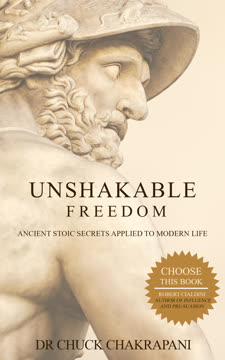
Key Takeaways
1. True Freedom is an Internal Choice
True freedom comes from choosing wisely.
Freedom's essence. Freedom is not dictated by external circumstances, wealth, or social status, but by the choices we make internally. Whether facing trial, exile, or even torture, individuals like Agrippinus, Rhonda Cornum, Viktor Frankl, and James Stockdale demonstrated that one can choose their response to adversity, thereby retaining their inner liberty. This profound realization empowers us to be free regardless of what life throws our way.
Unshakable resolve. These historical and modern figures, some Stoic practitioners and others simply embodying Stoic principles, chose not to be crushed by their predicaments. Agrippinus enjoyed his bath and lunch despite being condemned, while Viktor Frankl found mental freedom in a concentration camp. Their stories underscore that our reaction to events, not the events themselves, determines our freedom and happiness.
Personal power. We are often defeated by our own choices, not by external happenings. By focusing on what is within our control—our thoughts, beliefs, and actions—we unlock a powerful, unassailable freedom. This internal locus of control is the cornerstone of Stoic philosophy, offering a path to serenity and joy in a complex world.
2. Master the Dichotomy of Control
If you choose, you are free; if you choose, you need to blame no one and accuse no one.
Identify control. The fundamental Stoic principle for unshakable freedom is to clearly distinguish between what is entirely within our control and what is not. Our opinions, desires, aversions, and actions are fully ours to command. Everything else—our body, possessions, reputation, relationships, and external events—is beyond our absolute control.
Accept reality. Things not under our total control are "indifferents"—neither inherently good nor bad. Resisting these realities only leads to frustration and suffering. For instance, traffic delays are a given; our choice is to fume or use the time productively. This acceptance of reality, coupled with rational thought, prevents external circumstances from dictating our inner state.
Focus inward. True freedom stems from concentrating solely on what we can control. While we can influence some external factors (like maintaining health through exercise), we must acknowledge that ultimate control remains elusive. By releasing the need to control the uncontrollable, we free ourselves from anxiety and cultivate a resilient inner peace.
3. Release the Shackles of the Past
All the happiness you are seeking by such long, roundabout ways, you can have it all right now ... if you leave all the past behind you.
Past is immutable. The past, whether recent or distant, is unchangeable and therefore beyond our control. Dwelling on past regrets, missed opportunities, or injustices serves no purpose other than to imprison us in misery. Stoicism teaches that the past is an "indifferent" and has no power over our present freedom unless we allow it to.
Embrace the present. Individuals like Gac Filipaj, an immigrant janitor who pursued a degree despite his past circumstances, and Nelson Mandela, who forgave his captors after 27 years of imprisonment, exemplify this principle. They chose to leave bitterness and limitations behind, focusing on what they could do in the present moment to shape their future.
Preferred indifferents. While the past itself is an indifferent, our actions in response to it can be virtuous. Stoics distinguish between "preferred indifferents" (like education or health) and "dispreferred indifferents." We can strive for preferred indifferents, but without attachment, recognizing they are not essential for our freedom. This allows us to pursue goals without being bound by past failures or successes.
4. Conquer Fear to Live Freely
Where fear is, happiness is not.
Fear's grip. Fear is fundamentally incompatible with freedom. When we are afraid, our minds are constrained, and we lose the ability to act rationally and freely. Stoics like Helvidius, who defied Emperor Vespasian at the risk of death, and modern figures like Mahatma Gandhi and Malala Yousafzai, demonstrated profound fearlessness in the face of extreme threats.
Inevitable end. Stoics view death as a natural and inevitable part of life, not something to be feared. This understanding liberates them from the ultimate fear, allowing them to live fully and courageously. Helvidius chose to speak his truth, knowing that a life lived in fear of death was no life at all.
Everyday fearlessness. In daily life, fearlessness translates not into reckless defiance, but into doing what is right, even when it's uncomfortable or carries personal risk. It means fulfilling our duties and upholding our principles without being swayed by the fear of losing a job, reputation, or possessions. This inner strength ensures that external pressures cannot compromise our integrity or peace of mind.
5. Navigate Emotions with Rationality
Don’t grow peevish about trivialities.
Emotional toll. Our freedom is often eroded by a constant barrage of negative emotions triggered by everyday annoyances—burnt toast, traffic jams, rude people. These "tiny beetles," as Dale Carnegie's analogy suggests, cumulatively deplete our mental energy and sense of well-being, even more than major catastrophes.
Rational response. Stoicism teaches that it's not what happens to us, but our thoughts about what happens, that truly upsets us. By choosing to think differently, we can transform annoyances into opportunities for calm and reflection. Instead of fuming in traffic, one can listen to music or plan their day, reclaiming their mental space.
Practical techniques. Stoics developed techniques like "The Two Handles" and "Marcus' Nine" to manage emotional reactions. "The Two Handles" encourages choosing a perspective that fosters freedom over one that leads to anger. "Marcus' Nine" provides a step-by-step process of questioning and reminding oneself to diffuse hostility and cultivate compassion, ensuring that external events do not rob us of our inner peace.
6. Embrace the Present, Dispel Future Anxiety
Don’t let the future cause you anxiety, for the future will arrive in its own good time, and you will have the same mind that you use now to deal with the present.
Future's uncertainty. The future is inherently unpredictable and beyond our control. Worrying about hypothetical misfortunes—job loss, illness, financial instability—is irrational and unproductive. As Michel de Montaigne observed, most of our terrible misfortunes never actually happen, and even when they do, we often cope better than anticipated.
Planning vs. worrying. Stoicism distinguishes between constructive planning and debilitating worry. Planning involves taking rational steps to prepare for potential outcomes, while worrying is a mental loop that generates misery without changing events. By focusing on what we can do now to prepare, we free ourselves from the paralysis of anxiety.
Hedonic treadmill. We often postpone present happiness, believing a better future will bring ultimate contentment. However, humans adapt to new circumstances, leading to a continuous craving for more—the "hedonic treadmill." Stoics advise against this, urging us to appreciate and enjoy the present moment, recognizing that "the good old days are now."
7. Life's a Festival: Enjoy its Gifts
So why not enjoy this feast and pageant while it is given to you to do so?
Appreciate the now. Life, with all its preferred indifferents—nature, friendships, food, art—is a continuous festival to be enjoyed. Stoics, while not actively pursuing pleasure for its own sake, encouraged a deep appreciation for the good things available in the present. This means savoring every sandwich, every sunset, and every moment of connection.
Joy in virtue. Stoic joy is not fleeting pleasure but a consistent sense of well-being derived from living a virtuous life—a life aligned with reason, wisdom, justice, courage, and self-discipline. This rational approach ensures that happiness is a byproduct of our character, not dependent on external, transient pleasures.
Mindful enjoyment. Even in the face of impending death, as musician Warren Zevon exemplified by "enjoying every sandwich," one can choose to find joy. Stoics advise us to enjoy preferred indifferents without attachment, ready to let them go when circumstances change. This mindful enjoyment allows us to participate fully in life's offerings without being enslaved by them.
8. Virtue is the Path to the Good Life
According to Stoics, one could achieve the good life by being “virtuous.”
Rational living. For Stoics, "virtue" means living according to nature, which is synonymous with living according to reason. Unlike modern interpretations of virtue as mere moral probity, Stoic virtue encompasses wisdom, justice, courage, and moderation. A life guided by these rational qualities is inherently the "good life" (eudemonia).
Freedom's byproduct. Freedom is not a goal to be chased directly but a natural outcome of living virtuously. When our actions are rational and aligned with nature, we are unhindered by external events or internal turmoil. This internal consistency ensures a state of serenity and independence, regardless of external conditions.
Avoiding vice. Conversely, vice—foolishness, injustice, cowardice, intemperance—arises from irrationality and leads away from freedom. Stoicism provides a framework for understanding how our choices, driven by reason or unreason, directly impact our ability to live a free and happy life. It's a practical philosophy for daily living, not just abstract thought.
9. Everything is on Loan, Nothing is Owned
Keep this in mind always: Everything good in our life is given to us.
Impermanence of all things. A core Stoic insight is that nothing external truly belongs to us; everything—our loved ones, possessions, health, and even life itself—is on loan. This understanding prepares us for the inevitable loss and change that characterize existence, preventing undue grief or attachment.
Premeditatio Malorum. The technique of "Negative Visualization" (premeditatio malorum) involves regularly contemplating the loss of things we cherish. By mentally rehearsing the absence of loved ones or possessions, we cultivate a deeper appreciation for their presence now and build resilience for when they are inevitably gone.
Gratitude and acceptance. This practice fosters profound gratitude for what we have, transforming potential anxiety into appreciation. When loss occurs, we are better equipped to accept it as part of the natural order, rather than feeling personally wronged. It reminds us not to take good things for granted, but to savor them fully while they are present.
10. Consistent Practice Builds Mental Fortitude
One cannot achieve freedom by reading books or listening to lectures.
Knowledge vs. application. Understanding Stoic principles intellectually is only the first step; true freedom comes from consistent, diligent practice. Just as a physics professor can explain tightrope walking without being able to do it, we must actively apply Stoic techniques to rewire our conditioned responses and build mental fortitude.
The Stoic Gym. Stoics emphasized daily "workouts" for the mind, recognizing that old habits and emotional reactions are deeply ingrained. Techniques like "Anticipatory Prep" (morning meditation), "Course Correction" (end-of-day review), and "Passion Counter" help us become aware of our emotional patterns and consciously choose rational responses.
Lifelong commitment. Achieving unshakable freedom is a continuous journey, not a destination. Regular engagement with these mental exercises, even for a few minutes daily, gradually strengthens our ability to remain calm, rational, and free amidst life's challenges. It's a commitment to self-mastery that yields profound and lasting peace.
Last updated:
Similar Books