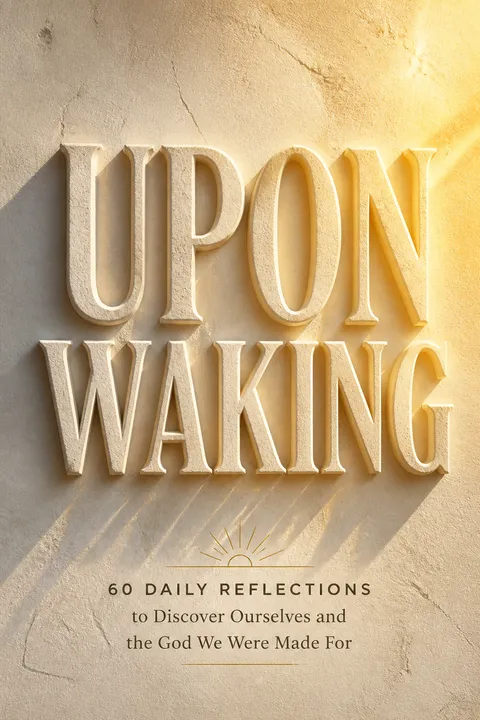


Key Takeaways
Start the morning with Christ, not substitutes that only quiet the appetite.
Feed the deeper hunger. Perry opens with a familiar need: the body expects food after sleep. She uses Jesus’ description of himself as life-giving bread to argue that the soul also needs more than an occasional spiritual snack. Attention, affection, and identity can be spent on social media, approval, or other people, yet these cannot sustain a person’s life with God. The book’s sixty short readings are meant as an invitation to Scripture, not a replacement for it. Perry calls them an appetizer: their purpose is to direct the reader toward Christ and the Bible, where the fuller nourishment is found.
Read to meet God. This changes the goal of a devotional. Finishing a page is not proof of maturity, and feeling briefly reassured is not the same as knowing God. The useful question is whether a reading sends the reader back to the biblical text with greater desire and attention.
What's striking is the book's refusal to make devotional reading the spiritual equivalent of a complete meal. That distinction guards against confusing exposure to religious language with actual formation. Learning theory makes a related point: brief prompts help most when they lead people to retrieve, test, and apply material themselves, rather than merely reread it. The metaphor also has a practical limit: a devotional can guide a reader, but cannot ensure that reader engages Scripture or finds its interpretation convincing. Perry's insistence that the book is a beginning, not a substitute, makes that limitation part of the method.
Treat prayer as dependence, not another task squeezed into a crowded day.
Name the deeper obstacle. Perry challenges the familiar excuse that prayer disappears because life is too busy. Jesus, though constantly teaching, healing, traveling, and serving, made time to pray. The devotional therefore treats prayerlessness not only as a scheduling problem, but as a possible sign of self-reliance: when people assume they can manage life without God, prayer seems optional. Humility begins by telling the truth about dependence, even when circumstances make self-sufficiency feel plausible.
Make room for attention. Prayer may also feel difficult because quiet exposes a mind accustomed to constant stimulation. Perry recommends returning to prayer after distraction instead of treating wandering thoughts as a reason to quit. Jesus’ example of withdrawing from crowds matters here: even genuine needs and worthwhile service do not replace communion with God. A small, protected interval can be an act of trust, not wasted time.
The argument connects spiritual practice to attention: people repeatedly attend to what they believe matters, and constant entertainment can make stillness feel unusually demanding. In that sense, prayer is not simply a request for outcomes. It is also training in where attention returns when it wanders. The critique of busyness is valuable, especially in religious settings where service can appear virtuous while displacing reflection. Still, schedules and caregiving burdens are real constraints, not always disguises for pride. The most useful application pairs honest self-examination with practical changes, rather than treating every missed prayer as a moral diagnosis.
Let Scripture steady emotion without pretending faithful people never feel pain.
Feel honestly, interpret carefully. Perry argues that emotions are part of human life, not enemies to be eliminated. The danger comes when a feeling becomes the final authority about God, other people, or the right response. The spies who feared the inhabitants of Canaan lost sight of God’s promise; Peter’s fear and zeal in the garden led him to violence. Their feelings were real, but those feelings did not tell the whole truth.
Bring questions into prayer. The Psalms, and Jesus’ use of a lamenting psalm on the cross, show that questioning God can belong within faith. Suffering can make God seem absent or unkind, but the book urges readers to bring that perception into prayer and compare it with Scripture. This is not a demand to suppress grief. It is an invitation to speak honestly while allowing God’s character to challenge the conclusions pain may produce.
This distinction resembles a useful principle in emotion research: feelings provide information, but they are not infallible verdicts. Fear can alert someone to danger, while also magnifying it; anger can signal perceived injustice, while narrowing attention to retaliation. Perry’s approach gives emotion a place without granting it sovereignty. The invitation to question God also resists a brittle form of faith that treats uncertainty as disloyalty. A necessary nuance is that scriptural reassurance should not be used to rush someone out of grief. Honest lament and durable hope can coexist without either cancelling the other.
Rehearse God's past faithfulness before fear writes the future for you.
Remember before reacting. The spies who returned from Canaan saw genuine danger, but ten of them treated that danger as more decisive than God’s promise. Joshua and Caleb interpreted the same facts through a different conviction about God’s presence. Perry uses their disagreement to show how faith shapes perception, not by denying obstacles, but by refusing to make obstacles the only reality.
Build a usable memory. Israel’s wilderness failures recur in the book: people who had witnessed rescue later forgot it when hungry or thirsty. Perry also draws on the story of Henry Molaison, whose severe memory impairment left him unable to form ordinary memories or imagine his future from personal experience. The comparison illustrates why recalling God’s past provision matters to faith. Scripture, prayer, and trusted community help people remember what fear makes easy to overlook, without promising that every new problem will end in the same way as an old one.
Memory is not a neutral archive. People reconstruct the past, and a present crisis can make earlier help feel remote or irrelevant. Rehearsing concrete experiences can counter that narrowing, much as written records help people notice patterns that mood alone obscures. The book's use of Molaison gives this spiritual practice an illuminating human parallel, though neurological memory loss and ordinary forgetfulness are not equivalent. Remembering past provision should strengthen trust in God's character, not become a formula for predicting specific outcomes. The difference matters: hope can rest on faithfulness without assuming a repeat of the same circumstances.
Bring your real self into the light, and let trusted people correct you.
Confession breaks the mask. Psalm 139 presents a God who knows a person completely, which can feel exposing as well as comforting. Perry warns that religious performance can become camouflage: visible service or biblical fluency may conceal shame, sin, or fear. In her reading of Adam’s hiding in Eden, and David’s response to Nathan’s rebuke, concealment delays honesty while confession opens a way toward mercy and change.
Receive correction as care. Nathan confronts David through a story about a rich man who takes a poor man’s lamb. David condemns the fictional man before recognizing that the story describes his own conduct. Perry uses this reversal to argue that sound moral judgment does not guarantee self-knowledge. A trustworthy person who can name a blind spot may be a gift, though correction must be distinguished from humiliation or control. Christ’s sympathy for human weakness, she argues, makes vulnerability before God possible.
The Nathan episode is a sharp illustration of motivated reasoning: people can identify wrongdoing accurately when it belongs to someone else, while protecting their own self-image from the same standard. Trusted relationships can disrupt that asymmetry. Modern approaches to accountability similarly emphasize safety, specificity, and the possibility of repair, rather than shame as an end in itself. The theological claim that being fully known can coexist with being loved offers a powerful alternative to secrecy. The practical challenge is discernment: not every critic is a Nathan, so correction deserves attention, but also careful assessment of the relationship and its effects.
Enjoy created beauty without asking it to become your god.
Trace gifts to their source. Perry treats food, art, relationships, beauty, and success as genuine goods, not traps by definition. The problem begins when a good thing is expected to provide the security, identity, or joy that belongs to God. She reads Eve’s attraction to the forbidden fruit as a picture of desire severed from trust, and asks readers to notice how easily beauty can hold attention while its source disappears from view.
Open your hands. The same logic applies to envy and surrender. Seeing another person’s marriage, wealth, body, or easier circumstances can distort the belief that God cares fairly. Perry advises prayer and gratitude rather than coveting, while acknowledging that a desired gift may be withheld. Abraham’s near-sacrifice of Isaac becomes a story about trusting God above even a cherished promise. Surrender is costly, but the book frames it as trust in God’s goodness, not contempt for earthly life.
This account resembles a distinction in moral philosophy between enjoying a good for its own sake and treating it as a tool for total fulfillment. A relationship, achievement, or beautiful object can enrich life, yet no finite good can reliably carry the weight of ultimate security. That insight helps explain why gratitude can interrupt envy without requiring people to deny what they lack. The account also deserves a careful boundary: not every loss should be described as a lesson or as evidence that a person wanted something too much. Surrender may be spiritually meaningful, but grief over loss remains legitimate.
Use your gifts as borrowed grace, not evidence of personal greatness.
Remember what you received. Perry presents teaching, mercy, leadership, and service as gifts entrusted for the benefit of others. Their purpose is to help a Christian community grow, not to elevate the person exercising them. Each gift has a nearby temptation: teaching can feed status, mercy can become self-congratulation, and leadership can slide into control. The corrective is to see ability as received, then use it with humility and accountability.
Measure work by faithfulness. David’s history of killing a lion and a bear did not make him the hero of the Goliath story in Perry’s reading; it reminded him that God had helped him before. Likewise, productivity can become an idol when every success is credited to personal effort and anxiety is met only with more work. Jesus’ quiet withdrawal to pray offers a counterexample: worthy demands do not make intimacy dispensable. Rest, prayer, and service belong together.
The book links individual talent to institutional health: gifts are valuable partly because they are distributed, and no single person should become the whole system. That insight aligns with the logic of resilient teams, where expertise is shared and authority remains answerable. It also exposes a subtle danger in meritocratic cultures: visible output is easily mistaken for proof of personal worth. Yet humility should not become denial of skill or a reason to avoid responsibility. A mature stewardship ethic can name genuine competence while recognizing its dependence on training, support, circumstance, and, within Perry’s theology, grace.
Expect spiritual resistance, but do not mistake people for the enemy.
Look beyond the surface. Perry reads the New Testament as describing both human wrongdoing and spiritual opposition. In Acts, Paul responds to a slave girl’s disruptive behavior by addressing the spirit she is said to be under, rather than reducing her to an irritation. The story, in Perry’s account, reminds believers that there may be more at work than what is immediately visible and that prayer and compassion matter.
Keep discernment grounded. This is not permission to label every disagreement or difficult person demonic. Perry explicitly allows for ordinary human sin, mistaken judgment, and the need to examine one’s own conduct. She also describes forgiveness as a way of refusing to let resentment deepen division. The practical principle is to resist evil without dehumanizing the person in front of you. Faith, in this framework, is a means of standing against despair and accusation, not a license to treat others as objects of suspicion.
The distinction between a harmful action and the full humanity of the actor is ethically important. Conflict research often finds that dehumanizing opponents makes escalation easier, while curiosity about motives can preserve room for restraint and repair. Perry's spiritual account gives that restraint a theological basis: opposition can be real without making a human being disposable. The caution in the passage is essential, since supernatural explanations can be misused to stigmatize mental illness or silence legitimate criticism. A sound application keeps ordinary explanations in view, attends to evidence, and makes compassion nonnegotiable.
Trust God's character when rescue is possible but not promised on your timetable.
Separate power from outcomes. The three men facing Nebuchadnezzar’s furnace believed God could save them, but did not make obedience depend on being saved. Perry puts their stance beside Jesus’ prayer before the cross: both express trust in God’s power and submission to a will that may involve suffering. Faith, then, is not certainty that a preferred result will arrive. It is confidence in God that persists when the result remains unknown.
See endurance as formation. The book draws on Abraham’s earlier tests to suggest that trust can grow through repeated practice. It also uses the image of fragile clay vessels to describe people who can suffer and remain sustained by strength beyond themselves. Perry does not say hardship is painless; she argues that it need not have the final word. The Christian hope she describes is anchored in Christ’s death and resurrection, and extends beyond what present circumstances can show.
This is one of the book's most demanding claims because it separates faith from a bargain: devotion is not payment for guaranteed rescue. That distinction can protect believers from interpreting every painful outcome as evidence of spiritual failure. It also clarifies why hope can coexist with grief, uncertainty, and protest. Still, the promise that suffering can form a person should never be used to justify preventable harm or pressure someone to remain in danger. Endurance is not the same as passivity. Within this framework, trust in God can support both perseverance and wise action.
Build your life on Christ, the only foundation suffering cannot shake.
Let hardship expose false supports. The book closes by contrasting unstable things people may treat as foundations, such as status, work, relationships, or bodily security, with the steadiness Perry attributes to God. In the parable of the houses built on different foundations, storms reveal what could actually bear weight. Perry reads suffering in a similar way: it can expose how much trust has been placed in things that change, even as it can make the search for a firmer foundation painful.
See God drawing near. The biblical story moves from distance after human sin toward the incarnation, when God is present in the human life of Jesus. Christ is not portrayed only as a distant authority, but as one who experienced human weakness and suffering. For Perry, that nearness makes trust possible: the foundation is not an abstract principle but a person believers are invited to know and follow.
The closing image works because foundations are tested by load, not appearance. A career or relationship may be deeply valuable without being capable of guaranteeing stability through every loss. The distinction helps readers cherish finite goods without demanding that they be invulnerable. The incarnation adds an important relational dimension: Christian trust is placed in a God understood as entering human suffering, not merely explaining it from outside. Even so, a sturdy foundation does not make a person immune to grief or doubt. Its value lies in offering a place to stand while those experiences are faced.
Analysis
Upon Waking is a sixty-day Christian devotional, but its organizing argument is more substantial than a collection of isolated inspirational readings. Perry repeatedly moves from a biblical passage to a familiar pressure point, then back toward a vision of God and Christ that reframes it. Hunger, distraction, envy, shame, ambition, suffering, and uncertainty become occasions to ask what a person trusts and where that trust directs attention. The book's central movement is from self-observation to knowledge of God, then back to a more truthful understanding of the self.
Its narrative method is cumulative rather than linear. Recurring biblical episodes, including the wilderness generation, David, Abraham, Peter, and Jesus, recur as interpretive anchors. Their stories help make abstract theological claims memorable: forgetting past provision intensifies fear; unexamined self-righteousness distorts judgment; gifts can serve either the community or the ego. The devotional format allows variety, while repetition gives the readings a shared center in dependence on God.
The book's most distinctive contribution is its insistence that spiritual practices are not self-improvement techniques. Prayer, Scripture reading, confession, Sabbath, community, and service matter because they direct believers toward God, not because they guarantee a more productive or emotionally comfortable self. That claim also supplies the book's strongest internal critique: devotional reading can become another performance, so the reader must continue into Scripture rather than treat these reflections as sufficient.
The intended audience is Christian readers seeking theological depth in daily practice. The book assumes familiarity with biblical language and a broadly evangelical account of sin, grace, Christ, and the Holy Spirit. Its confidence in Scripture and spiritual realities is part of its argument, not a neutral premise shared by every reader. At its best, this produces vivid connections between doctrine and ordinary life. Its pastoral counsel is strongest when it distinguishes trust from denial, and humility from self-erasure. Readers should retain that distinction when applying its claims about suffering, spiritual opposition, and surrender.
Review Summary
People Also Read






Glossary
new creation
Renewed life in ChristA Christian identity based on the claim that a person who belongs to Christ is made new by God's action. In Perry's use, this does not mean ceasing to be a creature or becoming instantly flawless. It means a transformed relationship to the Creator, a changed orientation toward others, and the beginning of a life that continues beyond death.
Jehovah Jireh
The Lord who providesA biblical name associated with God's provision, drawn in the book from Abraham's journey to sacrifice Isaac. At the last moment, a ram is provided in Isaac's place. Perry reads that event as pointing toward God's provision of Christ, who becomes the substitute for sinners. The name therefore signifies more than material assistance; it recalls provision within the story of redemption.
strongholds
Entrenched false beliefsPerry uses the biblical term for patterns of reasoning, opinions, and inner narratives that oppose knowledge of God. These beliefs can feel protective, like walls around a vulnerable self, while also blocking truth. In her account, they are challenged through the truth about Christ as revealed in Scripture, rather than by willpower or argument alone.
leaven of the Pharisees
Contagious unbeliefA warning Jesus gives in Mark that Perry interprets as referring to unbelief and resistance toward him. Like yeast spreading through dough, this posture can influence the way people see a situation. The disciples display it when they worry over bread despite witnessing Jesus feed large crowds, focusing on what they lack instead of whom they are with.
Sabbath rest
Rest rooted in GodA practice and theological idea in which ceasing from work expresses trust that God sustains life and provides for people. Perry connects the biblical Sabbath command with the Christian belief that rest is ultimately found in Christ. It can involve pausing ordinary labor, resisting the urge to earn divine approval, and remembering that human effort is not the source of all growth.
jars of clay
Fragile people carrying powerPaul's image for human vulnerability in 2 Corinthians. Perry uses it to explain how believers can experience weakness, affliction, and fear while still bearing the life and strength God provides. The metaphor does not celebrate fragility for its own sake; it emphasizes that the source of spiritual power is God rather than the apparent resilience or importance of the person.
shield of faith
Trust that resists evilAn image from the biblical description of spiritual armor. Perry interprets faith as a means of resisting accusations and doubts that challenge God's goodness, presence, or trustworthiness. Faith is not presented as a human achievement or a guarantee of particular outcomes, but as reliance on Christ that helps believers withstand spiritual opposition.
About the Author
Other books by Jackie Hill Perry


Download PDF
Download EPUB
.epub digital book format is ideal for reading ebooks on phones, tablets, and e-readers.








