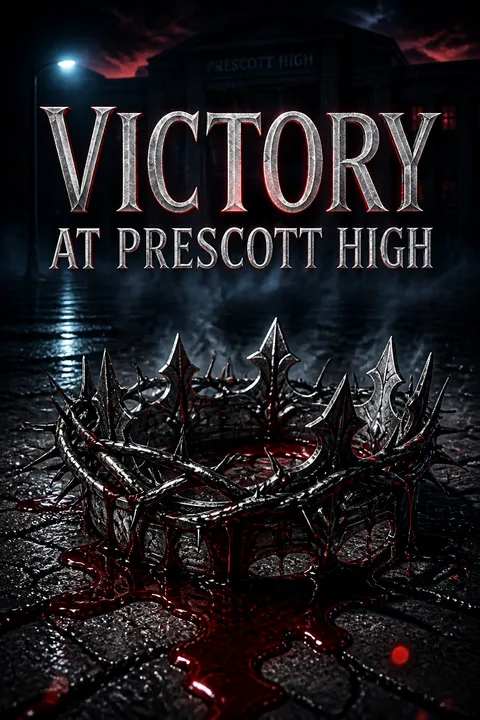


Plot Summary
The Garrote at Prescott
Callum Park is caught outside Prescott High in the middle of the Grand Murder Party's attack. Russ Bauer tightens piano wire around his throat, but Callum uses the dancer's instincts that once shaped his body to break free. He shoots one attacker, wounds Russ, then runs into an abandoned apartment building rather than retreating toward the school.
There, Maxwell Barrasso's second-in-command, Mason Miller, corners him. Callum escapes the collapsing building with a gunshot wound, a shoulder pierced by wood, and a cut throat. He sends Havoc's emergency signal, then loses consciousness before he can reach Bernadette. His disappearance leaves the others to face the siege without knowing whether he is alive.
The opening makes Callum's body both his history and his weapon. Dance has not vanished with his stolen career; its anticipatory discipline now lets him read violence as movement. Yet his escape is not triumph. The wounds and collapse expose the limit beneath Havoc's mythology, while his decision to pursue Russ shows how love and tactical judgment can pull in opposite directions. The unanswered signal turns individual survival into a problem for the whole group: Callum is missing precisely because he tried to protect them.
Stacey's Last Bell
Inside Prescott High, the attackers target Stacey Langford and the students connected to her sex-work organization. Stacey is shot in the hallway, and Bernadette's attempt to reach her comes too late. The school becomes a battleground; Havoc members fight through classrooms and corridors while teachers and students try to escape.
Bernadette kills James Barrasso, Maxwell's son, by smashing his head with a doorstop. Police and emergency crews arrive to find a massacre, but they cuff Bernadette and Victor rather than treating them as students who defended their school. She is taken away bloodied and furious, wearing the crown Victor gave her, while Havoc's howls carry through the schoolyard.
The attack collapses the distinction between a school and a territory people must defend. Bernadette's killing of James is an act of immediate survival, but it also changes the scale of the conflict: Havoc has killed the leader's son, and revenge now has a personal focus. Stacey's death gives the violence a cost beyond the central romance. The authorities' handcuffs deepen Bernadette's distrust, while the crown marks a different judgment, the one made by the people who fought beside her.
A Crown Behind Cuffs
At Sara Young's house, the FBI agent tells Bernadette she can avoid prosecution by giving information and testifying against Pamela, her mother. Bernadette refuses, rejects the role of informant, and leaves with a box of her sister Penelope's belongings.
Sara drives her to Aaron's house, where police watch the empty windows and the other Havoc boys are still in custody or otherwise accounted for. Callum is the exception. Meanwhile, Victor visits his mother Ophelia and Trinity Jade at an upscale restaurant. He says James is dead and gives Ophelia a week to secure an apology from Maxwell, but he knows the attack has ended any real chance of peace.
Sara and Victor offer Bernadette two competing forms of order. Sara's immunity deal asks her to trade information for legal safety; Victor's response is loyalty to a community that the law has already treated as suspect. Bernadette's refusal is not simply defiance, since she has no evidence that the state's protection will reach Prescott's vulnerable people. Yet the choice also binds her more tightly to Havoc. With Callum missing and James dead, loyalty offers belonging while making the next escalation harder to avoid.
Blood Leads Home
Bernadette and the boys track Callum's cracked phone to the buildings near Prescott High. They find dead GMP members, Havoc casualties, and a trail of blood that ends in the basement of a foreclosed house. The blood is recent, but Callum is gone, so they search nearby rendezvous points without finding him.
He finally slips into Aaron's house on his own, his throat cut and his arm and shoulder badly injured. Rather than accept a hospital visit, he asks Bernadette to use Oscar's medical supplies and the saline kept from Aaron's treatment. She stitches his wounds while he tells her he fought Mason and killed several men to get back to her.
The search converts uncertainty into physical evidence: Callum's phone, the bodies, and the blood mark where he has been, but none can reassure Bernadette that he is alive. His return restores the group, though it also reveals the price of his single-minded protection. Bernadette's improvised treatment reverses their usual roles. She is not merely the person being guarded; her steadiness and practical knowledge keep Callum alive long enough to recover. Care here is intimate, risky work, not a promise that danger has passed.
The Body Pays
After the hospital calls with her blood results, Bernadette discovers she had been pregnant and is now miscarrying. The news arrives while Callum is still missing and her body is already bruised from the attack. She tells Aaron first, then informs the rest of the boys.
They are angry that the GMP's violence may have ended a pregnancy, while Bernadette is caught between relief, grief, and resentment that the choice was taken from her. Aaron stays with her as she manages the bleeding and pain. Bernadette eventually asks for food, pain relief, and a computer so the group can plan their next move, insisting that her body does not remove her voice from the war.
The pregnancy does not become a simple symbol of future family. Bernadette did not want a child, yet she is still entitled to mourn the violent loss of a possibility. The boys' protective anger risks centering their own imagined fatherhood, while Aaron makes room for her uncertainty instead of demanding a particular response. Her insistence on continuing the strategy meeting is not proof that she feels nothing; it is how she reclaims agency after violence has made an intimate decision for her.
Penelope's Hidden Pages
In the box of Penelope's papers, Bernadette finds torn journal pages describing a mother who blamed her daughter and threatened her. The writing makes Pamela's possible role in Penelope's death impossible to ignore. Sara confirms that the family belongings included a small security camera from Penelope's room, and she charges Pamela in connection with the murder.
Bernadette visits her mother in jail seeking an explanation. Pamela denies nothing clearly, offers no useful account of Penelope's death, and instead says she married Bernadette's father for money and resented her children. Bernadette leaves without the confession or closure she wanted, carrying the knowledge that her sister had planned to escape.
The pages change Penelope from a memory Bernadette mourns into a person whose private record can contradict the family's public story. The camera matters because truth here is not secured by a confession; it is preserved through an object Pamela failed to recognize as evidence. Bernadette's visit exposes the limits of confrontation. Her mother can explain her own selfishness but cannot give her daughter a usable moral resolution. The absence of closure is itself a consequence Bernadette must learn to carry.
Mason's Locked Vault
Bernadette asks Stacey's girls to join Havoc and share what they know about Mason Miller, Maxwell's feared lieutenant who abducts and abuses sex workers. Vera refuses to send one of her girls into his hands, so Bernadette agrees to go with her as bait. Tom Muller, a supplier of girls to the GMP, arranges access to Kay's club, where Mason customarily takes a woman to a private room.
During the operation, Mason recognizes Bernadette, kills Tom in the corridor, and locks her inside a former bank vault. Callum and Oscar have already positioned themselves in the room. Oscar shoots Mason, and Bernadette finishes him with his own weapon.
Bernadette's plan tests whether solidarity means asking other women to bear risks she would not accept herself. Vera's refusal forces a more reciprocal arrangement: she joins the operation rather than sacrificing one of her girls. The trap succeeds through preparation and coordination, not a fair fight. Mason's death removes a specific predator, but the scene also exposes the peril of the justice Havoc administers. Bernadette's final shot makes her an active author of that justice, not merely its beneficiary.
Prescott Enters Oak Valley
With Prescott High closed after the shooting, Victor uses his educational trust and Havoc's leverage over school officials to get the group into Oak Valley Prep. They take scholarship places and an apartment on campus, while the girls attend Oak River Elementary under protected identities.
Trinity Jade must continue pretending to be Victor's fiancée so Ophelia will preserve the inheritance arrangement; Bernadette reminds her that Havoc knows her family secret.
At a cafe, Bernadette confronts Donald Asher, who once drugged her, and warns him that another assault will bring consequences. Sara questions the group's admission and their Portland movements, but does not pursue charges. The wealthy school offers safety, though its social world is no less predatory than Prescott's.
Oak Valley changes the setting without offering a clean escape from violence. Its security, access, and privilege are real, but so are its hidden abuses and its dependence on blackmail. Bernadette's confrontation with Donald turns a past assault into a boundary she can enforce, while the false engagement gives Victor temporary access to the inheritance. The move also tests whether Havoc can adapt without imitating the elites it despises. Its members enter the institution as outsiders, yet quickly learn how to use its rules against its powerful residents.
The List Goes to Ash
After Pamela's arrest, Bernadette keeps her last name on the revenge list and considers using one of Stacey's girls to punish her. Instead, Pamela obtains drugs from another inmate and dies by suicide in jail. The news leaves Bernadette angry that her mother has escaped the reckoning she had imagined, even though she had wanted her dead.
At Victor's grandmother's neglected house, the boys make a private ceremony of candles, food, whiskey, and shared blood. Bernadette crosses Pamela's name off the list with lipstick and burns the paper. The ritual does not make her grief disappear, but it lets her mark the end of a task that had shaped her identity.
The list once gave Bernadette a sequence of targets and the fantasy that each punishment could restore a piece of what had been taken. Pamela's suicide denies her the final confrontation Bernadette expected. Burning the list is therefore not forgiveness, nor proof that justice has arrived. It is a deliberate refusal to let revenge remain the organizing structure of her life. The ceremony's shared blood places that decision inside a chosen family, where witnesses can hold her to a future beyond the list.
Marie Leaves the House
A message from his mother brings Hael back to the home he shares with Martin. He finds Marie bruised and the house wrecked, then discovers his father attacking her in their bedroom. Hael drags Martin outside and nearly shoots him, but Bernadette persuades him to stop before the police intervene. Marie initially defends her husband and says she has nowhere to go.
Hael offers her a place with Havoc, and she finally agrees to leave. The group moves her to Aaron's house and arranges protection, while Hael considers sending her to relatives in Louisiana. The encounter also exposes the clown tattoo linking Martin to the Grand Murder Party, making his later presence at Oak Valley more than a family threat.
Hael's anger is not abstract; it has been built by watching his mother remain with the man who harms her. Bernadette's intervention does not solve that history, but it keeps Hael from turning protection into an irreversible act that would endanger the whole group. Marie's decision to leave is fragile and delayed, not a sudden transformation into a fearless survivor. The clown tattoo connects domestic violence to the larger organization, showing how the private home and the gang's public war occupy the same moral landscape.
The Baby Isn't Hael's
Hael's former girlfriend Brittany gives birth to a boy, and Bernadette visits her after the delivery. She tells Brittany that Hael is not the child's father, identifies Rich Pratt as the likely father, and makes clear that Brittany's earlier betrayal has cost her Hael. Bernadette still keeps Brittany available as an information source.
Brittany reports that the Violent Gang Task Force plans a raid at Oak Valley on graduation day, when Maxwell and Ophelia may be present. The news gives Havoc a possible end to the war, but the group cannot safely attack either leader while the campus is full of families and agents. They prepare for the raid instead, knowing the plan depends on a fragile timetable.
Brittany is both a person harmed by the group's retaliation and a source whose information may save them. Bernadette's treatment of her is deliberately harsh, but she draws a line at punishing the baby for its parents' decisions. That distinction complicates the idea of Havoc's justice: it can be coercive, yet Bernadette tries to prevent its costs from spilling onto the vulnerable. The impending raid offers institutional force where the group lacks a safe strategy, but its timing also places children and families near the conflict.
Heather Taken at Graduation
During the graduation ceremony, Bernadette spots Ophelia and Maxwell in the audience, while FBI agents Sara Young and John Constantine arrive nearby. Then a message from Kara reports an emergency. Ophelia has learned Heather's real identity from Trinity and taken her from the girls' dormitory. Bernadette and Victor corner Trinity in an elevator; she admits that she confirmed Heather was Bernadette's sister.
Bernadette ties Trinity up and threatens to expose her parentage and relationship with James. The confession gives Havoc a direction, but Ophelia and Maxwell are already escaping toward the campus gate with Heather. The group abandons the ceremony and races after them, turning the planned law-enforcement operation into a rescue.
The kidnapping makes the conflict intimate in the most direct way: Ophelia uses a child to reach Bernadette, and Trinity's self-protection supplies the information that enables it. Bernadette's interrogation of Trinity shows how quickly she can adopt Havoc's coercive methods when family is threatened. At the same time, her aim is not to preserve the inheritance or win a strategic contest; she moves because Heather is in danger. The graduation ceremony's public order becomes irrelevant once the private bond is attacked.
The Last Fight in Woods
Aaron blocks the escape route with the Bronco, trapping Maxwell's cars between Havoc's vehicles and the wooded grounds. Callum, Oscar, Aaron, and Hael fight the armed guards while Victor pursues Ophelia and Heather. Victor recovers Heather and kills Ophelia; Oscar and Callum help bring down Maxwell and his men.
Near the cars, Martin Harbin appears with Marie and a clown tattoo marking his GMP connection. He shoots at Hael, but Bernadette jumps into the bullet's path. Hael kills his father, while the rest of the group rush to Bernadette. She dies at the scene, leaving the boys to face the apparent end of Havoc just as the raid closes in.
The climax makes the group's protective ideal physically costly. Bernadette acts before she can weigh Victor's order to stay behind because Hael's life matters more to her than her own safety. The outcome is not a clean victory: Maxwell and Ophelia are stopped, but Martin's violence turns the rescue into a near catastrophe. The boys' differing responses expose their vulnerabilities, from Hael's rage to Victor's command and Callum's tears. Bernadette's sacrifice fulfills the story's most dangerous equation, that love can motivate protection and make self-destruction feel like duty.
A Heart Starts Again
At the hospital, the boys wait while surgeons work on Bernadette. Sara tells them Maxwell is dead and that she is not charging Havoc, then leaves a page from Penelope's journal for them to pass along if Bernadette survives. The letter reveals that Penelope had planned to leave for their grandmother's home in Nantucket and wanted Bernadette to seek protection from the boys.
It reframes the sisters' past without erasing the fear and loss that shaped it. A surgeon finally tells Victor that Bernadette is alive. Two months later, she is recovering at Aaron's house, reunited with the boys and the girls. The letter gives her a truth from Penelope that Pamela never offered.
The hospital scene allows the story's legal and emotional resolutions to meet without pretending they are the same thing. Sara releases the group from immediate prosecution, but Penelope's letter supplies a more intimate form of evidence: her sister had imagined escape and trusted Bernadette's ability to find help. The revelation cannot undo the murder or the years of silence. It does, however, give Bernadette a memory of Penelope that is not defined solely by victimhood. Her survival opens space for a future that revenge alone could not provide.
Epilogue
Over the following years, Victor receives his inheritance and Havoc buys and renovates his grandmother's old house. Bernadette and the five men remain together, while they use their resources to improve Prescott High and support the people the city has neglected.
Hael's mother finds a safer home, Callum teaches dance, and the three girls grow up within the family. Years later, Bernadette gets the five men's names tattooed on her skin, and the group continues to rule Springfield's underground while trying to keep its worst violence away from the vulnerable.
When Heather and Kara reach their senior proms, Havoc still checks their dates at the door. Bernadette's final victory is not an escape from Prescott, but the chance to reshape the place she once wanted to flee.
The future does not ask Havoc to become innocent. The group still uses intimidation and violence, and Bernadette remains emotionally bound to the people who helped her survive. What changes is the direction of their power: the inherited money repairs the house and the school, while the group claims responsibility for the underground instead of pretending it can be abolished. The girls' growing independence measures Bernadette's success more clearly than any enemy's defeat. She has built a family that protects without demanding that its youngest members remain children forever. The ending's domestic gestures, tattoos, school improvements, and protective rituals, give permanence to a life once organized around escape.
Analysis
The novel makes revenge both a survival strategy and a problem it cannot solve. Bernadette's list gives her a way to name people who have harmed her, but Pamela's death removes the confrontation she expected, and Penelope's journal cannot restore the sister she lost. The story's most meaningful shift is therefore not from weakness to strength. Bernadette already has force. It is her growing ability to distinguish protection from control, especially when she refuses to treat Stacey's girls as expendable and insists that the Havoc boys make room for her judgment.
The novel also refuses a clean division between respectable power and street violence. Oak Valley's wealth hides abuse, while Prescott's poverty limits safety and education. Sara Young's investigation offers a route to accountability, but her formal authority cannot replace the local networks people rely on. Havoc fills that vacuum through intimidation and violence, an answer the book presents as effective but morally unstable. Its later investment in schools and community care suggests that ruling the underground is not enough; the group must alter some of the conditions that feed it.
The romance's shared structure matters to that argument. Bernadette's attachment to five men does not resolve their trauma, and the group remains jealous, possessive, and damaged. Instead, the relationships provide a place where conflicting needs can be negotiated, where care is tested through concrete choices: tending wounds, respecting a refusal, protecting children, and returning after separation. The ending's survival is not a claim that love makes violence harmless. It is a claim that love can redirect power toward responsibility, even when no one in the family can become innocent again.
Review Summary
People Also Read





Characters
Bernadette Blackbird
Havoc's hard-won queenBernadette is a Prescott High student whose wit, anger, and fiercely defended independence conceal a history of family violence and loss. She treats lipstick, language, and style as forms of self-authorship, but she is not simply performing toughness: she knows how poverty and gender shape the choices available to girls like Stacey. Her search for revenge begins as an effort to regain control over a life adults have repeatedly claimed for themselves. Her relationships with the five Havoc boys give her belonging, but she increasingly insists on being a strategist and decision-maker rather than their protected possession. Poetry lets her examine what violence cannot neatly resolve.
Victor Channing
The controlled leaderVictor leads Havoc with a practiced command that disguises how deeply his childhood has shaped him. His relationship with his mother and his dependence on a restrictive inheritance trust make power both a tool and a source of fear. He tends to manage danger by planning, withholding emotion, and attempting to protect Bernadette through decisions made for her. Her insistence on partnership challenges that habit. Victor's loyalty extends beyond romance: he takes responsibility for the boys who follow him and is willing to turn inherited privilege into security for the family they have built.
Callum Park
The wounded dancerCallum is a former dancer whose knees were broken by school violence, ending the future he had imagined for himself. He remakes that lost discipline into a way of reading fights, moving with speed and precision that unsettle his enemies. His hood, scars, and dark humor help him manage a history he rarely explains directly. Callum is intensely attached to Bernadette, but his loyalty is not limited to her; he is also deeply bonded to Victor and the other boys. He wants to protect the people he loves, even when that impulse carries him beyond good judgment.
Aaron Fadler
Bernadette's first loveAaron is Bernadette's childhood sweetheart and one of Havoc's gentler presences, though his tenderness should not be mistaken for weakness. He has experience caring for younger children and carries a strong instinct to protect them. His love for Bernadette is rooted in shared history, but he must learn that devotion cannot mean deciding what risks she may take. Aaron's open affection often contrasts with the others' more guarded styles. He is also capable of decisive violence when someone he loves is threatened, a contradiction he must live with rather than explain away.
Hael Harbin
The laughing mechanicHael uses jokes, charm, sex, and his love of restored cars to keep pain from claiming every room he enters. He grew up around a volatile father and a mother whose fear makes leaving difficult, so his cheerful manner functions as both hospitality and armor. Hael is socially perceptive and often steadies the group by making tension bearable, but he can also become dangerously angry when his family is hurt. His bond with Bernadette asks him to risk being honest beneath the performance of the carefree man. He wants to give his mother safety without losing the chosen family he has found.
Oscar Montauk
The watchful tacticianOscar is Havoc's planner, hacker, and keeper of information. He prefers control, precise routines, and the distance offered by his devices, while intimacy makes him feel exposed. His elegant manners and sharp observations conceal a childhood shaped by severe family trauma. Bernadette draws him toward touch and emotional honesty without demanding that he become uncomplicated. Oscar's skills make him essential to Havoc's operations, but his deeper need is to belong without having to earn safety through perfect usefulness. He is especially attentive to the group's risks and often sees danger before the others do.
Sara Young
The conflicted investigatorSara is an FBI agent with the Violent Gang Task Force who approaches Bernadette as both a person of interest and a possible source. She believes in investigation and legal accountability, but the realities of Prescott repeatedly complicate her assumptions about who is protected by the law. Sara is perceptive enough to recognize Bernadette's strategic intelligence, yet she struggles to understand the loyalties that keep the girl from cooperating. Her attempts to help are sincere, although her role still places her on the opposite side of Havoc's secrecy.
Ophelia Mars
Victor's polished motherOphelia is a wealthy, socially skilled woman who treats relationships as arrangements and carefully maintains her public image. Her connection to Victor is strained by years of manipulation and by his refusal to play the obedient son she expects. She sees marriage, money, and family reputation as instruments that can secure influence. Ophelia's composure makes her difficult to read, but Victor recognizes the fear and calculation beneath it. She represents a form of power more respectable in appearance than the violence of the street, though no less willing to use people.
Pamela Pence
Bernadette's estranged motherPamela is Bernadette's mother, a beautiful and volatile woman whose life has been organized around money, status, and the relationships she believes can provide escape. She is difficult to approach emotionally, often answering vulnerability with contempt or deflection. Bernadette's memories of her contain both the longing for a mother and the knowledge that love cannot excuse harm. Pamela's history connects the family to people with wealth and influence, making her choices consequential far beyond her household.
Penelope Blackbird
The absent older sisterPenelope is Bernadette's older sister and the person whose absence shapes much of her younger sister's grief. Her journal pages reveal a thoughtful, observant young woman who understood the danger around her and imagined a different life. Penelope was protective of Bernadette and wanted her to have support, even when she herself felt trapped. Her writing gives Bernadette access to thoughts that were never spoken aloud. She remains a source of memory and moral clarity, not simply a tragic figure in someone else's story.
Heather Pence
Bernadette's younger sisterHeather is Bernadette's younger sister, practical, brave, and inclined to follow rules until someone she loves needs protection. She is closely connected to Aaron's household and to the other girls who become part of her family. Heather's loyalty can make her take risks beyond her years, while her affection for Bernadette gives the older girl a powerful reason to keep fighting. She is not merely someone to be rescued; she has her own judgments about trust, romance, and what makes a person worthy of her.
Stacey Langford
Prescott's lost queenStacey is a respected student and organizer whose circle of girls helps sex workers retain more control over their work and safety. Her influence at Prescott rests on practical loyalty, not just popularity. She is resourceful and protective, and she understands how easily girls without family support can be exploited. Bernadette recognizes in Stacey a possible friend and ally, a woman who might have understood the pressures of their neighborhood. Her network becomes an important source of knowledge and mutual aid.
Vera
Stacey's fearless secondVera is Stacey's close friend and a confident organizer among the girls. She is blunt, funny, and unwilling to let men or gangs treat her friends as expendable. Vera questions Bernadette's plans rather than agreeing out of fear, which makes her a valuable ally. She understands the risks of the sex trade from the inside and insists that protection must mean more than asking women to take dangerous assignments. Her friendship gives Bernadette a rare female connection outside her family.
Trinity Jade
The guarded heiressTrinity is a student at Oak Valley Prep whose composure depends on family reputation and social standing. She is careful about what others know of her parentage and her connection to Victor, and she reacts to threats by trying to preserve the life she has been promised. Her polished behavior makes her difficult to read, while Bernadette sees the insecurity beneath it. Trinity's relationship with powerful adults is transactional, but she is not simply a passive beneficiary; she makes choices to protect her position.
Maxwell Barrasso
The GMP's patriarchMaxwell leads the Grand Murder Party, an organization with enough reach to attack a school and enough money to maintain armed security. He is accustomed to command and expects other people to absorb the cost of his power. His son James and lieutenant Mason connect him to the conflict with Havoc, while his relationship with Ophelia links criminal influence to respectable wealth. Maxwell is a patient, formidable antagonist who does not mistake a school gang for a serious threat until Havoc proves otherwise.
Marie Harbin
Hael's frightened motherMarie is Hael's mother, a gentle woman whose fear and mental distress make her difficult to separate from a harmful home life. She loves her son, but her attachment to her husband repeatedly complicates his attempts to protect her. Marie's vulnerability should not be mistaken for indifference; she has spent years adapting to danger and trying to preserve some sense of normality. Her choices expose the emotional complexity of leaving an abusive relationship, especially when safety, money, and family loyalty are tangled together.
Martin Harbin
Hael's violent fatherMartin is Hael's father, a volatile man whose drinking and violence have made the family home unsafe. He treats Hael's independence as defiance and has little respect for Marie's wishes. His prison history and connections place him within the same violent world that Havoc is fighting. Martin's presence forces Hael to confront the difference between protecting someone and controlling their choices, a distinction that is especially difficult when the danger is inside the family.
Brittany Burr
Hael's former girlfriendBrittany is Hael's former girlfriend and the daughter of a powerful local law-enforcement figure. She is used to comfort and status, yet she has vulnerabilities that make her susceptible to pressure from both her family and Havoc. Brittany's choices around loyalty and information have consequences for the group, while her pregnancy forces her to confront the gap between the future she imagined and the one she has. She functions as a bridge between the private lives of the characters and the Task Force's investigation.
Tom Muller
The GMP's supplierTom is a well-connected fixer who supplies women to Mason and maintains ties to the wealthy world around Ophelia. He is opportunistic, financially desperate, and accustomed to treating vulnerable people as merchandise. His connections make him useful to Havoc, but he is never a reliable ally.
James Barrasso
Maxwell's reckless sonJames is Maxwell Barrasso's son and Trinity Jade's half-brother. He behaves with the entitlement of someone protected by a powerful family and is tied to the escalation against Prescott High. His personal relationships expose the rot inside the respectable world he inhabits.
David Benedict
The reluctant insiderDavid is a student at Oak Valley Prep and Tom Muller's son. He is anxious, guarded, and caught between his father's criminal world and his own attachment to Mack. His fear makes him cautious, but he can still provide information when the people he cares about are at stake.
Breonna Keating
Prescott's steadfast teacherBreonna Keating teaches at Prescott High and treats her students as people rather than problems to be managed. She is principled, brave in a crisis, and attentive to the ways poverty and institutional neglect shape a student's options. Bernadette trusts her more than most adults because Keating has shown care without demanding obedience or gratitude. She represents a form of authority that protects rather than exploits.
Ashley Fadler
Aaron's younger sisterAshley is Aaron's younger sister, spirited and affectionate, with a strong attachment to the people who make her feel safe. She grows up within the orbit of Havoc and gradually accepts its members as family. Her directness and childish enthusiasm offer the older characters moments of ordinary tenderness.
Kara Fadler
Aaron's young cousinKara is Aaron's young cousin, raised alongside Ashley and protected by the wider Havoc family. She is sociable, expressive, and quick to seek comfort from people she trusts. Her closeness to the group gives Aaron another lasting responsibility and strengthens the family's everyday bonds.
Donald Asher
The privileged assailantDonald is a wealthy Oak Valley student who once drugged Bernadette and expected access to her body. His entitlement depends on the assumption that money and social standing will shield him from consequences. Bernadette's confrontation makes clear that his status does not erase what he did.
Plot Devices
Victor's inheritance trust
A dangerous financial clockVictor's grandmother places conditions on the money he will inherit, including marriage and education requirements that bind him to his father and make graduation strategically important. Ophelia and the Grand Murder Party try to exploit the arrangement, while Victor uses the trust's educational provisions to move Havoc into Oak Valley Prep. The inheritance is never just wealth. It is leverage, a deadline, and a possible way to improve life in Prescott. Because the trust can be lost or delayed, the group must weigh immediate revenge against the chance to secure a future for themselves and their community.
Mare's Nest
A family emergency signalThe phrase is a shared distress signal used by Havoc when ordinary communication is unsafe or unavailable. It gives the group a simple way to identify danger, especially when police have seized their phones or a member is isolated. During the school attack, Callum sends it but the others cannot respond in time. Later, the younger girls learn the signal too, extending Havoc's protective network beyond the five boys. Its effectiveness depends on everyone knowing what it means and being able to act quickly when it appears.
The queen's crown
A visible claim to belongingVictor places a crown on Bernadette's head during the attack on Prescott High. The object gives visible form to a relationship that had been defined by protection, desire, and unequal power. Bernadette does not treat it as a decorative prize: she uses it to claim authority within Havoc and to insist that the boys hear her plans. The crown returns during private rituals and moments of decision, reminding the group that she is not an outsider being sheltered by them. It is a symbol of partnership, though the story repeatedly shows that earning authority still requires action.
Penelope's records
Evidence against family silencePenelope's box of school papers contains torn journal pages and a small security camera that Sara's team seized with the family's belongings. Together, the records challenge the assumption that Penelope's death was self-inflicted and direct attention toward Pamela. The writings also preserve Penelope's own voice, including her fear and her wish to escape. They do not provide Bernadette with every answer or force Pamela to confess. Instead, they make silence harder to maintain and give Bernadette a more complicated understanding of her sister's final plans.
Stacey's girls
Eyes inside the sex tradeStacey's organization gives Bernadette access to information the police and Havoc cannot gather easily. The girls know which men seek their services, how Mason chooses his victims, and where the Grand Murder Party operates. Their cooperation helps Havoc plan the attack at Kay's and later monitor the movement of GMP leaders. Bernadette's alliance with them also creates a test of leadership: she must decide whether protection means asking them to take risks or sharing those risks herself. Their knowledge is essential, but their loyalty is not something Havoc can simply command.
About the Author





Download PDF
Download EPUB
.epub digital book format is ideal for reading ebooks on phones, tablets, and e-readers.








