

Key Takeaways
Build every game story around a want blocked by something real
Conflict creates momentum. A story conflict exists when someone wants or needs something but an obstacle prevents them from getting it. The obstacle can be physical, social, or internal. In the opening of Star Wars, small struggles involving the droids, Princess Leia, and Luke gradually lead to the larger mission to rescue the princess. After that conflict is resolved, a new one takes over: the Rebels must stop the Death Star. The story keeps moving because someone is always trying to achieve something under pressure.
Keep the stakes personal. A threat need not endanger a planet to matter. The Walking Dead: Season One centers on protecting one child, Clementine. A modest goal can feel enormous when audiences care about the person pursuing it.
The useful connection is to game design itself: a player also acts because a goal meets resistance. Story and gameplay can therefore reinforce each other instead of competing for attention. But conflict alone does not guarantee engagement. A sequence of obstacles becomes tiring if players cannot understand what they are pursuing, why it matters, or how their actions change the situation. The strongest design makes the objective legible and the resistance consequential. Smaller stakes can help because they are easier to connect to a character's daily needs, relationships, and fears.
Shape the campaign as rising conflicts with breathing room, not nonstop escalation
Give the story a shape. The Three-Act Structure organizes a narrative around setup, confrontation, and resolution. The central conflict is introduced, pursued through increasingly difficult obstacles, and finally resolved. Within the middle, tension rises and falls: each crisis creates pressure, its resolution offers a brief release, and the next crisis raises the challenge. Without those valleys, relentless intensity can exhaust players.
Adapt the structure to play. Many games rush through setup because players expect to act quickly. Half-Life instead spends about fifteen minutes establishing an ordinary workday before disaster strikes, making the later chaos more vivid. Marvel: Ultimate Alliance 2 gives its setup three playable missions, around two to three hours in a typical playthrough. A quest in an MMO can use the same small-scale pattern of setup, challenge, and payoff.
This structure works best as a pacing instrument, not a compulsory blueprint. A crisis followed by relief resembles cycles of effort and recovery in physical training: intensity matters partly because it is not constant. The comparison also highlights a choice for designers. A slow opening can build contrast and attachment, but it asks players to wait for the game to begin. The Half-Life example shows that setup can still feel interactive and purposeful. The right opening depends on what kind of experience the player has been promised.
Align the playable character's motives with what players must do
Make actions feel like character. In a game, players do not merely watch the Hero; they control the character's body and often adopt the character's goals. Ludonarrative dissonance is a mismatch between what the story says about a character and what gameplay requires, or between the character's aims and the player's. A supposedly pacifist protagonist in a shooter creates such a contradiction. By contrast, Half-Life 2 gives the player reasons to resent the guards before offering a weapon, aligning the player's appetite for retaliation with Gordon Freeman's situation.
Give the Hero something personal to protect. In The Walking Dead: Season One, Lee's effort to keep Clementine safe gives the player's actions a human focus. A compelling antagonist matters too: the Villain should have understandable desires and a coherent plan, even when the means are destructive.
This is an unusually important distinction between games and passive storytelling. A novel can tell readers that a protagonist is conflicted while keeping them outside the decision; a game asks them to perform the decision. That makes alignment a form of interaction design as much as characterization. Still, friction is not always a flaw. A deliberate conflict between player and avatar can create moral discomfort or surprise, as long as it is purposeful and the game understands the cost. Unexamined contradiction feels like an accident; designed contradiction can become the point.
Give players only the information they need before the next action
Control the information flow. Exposition is information needed to understand and appreciate a story, but it does not all belong at the beginning. A useful test is whether players need a fact now to stay engaged. In Metal Gear Solid 2, the player waits more than eleven minutes before controlling Snake, while a lengthy conversation mixes essential instructions with background details. Uncharted 2 takes the opposite route: within seconds, the player controls an unfamiliar man trying to escape a train dangling over a cliff. The immediate goal is clear even when the backstory is not.
Let discovery do some work. Show events through action or the environment before explaining them in dialogue. Spread information across the experience, and quietly establish objects or abilities that will matter later. The player can enjoy a mystery, provided the story eventually pays it off.
Information design in games resembles interface design: a player needs the right instruction at the moment it becomes useful, not a manual read aloud before the first decision. Withholding context can create curiosity, but confusion and curiosity are not the same thing. Uncharted 2 keeps the immediate task obvious while leaving the larger situation unresolved. That distinction lets the player act before having a complete explanation. A useful test for any reveal is whether uncertainty makes the next moment more compelling, or simply makes the player unsure what the game expects.
Make surprises startling in the moment and convincing in hindsight
Earn the reversal. A strong surprise is unexpected but makes sense once the audience sees its clues. Planting establishes an object, ability, or fact that becomes useful later. Foreshadowing offers subtler hints about what may happen. In Aliens, Ripley is shown operating a powerful cargo loader well before she uses one to face the Alien Queen. The earlier scene gives the climax a satisfying payoff instead of making the machine appear from nowhere.
Watch for lucky escapes. A coincidence that worsens the Hero's situation is usually easier to accept than one that conveniently saves them. The film Jaws changes the novel's ending so the Hero defeats the shark using equipment introduced earlier. By contrast, an unprepared rescue arriving at the last second can feel like the writer, rather than the Hero, solved the problem.
The standard of an earned surprise is not simply whether the clue was visible. It is whether the reveal changes the audience's understanding without making the story feel rigged. This connects to fair play in puzzles: a solution feels rewarding when the pieces were available, even if they were not obvious. Yet subtle setup has a risk of its own. If every harmless detail later proves significant, audiences start treating the world as a code to crack rather than a place to inhabit. Selectivity preserves surprise.
Decide how much story players author before building the mechanics
Choose the balance deliberately. A game story is the narrative developers shape in advance; a player story is the distinctive sequence of events created through a player's choices and interactions. Uncharted emphasizes a crafted storyline, while games such as The Sims lean heavily on stories that emerge from their systems. Many games combine the two, giving players freedom in moment-to-moment play while keeping the main plot on a shared path.
Mechanics already tell a story. The verbs available to the player help define who the character is. A game centered on rooftop running naturally suggests a protagonist who can run, climb, and leap. Adding mechanics also adds development and level-design costs. Branching choices can create large amounts of content, so Marvel: Ultimate Alliance 2 lets the player choose a side, then brings the two paths together for a shared final act.
The choice between authored and emergent narrative is also a choice about where a game places its emotional risk. A crafted plot offers tighter pacing and more reliable character development. System-driven play offers unpredictable personal memories, but those experiences can be inconsistent and difficult to shape. Neither model is inherently more meaningful. The design question is what players are being invited to care about: a particular character's journey, their own improvised story, or the tension between the two. Mechanics should answer that question rather than quietly undermine it.
Let levels, props, sound, and animation carry story together
Make the world informative. A setting can reveal who lived there, what they valued, and what happened in their absence. Environmental storytelling communicates through objects, architecture, layout, and traces of activity rather than relying only on dialogue or cutscenes. BioShock uses signs, advertisements, and scenery to introduce ideas and places before explaining them. Gone Home builds much of its family story through items, letters, and recordings the player discovers while exploring a house.
Unify the team's intentions. A level design document can record where a mission fits in the plot, what characters feel, and what emotion the player should experience. An emotion map can chart those intended shifts. Character and environment documents help artists, animators, writers, and audio designers make compatible choices. A broken elevator, a character's walk, or a repeated voice line can strengthen the fiction or make it feel artificial.
Environmental storytelling rewards attention without necessarily interrupting play. It also shifts some narrative labor from explanation to inference, which gives players the pleasure of assembling meaning themselves. That pleasure depends on coherence: clues need to fit the physical space and the world's internal logic. Silence and visual detail are not automatically clearer than dialogue, especially for players who rush past optional objects. A robust design offers layered access, so a player can follow the essential story without inspecting every corner, while exploration deepens the picture.
Hire and empower a game writer before production hardens
Bring narrative in early. Game writing is a specialized craft, not a last-minute request for dialogue. A writer hired after levels and characters are settled may be left trying to patch structural problems that are expensive to change. A writer hired early but removed before final revisions leaves others to update the story without the same expertise. The writer also needs to understand game development: a linear script from another medium may not fit interactive play.
Make collaboration real. The writer should work alongside design, art, animation, engineering, and audio, and have meaningful influence over narrative decisions. Team leaders can teach shared storytelling basics so the entire team recognizes how choices affect characters, pacing, and believability. Everyone contributes to the story, but shared responsibility does not make specialized expertise unnecessary.
The production argument is as much about organizational design as artistic quality. If narrative decisions arrive after expensive assets are built, the team has created a path-dependent process: changing the story becomes harder precisely when the story needs revision. Early collaboration reduces that risk and gives disciplines a shared vocabulary for disagreement. Empowerment requires care, though. A writer's expertise should inform narrative choices, not erase the knowledge of designers and engineers. The practical goal is clear ownership of story intent alongside genuine cross-disciplinary negotiation.
Test story through tools, audio, AI, and actual player experience
Implementation changes the story. An enemy described as tactically brilliant must behave convincingly in play; an AI system can otherwise contradict the fiction. Voice-over needs context about a speaker's motives and surroundings, and the narrative team should help select important recorded takes. Repeated dialogue can quickly break immersion, so systems need testing and limits on how often lines play. Representative placeholders matter too: a single robotic voice file may hide bugs that appear only when final recordings are installed.
Use QA as a story check. Testers can flag a character acting against established beliefs, an unfair surprise, a confusing objective, or a line that repeats too often. They are not merely checking whether the game runs. Their first-time reactions can expose problems that the creators, too familiar with the material, may miss.
This closing principle treats narrative as something the shipped system performs, not merely something a script contains. That is a useful corrective to the idea that story quality can be assessed entirely in a document. AI behavior, audio timing, tools, and player attention all shape what the audience actually experiences. The process also benefits from multiple kinds of review: experts can judge intent and structure, while fresh testers reveal whether the experience communicates that intent. Neither perspective is sufficient on its own.
Analysis
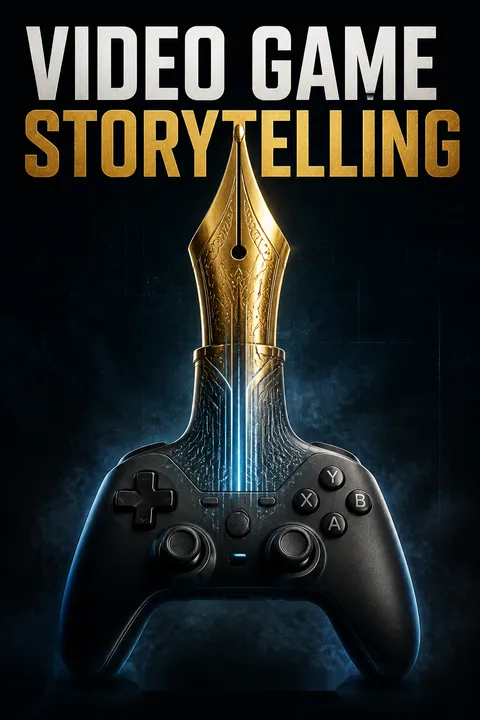
Video Game Storytelling is both a primer on narrative craft and an argument about how games are made. Its most consequential idea is not that games can borrow familiar story structures, but that narrative is distributed across a production team. A writer may define the intent, yet a level designer turns it into objectives, an animator gives it a physical manner, an engineer makes characters behave, and audio shapes its emotional force. Story quality therefore depends on coordination as much as inspiration.
The book's practical strength is its repeated translation between abstract principles and production decisions. Conflict becomes a mission obstacle. Exposition becomes a question of what the player needs before acting. Character consistency becomes a check on gameplay verbs, animation, and AI. This translation makes narrative legible to developers who may not identify as writers, and it offers teams a vocabulary for detecting problems before expensive assets are complete.
Its frameworks are best treated as diagnostic tools rather than universal laws. Three-act plotting and the Hero's Journey provide useful ways to locate missing setup, escalation, or payoff, but they represent a particular tradition of story analysis. Games can also value repetition, ambiguity, player-authored meaning, or stories without a single heroic center. The book acknowledges that variation, though its clearest examples favor authored, character-driven adventures.
The central design tension is between control and agency. A tightly shaped story can deliver deliberate pacing and emotional turns; systemic play can produce events that feel uniquely personal because the player caused them. The strongest design is not automatically a compromise between the two. It is a clear choice about what kind of experience the mechanics can sustain, followed by narrative and production decisions that honor that choice. The book's lasting contribution is to make that choice a team-wide responsibility.
Review Summary
Video Game Storytelling receives mostly positive reviews for its insights into game narrative development. Readers appreciate the practical advice, examples from games and films, and emphasis on integrating storytelling across development teams. The book is praised for its accessibility to both industry professionals and general readers interested in game design. Some criticize the basic storytelling concepts covered in the first half, while others find the entire book valuable. Overall, it's considered a useful resource for understanding narrative techniques in video games, with many recommending it as essential reading for game developers.
People Also Read



Glossary
Three-Act Structure
Setup, confrontation, resolutionA model that organizes a complete story into three broad phases: setup introduces the Hero and central conflict, confrontation follows the Hero's struggle against obstacles, and resolution shows the conflict's outcome. In games, the phases may span a campaign, a level, or a smaller quest, and need not correspond to visible breaks.
Monomyth
Recurring Hero's Journey patternJoseph Campbell's theory that many myths and modern stories share recurring character roles and a sequence of narrative phases. The Hero leaves a familiar situation, faces tests and a central ordeal, and returns changed or carrying a reward. The book presents it as a useful story-analysis tool, not a mandatory formula.
ludonarrative dissonance
Gameplay and story conflictA disconnect between the story's portrayal of a character and what gameplay asks the player to do, or between the character's goals and the player's goals. A narrative that calls a protagonist pacifistic while the game rewards frequent shooting is one example. The mismatch can frustrate players or, when deliberately designed, create meaningful tension.
game story
Developer-authored narrativeThe narrative content established by a game's developers, including its plot, characters, and planned events. It generally remains the same or similar across players' experiences. A game may combine this authored material with more variable events that arise from player decisions and game systems.
player story
Narrative from playThe experience-specific sequence of events produced by a player's choices, actions, and interactions with game systems. It may be memorable to the person who played it even when the same events would make an unremarkable story for an outside listener. Games vary in how much room they give this kind of narrative.
in media res
Beginning amid eventsA storytelling technique that begins after events are already underway, rather than starting with the full background. The story supplies earlier context later through flashbacks, discoveries, or dialogue. It can quickly engage an audience, but the immediate situation still needs to be understandable enough to follow.
seeding
Spread out story informationThe book's term for distributing small pieces of exposition across a story instead of concentrating them in one large explanation. Information arrives gradually, allowing audiences time to absorb it and preserving room for curiosity. Each detail should appear when it is useful or engaging, rather than simply because it exists in the writer's notes.
planting
Setup for later payoffIntroducing a detail before it becomes important, so a later event feels prepared rather than arbitrary. A story might establish that a character can use a particular tool, then rely on that ability during a crisis. Effective planting fits naturally into the earlier scene and does not announce too loudly how it will be used.
deus ex machina
Convenient outside solutionA resolution in which an unexpected force or coincidence solves a central conflict for the Hero, without adequate preparation or action by the characters. The term comes from ancient drama, where a god could be lowered onto the stage to resolve a plot. In modern stories, an unearned last-second rescue can have the same effect.
emotion map
Planned emotional progressionA guide that records the intended emotional effect of key moments in a mission or story. It helps design, narrative, and audio teams coordinate shifts such as rising confidence, sudden danger, or relief. The map can describe both the intensity of a feeling and where it should occur in play.
barks system
Condition-triggered dialogueA game system that plays short voice lines when specified events or conditions occur, such as combat actions, character states, or nearby activity. Barks can make characters and environments feel responsive, but repetition, poor timing, or mismatched lines can undermine immersion. Their triggers, variants, and playback limits need testing.
FAQ
What's Video Game Storytelling about?
- Narrative Techniques Focus: The book explores essential narrative techniques that game developers need to understand to create compelling stories in video games.
- Collaboration Emphasis: It highlights the importance of collaboration among writers, designers, artists, and programmers in storytelling.
- Structured Learning: Divided into two parts, the book covers basic storytelling principles and their application in game development.
Why should I read Video Game Storytelling?
- Enhance Game Narratives: It provides insights on integrating narrative into game design, making games more engaging.
- Expert Insights: Author Evan Skolnick shares practical advice and real-world examples from his extensive industry experience.
- Common Language for Teams: The book aims to establish a common language for discussing narrative elements among team members.
What are the key takeaways of Video Game Storytelling?
- Conflict is Essential: The book emphasizes that conflict is the driving force of any story.
- Three-Act Structure: Understanding this structure is crucial for organizing a narrative into setup, confrontation, and resolution.
- Character Arcs Matter: Developing characters, especially the Hero and Villain, is vital for engaging stories.
What is the Three-Act Structure in Video Game Storytelling?
- Basic Framework: It divides a story into three parts: Setup, Confrontation, and Resolution.
- Setup of Conflict: Act I introduces characters and the main conflict, setting the stage for the story.
- Climactic Resolution: Act III resolves the conflict, providing closure and satisfying the audience.
How does Video Game Storytelling define conflict?
- Core Definition: Conflict is when someone wants or needs something, but obstacles stand in the way.
- Multiple Conflicts: A well-structured narrative may contain several major and minor conflicts.
- Gameplay Connection: The book parallels story conflict with gameplay challenges, both requiring obstacles for engagement.
What are character arcs, and why are they important in Video Game Storytelling?
- Character Development: Arcs represent the transformation of characters in response to conflicts.
- Hero and Villain Focus: The Hero typically undergoes significant change, while the Villain may evolve differently.
- Engagement Factor: Well-developed arcs enhance player engagement, as players invest in characters' journeys.
What is the Monomyth, and how does it relate to video game storytelling?
- Hero's Journey Framework: The Monomyth outlines common archetypes and story beats found in myths and stories.
- Archetypes in Games: The book discusses using archetypes like the Hero, Mentor, and Villain in game narratives.
- Storytelling Depth: Understanding the Monomyth helps create richer, more resonant stories.
How does Video Game Storytelling address dialogue?
- Primary Function: Dialogue conveys exposition, informing the audience about plot, character, and emotions.
- Show, Don’t Tell: The book encourages using action and context to convey information.
- Character Voice: Each character should have a unique voice, reflecting their background and personality.
What are some common pitfalls in storytelling discussed in Video Game Storytelling?
- Exposition Overload: Excessive exposition, especially at the beginning, can overwhelm the audience.
- Inconsistency Issues: Maintaining consistency in character behavior and world logic is crucial.
- Coincidence Problems: The book warns against relying on coincidences to resolve conflicts.
How does Video Game Storytelling define ludonarrative harmony?
- Alignment of Gameplay and Story: It refers to the alignment between a game's narrative and its gameplay mechanics.
- Avoiding Dissonance: The book warns against ludonarrative dissonance, where gameplay contradicts the story.
- Importance for Player Engagement: Achieving harmony enhances player immersion and emotional investment.
What strategies does Video Game Storytelling suggest for improving game storytelling?
- Hire Early and Often: Hire a qualified game writer early and keep them involved throughout development.
- Foster Collaboration: Encourage collaboration between writers and other team members for a unified vision.
- Educate the Team: Educate the development team on storytelling principles to avoid narrative missteps.
What are the best quotes from Video Game Storytelling and what do they mean?
- "Story is conflict.": Emphasizes that without conflict, there is no narrative to engage the audience.
- "The best game stories emerge from a collaborative process.": Highlights the importance of teamwork in game development.
- "Without a want/but, there is no conflict.": Reinforces the need for clear character desires and obstacles for compelling stories.
Download PDF
Download EPUB
.epub digital book format is ideal for reading ebooks on phones, tablets, and e-readers.








