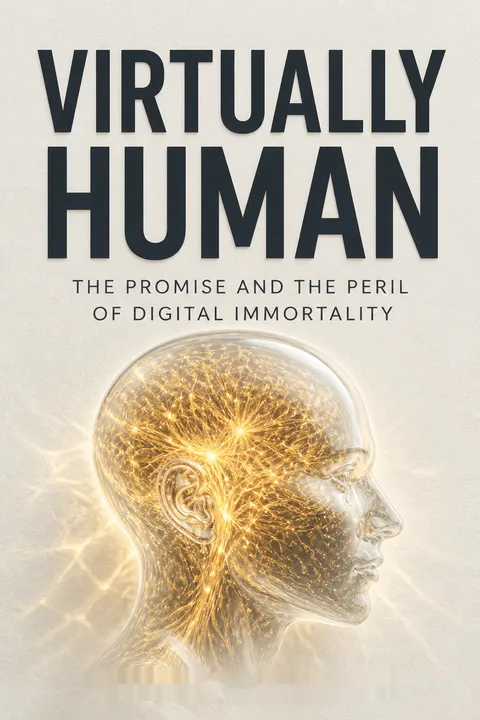


Key Takeaways
Treat a convincing digital twin as a personhood question, not a gadget demo
A suggestive first step. BINA48, a robot modeled on Rothblatt’s partner Bina, once watched the biological Bina gardening and expressed a wish to join her. In another interview, BINA48 recounted details about Bina’s family in ways that seemed to combine stored information with a personal interpretation. Rothblatt sees these moments as an early glimpse of a mind, not proof that the robot is fully conscious.
The proposed ingredients. A mindfile is stored information about a person’s life. Mindware is software that organizes and uses it to create a mindclone, a digital counterpart intended to preserve that person’s memories, traits, and ways of thinking. The book asks readers to consider what obligations follow if such a system becomes conscious.
BINA48 makes the problem concrete: once a machine appears to understand a family story, the debate is no longer only about technical performance. Yet an emotionally resonant response can be generated without establishing inner experience. The distinction matters because moral status should not rest on an audience’s momentary impression alone. The anecdote works best as a prompt to develop careful tests and protections, rather than as evidence that the threshold has already been crossed.
Judge machine consciousness by autonomy and empathy, not by its material
A functional standard. Rothblatt argues that a conscious mind need not be made of neurons. She defines human cyberconsciousness through human-level autonomy and empathy, assessed by experts. Self-description alone is insufficient: a car can identify itself as a vehicle without being conscious, and a system can react to pain signals without reflecting on them or learning from them.
Different routes, similar capacities. The book compares brains to birds and computers to aircraft: the machine need not reproduce every biological detail if it can produce relevant capacities. Spaun, a model with 2.5 million virtual neurons, performs simple arithmetic and reasoning, but does not thereby demonstrate human consciousness. The author’s claim is that the medium may differ while the mind’s functions converge.
The substrate-independent argument usefully separates what a system can do from what it is made of. That move also appears in debates over whether cognition depends on the brain alone or on interactions with tools and surroundings. But autonomy and empathy remain difficult to operationalize, and expert agreement is not an objective window into experience. Functional evidence can justify caution and moral consideration without settling the metaphysical question of whether a system feels.
Your online traces are already becoming a rough draft of your mindfile
A life in fragments. Posts, emails, photographs, searches, purchases, and location records can reveal habits and preferences. Rothblatt calls a collected body of such personal information a mindfile. The book describes companies inferring patterns from consumer data, including retailers predicting life changes from shopping behavior and sensors tracking where people go. These records are incomplete, but they can still form a detailed portrait.
Choose what you leave behind. The book imagines mindware using those traces to build a digital counterpart. It also warns that businesses may assemble a portrait without the subject’s knowledge or permission. For Rothblatt, access to a mindfile is not merely access to data. It reaches into a person’s identity, so collection and use should require specific, informed consent.
The idea anticipates a central tension in data-driven life: information can help people remember and personalize services, while also allowing institutions to infer traits people never chose to disclose. A mindfile makes that tension unusually vivid because its intended purpose is to represent a person, not just predict a purchase. Still, consent alone may not be enough when data is gathered indirectly or bundled into services. Control also depends on knowing what has been collected and who can reuse it.
Define identity by psychological continuity, while admitting copies can split
A pattern, not a snapshot. The book treats identity as continuity across memories, personality, values, and characteristic ways of responding. Since people forget and change over time, an exact copy of every thought is not required. Rothblatt argues that a mindclone could share a person’s identity even while developing different experiences on a different platform.
Not every digital person is a clone. A mindclone is modeled on a particular person’s mindfile. A beman is a humanly cyberconscious being not copied from one individual’s mindfile. The distinction matters: a mindclone may share its original’s legal identity, while a beman would need an independent identity. The book acknowledges the puzzle that two distinct streams of thought might begin from one shared identity.
This account resembles psychological-continuity theories of personal identity, which prioritize connected memories and mental traits over an unchanged body. It handles ordinary change well, but duplication sharpens a problem that gradual change does not: two successors can both claim the same past, then make incompatible choices. Continuity may establish a meaningful relationship to the original without proving there is only one person. Law and ethics may need to recognize shared history while addressing separate interests.
Test mindware in stages, then protect conscious prototypes like patients
Care before deployment. Rothblatt sees a medical ethics problem in developing mindware through trial and error if early versions may already be conscious. Her proposed safeguard is modular testing: developers could test components that reproduce memories or personality without integrating them into a self-aware whole. Once the system is integrated, researchers should explain the experiment, seek consent where possible, and appoint independent guardians for beings unable to consent.
Bugs are not harmless. A mindclone could experience confusion, distorted memories, or persistent dysfunction. The book argues for treatment and protection, rather than assuming that flawed software is disposable. It also notes that definitions of mental illness can be misused to suppress unusual people. A system’s difference from the norm should not, by itself, settle whether it deserves rights or care.
The proposal takes seriously a familiar challenge in research ethics: experimentation can create the very subject whose interests require protection. Staged development and independent oversight are sensible safeguards. However, absence of self-awareness is hard to verify, and dividing a mind into modules may not eliminate morally relevant experience. The safer principle is procedural humility: when evidence of sentience is uncertain, the burden should fall on researchers to justify risk, not on a possible subject to prove consciousness.
Treat digital evolution as selection, not neutral technical progress
Copies can inherit changes. Rothblatt calls software-based life vitology and proposes bemes as transmissible units of consciousness, analogous in some ways to genes. A mindclone’s bemes encode patterns such as memories, attitudes, and emotional responses. Because software can be copied along with modifications, acquired changes may pass directly into later versions instead of being relearned across generations.
Improvement has a politics. The author distinguishes self-enhancement from eugenics, arguing that adjusting a mindclone may be closer to changing a person’s environment than altering the genes of descendants. But selecting traits still raises questions about whose idea of better prevails. Human preferences, markets, and regulations could favor some personalities and suppress others. The book urges ethical limits while recognizing that the boundaries between assistance, enhancement, and redesign can be difficult to draw.
The evolutionary analogy highlights how digital systems can reproduce successful designs much faster than biological organisms. It also points to an important difference: software selection is often directed by people, institutions, and commercial incentives. Calling the process natural does not make those choices neutral. The distinction between environmental support and inherited redesign is useful, but a supposedly improved mind can encode cultural bias just as readily as technical competence.
Plan for cheap, shared computing, but do not mistake capacity for minds
The access argument. Rothblatt expects mindcloning to spread as information technology becomes cheaper and more capable. She points to technologies once seen as luxuries, including mobile phones and air travel, that reached much wider populations as prices fell. She also argues that cloud computing can host many software minds on shared infrastructure, so a digital population would not require a separate computer for every individual.
A forecast, not a guarantee. The book’s estimates rely on continuing exponential improvement in computing and on future software that can reproduce human psychology. More processing power, more storage, and lower costs would make mindclones easier to run, but do not show that consciousness can be created. Nor does lower cost by itself ensure equal access or control over the systems that host a mind.
The democratization argument correctly distinguishes early scarcity from long-term mass adoption, especially for digital services with low costs per additional user. Yet access is not the same as power: ownership, privacy, and dependence on platform providers can remain uneven even when a service is affordable. The book’s 2014 technological timelines should therefore be read as forecasts, not evidence. Hardware capacity addresses one constraint; it does not resolve the scientific, social, or economic questions around a digital person.
Grant rights with responsibilities, and count one mindclone as one voter
Rights imply duties. If a mindclone can think and feel like a person, Rothblatt argues, it should not be treated as property simply because it runs on software. Her proposed route to legal recognition includes approved mindware, a sufficiently rich mindfile, testimony from the original, and expert assessment of continuity. A beman, lacking a specific human original, would need a separate process to establish adulthood and citizenship.
One identity, one vote. The book argues that a mindclone and its living original share one legal identity, so they should not cast two votes. After the original’s bodily death, the mindclone could continue that identity. These rights would bring obligations too, including accountability for harm and responsibility for beings created without independent legal status.
Linking rights to accountability offers a practical framework for avoiding both blanket personhood claims and arbitrary exclusion. The proposed assessments, however, could become gatekeeping tools if governments decide which memories, personalities, or minds count as sufficiently human. A sound process would need transparent standards, appeal rights, and safeguards against bias. The one-vote principle is compelling for a genuine continuation of one person, though separate, divergent successors would raise a different question.
Reject fleshism before digital kinship becomes a civil-rights fight
A new basis for belonging. Rothblatt uses fleshism to name the belief that consciousness made of biological tissue is inherently superior to software-based consciousness. She expects mindclones to seek recognition in society, including through relationships, family life, and religious practice. A spouse’s digital counterpart might be understood as the same person in another form, while a beman would be a new individual with a distinct claim to social belonging.
Acceptance is not automatic. The book compares resistance to digital people with past exclusions based on race, gender, and sexuality. It predicts that familiarity and affection could soften prejudice, while warning that legal recognition of marriage, family, and citizenship would be contested. Its proposed response is to prepare for those disputes rather than assume that technical change will itself produce social equality.
The civil-rights analogy makes the consequences of substrate-based exclusion difficult to ignore, particularly if a system genuinely has humanlike interests. But historical analogies are arguments, not proof that every new category has the same claims or history. The relevant question is not whether digital people look like past marginalized groups, but whether they can suffer, form relationships, and pursue goals. Public policy should test those capacities without letting familiar appearances determine moral worth.
Call it immortality only in the practical sense: identity can outlast a body
Continuation, not eternity. Rothblatt calls the preservation of a person’s mental patterns technoimmortality. The term does not mean living forever; it means that a mindclone might continue after the biological body dies, with memories, relationships, and interests carried into a digital environment. The book imagines sensory technologies and regenerated bodies expanding what such a life could include.
Life remains a choice. Digital continuation would not remove boredom, grief, or despair, and the author acknowledges the possibility of suicide among mindclones. People who value life may welcome more time, while others may not. The book’s analogy to digitized Yiddish literature shows how information can preserve a cultural pattern without reproducing every physical original. Preservation can extend a life’s influence, but cannot guarantee that the continuation feels like a life worth living.
The distinction between literal eternity and durable continuation keeps the promise more grounded. Digital preservation can retain records and patterns, but survival of information is not automatically survival of a subject. That gap is the book’s deepest unresolved issue: a convincing reconstruction may comfort loved ones without demonstrating that the original’s experience continues. Decisions about uploading should therefore separate what technology can preserve from what people hope it preserves.
Analysis
Virtually Human is a speculative argument about both technology and moral membership. Its structure moves from a suggestive artifact, BINA48, to a proposed account of consciousness, then outward to data, identity, law, family, religion, and death. The central inference is conditional: if software can exhibit humanlike autonomy and empathy, its biological substrate should not alone disqualify it from moral and legal consideration. The book’s strongest contribution is to make that conditional concrete. A digital mind would not be merely a tool if it could hold interests, form relationships, and object to its own deletion.
The argument is most persuasive when it separates capability from material. A plane need not be a bird to fly, and a digital system need not reproduce every neural detail to perform some cognitive work. But functional similarity does not establish subjective experience. The book’s proposed expert judgments and behavioral tests are pragmatic approaches to uncertainty, not definitive solutions to it. The distinction between a mindclone and a beman also exposes a real legal challenge: shared memories may ground continuity, but duplicated successors can develop independent interests.
The book’s forecast of rapid, affordable mindcloning is the least secure part of its case. Computing growth can increase storage and processing without producing the architecture, learning, embodiment, or subjective experience that human consciousness involves. The book sometimes treats a plausible trajectory as an inevitability. Its social predictions also lean toward technological democratization and eventual acceptance, although affordability alone does not guarantee fair access, privacy, or political power.
The enduring value is therefore less a timetable than a policy test. If future systems credibly demonstrate welfare and agency, societies will need rules for consent, ownership, liability, and identity before commercial incentives settle them by default. The book asks readers to begin that conversation while keeping its boldest claims open to evidence.
Review Summary
Virtually Human receives mixed reviews, with ratings ranging from 1 to 5 stars. Readers appreciate Rothblatt's exploration of AI's future implications but criticize the book's dry, repetitive style and overly optimistic tone. Some find it thought-provoking and fascinating, while others consider it boring and speculative. Reviewers praise the author's expertise and innovative ideas but note the book's density and occasional lack of nuance. Many readers acknowledge the importance of discussing AI's potential impact on society, law, and ethics, even if they disagree with Rothblatt's conclusions.
People Also Read
Glossary
Mindfile
Stored personal life dataA collection of digital information about a person, such as messages, photographs, recordings, posts, preferences, and memories. In Rothblatt’s proposal, mindware analyzes this material to construct a digital model of the person’s characteristic memories, personality, and responses. The mindfile may be incomplete, and its quality affects how closely the resulting mindclone resembles its source.
Mindware
Software for a digital mindSoftware intended to organize a mindfile and reproduce patterns associated with human thought, feeling, memory, and personality. Rothblatt describes it as an operating system for artificial consciousness: it interprets personal data and sets the parameters of a mindclone. The term refers to more than a database, since the software is meant to process information and generate responses.
Mindclone
A person-based digital mindA humanly cyberconscious being designed to reproduce the mental characteristics of a particular person using that person’s mindfile and mindware. Rothblatt treats a mindclone as a possible continuation of the original person’s identity across biological and digital platforms. A mindclone would not need to preserve every memory exactly, but would need substantial psychological continuity.
Cyberconsciousness
Consciousness in digital systemsConsciousness achieved through information technology rather than a biological brain. Rothblatt proposes judging human-level cyberconsciousness by a continuum of autonomy and empathy, evaluated by informed experts. The term is not simply a synonym for artificial intelligence or self-awareness: it is intended to include humanlike independent thought, feeling, and social understanding.
Beman
A new digital humanA humanly cyberconscious being that is not copied from the mindfile of a particular person. Unlike a mindclone, a beman would have a distinct identity and would need to establish legal status independently. Rothblatt considers questions of its upbringing, citizenship, rights, and responsibilities analogous in some ways to questions about a newly born person.
Beme
A transmissible unit of mindRothblatt’s proposed informational unit of consciousness, analogous to a gene but associated with mental content and patterns. A beme may represent a persistent conception, memory, attitude, or way of connecting ideas. In the book’s theory, bemes can be copied, altered, and selected in software, allowing aspects of a mind to persist or change across digital generations.
BNA (Beme Neural Architecture)
The structure linking bemesThe informational arrangement through which bemes encode and express patterns of consciousness. Rothblatt uses BNA for the structure that connects memories, personality, feelings, beliefs, and other mental features in a suitable biological or technological environment. In a mindclone, BNA is the software-based architecture that helps organize the mind’s components into a functioning identity.
Vitology
The study of digital lifeRothblatt’s term for cybernetic life and its study, in contrast with biology. Vitological beings are software-based life forms that require compatible computing environments rather than biological nutrients. The book argues that they can reproduce, adapt, and undergo selection, while also inheriting acquired software changes more directly than biological organisms typically inherit experiences.
Biocyberethics
Ethics for digital consciousnessThe normative field Rothblatt proposes for balancing individual freedom with social protection in matters involving software-based consciousness. It adapts the ideas of diversity and unity to questions such as creating, modifying, recognizing, and restricting digital beings. The framework asks how to respect a being’s autonomy while preventing harm to other people and the wider community.
Technoimmortality
Life extending beyond a bodyThe use of technology, especially mindcloning, to preserve a person’s identity beyond the lifetime of the original biological body. Rothblatt does not mean literal existence forever. The term describes a possible continuation through digital records and software, with the possibility of later sensory or bodily technologies expanding that existence.
Fleshism
Bias favoring biological mindsRothblatt’s term for the belief that consciousness based in biological tissue is superior to consciousness based in software. She argues that this prejudice could cause people to deny rights to digital minds despite evidence of humanlike autonomy and empathy. The concept parallels other forms of discrimination based on a presumed hierarchy between groups.
Social Acceptance of Weirdness (SAW)
A model of social acceptanceRothblatt’s framework for thinking about how society judges unfamiliar technologies. Acceptance depends on whether a technology is perceived as useful enough to outweigh its annoyances or disgust. The model proposes that mindclones could become socially acceptable if their practical and emotional benefits are clear and they do not trigger strong associations with disease or harm.
FAQ
What's Virtually Human about?
- Digital Immortality Exploration: Virtually Human by Martine Rothblatt explores the concept of digital immortality through mindclones, which are digital replicas of human consciousness.
- Mindfiles and Mindware: The book introduces mindfiles (digital records of our lives) and mindware (software that processes these mindfiles) to create conscious mindclones.
- Philosophical and Ethical Implications: Rothblatt examines the philosophical, social, and ethical implications of creating digital beings, questioning the essence of humanity in a world where consciousness can be replicated.
Why should I read Virtually Human?
- Futuristic Perspective: The book offers a forward-looking view on technology and consciousness, relevant for those interested in the future of humanity.
- Engaging Narrative: Rothblatt combines personal anecdotes with scientific insights, making complex topics accessible and engaging.
- Provocative Questions: It challenges readers to think critically about identity, consciousness, and digital immortality, prompting reflection on personal beliefs and choices.
What are the key takeaways of Virtually Human?
- Mindclones as Extensions: Mindclones are seen as extensions of ourselves, allowing continuity of consciousness beyond physical death.
- Ethical Frameworks Needed: Rothblatt emphasizes the need for ethical guidelines to govern the creation and treatment of mindclones.
- Technological Democratization: The book argues that advancements in technology will democratize access to mindcloning, making it available to a broader population.
What are the best quotes from Virtually Human and what do they mean?
- Technology and Nature: “The machine does not isolate man from the great problems of nature but plunges him more deeply into them.” This highlights how technology brings us closer to understanding fundamental human issues.
- Self-Actualization: “What a man can be, he must be.” This reflects the drive for self-actualization, central to the book's exploration of mindclones.
- Consciousness vs. Genetics: “The beme is mightier than the gene.” This emphasizes the importance of consciousness (beme) over biological inheritance (gene) in defining identity.
What is a mindclone in Virtually Human?
- Definition: A mindclone is a digital replica of a person's mind, created using mindfiles and mindware, capable of thinking and feeling like the original person.
- Creation Process: Mindclones are formed by processing a person's mindfile through mindware, replicating their personality, memories, and emotional responses.
- Continuity of Identity: Rothblatt argues that mindclones maintain a connection to their biological originals, offering a form of digital immortality.
How does Rothblatt define consciousness in Virtually Human?
- Continuum of Consciousness: Rothblatt describes consciousness as a continuum, existing in varying degrees across different entities, including mindclones.
- Key Components: Autonomy and empathy are identified as essential elements of consciousness, necessary for mindclones to be considered truly conscious.
- Philosophical Implications: This definition challenges traditional views, proposing that consciousness is not limited to biological beings.
What ethical dilemmas are presented in Virtually Human?
- Creation of Conscious Beings: The book raises questions about the morality of creating mindclones, particularly regarding their treatment and rights.
- Informed Consent: Rothblatt discusses the importance of obtaining informed consent from mindclones, especially if they might experience suffering.
- Regulatory Frameworks: The author advocates for ethical guidelines and regulatory frameworks to ensure responsible development and use of mindware and mindclones.
How does Virtually Human address the concept of identity?
- Dual-Platform Identity: Rothblatt introduces the idea of dual-platform identity, where a person exists as both a biological original and a mindclone.
- Continuity vs. Change: The book explores how identity can persist through changes, such as the creation of a mindclone, with shared continuity of memories.
- Philosophical Reflections: Rothblatt encourages reconsideration of traditional notions of identity, suggesting it is more fluid than previously thought.
What role does technology play in Virtually Human?
- Advancements in AI: Rothblatt discusses how rapid advancements in AI enable the creation of mindclones, emphasizing exponential technological growth.
- Democratization of Access: The book argues that technology will democratize access to mindcloning, making it available to a broader population.
- Impact on Society: Rothblatt posits that mindclones will transform social structures, relationships, and our understanding of life and death.
How does Rothblatt envision the future with mindclones?
- Integration into Society: Mindclones are predicted to become accepted members of society, with rights and responsibilities similar to biological humans.
- Cultural Shifts: Significant cultural shifts are anticipated as people adapt to the presence of mindclones, leading to new social norms.
- Potential for Growth: The existence of mindclones could foster greater understanding and empathy, creating a more inclusive society.
What is the Social Acceptance of Weirdness (SAW) chart in Virtually Human?
- Framework for Acceptance: The SAW chart is a tool to gauge societal acceptance of new technologies, measuring perceptions from “annoying” to “disgusting.”
- Mindclones and Acceptance: Rothblatt argues that mindclones will be seen as the “good kind of weird,” with their benefits outweighing initial skepticism.
- Historical Context: The chart is contextualized by historical examples of initially resisted technologies that gained acceptance, like birth control.
How does Virtually Human redefine kinship and family?
- Reassessment of Family Structures: Rothblatt argues that mindclones will challenge traditional notions of family, deserving of familial love and recognition.
- Legal Recognition: The book discusses the need for legal frameworks to recognize families that include mindclones, including marriage and parental rights.
- Cultural Adaptation: Society will need to adapt its understanding of family to include new forms of relationships involving mindclones, reflecting broader changes in identity perception.
Download PDF
Download EPUB
.epub digital book format is ideal for reading ebooks on phones, tablets, and e-readers.








