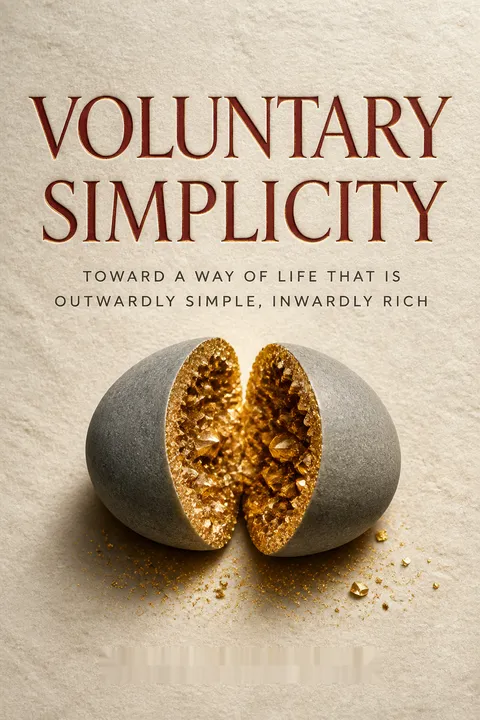


Key Takeaways
Choose less on the outside to make room for more life within.
The central bargain. Elgin’s voluntary simplicity is a deliberately chosen way of living with less material excess and more attention to what makes life feel full: relationships, meaningful work, nature, creativity, and inner development. It is not a uniform standard of possessions or a retreat from modern life. The right balance depends on a person’s purpose and circumstances, and it must be reconsidered as life changes.
Many ways in. The book describes simplicity as a garden with different entrances: reducing clutter, caring for family and the Earth, practicing frugality, finding soulful meaning, and changing business or civic life. A city gardener and a family that spends less time commuting may be simplifying in different ways. The shared aim is to make daily life more purposeful and less wasteful.
The strongest feature of this definition is that it refuses to turn restraint into a uniform moral test. In motivation research, autonomy matters: people are more likely to sustain a change when it reflects their own values rather than external pressure. That helps explain why the same outward behavior can feel liberating to one person and punishing to another. Still, personal choice is never entirely private. Housing, transport, work schedules, and income shape what options are available. A useful application is to ask both what matters most and which conditions make that priority realistically possible.
Make simplicity a choice, not a condition imposed by poverty.
Agency changes the experience. Elgin contrasts two people who cycle to work. One chooses the ride for exercise, outdoor contact, and energy conservation; the other rides because a car is unaffordable and resents the constraint. The activity looks identical, but its meaning and durability differ. Voluntary simplicity is therefore about intention as well as outward habits.
Poverty is not a lifestyle. Elgin recalls migrant farmworkers he encountered as a child, earning little, eating meager meals, and sleeping in their car during a brief harvest. He distinguishes that involuntary insecurity from chosen frugality: deprivation removes options, while purposeful simplicity aims to increase agency. For affluent people, simplifying can also mean confronting unequal access to resources rather than romanticizing hardship.
This distinction keeps an ecological ethic from collapsing into an aesthetic of deprivation. In psychology, perceived control is closely tied to motivation and well-being, so the bicycle example makes a useful point about the lived meaning of an action. Yet choice alone does not make a lifestyle fair or sustainable. A person may freely choose a high-impact life, while someone with few resources may have little power to choose otherwise. The ethical test must therefore include both personal agency and the social conditions that distribute options, costs, and security.
Treat ecological breakdown as a systems problem, not a shopping list.
Connected pressures compound. The book brings together population growth, poverty, climate disruption, dependence on cheap oil, freshwater shortages, species loss, and consumption beyond the Earth’s regenerative capacity. These pressures interact: energy costs affect food and transport, while climate disruption can intensify water scarcity and crop failures. Elgin argues that isolated efficiency measures cannot address the whole pattern.
Beware easy versions. He distinguishes deep simplicity from two misleading images: a nostalgic return to primitive living and a cosmetic green makeover that leaves habits of overconsumption intact. The book cites a 2008 estimate that humanity’s demand could require the equivalent of two Earths by the mid-2030s if trends continued, and reports that between one-third and one-half of species faced extinction risk. These are period-specific forecasts, not current measurements.
The systems lens is more useful than treating each environmental issue as a separate consumer choice. Systems thinking asks how feedback loops, infrastructure, and incentives connect problems, which helps explain why an efficient appliance cannot compensate for endlessly rising demand. The book’s urgency is compelling, though its 2009 projections should not be mistaken for present-day data. Its broader point survives that limitation: ecological risks are linked, and meaningful responses require changes in institutions and patterns of production as well as household behavior.
Notice your automatic habits before calling your choices voluntary.
Attention creates room to choose. Elgin calls ordinary distracted awareness embedded consciousness: a state in which people are absorbed in habitual thoughts and reactions, often without noticing them. He contrasts it with self-reflective consciousness, the ability to observe one’s experience while acting. The point is practical: a person who never notices what drives a purchase, routine, or response has less freedom to change it.
Practice in ordinary moments. The book recommends remembering oneself during everyday activities, such as eating, walking, or talking, rather than treating awareness as a rare spiritual event. Meditation was the most frequently reported inner-growth practice in Elgin’s late-1970s survey, named by 55 percent of respondents. He links attention to clearer perception, more deliberate behavior, and greater sensitivity to consequences for other people and the environment.
This account connects consumer behavior to a broader problem of habit: people often act on cues and routines before conscious evaluation enters the picture. Awareness can interrupt that sequence, making room to ask whether a purchase reflects a need, a social expectation, or a passing impulse. The idea also resembles metacognition, the capacity to notice and assess one’s own thinking. A caution is warranted: attention is helpful, but it cannot by itself overcome manipulative advertising, time scarcity, or limited alternatives. Individual reflection works best alongside environments that make considered choices practical.
Measure prosperity by connection, contribution, and health after needs are met.
Income has limits as a proxy. Drawing on research available to him, Elgin argues that money improves well-being when it meets unmet material needs, but adds less once basic security is established. He cites a global income threshold of roughly $13,000 per person per year beyond which additional income was associated with relatively small gains in happiness. The figure reflects the research and framing of the book’s period, not a universal present-day cutoff.
Look beyond purchasing power. Elgin highlights health, personal growth, close relationships, service to others, and contact with nature as major sources of satisfaction. He also describes a 20-year study of more than 4,700 people, reported in 2008, that found happiness could spread through social ties. The implication is not that money is irrelevant, but that income cannot replace belonging, purpose, or time with people.
The distinction between material security and material accumulation is central to well-being research: the first can prevent serious hardship, while the second often has diminishing returns. Social connection offers a different route to prosperity, one that can benefit people beyond the immediate household. However, claims about a single income threshold travel poorly across countries, eras, and family circumstances. The sounder lesson is conditional: money matters greatly when it buys safety and capability, but it is an incomplete scorecard once those foundations are in place.
Buy for use and purpose, not a marketable version of yourself.
Separate needs from wants. Elgin asks readers to distinguish necessities that support survival and growth from extras that mainly gratify psychological desires. Shelter may be essential; a large house with seldom-used rooms may not be. He suggests examining whether possessions support useful activity, whether they satisfy a real need, what ongoing costs or obligations they create, and how their production and use affect others and the Earth.
Identity can become merchandise. When belongings are used to signal status or construct an image, satisfaction tends to fade and the next purchase promises a new beginning. Elgin argues for aesthetic rather than ascetic simplicity: keep what serves life and beauty, and reduce what distracts or burdens it. He also draws on the idea of ephemeralization, or achieving more with less material input, as one part of a broader redefinition of progress.
The book’s account of identity-driven consumption anticipates a familiar pattern in behavioral economics: people adapt to new purchases, so their initial pleasure often fades while the desire for another upgrade remains. Asking about maintenance, debt, and external costs broadens the decision beyond the price tag. Yet consumption is not merely a personal identity project; it also supplies comfort, access, and participation in social life. The aim is not to shame possessions, but to distinguish objects that genuinely enable a chosen life from those that mainly perpetuate comparison.
Let small personal experiments grow into shared cultural change.
Examples can teach more than speeches. At a conference buffet, sociologist Elise Boulding chose a modest meal because she did not want to consume what others lacked. Elgin remembered the gesture years later, arguing that everyday conduct can make an ethical idea tangible. A small choice matters not because it solves a global problem alone, but because it can shape norms and invite imitation.
The survey has limits. Elgin’s Voluntary Simplicity Survey gathered more than 400 questionnaires and over 200 letters in the late 1970s. Most respondents were white and highly educated, and many came from relatively affluent backgrounds; 56 percent lived in cities or suburbs, and the average respondent had practiced simpler living for six years. This offers rich testimony, but not a representative portrait of everyone who lives simply.
Boulding’s meal illustrates how moral commitments become credible when they appear in ordinary conduct rather than only in public statements. Social learning often travels through visible examples, especially when an action is understandable and repeatable. The survey adds valuable texture about motives and trade-offs, but its demographic skew means it cannot establish how common those experiences were. That limitation matters: simplicity should not be treated as the discovery of one educated subculture. Its practices and meanings must be tested across different communities and material circumstances.
Tell a story of shared maturity, not inevitable collapse.
A larger identity can motivate restraint. Elgin frames humanity’s predicament through four evolutionary archetypes: a maturing species moving beyond impulsive growth, a heroic species facing a profound test, a witnessing species learning to observe its own behavior, and a cosmic species connected to a living universe. These are interpretive stories, not predictions. They recast ecological limits as a reason to develop responsibility and cooperation rather than as proof that humanity is doomed.
Meaning matters. The book finds versions of moderation and balance in Christian, Buddhist, Hindu, Taoist, Quaker, and Greek traditions. Elgin also proposes that the universe is fundamentally alive and interconnected, a worldview he sees as encouraging respect for nature. The practical claim is that people are more likely to protect what they experience as connected to their lives, rather than as a distant store of resources.
Stories about collective identity can influence what societies regard as possible, much as national narratives shape civic duty. Framing restraint as maturity may be more motivating than presenting it solely as loss. The spiritual image of a living universe also offers an expansive ethical imagination, but scientific observations of interdependence do not establish that the cosmos has consciousness or purpose. Those claims should remain distinct. The ecological case for care is already strong: human economies depend on living systems, whether or not those systems are understood in spiritual terms.
Build resilience where relationships, livelihoods, and resources meet locally.
Human scale supports cooperation. Elgin argues that neighborhoods and small communities can be easier places to build trust and share practical work than either isolated households or enormous institutions. His example is a cohousing community of about 70 people, with shared meals three evenings a week, rotating cooking and maintenance crews, regular meetings, and workspaces. The arrangement combines private homes with shared responsibilities and useful local services.
Prepare together. The book describes ecovillages and transition towns as experiments in adapting communities to climate change and dependence on oil. Their approaches include local food, repair skills, energy efficiency, and small businesses suited to local needs. Elgin presents these as ways to build resilience, not as a single blueprint. Existing cities and suburbs cannot simply be replaced, so local experiments can also help people improve the places where they already live.
Community resilience depends on relationships as much as infrastructure. Shared spaces can lower the cost of cooperation, make skills visible, and help neighbors coordinate before a crisis. This complements the familiar resilience principle of redundancy: communities are less vulnerable when they have multiple sources of food, knowledge, and support. Still, small scale is not automatically fair or efficient. Communities can exclude outsiders, reproduce unequal workloads, or struggle to fund specialized services. Local initiative is strongest when linked to public institutions and designed for broad participation.
Pair personal restraint with democratic action on the systems shaping consumption.
Private choices need public support. Elgin argues that individual decisions about food, work, transport, and spending matter, but cannot redesign energy systems, neighborhoods, or markets on their own. He warns that commercial media often normalize high consumption, while citizens lack strong ways to deliberate about shared priorities. His proposed response includes better sustainability reporting and Electronic Town Meetings: televised public discussions paired with feedback from a representative sample of citizens.
Fairness is part of sustainability. The book links resource use to poverty and conflict, arguing that affluent societies must moderate consumption while supporting decent living conditions for others. It presents compassion as practical cooperation, not merely private virtue. Personal restraint can help demonstrate what is possible, but durable change also requires institutions that make lower-impact options accessible and distribute the costs of transition fairly.
This is the book’s crucial bridge between lifestyle and politics. Individual behavior can signal values and build support, but infrastructure, prices, labor conditions, and regulation determine which choices are feasible at scale. Public deliberation can help surface trade-offs that markets conceal, although television or polling alone cannot guarantee representative participation or sound policy. The principle is broader than the proposed meeting format: pair personal experimentation with collective decision-making, and judge reforms by who benefits, who pays, and whether people can participate in shaping them.
Analysis
Voluntary Simplicity is best read as both an ethical argument and a practical theory of social change. Its central move is to reject the familiar opposition between material comfort and spiritual seriousness. Elgin does not ask readers to abandon possessions; he asks them to stop treating acquisition as the primary measure of identity, progress, or security. Simplicity becomes a balance between material sufficiency and attention to relationships, purpose, community, and the natural world.
The book’s most durable contribution is its integration of inner agency with outer systems. Attention matters because people often follow habits they have not examined. But agency also depends on the available choices, which are shaped by transport, housing, work, markets, and public policy. This prevents the argument from being reduced to private virtue, even as its emphasis on personal conduct sometimes risks placing too much responsibility on individuals. Its strongest reading treats personal change as an entry point into collective change, not a substitute for it.
The text moves among survey evidence, personal anecdotes, spiritual traditions, environmental forecasts, and speculative visions of a living universe. That range gives it warmth and ambition, but the evidence does not carry equal weight across those domains. The late-1970s survey offers vivid testimony from a narrow, relatively privileged sample. The forecasts reflect the moment of the 2009 edition and should be read historically. The spiritual interpretation of cosmic life is a philosophical proposition, not a conclusion established by the environmental data. Separating these kinds of claims preserves the book’s moral imagination without overstating its proof.
Its practical legacy is therefore not a fixed lifestyle template. It is a set of questions: What is enough for a life’s actual purpose? Which routines consume attention without returning value? Which decisions depend on public systems, and how might those systems change? Elgin’s answer is a plural one: simplify differently, learn locally, build relationships, and connect personal restraint to fairness and democratic participation. The book remains useful when read as an invitation to redesign prosperity, rather than as a prediction that one way of living can solve a planetary crisis.
Review Summary
Voluntary Simplicity receives mixed reviews. Many readers appreciate its message of conscious living and reducing consumption, finding it inspirational and relevant. Some praise the book's insights on personal growth and environmental awareness. However, others criticize it as repetitive, outdated, or lacking practical advice. The writing style is described as both accessible and overly academic. While some view it as a seminal work on simple living, others feel it fails to provide concrete steps for implementation. The book's predictions about societal changes are noted as both prescient and naive.
People Also Read





Glossary
Voluntary simplicity
Purposeful material and inner balanceA consciously chosen way of living that reduces unnecessary material consumption and complication while cultivating purpose, relationships, awareness, and service. It is not a fixed level of income or possessions, nor a demand for deprivation. Its practical form depends on a person’s circumstances, responsibilities, and priorities.
garden of simplicity
Diverse paths to simpler livingElgin’s metaphor for the many forms that conscious simplicity can take. These include reducing clutter, caring for family and the environment, living frugally, pursuing spiritual depth, and changing business or civic life. The metaphor emphasizes that there is no single model and that different approaches can support one another.
embedded consciousness
Absorbed, habitual awarenessElgin’s term for a common mode of awareness in which people are caught up in thoughts, feelings, and familiar reactions without noticing them as they occur. In this mode, behavior tends to run on habit, and people may mistake a conditioned self-image for their whole identity.
self-reflective consciousness
Awareness of oneself actingElgin’s term for the capacity to notice one’s experience while moving through daily life. This awareness includes thoughts, feelings, actions, and surroundings without requiring withdrawal from ordinary activity. He argues that it can reveal habitual responses and create more room for deliberate, responsible choices.
ephemeralization
More output, fewer material inputsA term associated in the book with Buckminster Fuller for producing greater results with less time, material, weight, or energy. Elgin uses it to describe a lighter, more efficient material economy, while arguing that genuine progress also requires growth in nonmaterial areas such as relationships, creativity, and insight.
etherialization
Shift toward nonmaterial developmentArnold Toynbee’s term, as presented by Elgin, for a civilization’s movement of energy and attention from material concerns toward nonmaterial life. Examples include personal growth, family life, the arts, community participation, and democracy. Elgin distinguishes this inward and social development from material efficiency alone.
Law of Progressive Simplification
Civilizational growth beyond material conquestToynbee’s historical principle, as described by Elgin, that a civilization’s progress is better measured by its ability to redirect resources and attention toward nonmaterial development than by territorial expansion or conquest. The idea supports Elgin’s claim that maturity can mean less material expansion and richer human and cultural life.
evolutionary archetypes
Stories guiding collective developmentElgin’s term for recurring images of humanity’s possible development that can help people imagine a shared future. He describes humanity as potentially maturing, undertaking a heroic journey, becoming more capable of witnessing its own behavior, and recognizing its connection to the cosmos. These are guiding narratives, not empirical forecasts.
Electronic Town Meetings
Technology-supported public deliberationElgin’s proposal for public discussions that combine television dialogues on important issues with feedback from a scientifically selected sample of citizens. The aim is to make public priorities more visible and help elected officials understand shared concerns. The format is meant to inform representative democracy, not replace it with constant direct voting.
Transition towns
Community preparation for energy changeA grassroots approach described in the book for helping communities prepare for climate change and declining dependence on cheap oil. Local groups identify vulnerabilities and develop practical responses, such as strengthening local food systems, skills, businesses, and energy resilience. The model treats community adaptation as a shared experiment rather than a prescribed plan.
Voluntary Simplicity Survey
Early testimony on simple livingElgin’s late-1970s research project, which collected more than 400 questionnaires and over 200 letters from people exploring simpler ways of life. Respondents described motivations, routines, relationships, work, and inner development. The material provides detailed qualitative insight, but the respondents were not a representative sample of the wider population.
FAQ
What's "Voluntary Simplicity: Toward a Way of Life That is Outwardly Simple, Inwardly Rich" by Duane Elgin about?
- Core Concept: The book explores the idea of voluntary simplicity, which is about living a life that is outwardly simple but inwardly rich. It emphasizes reducing material consumption to focus on personal growth and meaningful relationships.
- Historical Context: Elgin discusses how simplicity has deep roots in various wisdom traditions and how it has evolved over time to address modern challenges.
- Practical Guidance: The book provides practical advice on how to integrate simplicity into daily life, covering areas like consumption, work, and community involvement.
- Global Perspective: It also addresses global issues such as climate change and resource depletion, advocating for a collective shift towards sustainable living.
Why should I read "Voluntary Simplicity" by Duane Elgin?
- Personal Growth: The book offers insights into achieving a balanced life by focusing on what truly matters, such as relationships and personal fulfillment.
- Sustainability Focus: It provides a framework for living sustainably, which is increasingly important in today's world facing environmental crises.
- Practical Advice: Elgin offers actionable steps for simplifying various aspects of life, making it a practical guide for those looking to make meaningful changes.
- Inspirational Stories: The book includes real-life examples and stories that illustrate the benefits and challenges of living simply.
What are the key takeaways of "Voluntary Simplicity"?
- Balance and Purpose: Simplicity is about finding a balance between material and non-material aspects of life, allowing for a more purposeful existence.
- Conscious Living: Living more consciously involves being aware of one's actions and their impact on the world, fostering a sense of responsibility and stewardship.
- Community and Connection: Building strong relationships and community ties are essential components of a simple life, providing support and shared purpose.
- Global Responsibility: The book emphasizes the importance of addressing global challenges like climate change through collective action and sustainable living.
How does Duane Elgin define "Voluntary Simplicity"?
- Inner and Outer Balance: Elgin defines voluntary simplicity as a lifestyle that integrates both inner and outer aspects of life into a purposeful whole.
- Conscious Choice: It involves making deliberate choices to reduce material consumption and focus on personal and spiritual growth.
- Avoiding Distractions: Simplicity is about minimizing unnecessary distractions and clutter to focus on what truly matters.
- Life of Purpose: The ultimate goal is to create a life of purpose, where one's actions align with their values and contribute to the greater good.
What are the best quotes from "Voluntary Simplicity" and what do they mean?
- "Simplicity is the ultimate sophistication." This quote, attributed to Leonardo da Vinci, suggests that true sophistication comes from living simply and focusing on what truly matters.
- "The purpose of life was to create a life of purpose." This emphasizes the importance of living intentionally and aligning one's actions with their values.
- "Voluntary simplicity is a way of living that is outwardly simple and inwardly rich." This encapsulates the book's core message of finding richness in life through simplicity.
- "We are not powerless in the face of ecological breakdown." This quote encourages individuals to take action and responsibility for their impact on the environment.
How does "Voluntary Simplicity" address global challenges like climate change?
- Urgency of Change: Elgin emphasizes the urgent need for a collective shift towards sustainable living to address global crises like climate change.
- Systems Thinking: The book discusses how interconnected global issues require a holistic approach and collective action.
- Role of Simplicity: Simplicity is presented as a practical and effective way to reduce one's ecological footprint and contribute to global sustainability.
- Community Involvement: Elgin advocates for building strong communities that can work together to implement sustainable practices and policies.
What practical advice does Duane Elgin offer for living simply?
- Reduce Consumption: Focus on buying only what is necessary and choosing products that are durable, functional, and sustainable.
- Meaningful Work: Seek work that aligns with personal values and contributes to the well-being of others and the planet.
- Community Engagement: Get involved in local initiatives and build strong relationships with neighbors and community members.
- Mindful Living: Practice mindfulness and self-reflection to become more aware of one's actions and their impact on the world.
How does "Voluntary Simplicity" relate to personal happiness?
- Beyond Material Wealth: The book argues that true happiness comes from non-material sources like relationships, personal growth, and meaningful work.
- Social Connections: Strong social relationships are a key factor in personal happiness, as they provide support and a sense of belonging.
- Service to Others: Contributing to the well-being of others can enhance one's sense of purpose and fulfillment.
- Connection with Nature: Spending time in nature and appreciating its beauty can bring joy and perspective to one's life.
What role does community play in "Voluntary Simplicity"?
- Support System: Community provides a support system for individuals seeking to live simply, offering shared resources and encouragement.
- Collective Action: Communities can work together to implement sustainable practices and policies, amplifying individual efforts.
- Shared Values: Being part of a community with shared values can reinforce one's commitment to simplicity and sustainability.
- Social Engagement: Community involvement fosters social connections and a sense of belonging, which are important for personal well-being.
How does Duane Elgin view the relationship between simplicity and spirituality?
- Inner Growth: Simplicity is seen as a path to inner growth and spiritual awakening, allowing individuals to focus on what truly matters.
- Balance: The book emphasizes the importance of balancing material and spiritual aspects of life for a fulfilling existence.
- Universal Principles: Simplicity aligns with the teachings of various spiritual traditions, which advocate for moderation and mindfulness.
- Direct Experience: Living simply allows for a more direct and authentic experience of life, fostering a deeper connection with oneself and the universe.
What is the significance of the "living universe" concept in "Voluntary Simplicity"?
- Interconnectedness: The concept of a living universe highlights the interconnectedness of all life and the importance of living in harmony with nature.
- Conscious Participation: Individuals are encouraged to consciously participate in the unfolding of the universe by living sustainably and mindfully.
- Spiritual Perspective: Viewing the universe as alive and dynamic provides a spiritual context for simplicity, emphasizing the sacredness of life.
- Empowerment: Recognizing the universe as a living system empowers individuals to take responsibility for their actions and contribute to the greater good.
How does "Voluntary Simplicity" propose to redefine progress?
- Beyond Material Growth: Progress is redefined as a balance between material and non-material growth, focusing on personal and collective well-being.
- Ephemeralization: The concept of ephemeralization suggests achieving more with less, emphasizing efficiency and sustainability.
- Quality of Life: True progress is measured by improvements in quality of life, such as personal growth, social connections, and environmental health.
- Cultural Shift: A cultural shift towards valuing non-material aspects of life is necessary for redefining progress and achieving a sustainable future.
Download PDF
Download EPUB
.epub digital book format is ideal for reading ebooks on phones, tablets, and e-readers.








