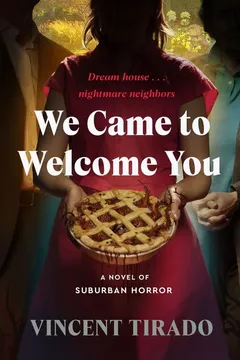


Plot Summary
A House Without Aspens
Sol Reyes, a wary molecular biologist, moves into Maneless Grove with her optimistic wife, Alice Song, hoping homeownership will give them room to build a life together. Their house already feels unlike its immaculate neighbors: it is dark, stiflingly hot, and missing the pale trees lining every other lawn.
A gnarled, leafless tree presses against the backyard wall. The HOA board arrives with wine, candles, a marble carving, and a contract restricting gardens, paint, and even tree care.
Sol and Alice refuse to sign, unwilling to surrender control of their property. That night, the lights fail and wind carries a clapping sound from the trees. Sol tries to treat these oddities as ordinary house trouble, but the house has begun making its own introductions.
The move promises security, but its first details make ownership feel conditional. Sol’s suspicion is not simply a symptom of anxiety: the contract really does reach into private choices, and the house really is materially different from its neighbors. The contrast lets the horror grow from a familiar pressure, the demand to accept intrusion as the price of belonging. Alice sees the move as a chance to begin again; Sol sees a beautiful setting that may be hiding a cost. Their different readings establish the marital tension that the neighborhood will exploit.
Welcome, Then the Hearing
At the HOA’s welcome party, Sol watches children run in unnervingly quiet patterns while adults make intrusive remarks about her clothes, race, and hair. A retired veteran, Lou, dismisses her Yale position with a racist joke; another resident touches her curls without permission.
Alice tries to smooth over the insults, but Sol feels exposed rather than welcomed. She drinks heavily to blunt the pressure, then reads an email from her department head: a plagiarism hearing could end her career.
Next-door neighbor Corinne Munro, an elderly Black woman, watches Sol from the edge of the gathering. When Alice drives them home, the entire party stands motionless, staring after them. The event leaves Sol with two new fears: that Yale may cast her out, and that Maneless Grove’s friendliness is a performance.
The party makes social acceptance look less like warmth than surveillance. Sol is expected to absorb racialized slights graciously, while the community’s strange coordination passes as normal to everyone else. Her drinking is both a coping strategy and a vulnerability the neighbors can read. The career email compounds the scene’s humiliation by threatening the achievement Sol uses to defend her place in institutions that underestimate her. Corinne’s silent attention offers a possible counterpoint, but at this stage even that attention feels difficult to interpret.
The Missing Fifth Step
After the party, Sol wakes from a nightmare of voices and finds a dirt-covered root protruding from a bedroom vent, with an eye blinking behind it. She tells Alice it may have been a mouse, but the sight stays with her. During a walk, Corinne joins Sol and speaks with surprising ease; for a few minutes, Sol feels she can share space without performing.
Back at Sol’s house, Corinne climbs the staircase. The step beneath her disappears, and she crashes to the floor, breaking her hip. Alice calls an ambulance while Sol stares at the step, which has reappeared. Alice sees an accident. Sol knows the house briefly removed part of itself, and the difference between their perceptions leaves Sol alone with the impossible.
Corinne’s fall converts atmosphere into consequence. Until now, the house has been unpleasant and uncanny; now its instability injures a person Sol has begun to trust. The brief ease between the women matters because it gives Sol a human connection that is not governed by the HOA’s polished social rules. Alice’s reasonable explanation protects her from panic, but it also leaves Sol without a witness. The scene makes uncertainty itself a threat: Sol cannot prove what she saw, yet someone has been hurt.
A Twig That Moves
Sol begins interviewing therapists and tells one about the neighbors, while avoiding the staircase because she fears being dismissed as unstable. The session reveals how little trust she has in being understood: the therapist misreads Sol’s Dominican identity and rushes toward diagnosis.
Sol’s memories explain why she watches for danger. As a teenager, she was stabbed by her mother after being exposed as queer, and her father later let her leave home rather than protect her.
At Yale, Sol has learned to keep her head down, especially now that a colleague’s plagiarism accusation has placed her work under scrutiny. At home, she finds a twig caught in her hair. It twitches, then disappears. Alice asks her to stop obsessing over the stairs, and Sol begins hiding what she sees.
Sol’s vigilance has a history grounded in real harm, so dismissing it as mere paranoia repeats the conditions that made her distrustful. Yet trauma also makes certainty difficult: she has learned that danger can arrive through family, work, or supposedly safe rooms. The therapist’s cultural misreading shows how even professional care can force Sol to translate herself before receiving help. The twitching twig sharpens the conflict between evidence and credibility. Sol starts keeping secrets not because she wants distance from Alice, but because she expects disbelief.
The Kennedy Girl
HOA representative Hope tries to enter Sol’s house through the backyard, claiming she needs a copy of the agreement and a spare key. Sol sends her away and later finds the neighborhood strangely empty, its identical houses displaying matching interiors through open curtains.
She encounters Veronica Kennedy, a silent girl who wanders far from home. Sol gives her a ride back, but a stench of decay follows the child into the car. Veronica’s parents do not answer the door, though their vehicle sits in the driveway.
Sol sets up a camera to confirm they are there, then abandons the plan when Veronica appears in the street again. The child’s stillness, the unresponsive house, and the odor leave Sol unsure whether she is protecting Veronica or being drawn toward something hidden.
The neighborhood’s uniformity becomes an instrument of disorientation: Sol cannot tell where people are, what is happening inside their homes, or whether ordinary explanations remain adequate. Veronica is not framed as a conventional child in danger so much as a troubling sign that Sol cannot interpret. Sol’s impulse to help her collides with fear of overstepping, a conflict made sharper by her own history of being watched and judged. The rot is a sensory clue that resists the community’s immaculate public face.
Corinne's Warning at the Hospital
Sol and Alice visit Corinne after her fall. When Alice steps away, Corinne grips Sol’s arm and warns her to leave the house and distrust a neighbor, but she cannot explain who or what she means. A painful buzz overwhelms Sol, then fades when Alice holds her. HOA president Nadine Adams arrives with her husband, Terry, and gives Corinne a carved marble charm she says can bring good fortune when buried or broken.
Corinne’s face goes blank in Nadine’s presence. That night, Sol sleeps on the couch and sees a charred figure move through the house, then climb the stairs toward Alice. She runs after it and cuts her feet on a broken mug, but Alice insists there was no spilled tea. Sol’s fear now has a warning and no explanation.
Corinne’s warning could be read as confusion, but her grip and fear make it difficult for Sol to dismiss. Nadine’s arrival seems to quiet Corinne, turning a neighborly visit into a contest over whose account of reality will prevail. The charm’s promise of luck introduces a material object that carries social pressure: accept the community’s symbols and perhaps receive its protection. The burnt figure extends the house’s threat into Sol’s sleep, where ordinary checks cannot settle what happened. Alice’s comfort helps Sol regulate, but cannot restore shared certainty.
Bodies Behind Curtains
At lunch, Sol’s Yale friend Amir Kazan warns that a new biology position may be opening, suggesting her job is already in danger. Returning to Maneless Grove, she brakes hard to avoid Veronica in the road and tries to take the girl home.
Veronica screams when Sol grabs her arm and runs away. At the Kennedy house, Sol peers through a curtain and sees two decomposing bodies hanging inside. She calls emergency services. Nadine arrives with a key, but the paramedics find only an empty, dusty living room.
Veronica returns and embraces Sol, whispering that her parents are in the roots. The odor of decay strikes Sol again, though nobody else reacts. Humiliated by the false alarm and unable to explain what she saw, Sol flees home carrying the child’s cryptic warning.
The false emergency tests Sol’s credibility in public. Her perception may be impossible, but the paramedics’ empty house does not erase the terror she experienced; it turns her into the person others can label unreliable. Veronica’s brief sentence supplies a clue while deepening the mystery, because it does not match the visible scene. The episode also echoes Sol’s professional crisis: she needs evidence to be believed, but the conditions keep removing it. Her attempt to protect the child becomes another occasion for the community to judge her.
Roots Beneath Sol's Skin
Sol searches online for the house’s previous owners, the Waterson family, while Alice celebrates a possible promotion. In the night, Sol dreams that roots grow through her feet and bind her to the dead. Alice finds her digging beside the backyard tree.
Later, Nadine invites Sol over, then uses the Kennedy incident to pressure her into joining the HOA, claiming the board protected her from legal trouble. Sol notices Nadine’s son in a photograph and learns little about him, but senses grief beneath Nadine’s charm.
On another walk, Sol becomes lost in streets that seem to repeat; a teenager guides her to the woods, where children silently chew bark from a tree. The neighborhood is no longer merely strange. It is changing bodies, memory, and the limits of Sol’s ability to leave.
The roots move from image to bodily threat, making the community’s language of connection feel less benign. Nadine’s offer of protection is coercive because she presents the danger Sol experienced as leverage for signing away independence. The children’s bark eating suggests that the system recruits through ordinary social structures, not just overt force. Alice’s bright hopes and Sol’s growing dread pull the marriage into the same conflict: whether safety means accepting the community’s terms or resisting its version of belonging.
A Warning Under the Tree
In the woods, the teenager leads Sol to children who carve bark from a tree and swallow it together. A red-haired resident named Finnian appears afterward, acting as if he knows Sol well, then again presses the HOA membership. Sol finally visits Laura Waterson, the house’s former owner.
Laura explains that a fire had damaged the property and that her son Randy became withdrawn and obsessed with digging in the backyard. When Sol asks about strange events, Randy confirms that something is buried beneath the tree’s roots.
Sol buys a trowel, digs beside the trunk, and uncovers a wooden box of handwritten pages. Its first warning tells whoever finds it to escape Maneless Grove. The pages offer Sol what the neighbors and her wife cannot: another person’s record of the same impossible place.
The journal changes Sol’s position from isolated witness to investigator with a predecessor. Laura’s account links the house, the children, and the tree without explaining them away. The repeated, altered appearances of Finnian make social identity feel unstable, while the swallowed bark hints that the community’s rituals are literal rather than decorative. Sol’s decision to dig is a turning point because she chooses evidence over avoidance, despite knowing that earlier contact with the tree has harmed her.
Corinne Dies, Clarke Confesses
Sol reads the journal’s early pages, which describe residents sharing thoughts, forgetting parts of themselves, and being pressured to fit the neighborhood. The next morning, Corinne dies. Sol is devastated despite having known her only briefly.
On the same day, Yale’s department head emails that Clarke has admitted tampering with Sol’s paper and experiments, clearing her of plagiarism. Sol should feel only relief, but Clarke’s sudden confession makes little sense.
She consults Dr. Moore, a therapist, and describes Maneless Grove without convincing him that the danger is real. The journal becomes her more reliable witness. Its entries suggest that the community’s welcome is a process of taking, not simply a strange social custom, and Sol resolves to find out who wrote them.
The two losses of certainty arrive together: Corinne is gone, while Sol’s career is restored through an explanation that feels incomplete. Relief cannot erase the suspicion that something else has intervened, and the journal offers a pattern without yet providing a cause. Corinne’s death also removes Sol’s only neighbor who openly warned her. The contrast between institutional vindication and private dread captures the novel’s recurring problem: a fact can be officially confirmed while the deeper forces shaping it remain invisible.
The Cult of the Neighbor
Amir researches the journal and finds an old account of the Church of the Neighbor, a local cult led by the elusive Esther Rhodes. Its members reportedly sought a shared mind through ritual practices.
He also remembers the case of Sean Adams, Nadine and Terry’s teenage son, who disappeared from Maneless Grove and was later associated with a house fire. Sol sees a possible connection between the pages, the HOA’s motto, and the community’s insistence on unity. The journal’s dated entries describe a woman who offers a private refuge and warns the writer about the Neighbor.
Sol cannot yet prove that the writer was Sean or that Esther is the woman, but the history gives the present a lineage. Maneless Grove may have been repeating an old experiment under a new, more respectable name.
Historical research expands the horror beyond one house and one couple. The cult’s language resembles the HOA’s social ideals, suggesting that modern respectability can conceal older forms of coercion. Sean’s disappearance makes Nadine’s private grief part of the community’s public structure, though Sol does not yet know how. The journal’s warnings also complicate the idea of rescue: Esther offers an alternative, but her secrecy and the writer’s dependence leave her motives unresolved.
A Branch Through Glass
Driving home, Sol hears a voice warn that someone is following her. She sees Corinne in the rearview mirror, now altered by roots, repeating her warning about the neighbor. Clarke then appears on the street, disheveled and armed with a knife.
He insists Sol somehow caused his confession and reveals that he sabotaged her work because he wanted her research position and recognition. A resident steps outside and orders him away, identifying Sol as part of the community. Clarke drives off and crashes; a tree branch pierces his windshield and kills him.
At Corinne’s crowded viewing, residents call her one of their own, while Alice cries in Finnian’s arms. Sol recognizes how completely the community can absorb grief and danger, then accepts an invitation to brunch that she does not want.
Clarke’s confession finally gives Sol a human motive for the academic sabotage, but his insistence that she caused his admission shows how little responsibility he can bear. His violent threat is answered by a community that protects Sol while also claiming her as its own. The tree’s intervention blurs rescue and punishment. At Corinne’s viewing, communal care looks genuine and deeply unsettling at once; Sol sees that affection can coexist with a system that decides who belongs and what must be sacrificed.
The Spa's Fourth Guest
At Inner Bliss Spa, Sol hears a collective voice through Bethany, the silent woman driving the group. The voice tells Sol that the residents are connected through the trees and urges her to stop resisting.
Meanwhile, Alice has been taking unlabelled blue pills from Nadine and has signed the HOA agreement without Sol’s consent. Sol confronts her at the spa after overhearing that Nadine concealed the story of her son and the house. Alice sends Sol away, furious that she has hidden the Kennedy incident and publicly weaponized Nadine’s grief.
Sol leaves the spa alone, then visits her father, Jose, after he repeatedly calls the nursing home staff. The collective helps her resist his baiting and identify the backyard tree as a strangler fig. A bonfire invitation waits when she returns.
The spa gives the collective a voice, but not a trustworthy one. Its soothing attention is paired with surveillance, pressure, and the promise of belonging. Alice’s hidden agreement crystallizes the marriage’s conflict: she wants stability badly enough to accept conditions Sol sees as dangerous. Sol’s visit to Jose reveals that the influence can also alter her emotional responses, making relief itself suspect. The invitation turns a social event into a looming choice about how Sol will respond to power she can no longer deny.
Finnian Names the Roots
At brunch, Finnian explains that Maneless Grove is an aspen grove whose trees connect residents into a shared mind. Bark and pollen carry the influence; the marble charms and welcome wine helped open the way.
The collective has eased Sol’s work crisis and protected her from Clarke, but it wants her to spread pollen through Yale and other workplaces. It also admits that Corinne was killed because the pain medication she needed affected Nadine’s pregnancy. Sol rejects the offer, especially after seeing Alice absorb new habits and lose parts of her Korean identity.
The collective warns that leaving may endanger Alice, whose connection is stronger. Sol leaves brunch knowing the neighbors are not simply strange or manipulative. They have made her a potential instrument of expansion.
Finnian’s explanation turns neighborliness into infrastructure: the community’s help is real, but it is also the mechanism by which it grows. The collective’s moral logic treats individual pain as a manageable cost when it benefits the whole. Sol’s resistance is therefore not a simple refusal of help; she must reject assistance that has been made inseparable from control. Alice’s changing language makes the stakes intimate, locating cultural loss inside the marriage rather than in an abstract battle over autonomy.
A Meal Reconnects Them
After a therapist helps Sol understand that she and Alice built intimacy through shared routines, Sol returns home and notices how much Alice has changed: she cooks with her other hand, has lightened her hair, and makes an unfamiliar quinoa meal.
Sol feels herself slipping into another person’s perspective while they eat. Instead of pretending the changes are harmless, she asks Alice whether she is truly happy. Alice admits she has made mistakes by hiding the agreement and throwing Sol under the bus.
The two apologize and promise to look after each other, though neither can undo the neighborhood’s influence. Later, Sol is trapped in the guest room when its door disappears and the walls heal after she strikes them. The house has isolated her, but a new presence appears when the collective falls silent.
The meal makes identity visible through small habits: handedness, language, cooking, and the familiar choreography of sharing a kitchen. Sol’s challenge is not to restore an idealized past but to ask whether their choices still belong to them. Alice’s apology gives the marriage a foothold, not a cure. The doorless room then makes isolation literal, setting up a second kind of connection that may offer escape while carrying its own danger.
Esther and the Nameless
With the HOA’s voice absent, shadows gather in the guest room and show Sol what the aspen collective cannot see. The entity beneath Maneless Grove is the Nameless, a predatory consciousness that feeds on the dead and uses the roots to hide them.
The aspens’ shared mind thought it had formed a partnership, but the older presence has been exploiting that connection. Sol recognizes that the dark backyard fig links her to both forces. The journal entries belong to Sean Adams, who was trying to escape the collective with help from Esther Rhodes, the woman whose shadow moved independently.
His final pages describe preparing a fire as his only route out. Sol makes a bargain with the Nameless, then approaches the town hall for the bonfire carrying supplies the HOA cannot easily refuse.
The revelation replaces a single monster with competing systems of predation. The Neighbor offers mutuality at the cost of personal boundaries; the Nameless consumes what the Neighbor cannot protect. Esther and Sean’s history shows that escape has been attempted before, but the pages do not promise a clean solution. Sol’s bargain is a strategic choice made under constraint, not a return to innocence. She intends to use the community’s own rituals while aligning herself with a force that may be no less dangerous.
Sol Runs for President
Sol arrives early at the town hall with vodka and a deliberately rule-bending dish, helping Finnian prepare for the annual bonfire while concealing her purpose. At the gathering, she watches Teresa and Hope react to Nadine’s absence and realizes the HOA’s leadership is vulnerable.
Rather than announce a revolt, Sol tells the residents she intends to run for president. The bonfire, meant to honor the community’s dead and renew its bonds, becomes her route into its governing structure.
She has not destroyed the aspens or freed Alice from the collective, but she has stopped being a target who can only react. By choosing office, Sol makes herself responsible for the same network she intends to redirect, accepting that influence can be used as leverage as well as control.
Sol’s campaign is an act of tactical adaptation, not a clean victory over the system. She recognizes that direct refusal has left her exposed, while participation may let her shape the rules and redirect the community’s reach. The bonfire’s festive surface conceals a political struggle over who gets to define sacrifice and belonging. Her choice is morally uneasy because it requires her to enter the institution that harmed her, but it also marks a shift from isolated skepticism to deliberate agency.
A Presidency for the Grove
Three months later, Sol is president of the HOA and has learned to manage the competing thoughts and sensations flowing through the collective. She shares access selectively, adding shadows to residents so the Nameless does not overwhelm her with every mind at once.
Her marriage with Alice is stronger, and Sol has helped her father become gentler by leaving him a marble charm. Yet the collective’s reach is still growing. During lunch with Amir, Sol learns that his family may move to Andor’s Grove, another gated community connected to Maneless.
She offers to make introductions. The scientist who once feared losing her job and her home now helps carry the network outward. Sol has gained power and purpose, but the ending leaves the cost visible: she is no longer merely resisting the roots; she is deciding where they grow.
The ending resolves Sol’s immediate helplessness without restoring a simple boundary between freedom and complicity. She has authority, a repaired bond with Alice, and a way to reduce the sensory burden of the collective. But her influence depends on extending the very system she once feared. The closing offer to Amir’s family turns the neighborhood’s expansion into an intimate act of hospitality. Sol’s transformation is therefore neither pure corruption nor uncomplicated triumph. She has learned that agency inside a coercive structure may protect some people while making her responsible for its spread.
Analysis
We Came to Welcome You turns the ideal of neighborly care into a horror mechanism by asking what happens when community does not merely support people, but claims the right to edit them. Maneless Grove offers real benefits: protection, useful connections, shared knowledge, and a place to live. Those benefits make its coercion persuasive. Residents are not forced into submission by a single villain’s threat; they are drawn in through wine, favors, job prospects, social invitations, and the promise that no one has to face hardship alone.
Sol’s identity makes the cost especially sharp. She has learned to monitor herself because racism, homophobia, and workplace power have made ordinary misreadings consequential. The novel does not treat her vigilance as a flaw to be cured. Instead, it distinguishes justified caution from the isolating habit of expecting herself to solve every danger without help. Her marriage to Alice becomes the emotional ground on which that distinction is tested. Alice’s optimism is not foolish, but her desire for security makes her vulnerable to a community that offers belonging in exchange for cultural and personal erasure.
The competing root systems complicate any easy moral division. The Neighbor is predatory despite its language of mutual aid; the Nameless offers an alternative but also feeds on human lives. Sol’s eventual authority does not restore a world untouched by harm. She gains room to act by entering the system and redirecting its power, while becoming responsible for its expansion. The conclusion therefore treats agency as consequential rather than pure. Sol can choose how the roots grow, but she cannot pretend that using them leaves her unchanged. The novel’s deepest question is not whether connection is good or bad. It is who controls the terms of connection, who pays for its benefits, and whether a collective can care for its members without deciding that their differences are expendable.
Characters
Sol Reyes
The wary scientistSol is a Black Dominican lesbian, a molecular biologist, and a person whose anxious attention has been sharpened by years of family rejection and workplace hostility. She looks for causes, records evidence, and distrusts social rituals that demand she make herself comfortable for other people. Her marriage to Alice is the safest relationship in her life, but her fear of being dismissed often makes her conceal what she needs. Sol’s central tension is between self-protection and connection: she wants a home and community, yet refuses to treat belonging as worth surrendering her judgment.
Alice Song
The hopeful partnerAlice is Sol’s Korean wife, a skilled marketing professional, and a naturally sociable person who often searches for possibilities where Sol sees risk. Her practical optimism helped the couple secure a home and has long offered Sol emotional shelter. Alice also wants professional recognition and a dependable future, which makes her receptive to promises of community support. She can be tactful with strangers but impatient when Sol’s anxiety or suspicion unsettles their plans. Her relationship with Sol is built from small acts of care, shared food, and the difficult work of understanding two different approaches to safety.
Nadine Adams
The polished HOA presidentNadine is a charismatic community leader and Alice’s close friend. She presents herself as generous, socially fluent, and eager to help newcomers settle in. Her authority comes less from open confrontation than from knowing how to make requests feel like favors and obligations feel like common sense. Nadine is protective of her family and invested in the neighborhood’s shared life, but her warmth can make it difficult to tell where care ends and pressure begins. Sol’s suspicion of Nadine grows from the mismatch between her affectionate manner and the force of her influence.
Corinne Munro
The watchful neighborCorinne is Sol’s elderly Black neighbor, a widow who has spent much of her life in Maneless Grove. She can be warm and unexpectedly perceptive, offering Sol an ease of companionship that the rest of the neighborhood does not. At other times, her attention seems distant or strangely fixed, leaving Sol unsure how much Corinne understands. Her history in the community gives her knowledge that newer residents lack. Corinne becomes important to Sol because she appears to recognize the danger before Sol can name it, while her own life remains entangled with the place she is trying to describe.
Jose Reyes
Sol's difficult fatherKnown to Sol as Papi, Jose is an aging Dominican man whose humor, pride, and volatility make visits to his nursing home emotionally complicated. He has a history of homophobia and poor treatment of Sol, yet their shared past keeps drawing her back. His work as a landscaper gives him practical knowledge of trees, while his bluntness can expose Sol’s habit of excusing painful relationships through duty and cultural obligation.
Amir Kazan
Sol's trusted colleagueAmir is a history professor at Yale and one of the few people Sol considers a friend. Sociable and compassionate, he notices when her reassurances do not sound convincing and offers help without demanding that she explain herself perfectly. His interest in historical oddities gives Sol a way to investigate Maneless Grove beyond her own impressions. He is also a husband and father whose family life contrasts with Sol’s guarded relationship to her own parents.
Terry Adams
Nadine's quiet husbandTerry is Nadine’s husband and a quiet presence beside her public confidence. He helps with community events and makes the carved charms used by the HOA. Sol notices that he often hangs back while Nadine manages conversations, making him difficult to read. His role connects domestic life, the association, and its rituals.
Sean Adams
The missing sonSean is Nadine and Terry’s son, whose absence shadows the family and the neighborhood. The surviving traces of his life suggest a young person who struggled to find a private self among people who valued collective belonging. His writings, when encountered, give Sol a voice from inside the community’s history. Sean’s experience makes the cost of isolation and the cost of forced unity difficult to separate.
Esther Rhodes
The elusive cult figureEsther Rhodes is a mysterious figure associated with the old Church of the Neighbor, a cult remembered through fragmentary records and rumor. Her name appears in accounts of residents seeking a way to escape Maneless Grove’s influence. She is difficult to place: part historical person, part legend, and part unanswered question. The uncertainty surrounding Esther makes her an unsettling counterpoint to the HOA’s insistence that everyone knows everyone.
Dr. Clarke
The threatened colleagueClarke is a newer Yale colleague whose polished manners conceal professional resentment. He sees Sol’s success as an obstacle to his own recognition and is willing to manipulate laboratory work and institutional procedure to gain an advantage. His conflict with Sol exposes how easily a powerful institution can treat a woman of color’s competence as suspicious while granting a white colleague room to maneuver.
Teresa
The HOA's formal faceTeresa is a board member who helps welcome newcomers and enforce the HOA’s expectations. She is polished, controlled, and adept at turning a demand into a neighborly suggestion. Her composure makes the association appear orderly even when its rules are invasive. Sol’s encounters with Teresa reveal how institutional pressure can be delivered with a smile.
Hope
The eager enforcerHope is an older HOA member who crafts gifts and approaches newcomers with conspicuous enthusiasm. Her friendliness often crosses into intrusion, as she assumes access to other people’s homes and time. She represents the association’s softest pressure: a demand framed as concern, difficult to challenge without being cast as unneighborly.
Finnian
The shifting treasurerFinnian is the HOA treasurer, an accountant with a genial manner and an unusual talent for appearing in Sol’s path. His height, build, and details seem inconsistent across encounters, though he insists on being recognized as the same person. He promotes the neighborhood as a network of useful connections. That combination of helpfulness and instability makes him one of the clearest signs that Maneless Grove’s ordinary social rules may not apply.
Roy
Finnian's candid husbandRoy is Finnian’s husband and one of the neighborhood’s few other openly gay residents. He initially offers Sol solidarity, but his friendly manner can become intrusive, including when he touches her hair without permission. His role shows how even well-intended inclusion can reproduce boundary violations when a person assumes familiarity too quickly.
Lou
The veteran neighborLou is a retired veteran who meets Sol with overt racism and later appears transformed in his manner toward the community. His sharp contrast between hostility and sudden belonging makes him a disturbing example of how quickly a person’s public identity can shift. Sol cannot tell whether his change reflects remorse, social pressure, or something more invasive.
Veronica Kennedy
The silent childVeronica is a young girl who wanders Maneless Grove without adult supervision and rarely speaks. Her immaculate appearance contrasts with her odd stillness and the disturbing odor Sol associates with her. She draws Sol toward the unanswered questions surrounding the Kennedy home. Veronica’s behavior makes her seem less like a conventional child and more like a messenger whose meaning Sol cannot yet understand.
Laura Waterson
The former homeownerLaura is the previous owner of Sol’s house, a mother who remembers her family’s unsettling experience there. She wants to believe the house was simply a difficult renovation, but her account of her son’s behavior betrays lingering concern. Her home, full of personal touches and a garden, offers Sol a glimpse of a life outside Maneless Grove’s rigid uniformity.
Aunt Julie
Alice's trusted auntJulie is Alice’s aunt, a psychiatrist in Toronto who helped support her through family estrangement. Alice trusts her deeply and maintains a close cultural and emotional bond with her. Julie’s concern gives Sol an outside perspective on changes in Alice’s behavior.
Dr. Henderson
Sol's department headDr. Henderson leads Yale’s biology department. He tries to assess the plagiarism case fairly and communicates with Sol while her position is at risk. His measured manner makes him difficult for Sol to read, but his professional judgment matters greatly to her.
Plot Devices
The HOA Agreement
A contract for belongingThe HOA contract initially appears to regulate ordinary matters such as lawns, paint, trees, and gardens. Its vague fines and demand for a spare house key reveal a wider claim over residents’ private lives. The agreement functions as both practical coercion and an ideological test: joining promises access to community support, while refusing marks a resident as isolated and suspect. Alice eventually signs it without Sol’s consent, making the contract a source of marital conflict as well as a mechanism of neighborhood control.
Aspen Pollen and Bark
The carrier of connectionAspens form the biological basis of the Neighbor’s shared consciousness. Bark and pollen help connect residents and can carry that influence beyond the gated community. The trees appear at first to be landscaping, then become clues in the children’s behavior, the neighborhood’s synchronized thoughts, and Sol’s unwanted connection to distant people. Wine and carved charms also help introduce the influence, disguising transmission as hospitality and tradition.
The Buried Journal
A witness from beforeThe handwritten pages Sol digs from beneath the backyard tree record an earlier resident’s fear, memory loss, and search for escape. Their dated entries disclose information gradually, giving Sol a way to compare her experiences with someone else’s instead of relying on proof that disappears. The journal’s warnings connect Maneless Grove to its older cult history and eventually to Sean Adams. It also raises a question the novel refuses to simplify: whether the person offering escape can be trusted.
The Strangler Fig
A rival root systemThe dark fig tree grafted against Sol’s house breaks the neighborhood’s visual uniformity. Its roots hide what the aspens fail to perceive and connect Sol to the Nameless, a separate intelligence beneath the Grove. The tree explains the recurring images of buried bodies, roots inside wounds, and shadows moving independently. It is not a simple weapon or solution; it gives Sol access to another force whose interests may not match her own.
The Labyrinthine Grove
A neighborhood that trapsManeless Grove’s repeated houses, looping streets, gates, and identical trees make navigation unreliable. Sol becomes lost even when she knows where she is trying to go, and the community’s polished sameness makes it hard to identify which residents are present or what has changed. The physical layout mirrors the HOA’s social structure: both promise safety and convenience while narrowing the paths available to anyone who wants to leave.

Download PDF
Download EPUB
.epub digital book format is ideal for reading ebooks on phones, tablets, and e-readers.








