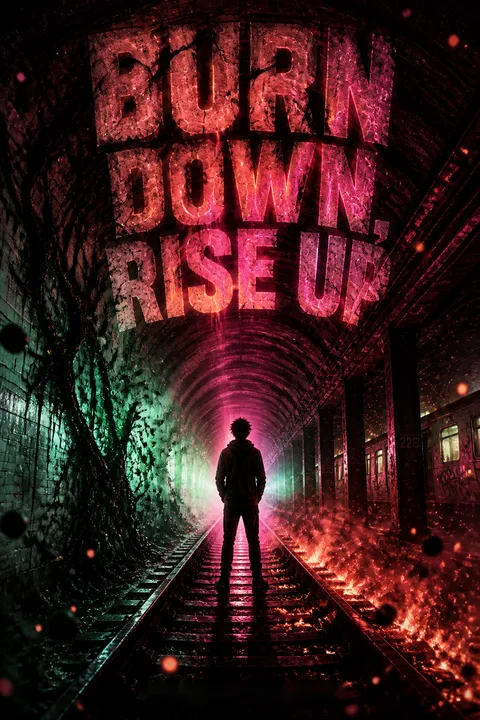


Plot Summary
Prologue
Francisco Cruz, known as Cisco, staggers through the Bronx with black rot spreading beneath his skin and his memories breaking apart. He reaches Lincoln Hospital, where his violent confusion passes the infection to a nurse before he escapes.
In the street, he calls his cousin Charlize and tries to explain the rules of a subway game he and his friends played. Something skitters after him, and the city keeps shifting around him. Cisco heads toward Charlize, hoping she can help before the rot consumes what remains of his mind.
Cisco’s disorientation makes the supernatural threat bodily before it becomes explanatory: infection blackens his veins, while broken memory turns familiar streets into unstable ground. His attempt to reach a hospital shows how readily people seek institutional care, even when the illness exceeds what institutions can name. The infection spreading through contact also establishes an intimate danger, one carried between people rather than contained in a distant haunted place. By ending on Cisco’s effort to reach Charlize, the prologue turns a frightening mystery into a relationship with immediate stakes.
The Hospital Window
Sixteen-year-old Raquel Celestin rides the Bronx subway with her best friend, Aaron, while news of local disappearances unsettles the neighborhood. At school, she sees Charlize, her childhood friend and Aaron’s crush, crying over Cisco’s disappearance.
Then Raquel’s estranged father, Samuel, arrives with news: Raquel’s mother has been attacked at Lincoln Hospital and placed in a coma after developing an unknown infection. Through her room’s glass, Raquel spots black mold spreading beneath her mother’s skin, then sees a decaying man in a corduroy jacket in the reflection.
The man vanishes when she turns around. With her mother unable to come home, Raquel packs for a stay at Samuel’s apartment, entering a family life she has kept at arm’s length.
The hospital glass turns Raquel into both witness and outsider: she can see her mother’s suffering but cannot reach her. That enforced distance echoes the emotional distance between Raquel and Samuel, whose care is real but practiced through separate routines. The corduroy figure disrupts the medical frame just as the infection does. Raquel’s crisis begins not with a chosen adventure but with the collapse of the ordinary systems she trusts: family, school, and hospital care can identify danger without explaining or stopping it.
A Burn From Sleep
At Samuel’s apartment, Raquel dreams of a ruined, burning Bronx and a badly burned child who accuses her of making promises she cannot keep. She wakes with a real burn on her shoulder. Samuel explains that Raquel suffered violent nightmares as a young child and slept more peacefully when she held resguardos, beaded spiritual charms he gave her.
The dream’s corduroy man also appeared in the vision, linking him to the figure Raquel saw at the hospital. Samuel suggests she may have inherited a sensitivity to spirits from her parents’ opposing faiths. Raquel wants a rational explanation, but the burn makes denial difficult. Her childhood symptoms, dormant for years, have returned alongside her mother’s infection and Cisco’s disappearance.
The burn collapses the boundary Raquel depends on between a frightening idea and a measurable fact. Her instinct is to question her own perception, but the injury refuses to stay private or symbolic. Samuel’s memory of her childhood expands the crisis across time: this is not simply a new haunting, but a capacity that adults once managed through competing religious practices. The resguardo therefore carries more than supernatural promise. It represents inherited care that Raquel dismissed because she did not yet understand what it protected her from.
Rot Between Cousins
Raquel finds Charlize replaying leaked subway footage of Cisco falling onto the tracks as if something were dragging him. At a community center, Charlize shows Raquel a photograph of Cisco with black growth on his arm. Raquel recognizes the same rot on her mother and admits the infection has left her comatose. The two girls agree to investigate together.
Samuel and an old neighborhood friend, Xiomara, explain how arson, neglected housing, and public abandonment devastated the Bronx during the 1970s. Raquel begins to suspect that her dreams reproduce this history. The phrase the Passengers repeat in her nightmare points toward broken promises made to residents. She asks Samuel for a resguardo, and its touch brings an unfamiliar calm.
Raquel and Charlize build trust through evidence rather than instant intimacy: a photograph and a hospital diagnosis give each girl a reason to risk being believed. Their shared investigation also restores a childhood bond that had faded into indirect encounters. Xiomara’s account shifts the mystery’s scale from a private infection to civic memory. The Echo is beginning to look like history that was never repaired, not because the past literally repeats unchanged, but because neglected conditions leave a present-day imprint. Raquel’s charm offers protection, but it also asks her to take seriously a form of knowledge she once rejected.
The Echo's Rules
Raquel, Charlize, Aaron, and Aaron’s older brother, Mario, visit Cisco’s Fordham dorm. His roommate, Amadeus, reveals that Cisco joined theater students in attempting an online subway ritual called the Echo Game.
Aaron finds its rules: choose a direction before 3 a.m., begin at three, keep moving until four, and never turn back or interact with the dead. A London survivor, Olivia, warns that the Echo recreates local catastrophe, traps players who break its rules, and can follow survivors home.
Despite the warning, Charlize insists on trying the Bronx version to find Cisco. Aaron secretly tells Mario that Raquel likes him, hoping to set them up, and brings him along under false pretenses. Before the girls’ first attempt, Charlize kisses Raquel, who cannot yet admit what she feels.
The rules promise control over an experience designed to resist it. Their vagueness lets players adapt the ritual, but that flexibility also makes the challenge feel more credible to curious teenagers. Olivia’s account punctures the idea that survival means safety: the Echo can persist as fear and altered behavior after a player escapes. Meanwhile, Aaron’s matchmaking lie reveals how friendship can become possessive when people treat romance as a contest. Raquel and Charlize’s kiss offers a brief counterpoint to the approaching danger, but Raquel’s hesitation shows how fear of naming desire can be as paralyzing as fear of the supernatural.
One Hour Underground
After sneaking out of Charlize’s home, Raquel and Charlize reach Simpson Street station before three in the morning. A second coin toss points to a different train than the one approaching, and the number on its display changes as it arrives. Charlize nearly freezes on the platform, but Raquel pulls her aboard. They begin the ritual and ride into darkness without announcements or a working route map.
Burned and mangled figures board, humming or repeating a Spanish phrase about false promises. Raquel discovers that touching one floods her with the victim’s final memories. Then the corduroy man appears and tells them Cisco has left the Echo. Charlize lunges at him, and Raquel’s anger and confusion intensify as the train keeps moving.
The altered train display makes the Echo’s invitation feel active: the environment does not merely wait for the girls but changes in response to them. The Passengers’ injuries turn historical abstraction into intimate contact, and Raquel’s involuntary memories make witnessing itself a form of exposure. Charlize’s instinct to attack the corduroy man grows from love and terror, while Raquel’s rising anger shows the Echo exploiting those attachments. Their first hour underground is not a puzzle with a clear solution. It is a test of whether they can distinguish their own choices from reactions being forced upon them.
The Cost of Leaving
The corduroy man’s taunts make Raquel sick, and his claim about Cisco devastates Charlize. When Charlize thinks she sees her cousin outside the train, she runs into the dark. Raquel follows, breaking the rule against leaving before four. The Echo shows her a burning Bronx crowded with ruined buildings and dead residents; she watches a man in a black suit infect someone with the same mold.
Passengers pursue her after she makes noise, while the corduroy man reveals that her childhood sensitivity has been shielded by prayer and charms. A centipede-like parasite drives her back toward the station. At 3:59, Raquel catches the train out, but Charlize is still missing. She returns home exhausted, carrying guilt and the Echo’s influence with her.
Raquel’s departure from the train is both a rule violation and a moral choice: she follows Charlize rather than preserve her own chance of escape. The choice does not rescue her friend, which makes the resulting guilt sharper than simple fear. The Echo then turns the Bronx’s history into a landscape of pursuit, using real civic wounds as an instrument of psychological destabilization. Raquel’s discovery of her own sensitivity offers no comforting mastery; it makes her more visible to the threat. Her escape is therefore technically successful and emotionally costly, a distinction the story keeps insisting matters.
A Week to Save Her
Back in the waking Bronx, Raquel wakes from another nightmare with black rot in her mouth and learns that the infection has spread to nurses. Charlize remains trapped, and the corduroy man later appears in a dream to tell Raquel that the school is safe and she must find a prison within the Echo. When Aaron challenges her for abandoning Charlize, Raquel lashes out by revealing Charlize kissed her.
Aaron leaves hurt, but Raquel apologizes and asks for help. A doctor then tells them Raquel’s mother may have only a week or two. Samuel explains that charms cannot replace community action, while Raquel gathers resguardos and her inhaler. She decides to return to the Echo with Aaron and Mario, even if they cannot guarantee Charlize’s rescue.
The aftermath reveals that escape has not ended the danger: rot, nightmares, and anger have crossed back into Raquel’s daily life. Her fight with Aaron exposes how the Echo’s influence amplifies an existing weakness, her tendency to avoid honesty until pressure makes her cruel. The mother’s prognosis converts the investigation from an urgent hope into a deadline. Samuel’s account of collective action reframes protection as something stronger than an individual charm, preparing Raquel to depend on others without pretending that dependence is easy or safe.
The Station Turns Back
At Hunts Point station, Aaron arrives with Mario and a gun he has obtained without explaining where it came from. Before they can begin the ritual, two officers confront them, having followed Raquel’s connection to the missing people. The station abruptly shifts into the Echo. One officer is dragged into the tunnel, and the other collapses after an unseen attack; both later become missing persons in the waking world.
The corduroy man appears down the tracks, and Raquel leads the boys onto a train. At three, they step into the dark platform and discover that the route has rearranged itself. A split at the turnstiles separates them. Raquel emerges alone into the burning Bronx, carrying the gun, bat, inhaler, and resguardos Samuel gave her.
The second attempt begins with institutions again misreading what is happening. The officers see a dangerous weapon and suspicious teenagers, while the actual danger remains invisible to them. Their disappearance exposes the limits of law enforcement in a crisis shaped by history and supernatural forces, without making their fear unreasonable. Aaron’s gun adds a human threat to the Echo’s threats, complicating the group’s sense of safety. When the turnstiles separate the friends, Raquel must test what she has learned alone, but the charms and practical supplies show that she is no longer entering the Echo empty-handed.
The Slumlord's House
Raquel finds Mario hiding from the missing Fordham students, now feral after a year in the Echo. On a rooftop, a parasite attacks; Raquel’s resguardo forms a shield when she concentrates on Charlize.
She realizes positive memories can counter the Echo’s distortions and identifies Hyde High as a safe place beyond the 1970s. The corduroy man’s clue leads her to a decayed house transformed into a juvenile detention center, the prison within the prison. Inside, the Slumlord drains her strength and fills her with eviction terror.
Raquel resists by recalling her mother forcing their real landlord to address mold in their apartment, then remembers her parents’ support and strikes the creature with her bat. Its body shatters, clearing rot from the house, though the threat remains.
The resguardo does not work as a generic weapon. It amplifies memories of care, giving Raquel a defense rooted in relationships and lived experience. That mechanism makes the Slumlord’s power especially pointed: he feeds on the insecurity created by neglect, housing precarity, and the loss of control over one’s home. Raquel’s memory of her mother pursuing a real landlord connects supernatural combat to practical resistance. Yet the victory is provisional. The creature embodies a recurring system, not an individual villain whose destruction can erase the conditions that produced it.
A Parade Through Death
After the Slumlord’s house collapses, the corduroy man guides Raquel toward Hyde, but the parasite returns and splits into smaller creatures. Aaron finds her as the resguardos repel them, then helps her flee toward the school.
At a fenced post office, they encounter Westley and the other Fordham students, who have become desperate and cannibalistic. Westley takes their gun and tries to use Raquel and Aaron as bait for the Passengers. Raquel refuses to abandon Aaron and recalls the Fish Parade, a neighborhood celebration that grew from protest.
Their resguardos flare as they remember the community, confusing the Passengers and allowing the pair to escape. Mario reaches Hyde ahead of them and carries the injured Raquel inside. The old school building keeps the pursuing dead outside, but Charlize is nowhere in sight.
The Fish Parade memory converts a specific civic practice into immediate protection. Community here is not sentimental background: it is an active resource that interrupts the Echo’s control over attention and threat. The contrast with Westley’s group matters. A year of isolation has made survival predatory, while Raquel and Aaron survive by refusing to treat each other as expendable. Their reunion also repairs, in action, the trust damaged by Raquel’s earlier outburst. Hyde’s safety is meaningful but incomplete, since a protected building cannot resolve the absence of the person they came to find.
The Rot Beneath Hyde
In Hyde’s cafeteria, Raquel finds black rot coating the walls and tables. Charlize’s bloodied knife lies nearby, evidence that she reached the school but remains buried in the infection. Raquel pushes into the mold with a resguardo and uses the knife to cut through it. A tendril pierces her leg, but she reaches Charlize and forces the charm into her hand.
A kiss and their shared memories bring Charlize back to herself and clear the cafeteria. Charlize then leads them to Cisco, whose body has died beneath the rot. Mario places the group’s remaining resguardos into Cisco’s chest. Their light drives the mold away and raises Cisco as a spirit, letting him reunite with Charlize and Mario even though he cannot return to life.
Raquel’s rescue of Charlize completes the emotional movement that began with their indirect childhood friendship: she finally risks herself openly rather than waiting for the other girl to clarify what she feels. Their shared memories function as evidence of reciprocal attachment, not a magical substitute for consent or choice. Cisco’s return is more limited and more truthful than a conventional resurrection. The charms preserve his presence as a spirit, but they do not undo death. The scene allows grief and connection to occupy the same room without pretending one cancels the other.
The Bronx Answers Back
Past four in the morning, Raquel leads the group toward the expressway and rebuilds the missing subway entrance by asking everyone to imagine its parts together. The Slumlord returns with the Passengers, who chant about the promises broken to them. Raquel names the landlord’s exploitation as the source of those betrayals, and the dead turn on him, tearing apart the creature that kept them trapped in repeated suffering.
Cisco stays behind, while the others enter the tunnel. Raquel remains long enough to hold the corduroy man as he dies for the last time; he admits the Echo used him as a lure and thanks her for helping him find peace. Raquel catches up with her friends on the tracks, and together they reach the living Bronx.
The ending changes the Passengers from scenery into agents. Raquel does not defeat them through force; she gives their repeated phrase a target and restores the history behind it. Their collective action makes the Slumlord’s violence legible as exploitation rather than an inexplicable curse. The rebuilt station extends this principle: the way out appears through shared memory, not individual mastery. Cisco’s inability to leave and the corduroy man’s final death keep the resolution from becoming total repair. Some losses remain, but the living can stop mistaking those losses for proof that solidarity is powerless.
A Living Neighborhood
The injured teenagers call an ambulance, and Raquel undergoes surgery to remove glass from her leg. Samuel tells her that the hospital has seen the mold recede from her mother’s lungs, though doctors cannot explain why.
When Raquel visits, her mother is awake and recovering, and Samuel brings her favorite tulips. Later, Raquel returns to school on crutches and presents a history project about Bronx organizing, the Fish Parade, and neighborhood care. Charlize, now with a shaved head, walks beside her and makes their affection plain.
Aaron accepts that Charlize has chosen Raquel, while remaining Raquel’s best friend. Raquel’s final account of the Bronx emphasizes its people and their work together, not the fire-scarred version the Echo tried to make permanent.
Recovery arrives as a process, not a reset: Raquel’s leg still needs months of healing, her mother remains weak, and the missing officers are unresolved. Yet Raquel can now place horror beside ordinary life without letting it define the whole neighborhood. Her presentation turns schoolwork into an act of authorship, correcting an account of the Bronx narrowed to damage. Charlize’s visible affection and Aaron’s continued friendship show relationships reorganizing rather than disappearing under jealousy. The ending locates hope in concrete practices of care, from organizing and housing advocacy to the simple act of walking someone to class.
Analysis
Burn Down, Rise Up makes horror inseparable from place. The Bronx Echo is not a generic haunted underworld; it is built from a history of arson, neglected housing, displacement, and public abandonment. The Passengers repeat a grievance they cannot fully explain, while the Slumlord turns structural harm into a predatory body. This supernatural form gives historical injury sensory force, but it also asks who benefits when a neighborhood is remembered only through destruction.
Raquel’s development is not a conversion from skepticism to unquestioning belief. She learns to work across kinds of knowledge: hospital evidence, family memory, neighborhood history, and spiritual practice. The resguardos matter because they amplify relationships rather than granting solitary power. Raquel survives when she recalls her mother’s advocacy, joins Aaron in a shared memory, and gives the Passengers a clearer account of their own suffering. Protection becomes collective without becoming effortless.
The relationships deepen this argument. Raquel’s avoidance of emotional honesty costs her trust with Aaron and delays her recognition of Charlize’s feelings. In the Echo, those evasions are magnified into danger, but repair remains possible through apology and action. Cisco’s presence as a spirit preserves connection while refusing an easy reversal of death. The novel likewise permits recovery without pretending that every harm disappears: Raquel is injured, the officers remain missing, and her mother’s healing is fragile.
The ending’s hope is deliberately local and practical. Raquel returns to school, presents the history of organizing, and names the Bronx through its people as well as its wounds. The story’s answer to inherited trauma is neither forgetting nor romanticizing resilience. It is accurate remembrance joined to mutual care, advocacy, and the willingness to make a way forward together.
Review Summary
Burn Down, Rise Up received mostly positive reviews, with readers praising its thrilling plot, diverse characters, and exploration of Bronx history. Many appreciated the Stranger Things-like atmosphere and the blend of horror with social commentary. The sapphic romance and strong friendships were highlights for some. Critics found the writing simplistic at times and felt certain plot elements were underdeveloped. Overall, reviewers recommended it as an engaging YA horror novel with a unique setting and important themes.
People Also Read
Characters
Raquel Celestin
The reluctant witnessA sixteen-year-old Bronx student, Raquel is disciplined, academically driven, and uneasy with spiritual explanations. She measures herself by a strict sense of right and wrong, which can make her compassionate but also self-punishing. Her asthma, close attention to neighborhood history, and instinct to research problems give her a practical way into danger. Raquel cares deeply for her mother, her best friend Aaron, and her rekindled friendship with Charlize, though she struggles to speak plainly about fear and desire. Her perspective anchors the story: she questions what she sees, notices how the Echo distorts the Bronx, and searches for ways to act without surrendering her judgment.
Charlize
Cisco's devoted cousinCharlize is Cisco’s cousin and a childhood friend of Raquel. Warm, generous, and attentive to other people’s feelings, she is accustomed to sharing good news, snacks, and advice. Cisco’s disappearance makes her grief visible, but her determination to find him also gives her a stubborn investigative streak. She and Raquel have a long history of missed invitations and unspoken closeness, which leaves both girls unsure how to read the renewed bond between them. Charlize’s courage is not the absence of fear; she acts while frightened because loyalty matters more to her than appearing composed.
Aaron
Raquel's loyal best friendAaron has been Raquel’s closest friend since childhood. Tall, observant, and sentimental, he often hides vulnerability behind short answers, jokes, and an eagerness to help. His crush on Charlize shapes some of his choices, including an ill-considered attempt to arrange a match for Raquel, but his bond with Raquel is deeper than romantic rivalry. He can be jealous and defensive, yet he is capable of recognizing when he has hurt someone and returning when help is needed. Aaron’s loyalty is most convincing when it costs him comfort, status, or certainty.
Cisco
The missing cousinFrancisco Cruz, called Cisco, is Charlize’s cousin and a Fordham student who enjoys drawing and working behind the scenes on theater sets. Gentle and attentive, he tends to make people feel safe, even when he has only just met them. His choice to accompany classmates into a supernatural challenge grows from that instinct to support someone who is afraid. Cisco’s disappearance and confused attempts to reach Charlize set the central mystery in motion. His bond with Charlize also links the younger group’s Bronx friendships to the dangers they are trying to understand.
Samuel
Raquel's spiritual fatherSamuel, whom Raquel calls Papi, is her father and an EMT whose irregular shifts often keep him away. He is emotionally expressive, curious about spiritual traditions, and inclined to use humor when difficult feelings leave him unsure what to do. His apartment and beliefs differ sharply from Raquel’s mother’s household, reflecting the distance between the separated parents. Samuel offers Raquel resguardos, memories of her childhood, and a perspective on Bronx history shaped by lived experience. He wants to protect his daughter, but his tendency to withhold frightening news shows how care can become silence when a parent mistakes shielding someone for helping them.
Raquel's mother
The determined nurseRaquel’s mother is a practical, hardworking nurse who raised her daughter with clear expectations and a strong sense of responsibility. Raquel remembers her as steady, devout, and exacting, someone who takes both schoolwork and household safety seriously. Her insistence on protecting Raquel from unsafe housing reveals a forceful advocate beneath that orderly exterior. Even when illness removes her from daily life, her habits and remembered acts of care remain central to Raquel’s decisions. The relationship is loving but sometimes constricted by Raquel’s fear of disappointing her.
Mario
Aaron's older brotherMario is Aaron’s older brother, a college student, and someone who uses jokes to manage awkwardness. He once had a close friendship with Cisco, but an unresolved conflict left distance between them. Mario can seem dismissive when other people are serious, making it difficult to know when he is truly engaged. His willingness to enter danger for Cisco and Charlize shows that his humor does not erase his loyalty. He is also a foil for Raquel and Aaron: less inclined to believe before experience forces him to reconsider.
The Corduroy Man
The smiling Echo guideA decaying man in a corduroy jacket repeatedly appears to Raquel in dreams and in the Echo. His bright smile clashes with his deteriorating appearance, and he offers warnings in riddles rather than clear explanations. He can seem threatening, amused, or unexpectedly calm, leaving Raquel unsure whether to trust him. His connection to the Bronx’s history gives him a role different from the Slumlord’s, though the distinction is initially difficult for her to recognize.
The Slumlord
The mold-bearing predatorThe Slumlord is the Echo’s monstrous embodiment of neglected housing and predatory landlords. His presence is associated with black rot, illness, and the draining of people’s strength. He manipulates fear and makes the vulnerable feel powerless, much as unsafe housing and exploitation can do in ordinary life. Unlike a conventional villain with a personal grievance, he represents a pattern of harm that has outlasted any single person. His influence reaches beyond one ruined building and into the larger history of the Bronx.
Xiomara
The Bronx's living historianXiomara is an older Bronx resident who knew Samuel when they were young. She remembers the fire years and the residents who organized to rebuild what landlords and public neglect had damaged. Her recollections are candid about loss and injustice, but she also understands the neighborhood through the ways its people kept making community. Xiomara gives Raquel historical context that textbooks and rumors do not provide.
Olivia
The surviving Echo playerOlivia is a London teenager who survives her local Echo Game and speaks with Raquel’s group online. Her experience has left her anxious, sleep-deprived, and alert to details others might dismiss. She warns that following the rules may help someone escape without ending the Echo’s influence. Olivia functions as a credible witness, but not an all-knowing guide: her account clarifies the danger while leaving the Bronx’s particular version unexplained.
Amadeus
Cisco's Fordham roommateAmadeus is Cisco’s roommate at Fordham. He knows Cisco through college and remembers his interest in theater work, his support for classmates, and his plan to try the subway challenge. His account gives Charlize’s group a concrete starting point for the investigation. Amadeus is not part of the central friendship circle, so his information is limited to what he witnessed and what Cisco chose to tell him.
Westley
The stranded Fordham studentWestley is one of the Fordham students trapped in the Echo. He has survived long enough to become wary and desperate, while retaining more awareness than some of his companions. His fear turns him toward coercion when Raquel and Aaron might offer a route out. Westley shows how prolonged danger can deform a person’s moral choices without making those choices harmless.
Mr. Wade
The school counselorMr. Wade is Hyde High’s guidance counselor. He escorts Raquel into conversations with police and tries to manage the school’s response to disappearances. His nervous manner suggests concern beneath his professional composure.
Dr. Yee
The hospital physicianDr. Yee updates Raquel and Samuel about the mysterious infection affecting Raquel’s mother. Careful and compassionate, the doctor communicates the medical team’s efforts while acknowledging the limits of what they understand.
Mr. Chan
Raquel's history teacherMr. Chan assigns the history presentation that gives Raquel a reason to investigate the Bronx’s past. He provides a classroom setting where her research can become a public account of the neighborhood.
Amanda Stones
The injured theater studentAmanda is one of the Fordham students who joins Cisco in the challenge. Her hospitalization after a street accident hints that the danger extends beyond the subway and can follow participants into ordinary life.
Alex
The video-finding classmateAlex is a Hyde student who finds the leaked subway footage of Cisco and Charlize. His discovery turns rumor into a visual clue that helps Raquel and Aaron take the disappearance seriously.
Plot Devices
The Echo Game
A history-bound survival ritualThe Echo Game is an online challenge adapted to different locations. Players begin around three in the morning, travel in one direction, avoid interacting with the dead, and must not turn back or leave before four. The rules offer apparent structure, but the Echo varies by place and can manipulate both memory and perception. Raquel’s group learns that rule-breaking can trap people, while even a successful escape may leave lasting psychological effects. In the Bronx, the ritual opens onto a distorted version of the borough shaped by its history of fires and abandonment.
Resguardos
Memory-powered spiritual protectionResguardos are small beaded charms Samuel gives Raquel, rooted in the spiritual practice he values. They first seem like a family custom, but Raquel discovers they can protect her in the Echo when she concentrates on meaningful memories. The charms amplify rather than replace those memories, making love, friendship, and community active defenses against the Echo’s fear and violence. Their protection has limits, and the book does not treat them as a simple guarantee of safety. Their importance comes from the relationships and histories they help Raquel hold onto.
The Bronx Echo
History turned hostile landscapeThe Bronx Echo repeats a distorted version of the borough during the years of widespread fires. Its ruined buildings, injured Passengers, smoke, and shifting streets turn local history into an environment that can attack or mislead visitors. The Echo draws on specific wounds, including housing neglect, arson, and broken promises of public support. It does not reproduce the past accurately: Raquel notices changes and absences, and her memories can alter parts of the landscape. The setting therefore makes history both a source of danger and a possible means of resistance.
Black Rot
A spreading mark of exploitationBlack rot appears on Cisco, Raquel’s mother, and eventually Raquel herself. It behaves like a contagious mold, moving through bodies and feeding the story’s uncertainty about whether the crisis is medical, supernatural, or both. Its connection to the Slumlord links personal illness to unsafe housing and neglect. The rot also marks how the Echo crosses into waking life, preventing characters from treating the subway challenge as a contained adventure. Its presence gives Raquel an urgent, tangible reason to find Cisco and confront what lies behind the infection.
Community Memory
A shared defense against erasureRaquel’s memories of the Fish Parade, her parents’ care, and Charlize’s friendship help her resist the Echo. These recollections are not merely comforting flashbacks: they focus the resguardos and interrupt the Echo’s distortions. The device broadens from private memory to collective history when Raquel invokes the Bronx community’s organizing and the Passengers redirect their anger toward the Slumlord. The story uses memory as a form of evidence, allowing characters to remember that the borough contains more than catastrophe and that people have acted together against harm.
FAQ
Synopsis & Basic Details
What is Burn Down, Rise Up about?
- Mysterious disappearances plague Bronx: The story centers on a series of unexplained disappearances in the Bronx, with a focus on a group of teenagers who get caught up in a dangerous game.
- A dangerous game: The teens discover a game called the Echo Game, which involves entering a distorted version of the Bronx's past through the subway system, leading to terrifying encounters.
- Fighting for survival: The main characters must navigate this dangerous world, confront their fears, and fight to save themselves and their loved ones from the Echo's influence.
Why should I read Burn Down, Rise Up?
- Unique blend of genres: The novel combines elements of horror, urban fantasy, and social commentary, offering a fresh and engaging reading experience.
- Exploration of complex themes: It delves into themes of community, resilience, historical trauma, and the power of memory, prompting readers to reflect on real-world issues.
- Compelling characters: The story features well-developed characters with relatable struggles and motivations, making their journey both emotional and captivating.
What is the background of Burn Down, Rise Up?
- Historical context of the Bronx: The story is deeply rooted in the history of the Bronx, particularly the period of urban decay and the fires of the 1970s, which serve as the basis for the Echo's distorted reality.
- Cultural influences: The novel incorporates elements of Afro-Latine culture, including references to Yoruba religion and spiritual practices, adding depth and authenticity to the narrative.
- Social commentary: It addresses issues of systemic neglect, redlining, and the impact of historical trauma on marginalized communities, highlighting the importance of community and resilience.
What are the most memorable quotes in Burn Down, Rise Up?
- "What else does a phoenix do when it's done burning?": This quote, spoken by Xiomara, encapsulates the theme of resilience and rebirth, highlighting the community's ability to rise from the ashes of the Bronx's past.
- "You're never really done with it, even when you're done.": This line, spoken by Olivia, emphasizes the lasting impact of trauma and the Echo's ability to haunt those who have experienced it.
- "We're not going to do this alone.": This quote, repeated throughout the story, underscores the importance of community and the power of unity in the face of adversity.
What writing style, narrative choices, and literary techniques does Vincent Tirado use?
- Vivid and immersive descriptions: Tirado uses rich sensory details to create a vivid and immersive experience, bringing the distorted world of the Echo and the real-world Bronx to life.
- Non-linear storytelling: The narrative shifts between the present and the past, blurring the lines between reality and the Echo, creating a sense of unease and disorientation.
- Use of symbolism and motifs: Recurring symbols, such as fire, rot, and the resguardos, add layers of meaning to the story, enhancing its thematic depth and emotional impact.
Hidden Details & Subtle Connections
What are some minor details that add significant meaning?
- The recurring smell of camphor: Papi's use of camphor, initially presented as a sleep aid, later becomes a symbol of protection and a connection to his spiritual beliefs, contrasting with the rot and decay of the Echo.
- The specific graffiti crew, TATS CRU: The mention of TATS CRU, a real-life graffiti crew, adds authenticity to the Bronx setting and highlights the importance of art and expression in the community.
- The description of the resguardos: The detailed description of the resguardos, including their colors and materials, hints at their spiritual significance and their connection to Yoruba traditions.
What are some subtle foreshadowing and callbacks?
- The mention of the "train challenge": The early mention of the "train challenge" by the young girl on the train foreshadows the central conflict of the story and the dangers of the Echo Game.
- The description of the man in corduroy: The recurring descriptions of the man in the corduroy jacket, including his cracked skin and moldy hands, foreshadow his connection to the rot and the Echo.
- The phrase "Falsas promesas": The repeated phrase "Falsas promesas" (false promises) foreshadows the themes of betrayal and broken promises, highlighting the historical injustices faced by the Bronx community.
What are some unexpected character connections?
- The shared infection between Mami and Cisco: The fact that both Mami and Cisco are infected with the same mysterious rot creates a direct link between their stories and highlights the interconnectedness of the characters' fates.
- The connection between the man in corduroy and the Slumlord: The man in corduroy's connection to the Slumlord, revealed through his cryptic warnings and shared presence in the Echo, suggests a deeper, more complex relationship between the two.
- The shared history of Mario and Cisco: The revelation that Mario and Cisco had a falling out over a girl adds a layer of complexity to their relationship and highlights the impact of past conflicts on present events.
Who are the most significant supporting characters?
- Papi: As Raquel's father, Papi provides a connection to the spiritual and cultural aspects of the Bronx, offering guidance and protection through his knowledge of resguardos and Yoruba traditions.
- Xiomara: As an elder in the community, Xiomara provides a historical perspective on the Bronx's past, offering insights into the causes and consequences of the fires and the community's resilience.
- Amadeus: As Cisco's roommate, Amadeus provides crucial information about the Echo Game and Cisco's activities before his disappearance, helping Raquel and Charlize understand the events leading up to the present.
Psychological, Emotional, & Relational Analysis
What are some unspoken motivations of the characters?
- Raquel's desire for control: Raquel's need to follow rules and maintain order stems from a desire to control her environment and protect herself from the chaos and uncertainty of her life.
- Charlize's need for connection: Charlize's eagerness to reconnect with Raquel and find Cisco stems from a deep need for connection and a fear of being alone, highlighting her vulnerability and loyalty.
- Aaron's desire for validation: Aaron's attempts to impress Charlize and his need to be seen as a hero stem from a desire for validation and a fear of being overlooked, revealing his insecurities and longing for acceptance.
What psychological complexities do the characters exhibit?
- Raquel's internal conflict: Raquel struggles with her desire to follow rules and her growing awareness of the injustices in her community, leading to internal conflict and a questioning of her own beliefs.
- Charlize's emotional vulnerability: Charlize exhibits a mix of strength and vulnerability, grappling with the loss of her cousin and her growing feelings for Raquel, highlighting the emotional toll of the Echo.
- Aaron's insecurity and need for approval: Aaron's actions are often driven by a need for approval and a fear of being left behind, revealing his insecurities and his struggle to find his place in the group.
What are the major emotional turning points?
- Raquel's discovery of her mother's condition: The revelation of her mother's coma and the mysterious infection is a major emotional turning point for Raquel, driving her to seek answers and take action.
- Charlize's encounter with Cisco in the Echo: Charlize's encounter with Cisco in the Echo, where he is barely recognizable, is a major emotional turning point, highlighting the devastating impact of the game.
- Raquel and Charlize's shared memories: The moment when Raquel and Charlize share their memories and feelings, solidifying their bond and providing a source of strength and hope.
How do relationship dynamics evolve?
- Raquel and Aaron's friendship: Raquel and Aaron's friendship is tested by the events of the story, but their bond ultimately endures, highlighting the importance of loyalty and forgiveness.
- Raquel and Charlize's romantic connection: Raquel and Charlize's relationship evolves from a childhood friendship to a romantic connection, offering a source of hope and healing amidst the chaos.
- Mario and Cisco's past friendship: The story explores the complex relationship between Mario and Cisco, highlighting the impact of past conflicts and the importance of forgiveness and reconciliation.
Interpretation & Debate
Which parts of the story remain ambiguous or open-ended?
- The true nature of the Echo: The exact nature of the Echo and its connection to the Bronx's history remains ambiguous, leaving room for interpretation and debate about its origins and purpose.
- The Slumlord's origins and motivations: The Slumlord's origins and motivations are never fully explained, leaving readers to speculate about his connection to the Echo and his role in the Bronx's history.
- The long-term effects of the Echo: The long-term effects of the Echo on the characters' minds and bodies are left open-ended, raising questions about the lasting impact of trauma and the possibility of healing.
What are some debatable, controversial scenes or moments in Burn Down, Rise Up?
- Raquel's decision to leave Charlize in the Echo: Raquel's decision to leave Charlize in the Echo to save herself is a controversial moment, raising questions about her loyalty and the limits of self-preservation.
- The use of violence and weapons: The characters' use of violence and weapons, particularly Aaron's possession of a gun, raises questions about the ethics of self-defense and the impact of violence on the characters' psyches.
- The portrayal of the Fordham kids: The portrayal of the Fordham kids as feral and cannibalistic raises questions about the dehumanizing effects of trauma and the potential for redemption.
Burn Down, Rise Up Ending Explained: How It Ends & What It Means
- The Slumlord's defeat is not permanent: The Slumlord's defeat is not a permanent solution, highlighting the cyclical nature of trauma and the ongoing struggle against systemic injustice.
- The power of community and memory: The ending emphasizes the importance of community and the power of memory to overcome adversity, suggesting that collective action and shared experiences are essential for healing and growth.
- The characters' new beginnings: The ending offers a glimpse of hope for the characters' future, suggesting that they have emerged from the Echo stronger and more resilient, ready to face the challenges ahead.
Download PDF
Download EPUB
.epub digital book format is ideal for reading ebooks on phones, tablets, and e-readers.








