Key Takeaways
1. Coyote: The Trickster Ancestor Who Shapes Our World
For better—but also, often for worse—a good part of our wonderfully imperfect world, history, philosophy, and bloodlines came from that prolific trickster, transformer, and shape-shifter.
Mythic origins. The Coyote People, including the author's Secwépemc and St’at’imc nations, trace their ancestry and worldview to Coyote, a complex trickster figure sent by Creator to arrange the world. Coyote is simultaneously revered for his creative acts and mocked for his foolishness, embodying the contradictions of humanity and nature. His stories explain geological, environmental, and cultural transformations, often with a tragicomic sensibility.
Flawed yet powerful. Coyote's actions, though often driven by self-interest or mischief, led to significant creations, such as liberating salmon for upriver communities. He is a figure of constant reinvention, dying and resurrecting multiple times, leaving behind "Coyote Rocks" as markers of his deeds and failures. This duality reflects an Indigenous understanding that the world is shaped by forces that are not simply good or evil.
A living philosophy. Coyote Stories are not mere echoes of the past but commentaries on the present, evolving with each retelling to incorporate contemporary values and interpretations. They remind the Coyote People of their origins, their nature, and the importance of remembering ancestors—the good, the bad, and the funny—as a fundamental act of cultural persistence.
2. St. Joseph's Mission: A Cradle of Trauma and Survival
Witnesses as well as records in the Royal Canadian Mounted Police archives attested to something even darker: newborn babies cast into the incinerator to be burned with the garbage.
A horrific beginning. The author's father, "Baby X," was found as a newborn in a garbage burner at St. Joseph's Mission, one of Canada's Indian residential schools. This chilling discovery, made by a night watchman in 1959, highlights the extreme violence and neglect Indigenous children faced in institutions designed to "unlearn our Indian ways." The mission's history includes documented cases of sexual abuse, abortions, adoptions, and infanticide.
Systemic abuse. Residential schools, made compulsory for Indigenous children by Canada's Indian Act, aimed to eradicate Indigenous cultures. The author's grandmother, Kyé7e, was forced to attend St. Joseph's, enduring a terrifying environment where priests and nuns were called "black bear"—a predator. This systemic abuse created generations of trauma, leading to cycles of dysfunction and violence within Indigenous families.
Truth unearthed. The discovery of unmarked graves at residential schools, including Kamloops and St. Joseph's, brought these hidden truths to light, forcing a national reckoning. The author's father's survival from the incinerator, deemed an "act of God" by his rescuer, became a powerful origin story for their family, symbolizing resilience against deliberate attempts at erasure.
3. The Enduring Power of Indigenous Names and Language
Because when we speak these words, tell these stories, and remember these names, the Coyote truths they hold come back.
Names as identity. The author's surname, NoiseCat, is a missionary's bastardization of their ancestral name, Newísket, whose original meaning is now lost. This loss reflects the profound impact of colonization on Indigenous identity. However, the act of seeking and speaking these names, even in fragmented forms, is an act of reclamation.
Language as creation. Salish languages, like Secwepemctsín, are agglutinative, meaning speakers constantly create words by combining morphemes. This linguistic structure reflects a worldview of continuous creation and transformation, mirroring Coyote's role in shaping the world. The very act of speaking these languages is an act of cultural survival and defiance against colonial attempts to silence them.
Reconnecting to ancestors. The author's journey to learn Secwepemctsín from his Kyé7e, and his exploration of names like Newísket, connects him to his great-grandmother Alice and a lineage that stretches back to Coyote. Despite the near extinction of these languages, their words hold ancestral truths, reminding the Coyote People that cultural and linguistic death is "like sleep," and that their ancestors, who know these stories and names, can bring them back.
4. Fathers as Flawed Heroes: A Legacy of Love and Abandonment
Because our fathers are Coyote. And we are Stump.
Coyote's paternal legacy. The author's father, Ed Archie NoiseCat, embodies the trickster Coyote's duality: a great creator and terrible demolisher. Like Coyote, who abandoned his son Stump, the author's father left him, creating a deep wound and a lifelong search for belonging. This pattern of paternal abandonment is echoed in the author's grandfather, Zeke, who fathered many children but raised few, and in Koko, a later father figure.
Survival and self-made legends. These men, shaped by residential schools, poverty, and violence, developed fierce independence and a drive to survive. The author's father, escaping the incinerator and numerous brushes with death, became a renowned artist, his "General Theory of Indian Relativity" justifying his flaws through his survival. Zeke, a logger and cowboy, almost single-handedly repopulated the Coyote People amidst genocide.
The pain of inheritance. The author grapples with inheriting these "Coyote ways"—alcoholism, philandering, and a restless spirit—while simultaneously loving and admiring his father's magic and resilience. The story of "Coyote and His Son" becomes a parable for the intergenerational trauma and complex love within Indigenous families, where sons are often left to reconcile their fathers' contradictions.
5. The Interwoven Tapestry of Indigenous Kinship and Land
Because for us, being related still means something.
K'wseltktenéws: Obligations to relatives. The Coyote People's concept of k'wseltktenéws—obligations to relatives—is a foundational law, extending beyond immediate family to the entire community, land, and even fish. This deep interconnectedness, exemplified by Coyote's liberation of salmon and the subsequent intermarriage between villages, ensured mutual support and sustainable resource management.
Land as identity. In Salish languages, the root morpheme "-emc" means both "land" and "people," signifying an inseparable bond. Indigenous communities, like the Nuxalk, trace their history and laws to specific places, with petroglyphs and ancestral sites serving as living records of their creation stories and ways of being. This deep connection to tmícw (living earth) defines who they are.
Family as resilience. Despite colonization's attempts to sever these ties, Indigenous families remain vast and interconnected, offering a network of support and belonging. The author's own sprawling family, with relatives across different nations and reserves, provides a sense of home and continuity, demonstrating how kinship acts as a powerful antidote to displacement and cultural erasure.
6. Reclaiming Sovereignty: From Local Battles to Global Influence
This is how governance and sovereignty, if you will, are being exercised by the nations.
Asserting inherent rights. Indigenous nations across North America are actively reasserting their sovereignty over ancestral lands and resources, challenging colonial systems that denied their existence. Examples include the Nuxalk Nation rebuilding traditional governance and the Tšilhqot’in Nation winning a landmark Supreme Court case affirming their title to vast territories.
Guardians of the land. Programs like the Nuxalk Guardian Watchmen exemplify a revolutionary principle: the return of territories and resources to Indigenous protection. These Watchmen monitor and restore natural and cultural resources, collecting data that informs environmental management and strengthens claims for Aboriginal title, demonstrating effective Indigenous stewardship.
Transforming the international order. Inuit leaders like Mary Simon have reshaped Canadian sovereignty and international affairs, securing Indigenous rights in Canada's Constitution and gaining permanent participant status for Indigenous peoples in the Arctic Council. These achievements demonstrate how Indigenous movements can influence global policy and challenge the nation-state paradigm.
7. The Unseen Strength of Indigenous Women Leaders
You never gave up. You continued to tell your stories—continued to tell these children’s stories.
Matriarchs as pillars. Indigenous women, like the author's Kyé7e, Kicya, and Auntie Martina Pierre, are the bedrock of their communities, preserving language, culture, and family ties despite immense hardship. Kicya, a revered basketmaker and mother of eighteen, embodies the strength and generosity that sustained the Coyote People through generations of colonial trauma.
Defying colonial norms. Women like Mary Simon, Canada's first Indigenous governor-general, and Deb Haaland, the first Native American cabinet secretary, have risen through colonial institutions while remaining deeply rooted in their Indigenous identities. Simon's fight for gender equality in the Indian Act and Haaland's focus on residential school inquiries demonstrate their commitment to correcting historical wrongs.
Healing and advocacy. Louise Brady, a Tlingit Herring Woman, leads the Herring Protectors, fighting to save herring populations and traditional harvesting practices against commercial exploitation. Her personal journey of overcoming addiction and trauma, and her dedication to her clan's traditions, highlight the profound healing and advocacy driven by Indigenous women.
8. Colonization's Lingering Scars: Poverty, Addiction, and Identity
It’s like there’s an invisible hand reaching out from the windswept rez cemetery pulling our loved ones to early graves.
Cycles of trauma. The legacy of residential schools, land dispossession, and cultural genocide manifests in ongoing challenges like widespread alcoholism, poverty, and mental health crises within Indigenous communities. The author's father and cousin Dakota's struggles with addiction and early death are poignant examples of these intergenerational scars.
The "Indian problem" persists. Despite official policies of "self-determination," many Indigenous communities still face third-world conditions, lacking basic infrastructure like running water and electricity. The Navajo Nation's disproportionate struggle during the COVID-19 pandemic, exacerbated by these conditions and an underfunded Indian Health Service, reveals the continued systemic neglect.
Internalized hate. Colonization not only inflicted external violence but also fostered internal divisions and self-hatred, leading to "Indian hate" within communities. The author's father's abandonment and Koko's violence reflect how the trauma of being deprived of love and family can perpetuate cycles of harm, even among those who sought to break them.
9. Storytelling: The Heartbeat of Indigenous Resilience
Everything you need to know about life is in the Coyote Stories—if you just listen carefully.
Nonfiction truth. For the Coyote People, their stories—lexéy’em (oral histories) and tspetékwll (creation stories)—are not fiction but truth, conveying deep knowledge about human nature, environmental change, and social relations. Discrediting these narratives as fantasy was a colonial trick to delegitimize Indigenous knowledge and justify land theft.
Remembering to survive. Storytelling is a vital act of cultural survival, ensuring that ancestral knowledge, languages, and ways of life are passed down through generations. The author's commitment to telling these stories, even the painful ones, is a way to remember, heal, and resist erasure, keeping the "Coyote truths" alive.
Humor and insight. Coyote Stories, often humorous and entertaining, use comedy to reveal unflattering realities and complex truths about human behavior and the world. This tradition of oral history, akin to stand-up comedy, offers profound insights into the human condition and the specific struggles and triumphs of Indigenous peoples.
10. "We Survived the Night": A Prophecy of Return and Renewal
Because no matter how hard, how long, and in how many ways they try to kill us, we will remain.
Coyote's return. The ancient belief among the Coyote People that Coyote will return in the End Times, marking a renewal of the world and the return of ancestors and old ways, offers a powerful message of hope. This prophecy suggests that colonial death is not permanent, and Indigenous peoples, like the trickster, cannot be kept down forever.
Resilience through tradition. Despite centuries of attempts to annihilate Indigenous cultures, traditional practices like fasting, Ghost Dances, and funerary rites persist, connecting people to their spiritual beliefs and ancestors. These ceremonies, often performed at the precipice of death, reaffirm the enduring life force and unique ways of being that define Indigenous identity.
A future reimagined. The author's personal journey, marked by his father's survival and his own quest for belonging, culminates in a commitment to break cycles of trauma while embracing the "Coyote ways" that make his people unique. The collective act of remembering, healing, and loving—despite the wounds—is a powerful affirmation that Indigenous peoples will not only remain but will also return, transforming the world anew.
Last updated:
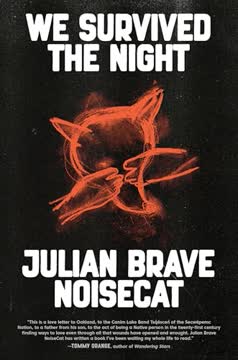
Review Summary
We Survived the Night receives widespread acclaim (4.34/5) for its innovative blend of memoir, journalism, and Indigenous folklore. Readers praise Julian Brave NoiseCat's weaving of his father's traumatic origins—found as a newborn in a residential school incinerator—with Coyote trickster tales and contemporary Indigenous issues. The narrative explores father-son relationships, intergenerational trauma, and cultural resilience. While some find the shifting between personal story and journalistic essays disjointed, most consider it profound, beautifully written, and essential reading that offers crucial insights into Indigenous life across North America.