

Plot Summary
Prologue
Alia Terra is a harsh world shaped by the Shift, an ancient upheaval that joined worlds and left humans living under monster rule. In crowded walled cities and poor settlements, hunger makes the temple's genetic matchmaking more than a romantic custom: a marriage to a monster can secure a woman's safety and give her family money. The matches promise biological compatibility, but the people entering them bring their own fears, needs, and ideas of what a marriage should be.
The prologue makes the romance's unequal starting conditions explicit. The temple offers Ina a route out of poverty, but that choice is made under pressure rather than in a landscape of equal options. Its language of genetic compatibility also sets up a useful tension: the institution can identify bodies that fit, but it cannot guarantee that two people know how to live together. The world makes marriage materially consequential before it becomes intimate, so the couple's private negotiations over attention, work, and freedom carry the weight of more than courtship.
The Wedding Before Work
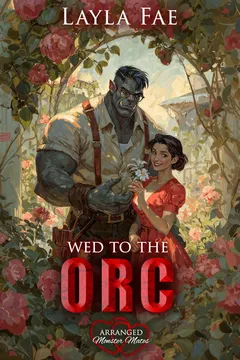
Lundark,1 an orc scientist who develops stronger portal materials,1 applies at the temple for a wife2 but bluntly says he wants sex, not companionship or children. Ina2 accepts the match because her mother is dead, her family's tavern has been lost to creditors, and her pregnant sister Rilla's3 household needs support.
The two meet at the temple, where Ina's2 warmth and curiosity immediately challenge Lundark's1 wish for a silent arrangement. He insists the match is biology, not destiny; she treats it as a chance to build a life.
They exchange vows over harmless blue fire, but when the priestess prompts him to kiss his bride,2 Lundark1 hurries away to protect his work schedule. Ina2 follows, determined not to let a disappointing beginning define the marriage.
Their first conflict is not simply between a talkative woman and a taciturn man. Each reads security differently. Ina sees dependable provision as a beginning that might grow into affection; Lundark treats the marriage as a controlled solution to a bodily need. His insistence on science helps him avoid the vulnerability of hoping for love after past courtships failed. The temple can match their biology, but the wedding exposes what it cannot settle: whether either partner will recognize the other as a person with claims, rather than as a function.
The Locked Lab
At Lundark's1 large house, he abandons Ina2 to the laboratory and locks away the temple's lubricant, trying to keep his new wife's2 scent from disrupting his experiments. Ina2 explores the unused rooms, discovers his books, and makes herself at home by cooking with the meat in his pantry.
The meal brings Lundark1 out of his workroom, and her knowledge, lively conversation, and excellent food surprise him. That evening he finally acts on the attraction he has been suppressing, taking careful pains to learn what gives her pleasure.
Afterward, however, he tells her to choose a separate bedroom, arguing that repeated sex will interfere with his work. He gives her money and a contraceptive patch, but his practical provisions cannot disguise the rejection she feels.
Domestic care becomes the couple's first language before either can manage emotional honesty. Ina uses the skills she learned in her mother's tavern to make an unfamiliar home hospitable; Lundark responds to the meal before he can admit he responds to her. His study of human anatomy shows conscientiousness, but also his tendency to approach intimacy as a solvable technical problem. The contraceptive patch adds a material kindness, yet his immediate retreat shows that useful provision is not the same as mutual commitment. Ina's hurt comes from the gap between his tenderness in bed and his refusal to share ordinary life.
One Kiss, Seven Silent Days
The next morning Lundark1 leaves a patch and money for Ina,2 who shops for clothes and returns to a house where his work keeps him secluded. When he complains that her singing distracts him, she bargains for a proper kiss in exchange for quiet mornings.
Lundark1 gives her a slow, attentive kiss, then abruptly leaves for the garden rather than continue the closeness. For a week he speaks to her only when necessary, while Ina2 tries to understand why he withdrew.
A letter from Rilla3 brings news that Lundark1 sent the family contraceptive patches after hearing about Rilla's3 repeated pregnancies. Ina2 confronts him with her sister's3 gratitude, and his embarrassed response finally breaks their silence. The gesture proves that he listens, even when he cannot yet show care directly.
The kiss and the package reveal two competing forms of intimacy. Ina seeks presence she can feel and answer; Lundark offers care at a distance, where it cannot demand emotional fluency from him. His silence after the kiss is not indifference so much as retreat from an experience he cannot regulate, but Ina has no reason to interpret it that way. The patches sent to Rilla complicate her sense of rejection: Lundark notices her family's hardship and acts generously, yet still leaves Ina to infer what his attention means. Practical kindness becomes evidence of feeling, but not a substitute for communicating it.
Flowers Break the Silence
Hoping to brighten dinner, Ina2 cuts flowers from a carefully tended patch in Lundark's1 garden. He reacts with anger because the plants, lunaderia, are a difficult-to-grow medicine he takes to suppress his mating urges.
His admission makes Ina2 realize that he has been managing his desire for her rather than simply losing interest. She asks why he needs the herbs when she is available, but Lundark1 can only say that she makes him lose control and that he needs to concentrate on work.
Hurt by his refusal to choose closeness, Ina2 stops singing, stops sharing meals, and makes herself almost invisible. Lundark1 initially expects to enjoy the quiet. Instead, her withdrawal leaves him restless, and he begins looking for reasons to leave the laboratory and find her.
The flowers turn a domestic mistake into a revelation about Lundark's central defense: he treats desire as a threat to agency. The herb is not only a plot mechanism but a physical expression of his belief that self-command requires suppressing attachment. Ina's silence then gives him exactly what he claimed to want, and its consequences expose the emptiness of that bargain. Her withdrawal is a boundary, not a strategy he can comfortably manage, while his new restlessness shows that control has concealed a need rather than removed it.
Books, Then Boundaries
After hearing Ina2 wish for books, Lundark1 lets her use the library beside his laboratory, keeping her out of the hazardous workroom but offering access to the collection. Ina2 accepts the books politely and leaves rather than treating the gesture as a full reconciliation.
The next morning, they discuss what she has read about the world before the Shift, and Lundark1 gives her a rare smile. When Ina2 mentions visiting Agran,5 the friendly, unmarried baker, Lundark1 orders her not to speak with unmarried males.
She erupts, reminding him that he has denied her affection while trying to control her ordinary life. Ina2 insists that she is faithful but will not surrender her freedom. She leaves him with the problem he has avoided: he wants a wife's loyalty without yet offering a husband's companionship.
The library is a meaningful gift because it meets Ina's intellectual appetite, not just her material needs. But she refuses to let a considerate act erase the larger pattern of exclusion. Her response to Lundark's command makes the marriage's power imbalance visible: he has treated his own work as nonnegotiable while expecting her social world to shrink around him. Jealousy finally reveals that he cares about losing her, but care expressed as restriction is still control. Ina's insistence on faithfulness alongside autonomy separates commitment from possession, forcing him to confront the difference.
A Walk Through Town
After Ina2 leaves, Lundark1 realizes that his anger comes from fearing another male might claim her, not from any evidence that she has been unfaithful. He catches up with her as she heads into town and asks to walk beside his wife.2 Ina2 allows it, and their joined hands soften the encounter. She introduces him to the people she has come to know, including Agran,5 who sells her favorite rolls.
Lundark1 pays for the bread and makes his bond with Ina2 clear without challenging her friendship with the baker.5 He buys her gardening books and carries the spade she wanted, then tastes her chocolate ice cream and finds it far too sweet. Their teasing and easy conversation make the town, usually a social burden for Lundark,1 feel welcoming.
Lundark's change begins not with a grand confession but with an alteration in attention. He follows Ina into the community she built while he was shut away, then discovers that listening to her stories feels restful rather than distracting. His possessiveness remains present, especially around Agran, but he begins to express it through public partnership and practical help instead of isolation. The scene also gives Ina room to remain herself: she keeps her friendships, chooses her purchases, and sets the pace of their outing. Their first shared pleasure is not a private fantasy but a day lived among other people.
The Lab Can Wait
Back home, Lundark1 finds Ina2 preparing tea and admits that his research no longer deserves every hour of his life. He promises to limit his laboratory work to six hours a day because he wants the rest of his time with her. Ina2 asks to move into his bedroom, and Lundark1 makes clear that he wants her there every night, not merely when instinct becomes difficult to ignore.
They return to intimacy with greater tenderness and mutual attention, and Ina2 also explores his body, turning his earlier habit of asking for precise reports into playful reciprocity. The change is concrete: he stops treating their marriage as a scheduled release and begins making room for her in his home, his time, and his priorities.
The resolution depends on a change in allocation, not merely a change in feeling. Lundark's work has been the institution around which he organized every hour, so promising a limit makes affection accountable to practice. Ina's request to share his room tests whether he means to offer a durable relationship rather than a moment of desire. Their intimacy becomes more reciprocal as she gains knowledge of his body and can return the attention he once controlled. The story's emotional payoff is therefore domestic as well as erotic: love becomes credible when it alters the daily architecture of his life.
Epilogue
Six months later, Ina2 interrupts Lundark's1 laboratory work at the end of his agreed hours and persuades him to leave his study for her. He yields, and the two spend the evening together before going into town for a winter festival, where Ina2 chats with neighbors and Lundark1 enjoys being beside her.
Five years later, Ina2 gives birth to their daughter in a pool set up in the living room. Lundark1 stays at her side through labor, and the new parents marvel at the baby's small fingers and green face. Their family life has grown from a marriage arranged for biology into a home where work, affection, and parenthood are shared.
The two time jumps measure change through ordinary consequences. At six months, Ina still has to call Lundark away from research, but he now honors the boundary they established and joins her in public life. Five years later, the birth of their daughter echoes the prologue's emphasis on reproductive matching while changing its meaning: a child is no longer the impersonal output of genetic compatibility but a wanted person welcomed by both parents. The living room birth also brings the story's private relationship into the center of their home, where labor and care are shared rather than delegated to Lundark's work or Ina's duties.
Analysis
Wed to the Orc places a romance inside an economy where marriage can mean food, safety, and a payment to one's family. That pressure does not erase Ina's2 agency, but it shapes what she can reasonably expect when she accepts Lundark's1 match. Her initial hope that security might grow into affection is tested against his attempt to keep the marriage functional and emotionally limited.
The central conflict turns on competing theories of control. Lundark1 trusts measurement: he researches Ina's2 body, regulates his workday, and takes herbs to suppress desire. These methods make him competent in the laboratory but helpless before the relational consequences of his choices. Ina,2 by contrast, uses conversation, food, humor, and direct bargaining to draw him into shared life. When she becomes quiet, Lundark1 learns that her energy was not noise around his real life; it was one of the things making the house feel inhabited.
The story's most important shift is from possession to participation. Lundark's1 jealousy first appears as an effort to restrict Ina's2 contact with other men, but the walk through town gives him a better way to express attachment: accompany her, listen, and make himself part of the community she has built. Likewise, his promise to limit laboratory hours turns affection into a practical commitment. The closing birth reframes the genetic match. Biology may have brought them together and made a child possible, but it is the daily exchange of care, freedom, and attention that turns the arrangement into a family.
Review Summary
Wed to the Orc receives mixed reviews, averaging 3.95/5. Readers praise the grumpy/sunshine dynamic between Lundark, an antisocial orc scientist, and Ina, his determined, vivacious human wife. Many loved Ina's feisty personality and refusal to be ignored. Common criticisms include the story's short length limiting character development, Lundark's emotionally unavailable and sometimes aggressive behavior, insufficient grovelilng before resolution, and an unexpected pregnancy epilogue. The spicy scenes, featuring notable size-difference elements, divided readers between finding them fun or underwhelming.
People Also Read


Characters
Lundark
The guarded orc scientistLundark is an accomplished scientist whose portal research gives him wealth, status, and a structure for nearly every hour of his day. He is direct to the point of cruelty, yet not careless: he studies human anatomy before bedding Ina2, provides contraception, and later helps her family. Earlier courtships have left him convinced that his difficulty expressing affection makes him an unsuitable romantic partner. He therefore tries to reduce marriage to a manageable arrangement, with sex separated from companionship and work protected from emotional disruption. His relationship with Ina2 presses on the difference between restraint and avoidance. Beneath his severe routines, he is curious, attentive, and more capable of tenderness than he believes.
Ina
The resourceful human brideIna is a warm, outspoken human who has spent years working to keep her sister's3 family fed and clothed. Growing up in her mother's tavern taught her to read moods, manage difficult men, and make a household welcoming, but she is not content to be valued only for those services. She reads widely despite limited schooling, notices beauty in flowers and clothes, and wants conversation as much as security. Ina enters the match with realistic motives, then discovers that financial safety cannot satisfy her longing for affection and shared life. Her persistence is tempered by self-respect: she will negotiate, tease, and reach toward Lundark1, but she also draws a line when his rules reduce her freedom.
Rilla
Ina's burdened sisterRilla is Ina's2 pregnant sister, living with her husband and children in a crowded home after the family's tavern is lost to creditors. Her household depends on her husband's mining wages and Ina's2 labor, so the temple match carries consequences beyond Ina's2 own future. Rilla's letters keep that family bond present after Ina2 moves away. Her circumstances show what women in their community risk when they lack money, reliable birth control, or independent protection.
Grish
Lundark's married friendGrish is Lundark's1 friend and a fellow orc with a human wife. His advice gives Lundark1 a model for what a temple bride might be like, but Lundark1 uses that example to expect shyness and deference. Grish's influence is indirect: he helps reveal how readily Lundark1 mistakes one couple's pattern for a rule.
Agran
The friendly bakerAgran is a young, unmarried orc baker who sells Ina2 the rolls she loves and enjoys exchanging local gossip with her. His easy friendliness becomes a flashpoint for Lundark's1 jealousy, though Agran himself behaves courteously. He represents the social ties Ina2 has built in town while Lundark1 has remained isolated in his laboratory.
Plot Devices
The Temple Match
A marriage by biologyThe temple uses DNA testing to pair human women with monster husbands, presenting genetic compatibility as a basis for marriage across species. In Alia Terra's unequal economy, the match is also a means of survival: a bride's family receives money, and the bride gains food, shelter, and protection. The device brings Ina2 and Lundark1 together while establishing their different expectations. Lundark1 treats the result as scientific compatibility and a practical arrangement; Ina2 hopes it can become a real partnership. The temple can create the meeting, but the story tests the limits of biological certainty by making the couple negotiate trust and care themselves.
Portal Research
Work as emotional refugeLundark's1 research strengthens irrylium, the material used to make portals more stable and durable. His scientific work explains his wealth and public importance, but it also gives him a socially acceptable reason to retreat from intimacy. He measures his days around experiments and fears that desire for Ina2 will make him unreliable. The lab's proximity to the house turns that conflict into a daily one: Ina's2 singing, cooking, and presence reach him even when he tries to shut her out. His eventual decision to limit his working hours makes the project more than background detail, because it shows how he changes the place work holds in his life.
Lunaderia Herbs
A measure of restraintLunaderia is a difficult-to-grow plant whose flowers and leaves can be brewed into a calming medicine for orcs. Lundark1 uses it to suppress his mating urges, believing that desire threatens his ability to focus on research. When Ina2 mistakenly cuts part of the patch for a table bouquet, his anger exposes the medicine's purpose and makes his rejection newly legible to her. The herbs give physical form to his attempt to regulate attraction rather than communicate about it. Their loss does not solve the couple's conflict; instead, it forces Lundark1 to acknowledge what he has been trying to control.
Birth Control Patches
Care beyond the coupleLundark1 gives Ina2 a human contraceptive patch after their marriage, partly to avoid an unplanned pregnancy while their relationship is still unsettled. When Ina2 tells him that Rilla3 is exhausted by repeated pregnancies, he sends patches to her sister3 as well. The device is practical protection in a world where poverty and limited access to contraception shape women's choices. It also reveals Lundark's1 habit of listening and helping quietly, even when he struggles to offer emotional reassurance. For Ina2, the package for Rilla3 proves that his attention has extended beyond the laboratory and beyond the terms he originally set for the marriage.
The Temple's Mating Oil
A bridge across differenceThe temple supplies a specialized oil intended to make sex between an orc and a human safer and more comfortable. Lundark1 has researched human anatomy and follows the temple's preparation carefully, reflecting his scientific approach to their physical difference. The oil helps make their first sexual encounter possible, but it cannot do the relational work of consent, attention, and trust. Ina's2 later willingness to explore intimacy with him follows the couple's emotional progress, not simply the use of a formula. The device connects the temple's biological matchmaking to the embodied reality of their marriage.
About the Author



Download PDF
Download EPUB
.epub digital book format is ideal for reading ebooks on phones, tablets, and e-readers.








