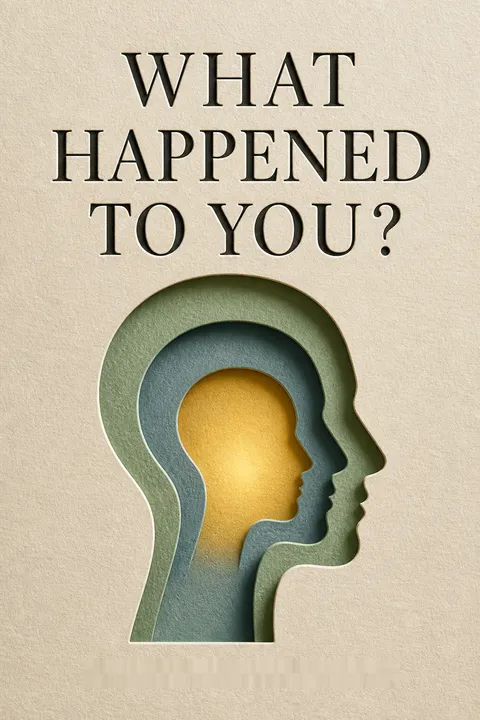


Key Takeaways
Replace blame with a history: behavior often began as protection
Behavior has a backstory. The book asks readers to look beyond labels such as difficult, defiant, or unreliable and ask what experiences shaped the behavior. Oprah describes how beatings taught her to stay quiet and please others. What looked like a personality trait was, in part, an adaptation that once helped her avoid danger. Dr. Perry makes a similar point about a veteran who dove for cover when a motorcycle backfired: his brain was reacting to learned danger, not choosing irrationality.
Explanation is not absolution. A history can make a response understandable without making every action harmless or removing responsibility. It changes the first step: understand what the behavior is doing for the person, then look for safer ways to meet the underlying need.
This shift is useful because blame often ends inquiry just when inquiry is most needed. In families, schools, and workplaces, the same outward behavior can have different causes, so a label rarely tells anyone what intervention might help. A history-based question also makes room for accountability that is responsive rather than humiliating. The caution is that not every conflict or setback is evidence of trauma. The lens works best as an invitation to investigate, not as a ready-made explanation for every difficult act.
A sound, smell, or touch can make yesterday feel present
The brain reacts in sequence. In Perry’s simplified model, sensory information is processed in lower brain systems before reaching the cortex, which supports language, reflection, and awareness of time. A cue resembling a past threat can trigger a bodily alarm before a person consciously recognizes what is happening. The lower systems do not reliably distinguish a present-day reminder from the old danger.
A scent changed a relationship. Sam, a boy with a history of abuse by his father, became aggressive around a new teacher. Perry noticed that both the teacher and Sam’s father used Old Spice. Once the teacher changed scents and Sam learned what might be happening, their relationship improved. A cue can activate a learned association without a clear, conscious memory, so reactions that seem to come from nowhere may have a history.
The account makes an important distinction between remembering an event as a story and carrying its learned signals in the body. That distinction can help explain why someone may feel panic or hostility without being able to name a cause. It also encourages practical curiosity: a sound, smell, tone, or physical distance may matter more than the words being exchanged. The brain model is deliberately simplified, however. It is a useful teaching map, not a complete account of every memory or reaction.
Treat early care as brain-building, not merely affection
Care is learned through experience. A baby depends on adults to meet needs such as hunger, warmth, and comfort. Repeated, attentive responses help the child regulate distress and connect human contact with safety and reward. Perry calls the brain’s capacity to change through experience neuroplasticity. The capability to love and form relationships develops through use, much as a skill develops through practice.
Gloria learned love through candy. As a mother, Gloria offered her daughter sweets because that was one of the few ways she had experienced care herself. Rather than shame her, the team helped her use sugar-free candy and learn about nutrition. Her foster mother, Mama P, understood that supporting Gloria was part of supporting the child. The story shows how care can teach new ways of caring, especially when guidance replaces punishment.
This account gives caregiving a concrete developmental meaning: attention is not a decorative extra, but part of how a child learns what relationships feel like and how to participate in them. It also shows why advice alone may not change a parent’s behavior; people often repeat the care they know. Supporting caregivers, rather than simply demanding better performance, can create the conditions for different patterns. Still, early experience influences development without fixing anyone’s future. The book’s emphasis on change matters as much as its emphasis on beginnings.
Measure trauma by its effects, not by a checklist score
An event is not the whole story. Perry uses a three-part definition: the event, the person’s experience of it, and its effects. The same school fire could be routine for an experienced firefighter, frightening but temporary for one child, and overwhelming for another. Trauma therefore cannot be defined only by how dramatic an event looks from the outside.
Risk is not destiny. The Adverse Childhood Experience study used a ten-item questionnaire to examine childhood adversity and adult health. Later research found that higher scores correlate with greater risk, not a guaranteed outcome. Perry reports that 60 percent of American adults in a 2019 CDC study had at least one ACE, and nearly a quarter reported three or more. The score does not capture timing, intensity, or supportive relationships, all of which shape a person’s experience.
The distinction between population-level risk and individual prediction is essential. A screening score can help reveal patterns across communities, but it cannot tell a clinician or teacher what one person needs. The book’s insistence on context also guards against ranking suffering by a tally. At the same time, broad definitions require care: if every painful experience is called trauma, the term becomes less precise. The event, the person’s felt experience, and lasting effects offer a more disciplined way to ask what happened.
Decode coping as regulation before calling it defiance or weakness
Survival has different gears. Under threat, people may become vigilant and fight or flee. When escape or resistance feels impossible, they may withdraw inward through dissociation, a change in attention and bodily response that can reduce contact with overwhelming distress. These patterns can persist after danger has passed. A child who watches for threat may struggle to attend in class; a person who learned to comply may become a people pleaser.
Relief can become a trap. The book describes how alcohol, drugs, overeating, cutting, or other behaviors may provide short-term relief to someone whose stress system is persistently activated. That relief can reinforce repetition, while shame and isolation deepen the distress. This reframes the question from why someone seeks pleasure to what discomfort the behavior temporarily quiets. It does not mean every instance of addiction has the same cause.
A functional account of coping changes the response from moral judgment to problem-solving: what need is being met, what harm is being created, and what safer source of regulation is available? That question is relevant to clinicians and to anyone supporting a friend. It also avoids romanticizing harmful behavior. Understanding a behavior’s relief function does not make the consequences disappear, and trauma is not a universal explanation for addiction. The book is strongest when it presents trauma as a major pathway to risk, not the only pathway.
Regulate first, connect next, and reason only when the brain is ready
Safety precedes explanation. Perry’s sequence of engagement is a practical guide: help someone settle, establish a sense of connection, and then use reasoning or ask for detailed information. When fear or anger dominates, access to reflective thinking can narrow. Telling a highly distressed person to calm down or explain themselves may add pressure rather than help.
Small encounters opened a door. When Perry interviewed Joseph, a three-year-old who had witnessed his sister’s abduction, he did not begin with a long interrogation. He returned for brief visits, played, colored, and let Joseph control the pace. As the child became more comfortable, he shared information that helped identify the killer. The lesson applies beyond interviews: connection is not a reward after cooperation; it can be what makes cooperation and learning possible.
This sequence resembles good teaching and conflict mediation: attention and comprehension depend partly on whether a person feels safe enough to engage. It also offers a useful test for adults: if a conversation is going nowhere, the problem may be timing, not a shortage of persuasive words. The approach does not require abandoning standards or avoiding hard topics. It asks that communication be matched to someone’s state, so that expectations become achievable rather than escalating the very distress that blocks learning.
Make healing repetitive, safe, relational, and controlled by the survivor
Change needs repeated experience. Perry argues that past associations are not simply erased; new, safer associations can grow alongside them through repetition. He calls the network of helpful relationships and everyday opportunities for support a therapeutic web. A therapist can be part of it, but so can family, teachers, friends, and community members.
The dose matters. A three-year-old whose mother had been killed made a brief comment about her death to a shop clerk and received a kind response. When his father tried to keep the painful conversation going, the child became overwhelmed and ran. Perry’s point is not to avoid painful memories, but to let the person control when and how much to revisit them. Brief, manageable moments of being heard can be more useful than forcing a long disclosure.
This view broadens healing beyond the consulting room without dismissing therapy. It also treats consent and pacing as part of the intervention, rather than administrative niceties. The idea of repeated, tolerable exposure connects naturally to learning: a system can update its expectations when new experience is safe enough to register. But gradual work is not a substitute for specialized care when symptoms are severe or risk is high. A supportive network and skilled treatment can complement each other.
Build resilience through connection and challenges sized for safety
Resilience is supported, not automatic. Perry distinguishes being changed by experience from snapping back unchanged. People may recover functioning after adversity, but connection, stress sensitivity, and the support available all influence how that happens. Predictable, moderate challenges can strengthen coping when a person has a safe base and help when needed. Challenges that overwhelm or remain uncontrollable can instead intensify distress.
A community kept Ally connected. After Ally witnessed her parents’ deaths, she had an aunt, a large extended family, a church, sports, and supportive teachers. Her grief remained, but she returned to school and community life. Perry contrasts this with the expectation that one adult should raise children alone. Care distributed across a dependable community creates more chances for children and adults to feel safe, practice skills, and recover together.
The emphasis on dosage is a valuable corrective to both extremes: shielding people from every difficulty and assuming hardship automatically builds character. The same challenge can be manageable for one person and overwhelming for another, so good support includes noticing capacity and adjusting demands. Community is not a vague virtue here; it supplies repeated relationships and practical help. The challenge is that not everyone has access to such a network, which makes community support a social responsibility as well as a personal resource.
Repair the systems that turn trauma adaptations into punishable failures
Institutions can repeat the harm. A child with delayed language, poor regulation, and high vigilance may be expected to function like any other child of the same age. If the child shuts down or lashes out, an uninformed school may label, medicate, suspend, or exclude them. Perry describes this as a mismatch between a child’s actual abilities and institutional expectations, one that can feed the school-to-prison pipeline.
Bias and isolation matter too. Early experiences, media, and social systems shape expectations about who seems familiar or dangerous. Perry argues that training alone cannot undo these learned associations; meaningful relationships across difference and fairer institutional practices also matter. The book likewise warns that screen-heavy, isolated modern life offers fewer chances for the everyday interaction that builds social fluency. A useful system asks what support and adjustment are needed, not only how to punish disruption.
The book’s social argument follows from its developmental one: institutions shape behavior through the demands they impose and the relationships they permit. A school that accommodates regulation and developmental differences may prevent a behavior from becoming a disciplinary record. Yet trauma awareness must not turn into a reason to excuse unequal treatment or to reduce people to histories of harm. Good policy pairs context with clear standards, checks whose behavior is punished, and changes the conditions that repeatedly produce exclusion.
Analysis
What Happened to You? is a conversational synthesis of developmental neuroscience, clinical cases, memoir, and social criticism. Its central move is both humane and operational: reinterpret behavior as an adaptation to lived conditions, then choose a response that meets the person’s developmental and relational needs. The book builds that argument from bodily reactions, early caregiving, and individual histories outward to schools, health care, criminal justice, racism, and community life. Its stories make abstract mechanisms memorable: a familiar scent changes how a boy experiences a teacher; a child’s ability to speak depends on feeling safe; a stable community helps a traumatized young person find a place to belong.
The strongest contribution is the insistence that regulation, relationship, and reasoning are not interchangeable steps. Advice and insight may fail when a person is overwhelmed, while rhythmic activity, predictable care, and dependable relationships can create the conditions for learning. This also turns healing from a private achievement into a shared practice. Families, teachers, clinicians, and institutions influence the experiences through which people adapt.
The framework is most useful when treated as a lens rather than a diagnostic machine. The book’s simplified brain diagrams can illuminate why reactions feel involuntary, but real development is complex, and behavior can have multiple causes. ACE scores indicate group-level risk, not individual destiny; trauma may help explain conduct without being its sole explanation or excusing harm. The authors also stress that recovery is not guaranteed by a single relationship or technique. Their more persuasive claim is that repeated, fitting experiences can expand a person’s options.
The book’s final implication is political as well as personal. If people are shaped by relationships and conditions, then care cannot be reduced to asking individuals to try harder. Supporting caregivers, reducing exclusion, and building connected communities are part of prevention. Compassion here is not softness in place of standards. It is a way to understand what a standard response will actually do, and whether it can help someone move toward safety, connection, and greater choice.
Review Summary
What Happened to You? is highly praised for its insightful exploration of trauma, childhood experiences, and healing. Readers appreciate the conversational style between Oprah and Dr. Perry, making complex concepts accessible. Many found the book eye-opening, offering a new perspective on understanding behavior through the lens of past experiences. The audiobook format is particularly recommended. While some felt parts were repetitive or too focused on childhood trauma, most readers found it valuable for personal growth and understanding others.
People Also Read








Glossary
Evocative cue
Sensory reminder of dangerAn evocative cue is a sensory feature, such as a sound, smell, image, or touch, that resembles part of an earlier experience and activates related reactions. The person may feel fear, anger, or shutdown without consciously recalling the original event. In the book, Old Spice evokes a boy’s memories of his abusive father.
Core Regulatory Networks (CRNs)
Networks that maintain balanceCore Regulatory Networks are interconnected neural systems that help coordinate the brain and body’s responses to demands, including stress. They influence functions such as arousal, heart rate, and emotional regulation. Perry argues that unpredictable, extreme, or prolonged stress can sensitize these systems, while manageable and predictable challenges can support more flexible responses.
Tree of Regulation
Model of regulation systemsThe Tree of Regulation is Perry’s model for describing how core regulatory networks influence functions throughout the brain and body. Its branches represent systems that help maintain balance during stress. The model emphasizes that regulatory processes affect not only feelings, but also attention, behavior, and bodily functions.
Sequence of engagement
Order for effective communicationThe sequence of engagement describes the order Perry recommends for reaching someone’s reflective thinking: first support regulation, then establish connection, and then reason or teach. Stress can limit access to higher-level thinking, so attempts to persuade or instruct may fail until the person feels steadier and safer.
Neuroplasticity
Experience-based brain changeNeuroplasticity is the brain’s capacity to change in response to experience. Perry emphasizes that change depends on activating the relevant neural systems, and that repetition and pattern matter. Practicing a skill changes the systems involved in that skill; repeated relational experiences can also shape the brain’s capacities for regulation and connection.
Adverse Childhood Experience study
Study linking adversity and healthThe Adverse Childhood Experience study used a ten-item questionnaire to measure certain adversities before age eighteen and compared scores with adult health outcomes. The findings linked higher adversity scores with increased health risks. The score is a population-level indicator, not a diagnosis or certain prediction for an individual, and it omits important context such as timing and supportive relationships.
Relational health
Quality of social connectionRelational health refers to the nature, quality, and quantity of a person’s connections to family, community, and culture. Perry treats these connections as important to regulation, belonging, and recovery. A person’s relationships can buffer adversity and help predict current well-being, though the concept includes more than simply having many contacts.
Therapeutic web
Network of healing relationshipsA therapeutic web is the collection of positive, supportive relationships and interactions that offer opportunities for regulation, connection, and healing throughout daily life. It can include therapists, family members, friends, teachers, and community members. The term stresses that healing support is not limited to formal therapy sessions.
Dissociation
Protective inward disengagementDissociation is a shift in attention away from the external environment and toward an inner experience. It can occur during ordinary activities such as daydreaming, and may serve as protection when a person faces distress that feels inescapable. When this response becomes highly reactive, it can contribute to avoidance, emotional withdrawal, or other difficulties.
Neurosequential Model
Developmentally ordered intervention modelThe Neurosequential Model is Perry’s approach to understanding development and organizing support according to the systems involved and the person’s developmental needs. It considers a person’s history, present capabilities, and state of regulation, then sequences experiences from foundational regulatory needs toward relational and cognitive work. It is an organizing framework, not a single treatment technique.
FAQ
What's What Happened To You? about?
- Focus on Trauma and Healing: The book explores how trauma impacts individuals, shaping their behaviors and relationships. It shifts the focus from "What's wrong with you?" to "What happened to you?" to promote understanding and healing.
- Conversations Between Authors: Through dialogues between Oprah Winfrey and Dr. Bruce Perry, the book blends personal stories with scientific insights, making complex concepts accessible and emotionally engaging.
- Neuroscience and Personal Stories: It combines neuroscience with real-life experiences to illustrate how trauma affects brain development and emotional regulation, offering hope and pathways for healing.
Why should I read What Happened To You??
- Understanding Trauma's Impact: The book provides insights into how trauma affects mental health and behavior, making it essential for those interested in psychology, education, or social work.
- Compassionate Perspective: It encourages a compassionate view towards oneself and others, promoting healing and resilience by shifting the question from "What's wrong?" to "What happened?"
- Practical Advice for Healing: Readers will find practical strategies for fostering resilience and healing, useful for parents, educators, and mental health professionals.
What are the key takeaways of What Happened To You??
- Trauma Shapes Behavior: Trauma significantly influences behavior and emotional responses, and understanding this connection is crucial for personal healing and improving relationships.
- Neuroplasticity and Healing: The brain's ability to adapt and change, known as neuroplasticity, suggests that healing is possible regardless of past trauma.
- Importance of Relationships: Healthy relationships are vital for healing from trauma, as positive interactions can help regulate emotional responses and foster resilience.
What is the significance of the phrase "What happened to you?" in What Happened To You??
- Shift in Perspective: This phrase encourages a deeper understanding of individuals' experiences rather than labeling them based on their behaviors.
- Empathy and Compassion: By asking "What happened to you?", we cultivate empathy and compassion, recognizing that actions may stem from unresolved trauma.
- Framework for Understanding: It serves as a framework for exploring the roots of emotional and behavioral issues, guiding readers to consider underlying experiences.
How does trauma affect brain development according to What Happened To You??
- Sequential Processing: The brain processes experiences sequentially, with lower brain areas responding before higher cognitive functions, leading to automatic emotional responses.
- Impact on Stress-Response Systems: Trauma can sensitize stress-response systems, making individuals more reactive to stressors, resulting in anxiety and difficulties in emotional regulation.
- Long-Term Effects: Early trauma can have lasting effects on brain development, influencing emotional and social functioning throughout life.
What is the Neurosequential Model mentioned in What Happened To You??
- Developmental Approach to Therapy: Developed by Dr. Perry, it is a framework for addressing trauma in a developmentally informed way, focusing on the brain's lower systems first.
- Sequence of Engagement: The model advocates for therapeutic interventions that start with regulation, then move to relational experiences, and finally to cognitive processing.
- Application in Various Settings: It can be applied in schools, therapy, and community settings to create supportive environments for healing.
What are some examples of trauma discussed in What Happened To You??
- Childhood Abuse: Personal stories of childhood abuse illustrate how these experiences shape behaviors and relationships, with Oprah sharing her own experiences.
- Witnessing Violence: The impact of witnessing violence, such as a child's experience of seeing his sister's abduction, is discussed, highlighting the potential for PTSD.
- Neglect and Emotional Trauma: The effects of neglect and emotional trauma are emphasized, showing how they can be as damaging as physical abuse.
What role does neuroplasticity play in healing from trauma according to What Happened To You??
- Brain's Adaptability: Neuroplasticity refers to the brain's ability to change and adapt, suggesting that healing is possible through positive experiences and supportive relationships.
- Rewiring the Brain: Consistent positive interactions can help rewire the brain to foster healthier emotional responses, mitigating the effects of past trauma.
- Hope for Recovery: Understanding neuroplasticity provides hope for those affected by trauma, as it suggests that change and healing are achievable.
How can understanding trauma improve relationships according to What Happened To You??
- Empathy and Compassion: Understanding trauma allows individuals to approach relationships with greater empathy and compassion, reducing judgment and fostering support.
- Improved Communication: Recognizing trauma's effects on communication can help navigate conflicts and misunderstandings more effectively.
- Building Trust: Understanding trauma fosters an environment where individuals feel safe to express their feelings, essential for developing healthy relationships.
How does What Happened To You? address the issue of relational poverty?
- Definition of Relational Poverty: It is defined as a lack of meaningful connections and supportive relationships, leading to increased vulnerability to mental health issues.
- Impact on Mental Health: Relational poverty can exacerbate the effects of trauma, making it harder to cope with stress and adversity.
- Strategies for Building Connections: The book offers advice for creating supportive environments, such as fostering open communication and encouraging community involvement.
What are some practical strategies for healing from trauma mentioned in What Happened To You??
- Seek Supportive Relationships: Surrounding oneself with nurturing individuals can help regulate emotional responses and promote healing.
- Practice Self-Regulation: Techniques like mindfulness and grounding exercises can help manage emotional responses to stressors.
- Engage in Therapeutic Activities: Activities like art, music, or writing can facilitate healing by allowing emotional expression and processing.
What are the best quotes from What Happened To You? and what do they mean?
- "What happened to you?": This encapsulates the book's central theme, urging readers to consider experiences that shape behaviors, promoting empathy and understanding.
- "The brain is a meaning-making machine.": Highlights the brain's role in interpreting experiences and forming beliefs, emphasizing the impact of past experiences on current perceptions.
- "Everything matters.": Emphasizes the interconnectedness of experiences across generations, reminding us of the lasting impacts of our actions and experiences.
About the Author


Download PDF
Download EPUB
.epub digital book format is ideal for reading ebooks on phones, tablets, and e-readers.








