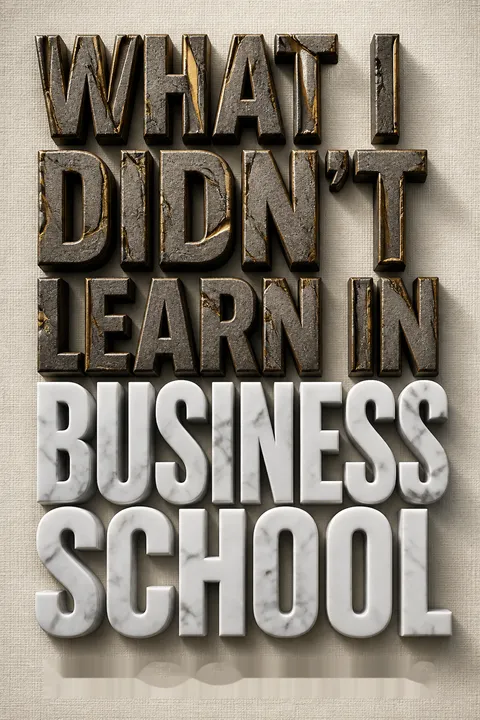


Plot Summary
Prologue
On a turbulent flight to Chicago, Justin Campbell reviews the briefing for his first consulting assignment and wonders whether his polished education has prepared him for real work. He has left a technical career for strategy consulting, where he hopes to prove himself to senior director Ken McCombs.
The client, HGS, has a patented fabric called Plastiwear, and its leaders have spent years debating what to do with it. As the plane settles, Justin senses that the smoother flight he expected may already be over.
The flight makes Justin’s professional uncertainty physical: he knows turbulence is statistically safe, yet knowledge does not give him control. That gap anticipates the book’s central distinction between mastering analytical tools and acting wisely when evidence is incomplete. His background also matters. A gifted student accustomed to well-defined problems is entering a workplace where the problem itself remains contested. The turbulence is not merely a mood-setting image; it frames the transition from academic confidence to judgment under pressure, with the client’s unresolved technology waiting at the end of the flight.
A Company at Crossroads
At a dawn kickoff, Justin meets consulting teammates Vivek Chatterjee, Gordon Lee, and manager Livia Chambers, then watches Ken demonstrate Plastiwear by wearing one of HGS’s prototype shirts.
The fabric feels luxurious, but HGS has delayed action for eighteen months because its executives disagree about what the technology is worth and where it belongs. In a meeting with CEO Carl Switzer and the senior team, oil and gas chief Scott Beckett argues that shirts fall outside HGS’s expertise; R&D chief Walter Albright insists the technology could support many products.
Carl adds urgency: private equity firm MG Management is seeking a major stake and has criticized HGS for failing to exploit innovation. Ken promises preliminary advice in nine days, and Carl assigns company veteran Bill Dixon to the team.
The apparent product question is already an organizational conflict. Beckett protects the established business, Albright champions technical possibility, and Carl must answer an outside challenge while keeping his leadership team intact. The nine-day deadline turns consulting into a test of selection: the team cannot simply gather every fact, so it must decide which uncertainties matter. Justin initially assumes analysis will settle the dispute. The meeting quietly shows why that assumption is fragile: managers are not neutral observers of strategy, and the technology’s future touches their authority, budgets, and identities.
The Shirt and Six Futures
After spilling coffee on his only clean shirt, Justin buys two replacements and discovers how much craftsmanship hides inside an ordinary garment. Feeling the softness of a costly fabric sample makes the proposed Plastiwear shirt seem commercially compelling.
His confidence falters when he finds six HGS net present value studies: two predict nearly a billion dollars in value, two predict a billion-dollar loss, and two hover around break-even. Alone with CFO Shirley Rickert, he learns that the reports use sharply different assumptions about plant costs, marketing, risk, and whether Plastiwear is an extension of current products or a radical innovation.
The spreadsheet arithmetic is sound, but no one can validate the underlying forecasts. Shirley treats the calculations as records of strategic disagreement, not a verdict.
The shirt purchase gives Justin a consumer’s concrete reason to believe in the product, while the competing financial models reveal that attractiveness is not the same as evidence. Each forecast embeds a theory of what HGS would become and what resources it would commit. Shirley’s restraint is not simple indecision: as CFO, she keeps competing interpretations visible rather than pretending that uncertain inputs yield objective certainty. Justin’s first professional disappointment follows from this distinction. Finance can calculate consequences once assumptions are chosen, but it cannot choose the strategy those assumptions describe.
Beckett's Narrow Wind
Scott Beckett gives Justin a forceful analysis of shirt manufacturing: fragmented rivals, powerful retailers and suppliers, easy imitation, and abundant substitutes make the business look unattractive. Justin reports the case to his team as persuasive and complete.
Ken later points out what the interview omitted. Beckett’s division competes for the same limited capital, and its chief may see himself as Carl’s successor; opposition to Plastiwear can therefore reflect both strategic judgment and personal stakes.
More importantly, Beckett analyzed only shirt making, not licensing, fabric production, or other applications. Justin recognizes that he accepted the latest confident argument instead of asking which business should be analyzed. Ken’s correction unsettles him, but keeps him on the assignment.
Beckett’s analysis is not false; its danger lies in how a valid framework can make a partial question appear settled. The five forces expose pressures within an industry, but do not identify the right industry or determine whether a firm can position itself against those pressures. Ken’s coaching also shifts scrutiny toward Justin: he is not merely learning to distrust client bias, but discovering his own attraction to tidy, authoritative answers. The exchange makes objectivity an active discipline, not a consultant’s automatic privilege. It requires resisting premature closure even when a conclusion feels rigorous.
The Empty Packaging Plant
Packaging chief Bob Hutchins urges Justin and Bill to make Plastiwear in his half-empty factory. He expects shared equipment, purchasing, environmental controls, and accounting to lower costs, while the new product would improve his division’s performance.
His confidence outruns the evidence: production has only been tested at small scale, and HGS has no retail expertise. At lunch, Livia explains why a convenient factory is not automatically the best home for a new business.
Outsourcing can bring specialist capabilities and competition, while in-house production may saddle an uncertain product with overhead. Yet suppliers could gain leverage or expose HGS’s technology. Justin begins to see that synergies must benefit the whole venture, not simply the division that claims them.
Hutchins’s proposal demonstrates how a local operational advantage can masquerade as corporate strategy. An underused plant is a real asset, but its existence does not establish that Plastiwear should bear its costs or be governed by packaging managers. Livia’s account of firm boundaries introduces a more conditional question: who can perform an activity well, and what risks arise when control is transferred? This reframes integration as a choice with tradeoffs rather than a reflex. Justin learns to separate a manager’s plausible operational story from proof that the arrangement creates value for HGS overall.
The Chain Beyond Shirts
Working alone after the interviews, Justin applies the VRIO framework to each stage of the Plastiwear value chain, from research and raw materials to fiber, fabric, assembly, branding, and retail.
He finds that many activities might be valuable but are not rare: HGS has not shown unusual skill in shirt production, purchasing, or distribution. His incomplete matrix exposes a more important omission. HGS need not enter retail clothing to exploit the invention; it might license the technology or supply specialized fabric to other manufacturers.
The exercise gives Justin a method for asking where HGS could create value that rivals would struggle to copy. For the first time, he sees unanswered questions as a research agenda rather than proof of failure.
Justin’s matrix marks a shift from applying frameworks to using one to generate inquiry. Value, rarity, and difficulty of imitation distinguish an attractive product from a defensible firm strategy. The value chain matters because control of one profitable activity does not require ownership of every downstream step. This also clarifies why the shirt prototype had distorted the debate: it made the most visible application seem like the whole opportunity. Justin gains confidence, but the insight is provisional. His framework is useful precisely because it reveals gaps, not because it supplies a quick answer.
A Miracle Without a Map
R&D inventor Jerry Tucker urges HGS to build a huge factory and pursue a sweeping transformation, but offers little evidence to guide the investment. His boss Walter Albright provides firmer possibilities: Plastiwear could serve earthquake-resistant building systems, more comfortable bullet-resistant clothing, fuel cells, and winter garments.
Albright argues that HGS’s established divisions are built to improve existing products, not explore uncertain markets, so the technology needs dedicated leadership and resources.
Justin’s market research begins to turn these claims into questions about demand, regulation, partners, and imitation. The scope grows faster than his working method, and he struggles to separate promising leads from an expansive vision that has not yet been tested.
Tucker and Albright share the belief that Plastiwear exceeds the shirt market, but they embody different relationships to uncertainty. Tucker treats ambition as a substitute for a staged plan; Albright connects exploration to concrete applications and organizational design, while still relying on unverified forecasts. Their disagreement with the established divisions is not simply enthusiasm versus caution. It concerns whether an organization optimized for reliable execution can tolerate experiments whose markets and customers do not yet exist. Justin’s task becomes one of disciplined imagination: neither dismissing unfamiliar uses nor mistaking possibility for proof.
The Cost of Going Alone
After Ken challenges him to form an independent view, Justin works through the night building a market matrix and gathering outside data. He feels newly purposeful, then arrives at the team room to find that Vivek and Livia have independently built a remarkably similar analysis, using a broader list of applications.
Justin has missed Vivek’s updates and the team’s planned work session. Rather than discard his research, they compare sources, mark disagreements, and combine their findings.
Vivek proposes organizing uses into segments such as clothing, construction, and recreation, which helps expose additional applications. Justin accepts that individual effort has value only when shared and integrated. His renewed confidence now rests less on winning credit than on contributing evidence to a common analysis.
Justin’s isolation is both a work-process failure and a defense against insecurity. He wants to demonstrate value by producing something entirely his own, but secrecy from teammates makes that work less useful and repeats the very self-reliance he needs to outgrow. The team’s response is instructive: they do not punish his effort or pretend it was efficient; they test it against their own evidence and retain what strengthens the whole. The matrix becomes collaborative infrastructure. Justin’s development depends on learning that competence is not diminished by shared authorship.
A Test That Holds Fire
At the R&D center, materials scientist Leonard Kibrick explains that Plastiwear emerged by chance during packaging experiments and may represent a new chemical platform, not just a fabric.
He walks Justin and Vivek through a laboratory test in which Plastiwear-covered wallboard withstands intense heat without visible damage; his team is also testing whether the liquid can protect lumber from fire. Kibrick describes a small research group generating more applications than it can investigate.
Vivek sees a possible source of HGS’s future core competence, provided the company builds the skills to exploit the technology and protects its intellectual property. The test gives the team tangible evidence, but not proof of commercial demand or an enduring advantage.
The burn test transforms an abstract promise into observable performance, yet it cannot answer the strategic question by itself. A material’s technical superiority becomes an advantage only when a company can develop products, reach buyers, protect knowledge, and learn faster than competitors. Kibrick’s account also complicates the story of invention: serendipity produced the molecule, but deliberate organization must produce its value. Vivek’s cautious language matters. Core competence is not an inherent property of Plastiwear; it would emerge from repeatable, hard-to-copy activities built around it.
A JV With an Exit
The consultants reject an outright sale or simple license because HGS would surrender the technology’s uncertain upside before understanding it. They advise against retailing shirts or manufacturing consumer products, where HGS lacks distinctive skills, and examine a joint venture with an experienced fiber and fabric producer.
Shared investment, contractual safeguards, and a possible later buyout could limit losses while preserving a path to expansion. The team recommends a separate Plastiwear division to explore markets, protect the brand and proprietary knowledge, and coordinate partnerships.
When R&D managers preview the proposal, Tucker reveals that sensitive takeover information has spread beyond senior management. The team adds security concerns and plans careful previews for executives whose budgets and ambitions may be threatened.
The recommendation does not resolve uncertainty by pretending to forecast it precisely. Instead, the proposed joint venture buys HGS time, learning, and the option to expand or exit. That structure links strategic analysis to organizational design: partners can provide manufacturing expertise, while a separate unit protects exploration from divisions built around established businesses. The leak reveals that implementation also depends on information control. The team must persuade people who may resist for understandable reasons, not merely present a technically elegant plan. Strategy here is a sequence of choices and relationships, not a single investment calculation.
A Boardroom Without Answers
Before the final meeting, Ken and Livia preview the recommendations with Beckett, Hutchins, and Carl. Beckett is relieved that HGS will not enter shirt retailing, while Hutchins objects to losing the packaging plant opportunity but sees value in reducing risk.
In the boardroom, the team presents a three-part plan: control Plastiwear’s knowledge and brand, focus on high-value uses and staged learning, and build a separate division to scale the effort. Executives challenge the costs, uncertain cash flows, milestones, and conditions for ending the project.
Livia and Ken answer for more than two hours, but Carl closes without announcing a decision. Justin feels the work has landed weakly until Vivek explains that a CEO must build management and board support before committing.
Justin’s disappointment exposes a mismatch between the dramatic resolution he expects and the institutional process the decision requires. A presentation can clarify choices and prepare a coalition without producing an immediate vote. The executives’ questions are not obstacles to be defeated; they surface governance problems that the strategy must survive, including investment limits and credible stop conditions. Vivek’s interpretation also remains an inference: Carl may already favor action, but the team cannot know simply from the meeting. The scene asks Justin to value influence and readiness, not only visible approval.
Epilogue
The next afternoon, Carl tells the consultants that the HGS board has approved, in principle, retaining Plastiwear and developing a portfolio of fiber and fabric applications through a new division. He appoints Livia vice president and general manager, with Bill as director of strategy and operations.
HGS extends the consulting engagement for several weeks, keeping Justin on the work while Vivek prepares to leave for a project in Malawi. The decision brings the exhausted team’s analysis into the company, but it also leaves the hard work of hiring, testing, partnering, and building the business ahead.
The ending resolves Justin’s immediate fear of professional failure, but not the strategic uncertainty surrounding Plastiwear. The board approves a direction rather than a finished business, and Livia and Bill move from analysis into the more exposed work of implementation. Their appointments turn the consulting team’s recommendations into organizational responsibility. Justin’s relief is earned, yet deliberately modest: he has contributed to a decision and retained his place, while the technology’s success remains unproven. The book closes on a transition from diagnosis to execution, where the next evidence must come from action.
Analysis
The novel’s central drama is not whether Plastiwear is a good product, but whether HGS can learn what kind of opportunity it has before its own structure distorts the answer. The white shirt prototype narrows attention because it is visible, imaginable, and easy to model. The R&D discoveries widen that frame, but possibility alone is not strategy. The consultants must connect technical promise to markets, defensible capabilities, organizational design, and the interests of managers who control budgets and implementation.
Justin’s education has given him analytical instruments, yet he initially treats them as answer machines. The incompatible financial models and Beckett’s incomplete industry analysis expose a deeper problem: tools are only as useful as the questions and assumptions guiding them. Justin’s development comes from learning to interrogate those assumptions, including his own need for approval. His decision to work alone shows that individual excellence can become counterproductive when it prevents integration. The team’s later progress depends on combining technical expertise, client knowledge, financial reasoning, and political judgment.
The proposed joint venture captures the book’s practical response to uncertainty. Rather than committing HGS to a giant factory or retreating into inaction, it creates room to learn while limiting exposure. The separate division similarly protects exploration from established units designed to exploit familiar products. These choices show strategy as a managed sequence of experiments, commitments, and relationships.
The ending refuses the fantasy that a persuasive deck automatically changes an organization. The board’s approval is a beginning, and Livia and Bill inherit the difficult work of turning plans into a business. Justin, meanwhile, learns that useful consulting is not omniscience. It is the disciplined work of making uncertainty more visible, helping decision makers see their options, and preparing an organization to act.
Review Summary
What I Didn't Learn in Business School received mixed reviews, with an average rating of 3.79 out of 5. Many readers found it engaging and insightful, particularly for MBA students and aspiring consultants. The book's narrative style was praised for making business concepts more accessible. However, some critics felt it lacked depth and relied on obvious insights. Several reviewers appreciated the reflection questions at the end of each chapter, while others found the protagonist's mistakes frustrating. Overall, it was considered a light but informative read for those interested in consulting and real-world business applications.
People Also Read





Characters
Justin Campbell
New consultant under pressureA Texas-born former systems engineer and recent MBA graduate, Justin enters consulting convinced that preparation and analytical skill will let him crack a business problem. His intelligence is real, but he has learned to excel in settings where questions and tools are supplied in advance. At HGS, he is repeatedly drawn toward the latest confident explanation, then forced to examine his assumptions and working habits. His insecurity appears as both overwork and a desire to prove himself alone. His girlfriend Jackie offers a personal counterweight to the firm’s relentless pace. Justin’s growth comes through learning to ask better questions, share incomplete work, and distinguish useful analysis from certainty.
Ken McCombs
Senior consultant and mentorKen is an experienced senior director who has spent decades building client relationships and leading strategy engagements. He is confident, direct, and impatient with analytical work that stops at a neat answer. He challenges Justin to recognize that managers’ arguments mix evidence with interests, and that consultants must question their own reasoning as carefully as the client’s. His feedback can feel severe because he prioritizes performance under pressure, though he also makes room for growth and expects a junior colleague to recover. Ken understands strategy as a combination of analysis, organizational influence, and implementation, not a report delivered in isolation.
Livia Chambers
Engagement manager and strategistLivia is the day-to-day manager of the consulting engagement, a composed and demanding professional with legal training and years of client experience. She keeps the team focused on the work while attending to the relationships and organizational conditions that determine whether recommendations can be used. Her thinking is pragmatic: she challenges unsupported synergy claims, considers what should be outsourced, and insists that analysis be prepared to withstand real executive scrutiny. Livia is efficient without treating people as interchangeable. She expects colleagues to communicate, coordinate, and deliver polished work, and she is alert to the difference between a sound recommendation and one the organization can actually implement.
Vivek Chatterjee
Analytical consulting veteranVivek is a chemical engineer with a PhD and two years of consulting experience, making him an unusually useful bridge between HGS’s science and the strategic questions around it. He works with exceptional stamina and tends to organize information quickly, but his greatest value is his ability to connect technical properties, market potential, imitation, and organizational capabilities. He encourages Justin to structure interviews and share work rather than treating every assignment as a solo test. His careful reasoning supports staged investment and alliances when forecasts are weak. Vivek’s confidence is measured: he sees promise in Plastiwear but insists that a technology is not, by itself, a competitive advantage.
Bill Dixon
HGS's inside guideBill is a former plant manager reassigned to corporate headquarters, where he serves as a trusted special assistant to CEO Carl Switzer. His informal appearance contrasts with his extensive knowledge of HGS’s culture, relationships, and operating history. Bill knows how managers work together, where old assumptions persist, and which potential partners may be credible. He does not arrive with the consultants’ analytical toolkit, but his practical perspective repeatedly tests whether their ideas make sense inside HGS. His loyalty to the company and to Carl gives him a distinct position on the team, while his willingness to contribute candidly makes him more than a conduit for information.
Carl Switzer
HGS chief executiveCarl is HGS’s chair, president, and CEO, a former chemical engineer who rose through the company’s research ranks. Physically commanding and comfortable with senior relationships, he nevertheless faces a management team divided over a technology the company has struggled to commercialize. The approach of private equity pressure makes delay more costly and places his leadership under scrutiny. Carl seeks an outside assessment while remaining responsible for the eventual choice and for securing internal and board support. His situation illustrates the limits of formal authority: a CEO can set direction, but a major strategic change still depends on investment, coalitions, and people willing to carry it out.
Scott Beckett
Protective division chiefScott leads HGS’s largest and most profitable division, oil and gas products, after decades in the industry. He is disciplined, blunt, and deeply loyal to his organization. His argument against shirt manufacturing is based on genuine competitive pressures, but his division also has much to lose if capital and attention move elsewhere. Beckett therefore embodies the difficulty of separating sound analysis from a manager’s institutional and personal stakes. He is not a simple obstructionist: his skepticism forces the strategy team to confront risk, competition, and opportunity cost.
Bob Hutchins
Packaging division advocateBob Hutchins runs HGS’s smaller packaging division, whose factory has substantial unused capacity. Sales-oriented and energetic, he sees Plastiwear as a chance to use that plant, improve his division’s results, and build on what he considers related capabilities. His optimism makes him a persuasive advocate for synergy, but the benefits he describes have not been demonstrated at scale. Hutchins represents a common managerial tension: a plan can make practical sense for one unit while failing to serve the new venture or the corporation as a whole.
Shirley Rickert
Consensus-minded CFOShirley is HGS’s chief financial officer, an experienced finance executive who manages the competing financial interpretations of Plastiwear. Her office has produced middle-ground analyses to ensure that extreme views do not dominate discussion. She understands both the usefulness and the limits of net present value calculations, especially when a radical innovation makes cash flows and risk difficult to estimate. Shirley’s measured style can look like reluctance to take a position, but it also reflects her role in making room for multiple views before a decision is made.
Walter Albright
R&D's strategic championWalter Albright heads HGS research and development and has spent years in specialty chemicals. He sees Plastiwear as a platform with applications far beyond shirts, including construction and protective clothing. Unlike Tucker, he connects broad possibility to organizational requirements: a new technology needs leaders, staff, and space to explore markets that established divisions may overlook. His confidence is substantial, but many of his market claims remain unverified. Albright’s perspective forces the company to confront the difference between refining known products and developing businesses around uncertain innovations.
Jerry Tucker
Visionary Plastiwear inventorJerry Tucker is an R&D scientist closely associated with Plastiwear’s invention. He believes the technology could transform both HGS and the markets it enters, and he is impatient with incremental thinking. His intense advocacy exposes the possibility that managers may protect comfortable routines at the expense of innovation. At the same time, his sweeping ambitions often outrun evidence, leaving others to ask how a vision becomes a viable plan. Tucker gives the book its sharpest version of the tension between boldness and disciplined experimentation.
Leonard Kibrick
Chemical applications researcherLeonard Kibrick leads a small R&D group exploring new uses for Plastiwear. A technically minded scientist, he sees the invention as a chemical platform that can take different forms and generate a family of products. He brings Justin and Vivek into the laboratory and shares both emerging applications and the limits of the research so far. Kibrick’s work grounds the more expansive claims about Plastiwear in experiments, while showing how much opportunity can remain invisible to executives focused on a single prototype.
Gordon Lee
Experienced financial analystGordon is a polished consultant with a strong background in finance and quantitative analysis. Although other client commitments keep him away from the earliest HGS interviews, he later helps Justin estimate profitability across possible product segments and identify the key drivers behind the numbers. His confidence can seem socially distant, but his analytical rigor helps the team distinguish useful ranges from false precision. Gordon’s work reinforces that financial modeling is valuable when it clarifies assumptions rather than disguising uncertainty.
Jackie Condon
Justin's perceptive partnerJackie is Justin’s girlfriend, a clinical psychology doctoral student at UCLA. Smart, playful, and emotionally perceptive, she notices the discouragement Justin tries to hide and gives him room to talk through the strain of his first engagement. Their relationship must survive distance and Justin’s punishing work schedule. Jackie’s calls remind him that professional identity is not the whole self, and that someone outside the consulting firm can hear what he cannot yet explain to his colleagues.
Plot Devices
Plastiwear
Technology with many possible usesPlastiwear is HGS’s patented material, first demonstrated as a soft, durable white shirt fabric. Its chemical properties suggest uses in construction, protective clothing, fuel cells, and other applications, but most have not been proven commercially. The technology drives the plot because it is simultaneously an asset and an unanswered question. It forces managers to choose among selling, licensing, manufacturing, or partnering, while the team must determine which activities could make its value distinctive and defensible.
The Six NPV Studies
Numbers reveal strategic disagreementSix net present value reports produce radically different estimates for Plastiwear shirts, ranging from a large loss to a large gain. The calculations differ in assumptions about factory costs, marketing, demand, and investment risk. Their function is not to provide a mystery with one hidden correct number, but to show how a financial tool can encode different strategic choices and managerial interests. Justin’s investigation of the studies begins his movement from mechanical calculation toward examining what assumptions mean and who benefits from them.
The Strategy Matrices
Turn uncertainty into questionsJustin and the wider team use frameworks and matrices to compare value-chain activities, market segments, competitive strengths, imitation risks, and organizational choices. These tools do not hand them a definitive answer. Instead, they organize scattered reports and interviews, identify missing evidence, and help set priorities under a compressed deadline. The matrices also expose the difference between doing analysis alone and integrating different sources of expertise. Their function is both practical and developmental: they guide the investigation while changing how Justin thinks about his work.
MG Management's Interest
Pressure that accelerates a choiceA private equity firm’s attempt to acquire a substantial stake in HGS intensifies a strategic debate that has already lasted years. Its interest raises the stakes for Carl and his executives, while increasing the chance that Plastiwear could be sold or exploited by someone outside HGS. The pressure gives the consulting project its short deadline and makes managerial careers, board oversight, and implementation more immediate. It does not supply the strategy; it forces HGS to confront a decision it has been postponing.
The Joint Venture Option
Limit losses, preserve upsideThe proposed partnership with an experienced fiber and fabric manufacturer divides the initial investment and gives HGS access to capabilities it does not possess. A potential buyout clause could let HGS expand ownership if Plastiwear succeeds or exit if it fails. The arrangement answers several risks at once: uncertain demand, limited manufacturing expertise, and the need to protect proprietary knowledge. It is presented as a way to learn and retain future choices, not as a guarantee of success or a substitute for carefully selecting a partner.
FAQ
What's What I Didn't Learn in Business School about?
- Business Novel Format: The book is a business novel that follows Justin Campbell, a recent MBA graduate, as he navigates strategic decision-making in a consulting role.
- Real-World Application: It highlights the gap between theoretical knowledge from business school and practical challenges in real-world business environments.
- Focus on Strategy: The narrative explores strategic decision-making within organizations, emphasizing the importance of both analytical tools and organizational context.
Why should I read What I Didn't Learn in Business School?
- Practical Insights: Offers valuable insights into strategic decision-making, making it relevant for aspiring managers and business students.
- Engaging Storytelling: Uses a fictional narrative to make complex concepts more relatable and easier to understand than traditional business texts.
- Lessons on Responsibility: Encourages readers to take personal responsibility for their learning, as Justin realizes, “It’s not that they didn’t teach it; I just didn’t learn it.”
What are the key takeaways of What I Didn't Learn in Business School?
- Importance of Context: Effective strategy development requires understanding the unique organizational context, not just analytical tools.
- Value of Relationships: Highlights the significance of building relationships and understanding the political landscape to implement strategies successfully.
- Continuous Learning: Encourages a mindset of continuous learning and adaptability, as Justin learns to navigate his new role's complexities.
What are the best quotes from What I Didn't Learn in Business School and what do they mean?
- Personal Responsibility: “It’s not that they didn’t teach it; I just didn’t learn it.” This reflects the importance of personal engagement in learning.
- Right Questions: “If you ask the wrong question, about the wrong industry, it doesn’t really matter what the answer is.” Emphasizes framing the right questions in strategic analysis.
- Risk-Taking: “The real risk is doing nothing.” Underscores the necessity of taking calculated risks in business to avoid missed opportunities.
What is the VRIO framework mentioned in What I Didn't Learn in Business School?
- Definition of VRIO: A tool to evaluate a firm's resources and capabilities to determine if they can provide a competitive advantage, standing for Value, Rarity, Imitability, and Organization.
- Key Questions: Prompts firms to ask if a strategy is valuable, rare, difficult to imitate, and if the organization is structured to exploit these advantages.
- Application in Analysis: Justin uses the VRIO framework to assess Plastiwear's potential, helping identify if HGS can sustain a competitive advantage.
How does What I Didn't Learn in Business School illustrate the concept of synergies?
- Synergies Defined: Refers to benefits when business units work together, creating more value than operating independently.
- Hutchins’ Perspective: Suggests Plastiwear can leverage synergies from the packaging division’s manufacturing capabilities to enhance profitability.
- Critical Viewpoint: Livia argues synergies are often overestimated, and Plastiwear's real value should be evaluated independently.
What challenges does HGS face in pursuing the Plastiwear opportunity?
- Market Attractiveness: The men’s dress shirt industry is fragmented with high rivalry, making it unattractive for new entrants.
- Internal Politics: Conflicting interests among HGS managers complicate decision-making and can bias analysis.
- Resource Allocation: HGS must consider how pursuing Plastiwear impacts existing operations and resource allocation.
How does Justin’s character develop throughout What I Didn't Learn in Business School?
- Initial Naivety: Starts as a typical MBA graduate, relying on theoretical knowledge without practical application.
- Growth Through Experience: Learns to question assumptions, develop viewpoints, and engage critically with information.
- Embracing Responsibility: Recognizes the importance of taking ownership of his learning and decisions, becoming an active contributor in strategic discussions.
What role does organizational politics play in What I Didn't Learn in Business School?
- Influence on Decision-Making: Personal interests and political dynamics within HGS affect strategic choices.
- Navigating Relationships: Understanding motivations and influences of stakeholders is crucial for strategy implementation.
- Balancing Interests: Consultants must balance analytical rigor with awareness of organizational context and politics.
How does What I Didn't Learn in Business School address the limitations of traditional business education?
- Real-World Complexity: Argues traditional education oversimplifies strategic issues, unpreparing students for organizational realities.
- Need for Critical Thinking: Highlights the importance of adapting theoretical knowledge to real-world situations.
- Learning from Experience: Advocates for experiential learning, suggesting real-world challenges provide valuable lessons.
What is the significance of Plastiwear in What I Didn't Learn in Business School?
- Innovative Technology: Represents a breakthrough in fabric technology with potential applications across industries.
- Strategic Decision-Making: Serves as a case study for understanding how companies assess new technologies and associated risks.
- Organizational Change: Illustrates challenges of implementing new strategies within established corporate structures.
How does What I Didn't Learn in Business School depict the challenges of consulting?
- High Expectations: Consultants face pressure to deliver results quickly while managing client expectations and team dynamics.
- Navigating Corporate Culture: Highlights difficulties in understanding and adapting to unique client organization cultures.
- Balancing Objectivity and Relationships: Discusses maintaining objectivity while building rapport with clients and stakeholders.
Download PDF
Download EPUB
.epub digital book format is ideal for reading ebooks on phones, tablets, and e-readers.








