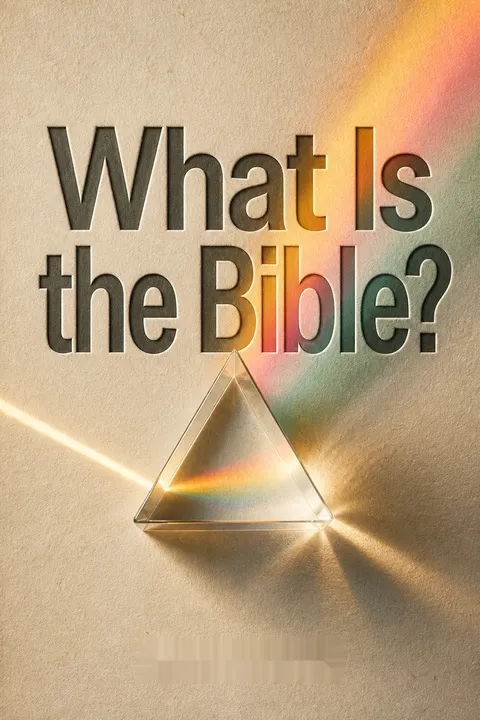


Key Takeaways
Read the Bible as a human library, not a divine rulebook dropped from the sky
Start with its makers. Bell asks readers to see the Bible as a library written by around forty people over roughly fifteen centuries, across three continents. Many stories circulated orally before people selected, edited, and recorded them. Later communities also decided which writings belonged in their collections. The authors wrote for particular audiences and purposes, shaped by their politics, economies, and assumptions about the world. The Bible is not one voice speaking outside history, but many voices speaking from within it.
Human does not mean disposable. Reading the text this way makes its struggles more recognizable: its authors wrestle with fear, power, injustice, grief, and hope. It also means a passage needs context before it can be treated as a timeless instruction. For Bell, attending to human authorship does not remove the possibility of the divine; it is the honest route by which readers may encounter it.
What's valuable here is the refusal to make faith depend on pretending that ancient texts arrived untouched by human judgment. Historical context can sharpen ethical reading: it helps distinguish what a writer describes from what a reader should endorse. The same method is useful outside religion, since laws, constitutions, and scientific accounts also emerge from particular communities and moments. Still, identifying human authorship cannot by itself establish or disprove divine inspiration. It clarifies the question rather than answering it, leaving readers free to consider what religious meaning a historically situated text may carry.
Change reading altitude: a word, a scene, and a whole book reveal different things
Move between scales. Bell uses altitude for the different distances from which a passage can be read: close attention to a word, the flow of a paragraph, or the arc of an entire book. Each scale can show something the others miss. In the story of Jesus and the accused woman, for example, Bell reads Jesus writing in the dust alongside the preceding festival, which had focused on water and included teaching from Jeremiah about people being written in dust. That context makes the gesture more than a private rebuke.
Look for the larger shape. Acts begins in Jerusalem and ends with Paul in Rome, suggesting a movement beyond its original community. Ruth's family story gains another dimension when its closing genealogy connects Ruth to King David. Ask what comes before and after a puzzling detail, and whether a repeated image or phrase links it to other stories.
This approach resembles close reading in literature: meaning often arises not from an isolated sentence but from its placement, echoes, and silences. Changing scale also guards against two common mistakes, treating every phrase as self-explanatory or dissolving specific details into a vague theme. Bell's proposed links can be illuminating, though a contextual interpretation is not automatically the only plausible one. A useful discipline is to separate what the text clearly says from what a reader infers, then ask whether the inference explains more of the passage than it obscures.
Read biblical violence as a problem the stories expose, not a model to copy
Notice the cycle. In Judges, Israel's wrongdoing is followed by foreign oppression, a cry for help, and rescue. Ehud frees his people by killing King Eglon, but the story's brief peace gives way to another cycle of wrongdoing and violence. Bell reads the repetition as evidence that violent rescue does not heal the underlying disorder. The Bible includes brutality, but inclusion alone does not tell readers whether a story celebrates or condemns it.
Keep the history visible. Bell argues that ancient tribal societies often understood survival through warfare, conquest, and loyalty to a group. Against that backdrop, biblical calls to free slaves, care for refugees, and leave food for the poor represent a different moral direction. He also reads texts gathered during exile as exposing the horror of violence. This is an interpretive claim, not a reason to excuse or minimize the violence itself.
The distinction between depicting violence and prescribing it is essential in any serious reading of history or fiction. Repetition, consequences, and narrative framing can show that a story is examining a social trap rather than offering a blueprint. Bell's account of a gradual moral movement also makes the Bible more readable as a human record of changing ideas. The caution is that a trajectory can become too neat: the texts preserve competing voices, and readers may disagree about whether a passage critiques violence or sanctifies it. Context supports judgment; it does not remove the need for it.
Let Jesus's stories make the excluded person your moral test
The unexpected neighbor. In the Good Samaritan story, a religious expert asks Jesus who counts as a neighbor. Jesus makes a Samaritan, a member of a despised group, the person who acts with compassion. The story turns a boundary question into a test of mercy. Bell notes that the expert avoids saying the Samaritan's name when answering, a small detail that hints at the depth of his prejudice.
The enemy can surprise you. Jonah resists taking a warning to Nineveh, Israel's enemy, then becomes angry when its people respond and are spared. The story asks whether a wounded community can wish mercy on its former oppressor. Bell connects this challenge to Jesus's willingness to cross inherited boundaries, including his encounters with Samaritans and Sidonians. Forgiveness does not require remaining near someone dangerous; the point is to resist letting hatred dictate who deserves compassion.
These stories expose how moral labels can conceal the very behavior they claim to identify. Social psychology describes a related pattern: people often judge outsiders by group identity while judging insiders by individual actions. A story that reverses those expectations can interrupt that reflex. The challenge is not to erase differences in power or harm. Mercy toward an enemy is not the same as denying accountability, and a person may need distance to be safe. The stories are most useful when compassion expands without turning into pressure on victims to reconcile on someone else's timetable.
Treat restoration of all things as the Bible's daring horizon
Follow the expansive language. Bell centers a Greek term, anakephalaiossathai, in Paul's letter to the Ephesians. The word suggests bringing things together under one head, and Bell connects it with retelling a story so that painful events remain part of it but acquire a new meaning. Other passages he cites speak of restoring, renewing, or reconciling all things, not merely a favored religious group.
Hope without erasure. Bell applies this vision to fractured relationships, suffering, and the world's injustices: restoration would mean making things whole, not pretending that harm never happened. He presents this as a central Christian hope and asks what living as though reconciliation were possible would change. The scale of the claim is enormous. It offers a horizon for hope, though the cited passages do not settle every theological dispute about what happens to every person or every wrong.
The idea of repair that incorporates rather than deletes painful history has a close analogue in trauma-informed practice and restorative justice. In both, healing requires naming what happened and addressing its consequences, not simply replacing a painful account with a cheerful one. Bell's reading of Paul's expansive language gives that repair a cosmic reach. Its strength is also its interpretive risk: words such as all can be read differently within their literary and theological settings. The hope is compelling, but it should be presented as a reasoned reading of the texts, not as a conclusion that every reader must accept.
Read apocalypse as a warning about power and a summons to act
Look for the present crisis. Bell reads the Tower of Babel as a story about new building technology used by a powerful ruler to consolidate an empire. Its bricks and mortar make a larger structure possible, but the project also serves the ambition of making the ruler's name great and keeping people from scattering. The story raises a question that remains relevant: who benefits when new capabilities concentrate power?
Distinguish three endings. Bell describes apocalypse as a sudden catastrophe, a human-caused disaster, or an unveiling that reveals reality and points toward its repair. The Book of Revelation, in his reading, is a letter of resistance to Roman propaganda, written to encourage communities living under imperial pressure. Rather than using it mainly to predict dates, he emphasizes its critique of domination and its invitation to care for the world people actually inhabit.
This reading connects ancient political critique with contemporary debates about technology and ecological risk. New tools do not determine their own moral use; ownership, incentives, and public accountability matter. Bell's distinction between catastrophe we cannot control and damage people can prevent is especially practical because it turns anxiety toward responsibility. Yet apocalyptic language can still be misused to intensify fear or to identify one's opponents as cosmic evil. A grounded reading asks who is harmed by a system, who benefits from it, and what concrete action would reduce that harm.
Interpret scripture openly, because no one reads it without choices
Interpretation is unavoidable. Bell argues that a person who says they simply follow the Bible still makes decisions about which commands apply today. Practices such as food restrictions or clothing rules are interpreted differently by different communities. In the story of circumcision, a ritual central to Abraham's community becomes a point of dispute when Paul argues that non-Jews need not adopt it to follow Jesus. The text's meaning is worked out in changing circumstances.
Choose useful questions. Bell resists treating the Bible as a single, error-free manual. Its books include poems, letters, stories, and accounts written for different purposes. Contrasting accounts, such as one that attributes David's census to God and a later one that attributes it to Satan, may reflect changing ideas about evil rather than a simple mistake. Ask what a text is doing and what kind of writing it is before deciding what authority to give it.
Making interpretation explicit is a form of intellectual honesty. It exposes the human decisions that can otherwise hide behind claims of pure objectivity, including decisions about which authorities deserve trust. The same principle applies to legal texts: a written rule cannot anticipate every case without interpretation. But openness does not mean every reading is equally strong. Historical evidence, literary form, and the effects of an interpretation can help distinguish careful readings from convenient ones. Readers can take scripture seriously without surrendering their judgment or pretending that judgment has disappeared.
Define sin by the harm it does to shared wholeness
Use a wider definition. Drawing on theologian Cornelius Plantinga Jr., Bell defines sin as a culpable disturbance of shalom. Shalom is a Hebrew term for peace, wholeness, health, and blessing. In this account, sin is not only breaking a rule; it is contributing to damage in relationships, communities, or the natural world. Exploitation, abuse, and everyday disrespect can all disrupt the conditions in which people and communities flourish.
Do not make wrongdoing your whole identity. Bell describes sin as a real, serious middle truth about people, between the claims that humans bear God's image and that they are loved and forgiven. He argues that identity should not be reduced to failure, and that repair includes taking responsibility for harm. This framing makes the word morally substantial without turning it into a tool for shame. It also asks a practical question: what action could help restore what has been damaged?
A relational definition shifts moral attention from rule compliance alone to consequences for other people and shared environments. That aligns with ethical approaches that assess actions by the harm they cause and the duties they create for repair. It can make the concept intelligible even to readers who do not share the book's theology. At the same time, a broad idea such as wholeness needs concrete standards. Without attention to power, consent, and evidence of harm, appeals to communal harmony can be used to silence people who challenge an unjust status quo.
Ask why a story endured before deciding what it means for you
Begin with the first audience. Bell recommends asking why people found a passage important enough to write down, then why it survived. Genesis begins, in his reading, as a counter-story to Babylonian creation myths: a poem of order and abundance rather than a world made through divine violence. For Israelites living in exile, the story could offer a different account of who they were and what creation meant.
Then notice your recognition. The Psalms preserve anger, fear, and the feeling that God is absent; the prophets accuse rulers and institutions of exploiting the poor. These texts endure, Bell argues, because they give language to recurring human experiences. Reading them can connect personal pain with a wider history without pretending the situations are identical. Ask what the passage meant in its world, what human experience it speaks to, and what response it invites now.
Questions about a text's original audience and later survival bring cultural memory into view: communities preserve stories because those stories help organize identity, grief, and hope. The method also resists quick moralizing by making readers ask what pressure or need a passage addressed in its first setting. Survival, however, is not proof that a text is true or ethically sound. Traditions preserve conflict as well as wisdom. Its endurance is a reason to investigate its power, not a substitute for assessing its claims and consequences.
Analysis
Bell's central contribution is not a single doctrine about the Bible but a reading practice. He asks readers to move between historical context, literary form, and present-day moral consequence. That practice offers an accessible alternative to two familiar habits: dismissing ancient writing as primitive, or protecting it from scrutiny by treating every passage as equally direct and timeless. His examples make interpretation feel less like a technical specialty and more like attentive reading.
The book's organizing claim is that the biblical library records a movement toward wider compassion, nonviolence, and restoration. That lens lets Bell read troubling passages as part of an unfinished human history rather than a final moral code. It also gives the book its most important tension. A developmental story can illuminate change, but it can also make the record seem more coherent than it is. The texts do not speak with one voice, and a later interpretation should not automatically be assumed morally superior simply because it is later. Bell's argument is strongest when it shows the evidence for a reading and leaves room for disagreement.
His political readings are particularly useful. Jonah's resentment toward Nineveh, the Samaritan's role as neighbor, and Revelation's parody of imperial power all ask readers to examine who is excluded, who benefits from authority, and how fear sustains group identity. These questions travel beyond religious settings. They apply wherever institutions tell stories that justify unequal power.
The book's method is ultimately ethical as well as literary. Readers are encouraged to approach scripture with curiosity, to recognize their own interpretive choices, and to judge readings by the lives they produce. That last test is powerful but incomplete on its own: good intentions do not guarantee sound interpretation. Historical evidence, attention to harm, and openness to correction remain necessary. Bell's larger invitation is to read without either surrendering judgment or closing the door on wonder.
Review Summary
What Is the Bible? by Rob Bell receives mixed reviews. Many praise its fresh perspective on reading scripture, encouraging readers to approach the Bible "literately" rather than literally. Bell's engaging writing style and ability to make ancient texts relevant are widely appreciated. However, some criticize his theology and interpretations as controversial or lacking depth. The book is seen as potentially eye-opening for skeptics and those struggling with faith, but may challenge traditional views. Overall, it sparks conversation and encourages deeper engagement with scripture, despite disagreements on specific points.
People Also Read

Glossary
Altitude
Scale of biblical readingBell's term for the different levels at which a passage can be examined. A reader can focus on a word, a sentence, a scene, a whole book, or the Bible's larger patterns. Moving between these scales can reveal links and meanings that are easy to miss when a passage is read in isolation.
Anakephalaiossathai
Gathering things under one headA Greek word used in Ephesians 1 and translated in various ways, including bringing things together, summing up, or recapitulating. Bell emphasizes its sense of gathering everything under one head and relates it to retelling a story so that painful events remain included while gaining a different perspective.
Covenant
A binding relational pledgeIn the ancient practice Bell describes, a covenant was a solemn bond or agreement between parties. A ritual involving divided animals could dramatize the consequences of breaking the pledge. In Genesis 15, Bell highlights that only God passes between the pieces, interpreting this as a promise of divine faithfulness even if Abraham fails.
Shalom
Peace and shared wholenessA Hebrew term associated with peace, wholeness, health, and blessing. Bell uses it to describe the harmony intended for relationships among people, communities, the earth, and God. Drawing on Cornelius Plantinga Jr., he presents sin as culpable disruption of this wholeness rather than merely violation of a rule.
Incarnation
Words embodied in lifeBell uses incarnation to describe the movement from written teaching to lived action. In his account of Jesus's claim to fulfill the Law and the Prophets, the meaning of scripture becomes visible in concrete human life. The term also names the Christian belief that the divine and human meet in Jesus.
Binding and loosing
Making interpretive decisionsA first-century Jewish expression Bell presents as referring to decisions about how religious teaching should be interpreted and lived. Jesus's use of the phrase gives his followers responsibility to apply the tradition in their own circumstances rather than merely repeat earlier rulings.
Theopneustos
God-breathedA Greek term in 2 Timothy 3:16, formed from words associated with God and breathing. Bell connects breath with spirit and life, and reads the term as describing scripture as useful for teaching and forming people to do good. It does not, in his account, require treating the Bible as a text without human authorship.
Exousia
Power used for a purposeA Greek word often translated as authority, power, or influence. Bell emphasizes its active and relational character: authority involves giving something weight and allowing it to shape action. Applied to scripture, this means readers interpret it and decide what influence it should have rather than obeying it without interpretation.
Apocalypse
Unveiling hidden realityBell emphasizes the word's sense of uncovering or revealing. He distinguishes a sudden catastrophe, a disaster produced by human choices, and an unveiling that exposes what is happening and points toward restoration. This reading presents apocalyptic writing as a source of resistance and hope, not only as a forecast of future events.
FAQ
What's "What Is the Bible?" about?
- Exploration of the Bible: The book explores how the Bible, a collection of ancient texts, can transform the way we think and feel about everything.
- Human and Divine Intersection: It delves into the intersection of the human and divine, showing how the Bible reflects human experiences and divine inspiration.
- Contextual Understanding: Rob Bell emphasizes understanding the Bible in its historical and cultural context to uncover its deeper meanings.
- Invitation to Engage: The book invites readers to engage with the Bible in a way that is dynamic, questioning, and open to new insights.
Why should I read "What Is the Bible?" by Rob Bell?
- New Perspective: It offers a fresh perspective on reading the Bible, encouraging readers to see it as a living, breathing document.
- Deeper Understanding: The book provides tools to understand the Bible's historical context, enhancing comprehension and appreciation.
- Engaging Style: Rob Bell's engaging and accessible writing style makes complex theological concepts understandable.
- Personal Growth: Reading the book can lead to personal growth by challenging preconceived notions and encouraging a deeper spiritual journey.
What are the key takeaways of "What Is the Bible?"?
- Bible as a Library: The Bible is a collection of diverse texts written over centuries, not a single book with a uniform message.
- Context Matters: Understanding the historical and cultural context of biblical texts is crucial for accurate interpretation.
- Dynamic Interpretation: The Bible should be read as a dynamic text that invites ongoing interpretation and engagement.
- Human Experience: The Bible reflects the human experience, capturing the struggles, hopes, and insights of its authors.
How does Rob Bell suggest we read the Bible?
- Read Literately, Not Literally: Bell encourages reading the Bible according to its literary forms, whether poetry, history, or parable.
- Ask Questions: Engage with the text by asking questions about its context, purpose, and meaning.
- Turn the Gem: Approach the Bible like a gem with many facets, allowing different perspectives to reveal new insights.
- Embrace the Humanity: Recognize the human element in the Bible, understanding it as a record of human encounters with the divine.
What is the significance of the title "What Is the Bible?"?
- Questioning Approach: The title reflects the book's approach of questioning and exploring the nature and purpose of the Bible.
- Invitation to Discover: It invites readers to discover the Bible's relevance and transformative power in a modern context.
- Challenge Assumptions: The title suggests a challenge to traditional assumptions about the Bible, encouraging a fresh look.
- Exploration of Identity: It hints at exploring the Bible's identity as both a human and divine document.
What are the best quotes from "What Is the Bible?" and what do they mean?
- "You can take it way farther." This quote encourages readers to explore beyond traditional interpretations and find deeper meanings.
- "All things are yours." This phrase suggests that truth and insight can be found in many places, not just within the Bible.
- "The Bible is a library of books." It emphasizes the diversity and complexity of the Bible, encouraging a nuanced approach to reading it.
- "The Bible is a profoundly human book." This quote highlights the human element in the Bible, acknowledging its authors' experiences and perspectives.
How does Rob Bell address contradictions in the Bible?
- Contextual Evolution: Bell explains that contradictions often reflect the evolving understanding of God and the world by the Bible's authors.
- Human Perspective: He emphasizes that the Bible is written from human perspectives, which can change over time.
- Invitation to Explore: Contradictions invite readers to explore deeper meanings and understand the Bible's dynamic nature.
- Growth in Understanding: They illustrate the growth in human understanding of the divine, showing a progression in theological thought.
What is Rob Bell's view on the Bible's authority?
- Relational Authority: Bell suggests that authority is relational, given by readers who find the Bible meaningful and transformative.
- Interpretation Required: The Bible's authority involves interpretation, as it must be understood in context and applied to life.
- Dynamic Engagement: Authority comes from engaging with the Bible's teachings and allowing them to shape one's life.
- Beyond Literalism: Bell moves beyond literal interpretations, seeing authority in the Bible's ability to inspire and guide.
How does "What Is the Bible?" redefine the concept of sin?
- Disturbance of Shalom: Sin is defined as anything that disrupts the peace and harmony God intends for the world.
- Beyond Rules: It moves beyond the idea of sin as merely breaking rules, focusing on its impact on relationships and community.
- Human Experience: The concept of sin is tied to the human experience of guilt and the need for reconciliation.
- Forgiveness and Identity: The book emphasizes that sin is forgiven in Christ, and our primary identity is found in being loved by God.
What does Rob Bell say about the inspiration of the Bible?
- God-Breathed: Bell describes the Bible as "God-breathed," meaning it is inspired by the divine but written by humans.
- Dynamic Process: Inspiration is seen as a dynamic process involving human authors and divine influence.
- Life-Giving: The Bible is inspired in the sense that it brings life, hope, and guidance to its readers.
- Beyond Literalism: Inspiration is not about literal accuracy but about the Bible's ability to speak to the human condition.
How does "What Is the Bible?" address the concept of predestination?
- Instrumental Election: Election is seen as instrumental, meaning chosen for a purpose, not for exclusion.
- Expansive Understanding: Predestination is about God's expansive desire to include and bless all people.
- Contextual Interpretation: The concept is understood within the context of the Bible's broader narrative of redemption.
- Focus on Mission: Predestination emphasizes the mission and calling to bless others, not exclusion or favoritism.
What is the "turning the gem" method in "What Is the Bible?"?
- Multiple Perspectives: "Turning the gem" involves looking at the Bible from multiple perspectives to gain new insights.
- Dynamic Interpretation: It encourages a dynamic approach to interpretation, recognizing the Bible's complexity.
- Engagement with Text: Readers are invited to engage deeply with the text, allowing it to reveal different facets of truth.
- Ongoing Discovery: This method supports ongoing discovery and learning, as each turn of the gem offers something new.
About the Author



Download PDF
Download EPUB
.epub digital book format is ideal for reading ebooks on phones, tablets, and e-readers.








