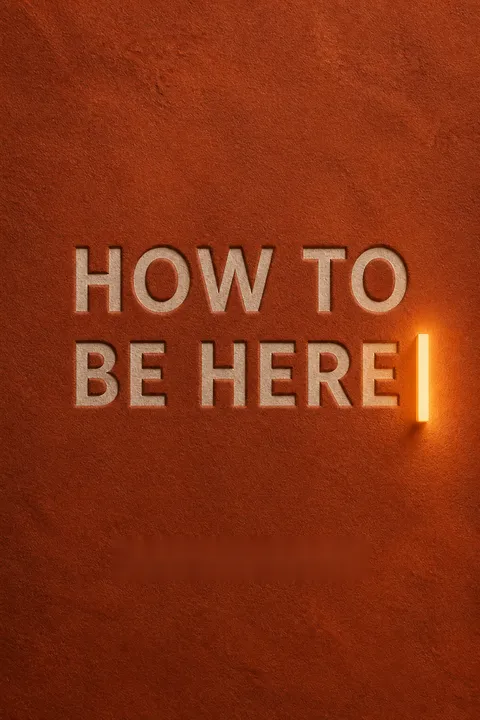


Key Takeaways
Treat your life as unfinished work, not a script already written
Life is still taking shape. Bell opens with a failed attempt to dictate a book in one sitting. The words were his, but the work did not feel like his. The blinking cursor became a picture of any unfinished task or life waiting for a person's contribution. Drawing on the biblical creation story, he presents the world as still becoming, with people invited to help shape it. Creativity, in this account, is not limited to artists. Accounting, parenting, and other ordinary work can help build a world in which people flourish.
Pain is not the whole story. Bell describes his father losing his own father and brother young, then choosing to become the loving, present parent he had needed. That response did not erase the losses. The point is that, after grief and anger have room, a person may still shape what comes next.
The book’s strongest claim is about agency without omnipotence: people cannot choose every circumstance, but can sometimes influence what their response creates. That distinction resembles the psychological idea of perceived control, which is associated with persistence and well-being when it reflects real choices. The account also wisely leaves room for grief before asking what good might follow. Still, the invitation to make meaning from pain needs care. Trauma is not a task that everyone must transform into service, and some situations call first for protection, treatment, or practical support.
Stop borrowing other people's scorecards; your path starts on its own blank page
Comparison spends your attention. Bell describes the inner loop of feeling insufficient, then adds a second distraction: watching people whose lives seem easier or more successful. In a story from Jesus’s life, Peter shifts attention from his own demanding path to another disciple’s future. Bell uses that moment to ask why someone else’s circumstances should decide what one person does next.
You have incomplete information. A performer who looks tireless may be struggling privately; a friend who appears settled may have costs invisible from the outside. Comparing a person’s full experience with another’s public image produces a distorted judgment. Bell’s alternative is to return attention to the work and relationships actually in front of the person. No one else has lived that particular combination of responsibilities, history, and possibilities.
Comparison is not always useless. Social comparison can help people learn standards, locate role models, and notice unfair differences in opportunity. The trouble comes when it becomes a verdict on personal worth or a reason to postpone action. Bell’s emphasis on incomplete information is especially relevant in an era of curated online lives, where visible success is often detached from its costs. A practical distinction follows: compare methods when learning, but avoid treating another person’s outcome as proof that one’s own path is either inferior or guaranteed.
Test what energizes and angers you; vocation is discovered through experiments
Purpose develops through trying. Bell uses the Japanese word ikigai for a person’s evolving reason for being: the mix of work, relationships, interests, and commitments that makes a day feel worth entering. He argues that people discover this through action, not endless speculation. Volunteering, taking a class, shadowing someone, or following a curiosity can reveal what fits.
Meaning need not be a job. Bell made an album that friends barely noticed, yet making it still mattered to him. He warns that turning a loved activity into paid work can burden it with pressure. He also suggests watching for issues that provoke a strong response: what seems wrong may point toward work a person feels called to do. A New York bus driver, for instance, gives passengers a moment to set down the day’s worries, making a routine route feel like service.
This account treats vocation as an adaptive process rather than a single hidden destiny waiting to be found. That fits career-development models in which interests and identity change through experience, feedback, and changing circumstances. It also loosens the modern demand that a job deliver every form of meaning. The caution is that exploration requires time, money, and room to fail, resources distributed unevenly. Small experiments can help make exploration safer, but they cannot remove economic constraints. A satisfying direction may also be a season of care or stability, rather than a dramatic career change.
Build satisfaction around the craft, not the prize waiting at the finish line
Novelty eventually runs out. Bell recalls touring a talk in 25 cities over 28 days. The first excitement faded, leaving the repeated work itself. He was glad to return to the stage because he enjoyed shaping stories and ideas, noticing details, and improving the performance. He calls this orientation craft: respect for the work and its ongoing practice, independent of applause.
The prize can disappoint. A doctor Bell knew bought the Corvette he had wanted for years. Not long afterward, he sold it, surprised that owning the car felt less fulfilling than imagining it. The story contrasts external success, which tends to point toward the next acquisition, with satisfaction found in doing the work well. Bell extends the idea to humble tasks, such as a city worker carefully showing a colleague how to change a trash bag.
The distinction between craft and status echoes research on intrinsic motivation: activities can be sustained by interest, mastery, and contribution, not only by rewards or recognition. This does not make external rewards irrelevant. Pay, stability, and fair treatment are material needs, not spiritual shortcomings. Nor should enjoyment of craft excuse exploitative working conditions. Bell’s useful question is narrower: apart from the outcome, is there something in the practice that deserves care? That question can restore dignity to routine work without pretending that every job is fulfilling or that workers should accept poor conditions.
When the whole project overwhelms you, name the next single step
Start with what is knowable. Bell spent years collecting scenes and characters for a novel before sitting down to write its first line. He did not know how to write the whole book, but he knew what the next action was. His rule is to focus on the first step rather than trying to solve steps 17 or 24 before beginning.
Let the work teach you. Bell also recounts making a short film planned for roughly twice its eventual length. The rough cut was much shorter, and the team initially worried about the difference. Once they showed it to people, the compact version proved compelling. The lesson is to avoid judging a project too early: a first attempt may reveal a better shape than the plan predicted. Nerves can accompany important work, but they are not a guarantee that the work is right.
Breaking a daunting project into concrete actions is closely related to implementation planning: a vague intention becomes easier to enact when the immediate behavior is clear. It also limits the mental burden of forecasting outcomes that cannot yet be known. Bell’s advice to suspend judgment is valuable during exploration, when premature criticism can prevent useful discovery. It should not mean ignoring feedback or continuing a harmful plan. The balance is temporal: create enough room for a rough attempt to exist, then assess it against evidence, purpose, and the people affected.
Compare the risk of trying with the slow cost of staying put
Inaction has a price. Bell’s Dickie Shoehorn stories became a book project, complete with illustrations and hopes for a series. Publishers showed no interest, and the book ended up stored in a garage. Bell still argues that making it was not wasted effort: it allowed him to try, learn, and avoid wondering indefinitely what might have happened.
Look at both sides. A friend who started a business earned nothing in its first year, yet felt unusually alive doing the work. Bell uses that example to question the assumption that the safest option is always to stay where things are familiar. He suggests asking what could go wrong by trying and what could be lost by not trying. Risk should be chosen with attention to consequences, not romanticized as automatically noble.
The useful move here is to make omission visible. Decision research often finds that people regret missed possibilities differently from failed attempts, especially when the missed option remains imagined and therefore flawless. But the book’s celebration of risk needs a material counterweight: failure can threaten housing, health, or dependents, and a safety net changes the calculation. A thoughtful experiment can preserve the insight without demanding a leap: test demand, build savings, or try the activity at small scale. Courage is not the absence of risk assessment.
Give the work your full effort, then release other people's response
Begin with the task at hand. Early in his career, Bell was asked to crawl beneath large Christmas trees and connect their lights, a dirty and unglamorous assignment. He presents such work as a chance to learn and contribute, not as proof that someone is destined to remain at the bottom. The work available now may be the starting point for work that comes later.
Separate effort from reception. Bell describes saying yes to speaking opportunities, including awkward events and performances that went badly. His two-part practice is to commit fully to the work while accepting that an audience may dislike it, misunderstand it, or ignore it. Letting go of that reaction is not indifference to quality or results. It is recognition that other people’s responses cannot be controlled, and that applause cannot be the sole source of motivation.
This pairing resembles a useful distinction in performance psychology: focus on controllable process goals while treating external results as uncertain feedback. It can protect attention from approval-seeking and help people keep learning after rejection. The emphasis on doing low-status work can also build competence, provided the assignment is not exploitative and there is some path to growth. Humility should not become a demand to accept disrespect. Full effort is most sustainable when paired with boundaries, fair compensation, and the ability to refuse work that harms others.
Shape your spaces and weekly rhythms to defend attention and restore perspective
Make the environment support the work. Bell describes a desk and a small collection of objects that remind him what matters and help him begin. He distinguishes useful details, such as tools and meaningful reminders, from clutter that pulls attention without serving a purpose. He also notes that phones and constant email can turn one activity into several competing ones.
Make rest part of the structure. Bell and his wife tried setting aside a weekly Sabbath, a day with less work and fewer demands. At first, slowing down felt unpleasant, which helped them notice how accustomed they had become to constant stimulation. The practice gave time to notice fatigue, process difficult experiences, and enjoy activities without measuring them by productivity. Bell argues that this pause can change how the other days feel, too.
The section connects attention to design rather than treating distraction as a personal defect. Environmental cues influence behavior, while uninterrupted time supports deeper engagement. A recurring day of rest can also challenge the assumption that every hour must justify itself through output. Yet a full day off is not equally available to caregivers, shift workers, or people in precarious jobs. The principle can scale: protected meals, device-free intervals, or a consistent stopping time may offer some of the same boundary. Rest becomes more than another performance metric when it is not judged by how productive it makes Monday.
Notice the ocean in front of you before chasing a better life
The familiar can disappear from view. After a concussion from repeated falls while wakeboarding, Bell spent days unable to think normally about past or future. He became intensely absorbed in ordinary things: his family, a speck of dust, and a burrito whose flavors he noticed one by one. As his memory returned, the heightened experience faded, but he kept the insight that daily life contains more than routine makes visible.
Attention changes the scene. Bell’s friend Cory later recalled being so consumed by work worries that he could not really see the Pacific Ocean during a drive along the coast. He changed aspects of his life and eventually found himself able to notice it. The book’s practical challenge is to look closely at the people and places already present, rather than assuming fulfillment must be somewhere else.
The concussion story is memorable because it makes ordinary perception feel newly strange, but it should not be mistaken for a recommended route to presence. Brain injury is serious, and Bell’s altered awareness was an accidental consequence, not a reliable wellness technique. The broader lesson has gentler parallels in mindfulness practices that train attention toward sensory experience without requiring unusual states. Attention can reveal value in familiar surroundings, though it cannot make every circumstance good. Sometimes noticing clearly confirms that a relationship, workplace, or living situation needs to change.
Analysis
How to Be Here is a spiritual self-help book built as a sequence of personal stories rather than a single technical system. Its central argument is that life is both received and made: people inherit circumstances they did not choose, yet still participate in shaping what happens next. Bell carries that claim from large questions of creation into practical behavior: find a direction through experiments, practice the work itself, take the next step, risk rejection, protect attention, and notice the life already present.
The stories are the book’s engine. The failed dictation of a manuscript introduces the intimidating blank page; the rejected Dickie Shoehorn project makes risk concrete; the Corvette story exposes the gap between achieving a goal and feeling fulfilled; the concussion makes attention vivid. These episodes translate spiritual ideas into scenes readers can remember. The recurring metaphors of unfinished creation and a next step also give the book coherence without turning it into a rigid checklist. Its strongest contribution is how it joins vocation with ordinary life. Purpose is not confined to a dream job, artistic talent, or public achievement. A bus driver can make a commute humane, and a parent’s care can be meaningful work. Likewise, rest and physical surroundings are not decorative extras. They influence whether a person can give sustained attention to what matters.
The approach has limits. Bell’s confident language about personal agency can understate how poverty, discrimination, illness, trauma, and care responsibilities restrict choices. His encouragement to find good in suffering may help some readers, but must not be used to rush grief or excuse preventable harm. The book is best treated as an invitation to notice available choices, not proof that everyone can create the same opportunities. Its spiritual frame offers hope; its practical wisdom is strongest when paired with material realism, boundaries, and patience.
Review Summary
How to Be Here receives mixed reviews, with an average rating of 3.94/5. Many praise Bell's engaging writing style and find the book inspiring and thought-provoking. Readers appreciate its focus on living mindfully and finding purpose. Some criticize it as overly simplistic or repetitive, while others find it life-changing. The book explores themes of creativity, presence, and embracing life's challenges. Bell's unique formatting and use of personal anecdotes are noted. Overall, it's seen as a motivational text that encourages readers to live more fully in the present.
People Also Read





Glossary
blinking line
unfinished work awaiting actionBell’s metaphor for whatever is not yet made or decided in a person’s life. It can mean a literal blank document, but also a job, relationship, project, or challenge that calls for a response. The image emphasizes possibility and responsibility without implying that people control every circumstance.
ikigai
evolving reason for beingA Japanese term Bell uses for the sense that a day matters and that a person has work or contribution to give. In this book, it is not limited to a profession. It includes how someone spends time and energy across work, family, play, service, and changing responsibilities.
craft
care for work itselfBell’s term for taking the practice and details of work seriously, with gratitude, respect, and a willingness to improve. Craft differs from success understood as status or possession of a goal. It can be present in prestigious work or routine tasks, and its value does not depend entirely on recognition.
The First Number
the next concrete stepBell’s way of directing attention to the first action in a project rather than trying to solve every later stage in advance. The step might be a call, appointment, form, or sentence. Completing it provides information for choosing what comes next and helps interrupt paralysis caused by imagining the whole undertaking.
The Dickie Factor
weigh both risksThe book’s name for considering the danger of trying something and the danger of not trying it. Bell illustrates the idea through his unpublished Dickie Shoehorn children’s book. Even when an attempt is rejected, trying can provide learning and end uncertainty; staying put can also carry costs.
Sabbath
regular time away from workBell describes Sabbath as a weekly day deliberately set apart from ordinary work and productivity. His practice involved choosing activities that restored attention and enjoyment, without a schedule or to-do list. He presents the pause as a reminder that personal worth is not measured solely by output.
surrendering the outcomes
release control of reactionsBell’s practice of giving full effort to work while accepting that other people may respond with praise, criticism, indifference, or misunderstanding. It does not mean abandoning goals or caring about results. It means recognizing that other people’s reactions cannot be guaranteed or controlled.
ex nihilo-ness
creation from apparent nothingBell’s playful adaptation of the Latin phrase ex nihilo, meaning out of nothing. He uses it to describe the mystery of existence and the human ability to make something that did not previously exist, such as a sculpture, a story, or a way of responding to hardship.
About the Author


Download PDF
Download EPUB
.epub digital book format is ideal for reading ebooks on phones, tablets, and e-readers.








