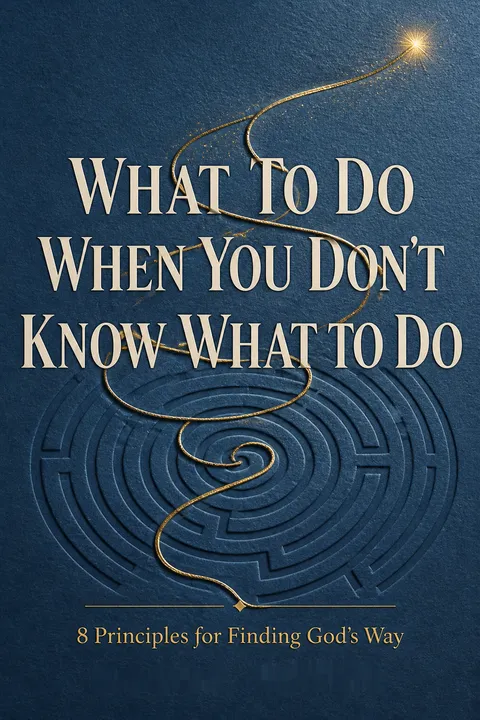


Key Takeaways
Trust God, then take the next step you can actually take.
Faith means relationship, not optimism. The book distinguishes trusting God from positive thinking or trying harder with religious language. Abraham’s journey from home illustrates the idea: he did not know the destination, but acted on confidence that God did. Marian, a mother who became addicted to crack after trying it once, could not stop through willpower alone. She asked for help and accepted a place in treatment. When donations fell $5,400 short, a caller offered that exact amount from an inheritance. The authors present the outcome as God’s provision, not faith as a technique for controlling events.
Pair trust with action. The book’s central claim is that God does what exceeds a person’s capacity, while the person takes the steps available: ask for help, accept support, and follow through. The route may differ from the one originally imagined.
The most practical strength of this faith model is that it rejects both magical thinking and solitary self-rescue. Trust is not described as a substitute for action, and action is not treated as proof that a person can manage everything alone. The story’s striking coincidence makes the point memorable, but it should not be mistaken for a promise that every crisis will resolve in a dramatic or timely way. That distinction matters: faith can orient effort and sustain hope without making people responsible for outcomes beyond their control.
Choose companions who can comfort you and tell you the truth.
Build a team, not a cheering section. The authors urge readers to seek people who offer practical support, love, courage, honest feedback, wisdom, experience, good examples, shared values, and accountability. No single companion needs to provide everything. A friend may offer care, while a counselor brings expertise and a peer offers the perspective of having faced a similar struggle.
Even experts keep learning. Henry Cloud recalls being surprised that champion golfer Jack Nicklaus still consulted his teacher, Jack Grout, about his swing. The lesson is not that everyone needs constant advice, but that excellence does not eliminate the value of guidance. Readers are encouraged to ask trusted people directly for the kind of help they need, or to join a structured group when their current circle cannot provide it.
A support network works best when care and correction coexist. Reassurance alone can leave a person repeating familiar mistakes, while criticism without affection can make honesty feel unsafe. The book’s list also implies that support is a set of distinct functions, not a single relationship that must meet every need. A useful test is whether a companion helps someone see more clearly and act more responsibly, rather than simply agreeing or taking over.
Let hopelessness send you searching for missing knowledge and skilled help.
Look for the missing piece. The book treats hopelessness not only as pain, but sometimes as evidence that a person lacks information about a problem or its possible remedies. Its proposed response is to ask God for wisdom and then search actively for it through people with relevant experience, books, groups, pastors, counselors, and professional programs.
Use the right kind of help. A friend may offer useful perspective, but clinical depression or addiction can require trained care. The authors recommend checking a resource’s track record and seeking referrals rather than trusting every self-proclaimed expert. Their point is practical: people do not need to invent a solution from scratch when established services may already address grief, substance use, relationship problems, debt, or career transitions.
This approach turns a vague feeling of being stuck into a research question: what is not yet understood, and who has the relevant competence? It also makes help-seeking part of faith rather than its opposite. The crucial qualification is discernment. Seeking expertise does not mean surrendering judgment to anyone with a title; readers still need to assess fit, evidence, and safety. Wisdom is not merely advice received, but good information tested against the actual problem.
Finish old pain before it keeps directing present-day behavior.
Unresolved pain travels forward. The authors call the work of resolving old hurts and conflicts “finishing.” When painful experiences are buried rather than processed, they can shape present relationships and choices. Finishing may involve naming what happened, grieving losses, receiving forgiveness for one’s own mistakes, making amends, forgiving those who caused harm, and changing patterns learned in the past.
Forgiveness has limits. The book defines forgiveness as releasing a claim for retaliation or repayment, not denying that harm occurred or automatically restoring trust. It also asks readers to examine habits such as avoiding conflict or refusing closeness, and to question self-images formed in relationships that devalued them. Trusted relationships can help replace those distorted views with a more balanced understanding.
The useful distinction here is between releasing the past and pretending it was harmless. That distinction prevents forgiveness from being reduced to forced reconciliation or instant trust. The idea of “finishing” also makes clear that insight alone may not resolve an injury: grief, honest conversation, changed behavior, and support can all be part of the work. The framework should leave room for individual pace. Pressuring someone to declare an experience resolved can reproduce the very silencing the process is meant to undo.
Own your next move without confusing agency with blame.
Responsibility is not fault. The authors distinguish causing a problem from taking responsibility for responding to it. A person may lose a job through economic conditions or suffer because of another person’s behavior, yet still have choices about seeking help, making plans, and taking the next step. Ownership means acting on the part of life one can influence, not accepting blame for everything that happened.
Sharon changes the pattern. After her husband, Rob, left, Sharon initially felt shocked and unsure what to do. In prayer and reflection, she recognized ways she had blamed him while overlooking her own hurtful behavior. She apologized and worked on patterns such as defensiveness and unrealistic expectations. Rob then began addressing his own withdrawal. The story shows how one person’s responsibility can invite, but cannot guarantee, change from another.
This is a strong model of agency because it separates “Who caused this?” from “What can be done now?” The distinction can reduce paralysis without erasing injustice. It also guards against a common misuse: telling harmed people that they are responsible for abuse or another person’s choices. Taking ownership should mean gaining leverage over one’s own decisions, boundaries, and help-seeking, not accepting moral blame for conditions one did not create.
Ask what trouble can teach without treating suffering as automatically good.
Look through the problem. The authors encourage readers to ask what a difficulty might reveal about their needs, habits, or character, while still working to relieve pain and solve the immediate problem. They compare this to medical treatment: a physician may recommend difficult rehabilitation rather than quick relief because recovery requires more than masking a symptom.
Look upward and inward. In the book’s Christian frame, looking upward means seeking God’s perspective and resources; looking inward means examining wounds, attitudes, and weaknesses that the crisis brings into view. Accepting that pain is part of life can make it easier to choose a response. The aim is not to call every hardship good, but to find a way through it that includes learning and change.
Meaning-making can help people recover a sense of direction when circumstances cannot be quickly changed. The book’s emphasis on looking both beyond oneself and within oneself is especially useful because it avoids treating every problem as either purely external or purely personal. Still, pain is not evidence that someone needs a lesson, and growth should not become a reason to delay safety, treatment, or practical relief. The most humane reading is that people may draw value from hardship, not that hardship is valuable in itself.
Give change time, and match your effort to its season.
Progress has a pace. John Townsend describes living with osteopenia, a condition that makes bones more porous. Because bone changes slowly, he had to wait a year between X-rays while continuing supplements and exercises. The example illustrates the authors’ claim that time gives healing and change room to develop, but waiting by itself does not produce them.
Work with the season. The book uses four seasons as a model for change: winter is preparation, spring is starting new practices, summer is maintaining them, and fall is gathering results. Someone in a quiet or discouraging period may be organizing resources rather than failing. The practical instruction is to keep taking appropriate steps, review progress, and avoid demanding a harvest during the preparation stage.
The seasonal model gives slow progress a structure, which can make waiting feel less like empty delay. It also preserves agency: the person plants, tends, and adjusts, even when results are not immediately visible. Its limitation is that real change rarely follows a neat calendar. People may return to preparation after a setback or need support from several stages at once. The metaphor works best as a prompt to ask what this period requires, not as a rigid timetable for recovery.
Bring every part of yourself, including fear, into your relationship with God.
Do not compartmentalize faith. The authors interpret loving God with one’s whole self as bringing values, desires, emotions, wounds, relationships, motives, mistakes, talents, and preferences into that relationship. The point is not to appear spiritually polished, but to make one’s actual inner life available for guidance, forgiveness, and healing.
Turn belief into a plan. The book’s conclusion translates the journey into practical work: set a clear goal, record progress, gather resources, learn about the problem, choose manageable tasks, and review what is or is not working. Readers are also urged to adapt the plan, pray, and pace themselves. Faith is presented as both trust and movement, rather than an idea kept separate from daily decisions.
The whole-person emphasis offers a coherent alternative to treating spirituality as a narrow set of beliefs detached from emotion and behavior. It invites people to examine not only what they think, but what they avoid, desire, and do. The practical planning advice keeps that invitation from becoming purely introspective. One important boundary is that openness should not mean unquestioning compliance or disclosure to unsafe people. A relationship that supports growth must also allow honesty, choice, and appropriate limits.
Treat addiction as a whole-life recovery, not a test of willpower.
Admit the loss of control. The book describes addiction as a pattern in which a person cannot reliably stop a behavior or substance despite harmful consequences. Jeri, who struggled with binge eating, repeatedly lost weight through dieting and regained it. Her recovery began when she stopped treating the problem as a shortage of resolve and sought support from God, other people, and structured care.
Change the conditions around it. Jeri identified triggers, addressed past pain, practiced honesty, repaired relationships, and developed her talents. The authors report that she went from 300 to 150 pounds, attributing the change to broad recovery rather than dieting alone. For substance addiction, they also advise professional medical supervision, especially when withdrawal may be dangerous. The approach is recovery as a life-wide process, not a solo contest of self-control.
The account’s strongest insight is that a harmful behavior can be maintained by isolation, pain, and relationship patterns, so removing the behavior without changing its context may leave the person vulnerable. The emphasis on support and medical supervision makes the advice more grounded than a simple appeal to spiritual effort. At the same time, one person’s dramatic outcome cannot establish a universal path or explain every addiction. The useful lesson is to build a layered recovery plan, not to expect every person to recover in the same way.
Respond to depression with connection and clinical assessment, not pep talks.
Depression needs investigation. Eric, a successful businessman, remained depressed despite prayer, church volunteering, golf, and encouragement to think positively. He had never let friends see his distress. As he joined a small church group and practiced being known by safe people, he began to feel more connected and hopeful. The authors present isolation as one possible contributor in his case, not a universal explanation.
Check emotional and medical factors. The book lists persistent changes in mood, appetite, sleep, energy, concentration, self-image, and hope as signs worth taking seriously. It notes that some depression has a medical component and recommends professional assessment, including psychiatric care for severe symptoms. Connection can be important, but it does not replace treatment when clinical or medical needs are present.
The account resists a familiar but damaging response: telling a depressed person to appreciate what is going well. It instead treats symptoms as information that deserves curiosity and care. Its relational explanation is plausible within Eric’s story, while the medical caveat prevents that explanation from becoming a universal theory. The most reliable stance is plural: investigate relationships, circumstances, and health together, and let qualified clinicians assess needs that supportive friends cannot diagnose.
Rebuild sexual intimacy through trust, shared agency, and acceptance.
Intimacy needs adult partnership. Dan and Linda’s marriage had stalled sexually. Dan often made decisions for Linda, while she avoided disagreement. The authors saw a parent-child pattern: Linda felt powerless, and Dan held control. As he invited her opinions and she began speaking up, she regained a more equal role and her desire returned.
Make safety the foundation. The book links sexual connection to emotional closeness, trust, shared responsibility, and acceptance of each partner’s imperfections. It argues that broken trust cannot be repaired by technique alone, and that each spouse needs enough independence to be a distinct partner. Acceptance does not require approving every behavior, but it does mean avoiding contempt and conditional affection. The couple’s story illustrates one relational pattern, not a formula for every sexual difficulty.
The model usefully shifts attention from sexual performance to the relationship in which desire develops. Shared agency matters because intimacy is difficult to separate from whether each partner can speak, disagree, and feel safe. The case also cautions against treating one spouse’s desire as a problem to be corrected in isolation. This is a diagnostic lens, not a universal cause: physical health, past experiences, and individual differences may matter too. Any repair must preserve mutual consent rather than making sex the price of restored harmony.
Analysis
The book’s eight principles form a practical theology of help-seeking. Its central movement is from self-sufficiency toward dependence on God, but not toward passivity. Readers are asked to pray, seek expertise, accept community, examine their own behavior, and persist through a process whose outcome they cannot fully control. The most memorable stories make that structure concrete: Marian’s treatment depends on help beyond her willpower, Sharon’s marriage begins to shift when she owns her part, and Eric’s depression prompts him to risk being known. Across these cases, change is relational and behavioral, not merely a change in attitude.
The framework is strongest when it treats spiritual life, relationships, and practical resources as mutually reinforcing. Faith does not replace a counselor, support group, or medical assessment; these may be channels through which help arrives. The book also offers useful distinctions, especially between responsibility and blame, forgiveness and restored trust, or waiting and doing nothing. Those distinctions reduce the odds that its advice will collapse into either moralism or passive hope.
Its more challenging claims need careful handling. Calling problems gifts can help readers find meaning, but can also sound as though suffering is inherently beneficial or divinely assigned. The safer interpretation is that people may grow through hardship without needing to call the hardship good. Similarly, the relational explanation of depression illuminates Eric’s case, but depression is not reducible to isolation; the book itself acknowledges medical factors and professional care. The intimacy chapter’s parent-child dynamic is insightful, yet it should remain one possible pattern rather than a general explanation.
Taken together, the book is most useful as a guide to the next responsible step, not as a promise of a particular outcome. Its enduring question is less “How can I force a way?” than “What help is available, what part is mine to do, and what must I stop carrying alone?”
Review Summary
What to Do When You Don't Know What to Do receives mostly positive reviews, with readers praising its practical advice and biblical foundation. Many find it helpful for dealing with life's challenges and growing closer to God. The book's eight principles are appreciated for their applicability to various situations. Some readers note that it's a quick, easy read, though a few criticize its lack of depth in Scripture. The bonus sections on specific problems are particularly valued. Overall, readers find the book encouraging and useful for those facing uncertainty or difficult times.
People Also Read










Glossary
finishing
Resolving unfinished past painThe authors use “finishing” for working through painful events and relationships that remain unresolved. This may include acknowledging what happened, grieving, receiving or seeking forgiveness, making amends, and changing patterns learned in response to past hurt. The aim is to reduce the past’s continuing influence on present choices and relationships, not to deny or excuse harm.
ownership
Taking responsibility for your responseIn the book, ownership means taking responsibility for one’s choices, needs, and next steps, whether or not one caused the problem. It includes identifying needed resources, acknowledging weaknesses, seeking accountability, and acting where action is possible. Ownership is distinct from blame: it does not mean accepting responsibility for another person’s harmful behavior or for circumstances outside one’s control.
traveling companions
People who support growthThe book’s metaphor for the people who accompany someone through difficulty and change. Useful companions may provide emotional support, love, courage, honest feedback, relevant experience, wisdom, good examples, shared values, or accountability. The authors encourage readers to seek people who are themselves growing and to use professionals or structured groups when friends alone cannot meet the need.
seasons of your life
Stages in a growth processA four-part metaphor for the changing demands of personal growth. Winter is preparation and clearing obstacles, spring is beginning new practices, summer is maintaining growth, and fall is gathering results and expressing gratitude. The model encourages patience and season-appropriate effort, while treating time as a context for change rather than a cure by itself.
About the Author
Other books by Henry Cloud









Download PDF
Download EPUB
.epub digital book format is ideal for reading ebooks on phones, tablets, and e-readers.








