

Key Takeaways
Let markets reveal a country's strengths, but make their rules fair
Markets coordinate choices. Adam Smith argued that prices and competition can guide producers toward what people want without a government choosing every industry. Specialization makes this powerful: Smith observed that ten workers dividing pin-making tasks could produce far more than one person doing every task. Yet he did not argue for a state that did nothing. He supported public education, transport, competition, and safeguards against dangerous banking practices.
Measure the modern economy. Smith gave manufacturing more weight than services, which he could not imagine being traded at today's scale. The book argues that this old bias persists in economic statistics: training, software, and professional services are hard to count, even though they dominate many economies. Governments should improve the rules and measurement of markets, not assume they can successfully pick the sectors that deserve to grow.
The distinction between directing markets and designing their conditions is crucial. Competition does not arise automatically: laws, infrastructure, and credible rules shape whether firms can enter and workers can move. Measurement also influences policy. If services and investment in skills are undercounted, decision-makers may mistake a statistical blind spot for economic weakness. The caution is that market signals reflect existing purchasing power, not necessarily social need. Smith's framework explains coordination well, but it does not by itself decide which outcomes society should accept.
Judge trade by what it lets people produce, not by deficits alone
Specialization creates gains. David Ricardo's comparative advantage says countries can benefit from trade by specializing in what they produce at the lowest relative cost, even if a trading partner is more efficient at producing everything. His example compares English cloth and Portuguese wine: England could gain by specializing in cloth, while Portugal specialized in wine, then both traded. The point is not that every country wins equally, but that total production and consumption can rise.
Deficits need context. Ricardo would not treat imports exceeding exports as proof of failure. A trade balance reflects what an economy produces and buys, and the UK, for example, exported services while importing manufactured goods. Ricardo's model is limited: it assumes resources adjust smoothly and says little about workers displaced from shrinking industries. Trade can raise national income while leaving particular workers worse off.
A national trade balance is an incomplete measure of economic health, much like a household's spending on tools says little without knowing what those tools enable. The sharper question is whether trade supports productive capacity and whether the gains reach those bearing its costs. Ricardo's theory clarifies why specialization can benefit both sides, but it is not a guarantee of fair terms or painless adjustment. Its policy value depends on pairing openness with credible ways for displaced workers and regions to recover.
China grew by borrowing market incentives without surrendering communist rule
A hybrid transformation. China began market-oriented reforms in 1979 after decades of central planning. Since then, its economy grew at an average rate above 9 percent for years, while hundreds of millions escaped extreme poverty. Investment, industrial upgrading, exports, and workers moving into more productive businesses all contributed. The result was neither a fully planned economy nor a conventional free market: the Communist Party retained political control and the state kept influence over major sectors.
Marx's forecast meets reality. Karl Marx expected capitalism's class conflict and crises to lead toward collective ownership. China instead combined private enterprise and market exchange with a communist government, and developed severe inequality and debt risks. Central planning had weakened incentives and produced inefficient investment, while market reforms generated rapid growth. The case shows that a political label alone cannot explain how an economy works.
China's experience separates two questions often bundled together: who governs, and how production and exchange are coordinated. Markets can operate within an authoritarian political system, while state ownership can coexist with private businesses. That makes the case analytically useful, but difficult to copy. China's scale, prior industrial base, and policy sequence were particular to its history. The lesson is not that one institutional mixture works everywhere, but that observed growth depends on the mechanisms and incentives inside a system, not its name.
Measure growth by who gets paid, not only by what economies produce
Unequal gains matter. Alfred Marshall developed tools for analysing prices and output, but also took poverty and opportunity seriously. In the United States, the top 1 percent came to receive about one-fifth of all income, while average wages stagnated over decades. Marshall grew more willing to accept progressive taxation, but worried that poorly designed redistribution could weaken incentives. He also backed education as a way to expand workers' opportunities.
Market power shapes pay. Joan Robinson challenged the assumption that competition always makes wages match workers' contribution. Her term monopsony describes an employer with power in the labour market, allowing it to pay less than the value a worker produces. Limited job choices, weak bargaining power, and temporary work can help employers preserve that advantage. Robinson's remedy included stronger worker bargaining and more competition, while recognizing that policy design can have trade-offs.
This pairing connects the distribution of income to the structure of markets. If workers have few realistic employers, wage outcomes cannot be explained by productivity alone. And if the gains from growth concentrate, the social question is not an optional add-on to economic performance. Still, redistribution and competition policy solve different problems: transfers can soften unequal outcomes, while market reform can alter bargaining power. A sound response needs to distinguish them rather than treating any single tax or wage rule as a universal fix.
Interrupt debt spirals before falling prices make repayment harder
Debt can feed a downturn. Irving Fisher's debt-deflation theory describes a destructive loop: borrowers sell assets to repay debt, widespread selling pushes prices down, and falling prices increase the real burden of what remains owed. Defaults and bankruptcies then weaken banks and restrict lending. Japan's prolonged stagnation after its early 1990s property crash illustrates how hard it can be to escape weak demand and falling prices.
Money matters in a crisis. Milton Friedman and Anna Schwartz argued that Federal Reserve failures turned the 1929 crash into a far deeper Depression. From 1930 to 1933, the US money supply contracted by more than a third amid bank failures. Friedman therefore supported central bank action to keep money and credit flowing. Yet the 2008 crisis differed: opaque assets and bank solvency, not simply deposit withdrawals, were central problems. Emergency support can limit contagion, but can also reward excessive risk-taking.
Fisher and Friedman show why financial crises are not merely pauses in ordinary commerce: falling asset values alter the capacity to borrow, lend, and spend. The key distinction is between liquidity, when institutions cannot get cash, and solvency, when their assets cannot cover their obligations. The appropriate rescue depends on which problem dominates. Broad support may prevent a panic, but repeated rescues can weaken incentives for caution. Stability therefore requires both crisis response and rules that limit dangerous leverage beforehand.
Invest publicly when private demand collapses and workers sit idle
Demand can stay weak. John Maynard Keynes rejected the belief that markets quickly restore full employment after a crash. When households spend less and businesses postpone investment, falling demand can leave workers and equipment unused. Keynes argued that government borrowing and spending can fill the gap, especially when interest rates are low and private firms are reluctant to invest.
Build for the recovery. Keynes favored public investment that could support jobs now and make private activity more productive later. Better transport or digital infrastructure can raise the return on private investment, a process called crowding in. In Britain, public investment fell from 3.3 percent of national output in 2008 to 1.9 percent in 2011. Keynes's case was not that every deficit is wise: he called for spending in downturns and restraint in stronger periods.
Keynes's central contribution is to treat timing as part of policy. A budget cut during weak demand can deepen the very weakness it is meant to cure, while investment can address immediate unemployment and future capacity together. But public spending is not automatically productive. Project selection, delivery, and maintenance determine whether it adds lasting value or merely shifts money around. Fiscal flexibility is most persuasive when governments preserve room in good times, then use it deliberately when private demand and employment falter.
Make room for experiments, because today's market leader can become tomorrow's relic
Innovation reshapes industries. Joseph Schumpeter described economic growth as a cycle in which new products, methods, markets, and business structures displace older ones. This process, called creative destruction, can raise living standards while destroying firms and jobs. Nokia and BlackBerry once led mobile phones, but lost ground when rivals built stronger software ecosystems and touch-screen devices. Kodak even developed an early digital camera, yet failed to adapt its business before competitors took the market.
Support renewal, not permanent protection. Schumpeter saw entrepreneurs and access to credit as essential because new ventures need resources before they have a record of success. Large firms can also fund research, but their size does not guarantee survival. Government can help promising innovation, he argued, but should not keep declining industries alive indefinitely. The economic question is not how to prevent change, but how to make experimentation possible and help people manage its costs.
Schumpeter's lens corrects a static picture of competition. A firm can dominate today and still be vulnerable if it treats current profits as proof that customers will stay. Yet destruction is not automatically creative: displaced workers and communities may suffer long after consumers gain a cheaper or better product. The policy challenge is to protect people's capacity to adapt without guaranteeing every incumbent's survival. Innovation policy should therefore be judged both by what new activity it enables and by who bears the transition.
Use prices to coordinate knowledge no central planner can possess
Knowledge is scattered. Friedrich Hayek argued that no government office can gather all the local knowledge held by consumers, workers, and firms. Prices communicate changing scarcity and demand, allowing people who do not know one another to adjust their choices. Hayek called the emergence of order through individual decisions spontaneous order. This is why he opposed central planning and warned that expanding state control can weaken freedom as well as economic coordination.
Markets still need rules. Hayek did not require a state-free society. He accepted a basic safety net and government action where markets could not manage important risks. On financial crises, he emphasized how artificially cheap credit can encourage investments that later prove unsustainable. Unlike Keynes, he favored allowing painful corrections rather than using broad stimulus to preserve bad investments. His approach highlights the cost of intervention, though it can understate how much unemployment and financial damage a correction may cause.
Hayek's knowledge problem is a powerful argument against overconfidence: even an intelligent policymaker cannot direct an economy using information that is dispersed, changing, and partly tacit. Prices compress some of that information into signals. But prices do not reveal every social cost, and market power can distort them. The strongest version of Hayek's case is therefore not that government should vanish, but that public authority should be cautious about replacing decentralized decisions and careful about maintaining the legal conditions that make exchange possible.
Build institutions that reward production, because rules inherit history
Rules shape incentives. Douglass North used institutions to mean the formal laws and informal norms that structure everyday exchange. Secure property rights, reliable contracts, and limits on arbitrary power can encourage investment and productive enterprise. Institutions also shape which activities pay: weak systems may reward political access or monopoly rather than innovation. North called the persistence of past institutional patterns path dependence, because earlier rules influence what reforms are possible now.
Reform must fit its setting. China relied partly on trust-based networks as its legal system developed. Vietnam struggled to reform state-owned firms whose leaders benefited from the existing arrangement. These examples show why simply importing a foreign legal code rarely creates effective institutions. Formal rules can change quickly, but norms and enforcement take longer. Countries need institutions that work in their own social and political conditions.
North widens the explanation of prosperity beyond capital, workers, and technology to the rules that organize them. This helps explain why similar policies can produce different results across countries. It also makes institutional reform harder to prescribe: a law on paper cannot substitute for enforcement, trust, or a coalition able to sustain change. The framework is strongest when it identifies mechanisms and incentives, rather than treating institutions as a catch-all explanation for every national difference.
Treat productivity as built through investment, not a mysterious residual
Growth needs more than inputs. Robert Solow's growth model separates the contribution of workers and physical capital from the additional output associated with technological progress. The unexplained portion is called the Solow residual, though it includes more than technology alone. Skills, research, better equipment, and improved ways of working can all help workers produce more. Ageing populations may slow growth, but they do not make stagnation inevitable.
The technology puzzle remains. Computers became common while productivity growth often remained weak, a mismatch known as the Solow paradox. Solow suggested that firms may need time and investment to reorganize around new tools. Britain faced a related productivity puzzle after the 2008 crisis: output per hour was estimated to be about 16 percent below its expected path. Weak investment, poor resource allocation, and measurement problems all contributed.
Solow's model is valuable partly because it makes the limits of growth visible: adding workers or equipment eventually produces smaller gains unless productivity improves. The residual is an accounting label, not an explanation by itself. That distinction encourages questions about skills, management, technology adoption, and institutional conditions. It also cautions against declaring a new technology economically transformative before firms have reorganized around it. Productivity policy is therefore less about buying equipment alone and more about making tools, people, and practices work together.
Keep trade open, but compensate workers whose industries lose
National gains hide local losses. Paul Samuelson extended Ricardo's trade analysis to show how trade can change wages and incomes within a country. When production shifts toward exports and away from import-competing industries, the economy may gain overall while some workers lose jobs or bargaining power. Globalization helped emerging economies grow and reduced income differences between countries, but inequality within many countries remained high or increased.
Adjustment is domestic work. The book argues that tariffs alone cannot fix wage stagnation, which also reflects automation, weaker worker bargaining, and changes in skills. Governments can use training, income support, and investment in infrastructure to help people and regions adapt. Trade agreements can also open services markets, where major economies have strengths. The challenge is to share the benefits of openness widely enough that political backlash does not undermine trade itself.
This is the book's most practical synthesis: protect the gains from exchange without pretending that aggregate benefits automatically compensate those who lose. Samuelson's framework clarifies why the distributional question is part of trade policy, but the causes of wage pressure overlap with technology and labour-market power. Compensation should therefore be targeted to real adjustment needs, not used to preserve every job unchanged. An open economy earns public consent through visible routes into new work, not simply by asserting that the national total has risen.
Analysis
The book works as a guided tour of economic arguments, but its deeper subject is how to reason when growth, fairness, stability, and freedom pull in different directions. Each economist supplies a different diagnostic instrument. Smith and Hayek emphasize decentralized coordination. Ricardo asks how specialization raises total output. Marx draws attention to class and ownership. Marshall and Robinson expose distribution and market power. Fisher and Friedman track money and debt, while Keynes focuses on deficient demand. Schumpeter explains innovation through disruption, North through institutional continuity, and Solow through the sources of productivity.
The strongest feature is that these theories are not presented as interchangeable recipes. A policy that addresses one failure can create another. Stimulus can support employment but preserve weak investment. Competition can raise efficiency while disrupting livelihoods. Redistribution can soften hardship but needs design that sustains participation and investment. The book's counterfactual question, what would a great economist advise today, is most useful as a prompt to identify the mechanism behind a problem, not as a claim that a long-dead thinker would endorse one exact modern policy.
The framework also has limits. The economists wrote in different institutional settings, and their models simplify the world in different ways. A theory of trade gains does not settle questions of bargaining power; a theory of market prices does not establish that measured output reflects social value; and a growth model's residual does not tell policymakers which institution or technology to change. The reader should therefore ask what a model holds constant, which outcomes it measures, and who bears the adjustment costs.
Taken together, the chapters recommend disciplined pluralism. Diagnose the problem before choosing a tool, distinguish short-run stabilization from long-run transformation, and examine who gains as well as whether national output rises. Economic ideas matter most when they clarify trade-offs and expose assumptions, not when they are used as slogans for either markets or government.
Review Summary
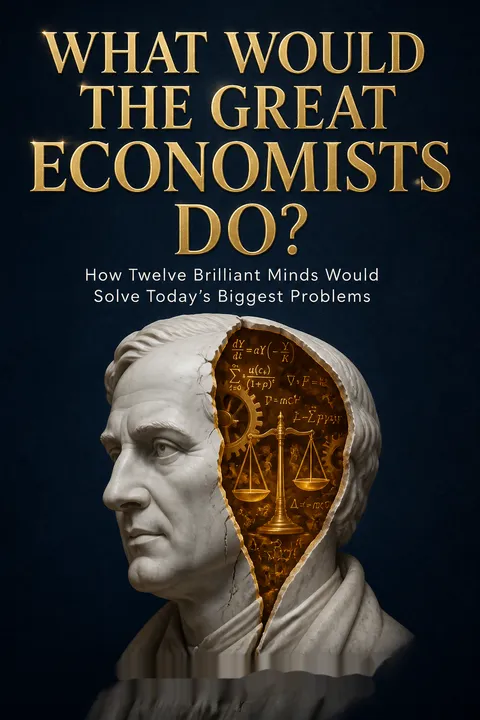
What Would the Great Economists Do? receives generally positive reviews for its accessible introduction to major economic thinkers and their ideas. Readers appreciate the biographical details and historical context provided for each economist. The book's approach of applying these theories to modern economic issues is praised, though some feel it falls short of fully exploring solutions. Critics note the narrow focus on growth-oriented economics and lack of environmental considerations. Overall, reviewers find it an informative overview for those interested in economic history and theory.
People Also Read





Glossary
invisible hand
market coordination through pricesAdam Smith's term for the unintended coordination that can emerge when people pursue their own interests within competitive markets. Prices help signal what is scarce and wanted, guiding producers and consumers without a central authority directing every decision. Smith's view still assumed rules and public functions, including education, infrastructure, and justice.
comparative advantage
specialize by relative efficiencyRicardo's principle that countries can benefit from specializing in goods they produce at lower relative cost and trading for other goods. A country may gain even if another country can produce every item using fewer resources. The theory explains potential gains in total output, but does not guarantee that gains are shared equally.
surplus value
value beyond workers' wagesMarx's account of how capitalist production generates profits from the difference between the value produced by workers and the wages they receive. Marx argued that mechanization and competition could increase pressure on wages and employment, intensifying conflict between workers and owners. This process formed part of his explanation for capitalism's instability.
monopsony
employer power over wagesJoan Robinson's term for a labour market in which an employer has enough power to influence pay and employment conditions. When workers have few alternative employers or face obstacles to changing jobs, the employer may pay less than the value of their output. Robinson used the concept to explain wage gaps that perfect competition cannot.
debt-deflation
falling prices magnify debtIrving Fisher's theory of how attempts to repay excessive debt can deepen a downturn. Borrowers sell assets, pushing prices down. Falling prices increase the real burden of remaining debts, leading to more distressed sales, defaults, and reduced spending. The resulting contraction can make repayment even harder and weaken banks and businesses.
financial accelerator
financial shocks amplify downturnsA mechanism linking asset prices, borrower creditworthiness, and lending. When asset values fall, borrowers have less collateral and their net worth declines. Lenders then face greater risk and restrict credit, which reduces spending and investment and can push asset values lower still. Ben Bernanke used this reasoning to explain how financial crises spread into the wider economy.
paradox of thrift
more saving can reduce savingsKeynes's explanation of why an economy can weaken when everyone tries to save more at once. Increased saving reduces consumption, lowering sales and output. As incomes fall, the total amount people can save may also fall. The paradox is especially relevant when private investment is too weak to replace reduced consumer spending.
creative destruction
innovation replaces older businessesSchumpeter's account of economic change in which new products, technologies, markets, and organizations displace established firms and industries. The process can raise productivity and living standards while causing losses for companies, workers, and communities tied to older activity. Access to credit and room for experimentation help new ventures emerge.
spontaneous order
order without central directionAn idea associated with Hayek's Austrian School: social and economic coordination can emerge from individual decisions made under shared rules, without a central planner designing the whole system. Prices help people adjust to information they do not all possess. The concept depends on a framework of law, exchange, and recognized property.
path dependence
history shapes future choicesNorth's concept that past institutional arrangements influence present incentives and constrain future reform. Formal laws can change quickly, but customs, enforcement practices, and groups that benefit from existing rules may persist. A country can become caught in a reinforcing cycle of productive or damaging institutions, making its economic direction difficult to change.
institutions
rules governing social exchangeIn North's specialized use, institutions are the formal rules and informal norms that structure interaction in a society. They include laws and property rights, as well as customs and codes of conduct. Institutions reduce uncertainty and shape the costs and rewards of economic activity, influencing whether people invest, innovate, cooperate, or seek political privilege.
Solow residual
unexplained growth contributionThe portion of measured economic growth not attributed to increases in labour and capital in Solow's growth accounting. It is often treated as a measure of technological progress, but it also captures other influences not separately accounted for, including measurement errors. It identifies an unexplained contribution rather than explaining exactly what caused it.
secular stagnation
persistently weak economic growthA condition of prolonged slow growth associated in the book with factors such as ageing populations, weak investment, and persistently subdued demand. The term was used in the 1930s and revived in debates about the post-crisis economy. It describes a risk of long-lasting weakness, not a claim that stagnation is unavoidable.
factor-price equalization
trade pressures wages toward convergenceSamuelson's theorem linking international trade to the prices paid for production inputs, especially wages. When countries trade goods, prices of those goods may move closer together, putting pressure on wages in the industries producing them to converge as well. This helps explain why trade can benefit a country overall while disadvantaging particular workers.
Download PDF
Download EPUB
.epub digital book format is ideal for reading ebooks on phones, tablets, and e-readers.








