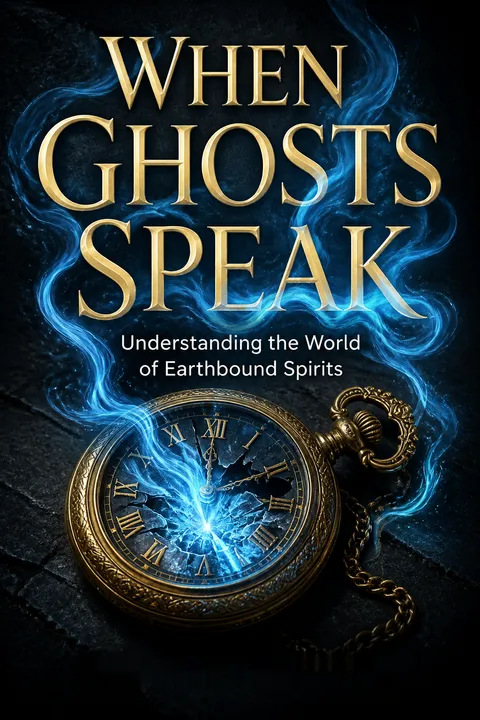


Key Takeaways
Treat earthbound spirits as familiar personalities, not upgraded horror villains.
People remain themselves. Winkowski describes earthbound spirits as deceased people whose personalities, preferences, and grudges persist. In her account, they are usually recognizable human figures, not monsters, and death does not grant them wisdom or superpowers. Her opening story with actress Jennifer Love Hewitt illustrates the point: one spirit was a former high-school acquaintance who had stalked Love while alive and still watched her after death. Winkowski says his family later confirmed that his room had been covered with Love's photographs.
Separate kinds of spirits. The book distinguishes earthbound spirits, who have not crossed into the Light, from spirits who have. The latter, in Winkowski's model, can return with comfort or messages, while earthbound spirits remain attached to earthly concerns.
The continuity of personality gives the book a humanizing frame: the dead are not automatically evil, wise, or morally transformed. That framing can reduce panic and discourage treating every unexplained event as an attack. It also resembles a familiar idea in psychology: habits and character tend to persist across changing circumstances. The important distinction is evidentiary. The stalker story is compelling testimony, but the family's later confirmation does not independently establish that a spirit caused the experience. The human-scale interpretation is useful even for readers who regard the supernatural explanation as unproven.
Check wiring, health, and ordinary causes before blaming a ghost.
Rule out the mundane. Winkowski warns against making a ghost the explanation for every misfortune. Flickering lights, strange noises, cold rooms, and broken appliances can have ordinary causes. On one day of house calls, she visited three homes where owners expected her to find spirits. She found none; one caller needed an electrician, not a paranormal investigator. The book's central practical test is to consider whether unexplained problems cluster together, rather than treating one odd event as proof.
Notice the pattern. Winkowski says people often describe a general sense that something is wrong, but she also stresses that bad luck happens without supernatural causes. Clearing a home, in her terms, would only remove a supposed source of interference, not guarantee a sudden windfall or solve every problem.
This is the book's most transferable discipline: investigate competing explanations before settling on a dramatic one. A faulty circuit, poor sleep, illness, or stress can produce experiences that feel eerie without requiring a paranormal cause. The same principle appears in clinical diagnosis and engineering troubleshooting: check common failure points before invoking rare ones. Winkowski's insistence on not claiming a ghost when she sees none is a valuable restraint within her own framework. The limitation is that a cluster of symptoms still cannot establish a haunting; patterns can also emerge by chance or through shared ordinary causes.
Do not feed a frightening encounter with the reaction it seeks.
Emotion becomes fuel. In Winkowski's model, ghosts need energy, especially the emotional energy of living people. She says a spirit may disrupt an appliance, notice the anger that follows, and repeat the behavior because the reaction sustains it. She distinguishes this from drawing power directly from household electricity. The practical response she recommends is to stay calm, avoid shouting at a spirit, and not stage attempts to provoke it.
Attention can escalate. One woman confirmed that a spirit lived in her home, then held a séance with friends to make it communicate. The lights flickered, a table tipped, and glasses shattered. By Winkowski's next visit, the spirit seemed far more active. The story supports her warning: deliberately dramatizing a feared presence may intensify the household's distress, whatever the cause.
The proposed energy transfer is supernatural, but the behavioral loop is recognizable: an alarming event attracts attention, attention increases arousal, and heightened arousal makes further events feel more salient. In ordinary settings, repeatedly testing a fear can reinforce vigilance rather than resolve it. Calm observation is therefore a sound response even without accepting the ghost explanation. A useful safeguard is to record what happened and check mundane triggers instead of deliberately provoking another incident. Otherwise, the advice to ignore a problem could delay fixing an electrical fault or addressing a real safety risk.
Treat crossing over as release from fear, not a forced verdict.
The Light is an invitation. Winkowski describes a white Light as the route spirits can take after death. She says it appears at death and, in her observations, remains for roughly 72 to 80 hours after the final memorial service. In her account, some spirits miss that opportunity and remain earthbound. She believes a person can choose whether to enter, and that people who cross over regain their most vital appearance.
Fear can be addressed. One elderly spirit resisted leaving because she feared her deceased husband would no longer find her attractive. Winkowski reassured her that she would return to her younger appearance, and the woman entered the Light. Other spirits fear punishment, separation, or judgment. The author's approach is to listen for the specific fear, offer reassurance, and avoid treating departure as a sentence imposed by the living.
The scene with the elderly woman makes an abstract afterlife belief emotionally legible: her hesitation is about love and self-image, not theology alone. In many traditions, rituals of transition work partly by giving people a story that makes loss less frightening. Still, the book's precise timetable and claims about what happens beyond death come from Winkowski's reported experience, not independently verifiable evidence. The most broadly useful element is the method of responding to fear with patience rather than pressure. That same method can help living people facing bereavement, even when they interpret the afterlife differently.
Ask what a spirit is attached to before demanding it leave.
Attachments explain resistance. Winkowski says spirits may remain because of a place, a possession, unfinished business, revenge, curiosity, or a desire to protect someone. In her view, death does not erase a person's habits: a collector may cling to objects, and a controlling person may remain invested in a home. She often tries to understand the attachment before asking the spirit to go.
Small details can matter. Two close couples began arguing after buying watches at auction. Winkowski says the previous owner had followed the watches because he worried that each piece was stored in the wrong box. Once the women switched the boxes, he agreed to leave. Another spirit followed a beloved car and tried to drive its new owner's wife away. These stories make the author's method resemble mediation: uncover the grievance, address it, then seek agreement.
The stories turn haunting into a problem of attachment and unresolved conflict, which is a useful interpretive move even outside the book's spiritual claims. In conflict resolution, people often argue over visible objects or actions while the underlying concern is recognition, control, or loss. Asking what a person cannot let go of can reveal that deeper issue. The caution is not to let a neat explanation replace verification. The watch story is presented as a spirit's account, and the changed boxes do not prove that the spirit caused the household arguments. Still, the mediation model is humane and specific.
Grief can keep the dead close, but love may require release.
The living can hold on. Winkowski describes a young father who remained earthbound after his wife begged him not to leave. Months later, the wife called again because the household was struggling and the children were affected. She then gave him permission to cross over, despite the pain of letting go. In the author's account, the spirit's wish to comfort his family had become entangled with the family's grief.
Consent matters. Winkowski says she advises families but does not claim final authority over either the living or the dead. She will not make the Light when a homeowner refuses permission, and she recognizes that grief can complicate a spirit's decision. Her stories repeatedly show the value of asking what the bereaved person wants, while also considering whether keeping someone close is helping or deepening distress.
This section's emotional insight does not depend on believing that spirits remain in homes. Bereavement often includes a powerful wish to preserve connection, and a person can experience continuing bonds through memory, ritual, or dreams. The story usefully distinguishes love from possession: supporting the dead person's imagined welfare may mean accepting separation. At the same time, framing illness or family difficulty as the effect of a deceased relative could intensify guilt in vulnerable mourners. The safest reading keeps the compassion and consent at the center without treating suffering as evidence that a loved one's spirit is causing it.
Take children's reports seriously without declaring every imaginary friend supernatural.
Listen without frightening them. Winkowski believes children can be unusually sensitive to spirits and argues that an imaginary companion should not be dismissed automatically. She recounts meeting Suzy, a child spirit who frightened a four-year-old girl and threatened to burn the home. Suzy had stayed because she feared her dead parents would punish her. Winkowski says she reassured the child spirit and helped her leave.
Keep a grounded response. The author also describes spirits of children seeking homes where they can be around other children, since they remain the age at which they died. Her practical lesson is to notice when a child becomes frightened, withdrawn, or unwilling to enter a room, and to ask calmly what is happening. The child's feelings deserve attention whether the explanation is an imaginary friend, ordinary fear, or something the family cannot explain.
The strongest advice here is relational: do not ridicule a child's fear, and do not rush to impose an explanation. Developmental psychology recognizes that imaginative play can be vivid, while a child's distress is still real regardless of what caused it. A parent can ask open questions, make the child feel safe, and check for practical sources of fear without labeling the experience paranormal. The book's certainty about child spirits goes beyond the evidence it presents. Taking a report seriously should mean careful listening, not confirming a supernatural cause or increasing a child's anxiety.
Treat messages from the dead as leads, never as proof.
Claims need checking. Winkowski recounts sharing information from spirits with law-enforcement contacts, including names and details that she says helped investigators pursue cases. She also stresses that information from a spirit cannot serve as evidence in court and must be independently verified. In one case involving a missing child, information she passed along had already been withheld by federal investigators. She was then watched as a possible suspect because she appeared to know confidential details.
Protect the living. A story can be compelling and still be wrong, incomplete, or impossible to confirm. Winkowski says she must consider the consequences before repeating a spirit's accusation, especially when a living person could be harmed. Her own experience shows why restraint matters: details should be checked through ordinary investigative procedures, and unverifiable claims should not be treated as a verdict.
This is an essential safeguard for any claim presented as hidden knowledge. In law, a lead is a reason to investigate, while evidence must be obtained and tested through procedures that allow scrutiny. The distinction also protects grieving families from accusations that cannot be substantiated. Winkowski's account of becoming a suspect demonstrates that even information believed to be paranormal can have serious real-world consequences. The standard should be especially high when a claim implicates someone in a crime. Curiosity may justify checking a detail; it cannot justify conviction, public accusation, or bypassing due process.
Avoid summoning rituals, and use protective practices with clear-eyed caution.
Do not invite what you fear. Winkowski warns against Ouija boards, séances, automatic writing, and rituals intended to summon spirits. She says these practices may attract earthbound spirits rather than the deceased relative someone hopes to contact. She also cautions against yelling at spirits or casually using holy water, which she believes can escalate conflict. Her advice is to seek a trusted, experienced religious or spiritual adviser rather than improvising a dramatic ritual.
Know what is being claimed. The author's protective practices include visualizing white Light, using sea salt, smudging with herbs, and carrying energized quince seeds. She says those seeds can block spirits from entering, but also warns that placing them in a home before spirits are gone could trap them. These are practices from her spiritual framework, not established methods for verifying or controlling paranormal activity.
The practical core is a warning against escalation: frightening yourself, staging a séance, or treating a suspected presence as entertainment can increase distress. The specific protective objects and rituals are different. Their claimed effects are not established by the accounts in the book, and readers should not mistake a ritual for a substitute for repairing a faulty appliance, seeking medical care, or leaving an unsafe environment. The book's caution about not trapping a supposed spirit is internally consistent, but it also shows why people should avoid experimenting with methods whose effects they cannot verify.
Separate ordinary haunting claims from danger that needs expert care.
Different problems need different responses. Winkowski distinguishes earthbound spirits from what she calls dark entities, which she believes are nonhuman and rare. She also distinguishes both from curses, which she defines as negative energy placed by a living person. These categories are part of her spiritual model, not interchangeable explanations for strange events.
Do not diagnose possession alone. The author notes that experiences she associates with possession can resemble mental illness and says a layperson cannot reliably tell the difference. She recommends seeking guidance from a trusted religious adviser for alleged dark entities and does not encourage people to confront them alone. For anyone experiencing voices, severe fear, or physical symptoms, the sensible first step is also to seek qualified medical or mental-health assessment, rather than assuming a supernatural cause.
The book's clearest safety boundary appears here: unusual experiences should not be used to diagnose possession or dismiss mental illness. That restraint matters because fear-based explanations can delay care and increase isolation. The author's categories may help her organize her own experiences, but they are not clinical or scientific classifications. A careful reader can preserve the distinction between ordinary grief, medical symptoms, alleged spiritual phenomena, and immediate danger without treating any single account as a diagnosis. When symptoms are intense or persistent, qualified health professionals are a more reliable first contact than paranormal interpretation.
Analysis
When Ghosts Speak is best read as a memoir of a claimed ability and a practical guide built from the author's accumulated case stories, rather than as an empirical investigation of whether ghosts exist. Its narrative strength lies in the contrast between Hollywood horror and ordinary human motives: a dead person may be nosy, possessive, anxious, or kind, but does not automatically become a monster or a sage. That premise lets Winkowski tell stories that are at once eerie and domestic, involving a missing checkbook, an antique watch, or a grieving family.
The book is most persuasive when it recommends restraint. Winkowski says not to blame every misfortune on spirits, to check ordinary causes, to avoid provoking a feared presence, and to verify information before repeating accusations. Her accounts of working with police make the stakes plain: an unverified claim can affect investigations and innocent people. These cautions are more reliable as general advice than her explanations of energy, curses, or the afterlife.
The central epistemic limitation is that vivid anecdotes cannot establish paranormal causation. An event occurring alongside a claimed haunting does not show that a spirit caused it, and a later confirmation of a detail does not validate the full interpretation. The book offers little systematic comparison with nonparanormal explanations, and its proposed signs, such as fatigue or headaches, are broad enough to fit many ordinary conditions. Readers should therefore distinguish the author's testimony from independently established knowledge.
That distinction need not erase the book's human value. Its best stories are about grief, attachment, fear, and the desire to resolve unfinished business. Those themes can be understood spiritually, psychologically, or metaphorically. A grounded reading keeps the compassion and practical cautions, while seeking medical, electrical, or legal expertise where appropriate and treating supernatural claims as claims, not proof.
Review Summary
When Ghosts Speak receives mixed reviews, with readers praising its fascinating stories and down-to-earth approach to the paranormal. Many find Winkowski's accounts of communicating with earthbound spirits intriguing and comforting. Critics appreciate her matter-of-fact style but question some of her claims and advice. Some readers express skepticism about her abilities, while others find validation for their own experiences. The book's practical tips for dealing with spirits and its insights into the afterlife are generally well-received, though some find the content repetitive or lacking in depth.
People Also Read
Glossary
earthbound spirits
Spirits not yet crossed overWinkowski's term for deceased people who have not entered the white Light and remain connected to earthly places, possessions, or concerns. In her account, they retain their living personalities and do not gain higher knowledge simply by dying. She distinguishes them from spirits who have crossed into the Light and may return to visit or communicate.
white Light
A passage after deathThe bright spiritual presence that Winkowski says accompanies people at death and offers them a route to leave earthly existence. She describes spirits entering it by choice and believes they can be helped to find it if they remain earthbound. Her use of the term is a spiritual belief based on her reported experiences, not an empirically verified description of the afterlife.
negative energy
Harmful emotional or spiritual forceWinkowski's broad term for a harmful influence that may come from hostile thoughts, a curse, or the presence of an earthbound spirit. She associates it with difficulties in health, relationships, mood, or surroundings. The book treats energy as transferable and sometimes removable through spiritual practices, while not defining a measurable physical quantity.
quince seeds
A claimed protective charmSeeds from the quince fruit that Winkowski says her relatives specially energize to keep earthbound spirits from entering a space. She recommends placing them over doorways only after a home has been cleared, because she believes they could trap a spirit already inside. She also suggests carrying them as protection in places likely to attract spirits.
malocchio
Italian evil eye curseAn Italian term for the evil eye, a form of curse or harmful influence that Winkowski says her grandmother's family was known for removing. The book places it within a broader category of culturally specific curses, understood by the author as negative energy directed at a person or object.
portal
An alleged spirit passageIn Winkowski's account, an energy opening between the human world and the spirit world that allows spirits to enter and leave a place. She says some rituals and symbols may create portals, sometimes unintentionally. The term describes her spiritual framework, rather than a scientifically established physical structure.
walk-ins
Spirits entering a revived bodyWinkowski's term for spirits she believes may enter a body during a period when its original occupant is near death or unconscious. She associates the idea with people who are resuscitated after being thought dead and later display marked changes in preferences or behavior. The explanation is a paranormal interpretation, not a medical account of resuscitation.
Old World curses
Ritualized, object-linked cursesWinkowski's category for curses that she says are deliberately placed through specific rituals, often by directing harmful energy into an object made of metal or stone. She believes the object can continue affecting its owner from a distance. She contrasts these with negative energy that accumulates through repeated hostile thoughts or feelings.
Download PDF
Download EPUB
.epub digital book format is ideal for reading ebooks on phones, tablets, and e-readers.








