

Key Takeaways
Protect your calling from people who turn compassion into endless distraction.
Compassion needs direction. Gary Thomas argues that loving people does not mean giving every person unlimited access to your time, attention, and emotional energy. His opening story follows Greg, whose coworker Aaron spreads gossip, lies, and intimidates anyone who challenges him. Greg’s distress follows him home, eroding his health and presence with his family. The author recognizes his own role in the pattern: he kept trying to appease destructive people while neglecting healthier relationships and meaningful work.
Defense serves the mission. Thomas frames boundaries not as permission to become uncaring, but as protection for the work and relationships that matter. His Christian starting point is service to God, not self-protection alone. In this view, stepping back can be responsible stewardship rather than selfishness.
The central shift is from asking, “How can this person be made happy?” to asking, “What is this relationship consuming?” That question resembles opportunity-cost analysis: every hour spent managing one relationship is unavailable elsewhere. The book’s religious framework gives that calculation moral weight by treating care as a finite resource entrusted to a purpose. Still, the language of mission can be misused to excuse avoidance. The test is not whether an interaction feels inconvenient, but whether a repeated pattern is damaging responsibilities, health, or other relationships.
Judge toxicity by repeated harm, control, and refusal to engage honestly.
Hard is not toxic. Thomas distinguishes a genuinely destructive pattern from ordinary conflict, personality differences, or someone’s initial resistance. He describes common signs: manipulation, persistent blame, attempts to control, malicious attacks, and an appetite for conflict. One example is Samantha, a student whose constant accusations and demands pushed several roommates out of their shared suite. Andrea tried to appease her, apologized for things she had not done, and lost much of her first college year to the turmoil.
Notice the pattern’s cost. Thomas suggests observing whether contact repeatedly leaves someone depleted, preoccupied, fearful, or less available to healthy relationships. These effects can justify distance without establishing a psychiatric diagnosis. Toxicity, in his framing, can appear in different combinations rather than one fixed checklist.
The emphasis on patterns is valuable because a single cruel outburst does not define a person, while a recurring pattern can become dangerous even when each episode seems explainable on its own. Behavioral science similarly distinguishes an isolated incident from a stable pattern across time and context. The book also cautions that some people behave harmfully only in close relationships, so an agreeable public image proves little. The limitation is that personal distress alone cannot identify who is at fault. Outside perspective can help test interpretations without dismissing the person seeking help.
Follow Jesus by leaving some encounters without chasing approval.
Leaving can be faithful. Thomas counts forty-one Gospel episodes in which Jesus withdrew, let someone depart, or sent people away. Some accounts overlap, but he identifies more than two dozen distinct occasions. Jesus left to avoid violence, find time for prayer, continue his work elsewhere, or stop arguing with people who had closed themselves to his message. When a wealthy young man rejected Jesus’ challenge and walked away, Jesus did not bargain with him or pursue him.
Rejection is not failure. The book’s point is not that every disagreement calls for withdrawal. Rather, even Jesus did not persuade everyone, and he did not let another person’s response control his entire schedule. Thomas presents retreat as one possible way to preserve both purpose and well-being.
The example challenges the common assumption that moral seriousness requires endless availability. In practical terms, a person who cannot accept another’s refusal may turn care into pressure, and a conversation into a contest for control. Yet Jesus’ choices arise within a particular theological story and cannot automatically settle every modern relationship. The useful lesson is narrower: persistence is not always virtuous, and withdrawal need not signal indifference. The reasons for leaving, the risks involved, and any responsibilities to dependents still matter.
Invest deeply in people who can receive help and pass it onward.
Choose investments carefully. Thomas calls those he prioritizes “reliable people,” drawing on 2 Timothy 2:2: people who can receive what they are taught and teach others. Jesus serves many people, but he also devotes sustained attention to his disciples. Thomas connects this pattern to Nehemiah, who refused repeated attempts to pull him away from rebuilding Jerusalem’s wall. The work was completed in fifty-two days despite the opposition.
Resistance is not a verdict. Rosaria Butterfield initially opposed Christianity, but she engaged in thoughtful conversations with pastor Ken Smith and remained open to learning. Their patient friendship eventually led her to faith. The distinction is not agreement versus disagreement; it is whether an exchange has honesty, curiosity, and room for growth. Focused investment can coexist with generosity to strangers and people in crisis.
This approach resembles mentorship models in which knowledge travels through trusted relationships rather than remaining with one expert. It also guards against a false binary: either serve everyone equally or reject people who are difficult. Butterfield’s story demonstrates why receptivity matters more than ideological similarity. At the same time, the word “reliable” should not become a code for compliant or already convinced. A healthy mentor invests in teachability and integrity, not merely in people who affirm the mentor’s views.
Use labels to understand behavior, never to damage someone’s reputation.
Names can clarify. Thomas argues that privately recognizing a harmful pattern can help someone stop blaming themselves and choose a safer response. Alicia, for example, had treated an abusive marriage as an ordinary marital problem and blamed herself when standard advice failed. A more accurate description helped her understand why those strategies were not working. Thomas distinguishes this kind of practical labeling from name-calling, which aims to humiliate or discredit.
Speak with restraint. He warns against amateur psychiatric diagnoses and describes detraction as damaging someone’s reputation through unnecessary criticism. In his account, discussing a concern is appropriate when it helps someone respond wisely or protects a person at risk. Spreading accusations to people who are neither part of the problem nor able to help is gossip, not discernment.
A label can function like a map: it helps explain why familiar strategies fail and identifies a different route. But maps simplify, and a label can harden into a verdict that blocks new evidence. The distinction between understanding and smearing is therefore essential. A careful description sticks to observable behavior, its effects, and needed safeguards, rather than claiming certainty about another person’s inner life. This makes the insight useful beyond religious settings, including workplaces and families where reputational harm can outlast the original conflict.
Set limits without becoming the controller, prosecutor, or rescuer.
Keep control of yourself. Some relationships cannot be ended immediately because of work, family, or financial ties. Thomas uses Jesus’ relationship with Judas as a model: Jesus knew Judas was stealing and would betray him, yet did not make stopping Judas’s every sin his mission. He remained honest about the betrayal without becoming hateful or manipulative himself. This approach also means resisting the urge to investigate or correct every flaw in a coworker or relative.
Make boundaries concrete. Mike, who worked with a manipulative business owner, refused a large cash gift intended to secure his loyalty and directly identified the manipulation. The broader advice is to limit access, communicate clearly, and seek help when stakes are high. When abuse could escalate, especially in a marriage, the book urges involving experienced support rather than confronting the person alone.
The distinction between self-governance and controlling another person is a strong ethical anchor. It shifts attention from winning a power struggle to deciding what contact, information, or assistance is safe to offer. Boundaries work best when they describe the speaker’s own action, not a threat to force another person’s behavior. The Judas example should not be read as a demand to tolerate preventable harm: responsibilities to children, colleagues, or vulnerable people may require intervention. The book’s insistence on support in dangerous situations is therefore crucial.
Honor family without making blood ties more important than safety.
Family love has limits. Thomas argues that Christian allegiance to God outranks loyalty to relatives, while acknowledging how painful that can be. He describes Austin, who refused to leave his children alone with parents who had abused him and whose behavior still raised safety concerns. His parents invoked forgiveness to challenge the boundary, but forgiveness did not require giving them unsupervised access to the children.
Let adults own their choices. The same principle applies to adult children. Shanice repeatedly abandoned her work and marriage to rescue a daughter whose crises continued without meaningful change. Thomas urges parents to remain open to a returning child while not fighting every battle on that child’s behalf. He also distinguishes a parent who sometimes behaves badly from one whose repeated behavior makes close contact unsafe.
Family systems can make boundaries feel like betrayal because each person’s choices affect the group. The book counters that pressure by treating safety and responsibility as more important than appearances of unity. Its distinction between care and rescue is especially useful: support can preserve a person’s agency, while repeatedly removing consequences can unintentionally sustain a harmful pattern. Still, stepping back should not be confused with abandoning a dependent child or someone in immediate danger. The relevant question is what kind of help protects life without taking over another adult’s responsibility.
In marriage, protect people before protecting the institution.
Difficulty is not abuse. Thomas separates the ordinary hardship of two imperfect people learning to love from a destructive pattern marked by unrepentant control, cruelty, or violence. Darin and Lesli’s marriage improved when both began owning their behavior and changing it. In contrast, Christine endured a husband’s humiliation, infidelity, and physical aggression despite years of counseling. Leaving the relationship eventually restored her safety and ability to serve others.
Start with safety. The book says immediate protection comes before deciding the marriage’s long-term fate. Separation may be temporary or permanent, and any step that could provoke violence should be planned with experienced help. Promises of change are not enough; repentance must be tested through sustained behavior. Thomas warns against treating the formal survival of a marriage as more important than the lives of the people inside it.
The distinction between a strained relationship and coercive abuse is indispensable, especially in communities that treat endurance as the highest marital virtue. Research and clinical practice also emphasize that separation can be a high-risk period for an abused partner, reinforcing the need for safety planning and specialist support. The book’s argument is strongest when it refuses to issue a universal divorce rule and instead prioritizes safety and observable change. Its religious readers may still need independent legal and clinical guidance, since pastoral counsel alone cannot manage every danger.
Test criticism carefully instead of calling every opponent toxic.
Opposition has different motives. Thomas describes Christians who use religious language to shame others into compliance, but he also warns that disagreement is not proof of malice. A person may be sincerely concerned, or may be trying to silence and derail someone. The difference appears in the quality of engagement: whether the critic listens, addresses specific claims, and allows an honest reply, or persistently seeks control and humiliation.
Stay open to correction. The book presents courage and humility as necessary partners. A trusted, mature person may notice a real failure that an adversary has also criticized. Christians should not dismiss every rebuke as persecution, especially when their own conduct may be harsh or self-righteous. Thomas’s broader standard is to pursue truth without retaliation and to consider who is speaking, what they are asking, and whether the criticism is accurate.
This is an important corrective to a framework that can otherwise become self-sealing: anyone who challenges the boundary can be labeled toxic, and the label can then dismiss the challenge. The distinction between critique and derailment is best assessed through evidence, not presumed motives. Specific examples, independent observers, and a willingness to revise one’s view all reduce the risk of confusing accountability with attack. The book’s Christian emphasis on humility is not a decorative caveat; it is what keeps self-protection from becoming self-righteousness.
Stop toxicity at its source by changing how you treat yourself and others.
Transformation starts inward. Thomas closes with Doug, a man whose anger and appetite for conflict damaged his marriage, work, and friendships. Through Christian community and a renewed faith, Doug began replacing outbursts with listening, patience, and apologies. His life improved not because he learned to control everyone else, but because he became more responsible for his own responses. Thomas connects this change to the biblical contrast between rage and malice on one side, and compassion and gentleness on the other.
Do not become your own bully. Sofia’s stress led her to speak to herself with contempt after difficult days. She began noticing small successes instead of treating shame as motivation. Thomas’s spiritual answer is to locate worth in being loved by God, rather than in perfect performance or other people’s approval.
The book’s final turn prevents boundary-setting from becoming a one-way moral exercise. Anger often protects more vulnerable feelings, such as fear or shame; learning to name those emotions can create choices that retaliation forecloses. Self-compassion can support accountability because a person who is not busy defending against self-contempt may be more able to admit harm and repair it. The religious language of divine acceptance supplies a stable source of worth for this process. It does not remove the need to make amends or change behavior.
Analysis
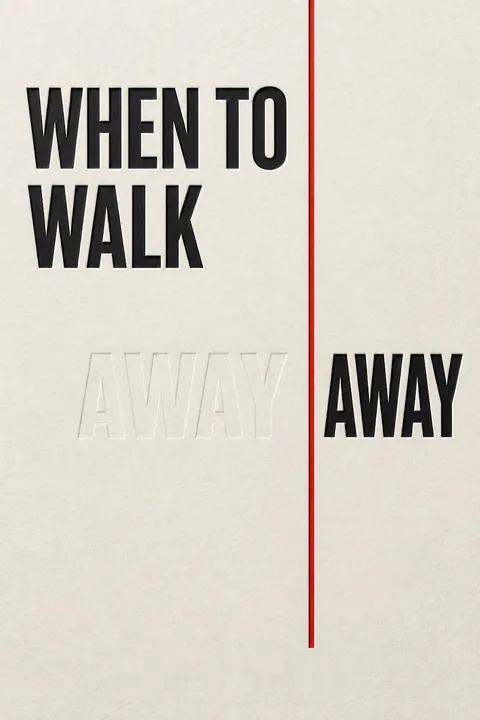
When to Walk Away is a Christian pastoral guide to boundaries, built from biblical interpretation, personal confession, and case histories. Its governing claim is that love is not identical to access: a person can wish another well while limiting contact, refusing manipulation, or leaving an unsafe relationship. Thomas makes that claim most persuasive through the contrast between Jesus’ repeated withdrawals and Christian habits of people-pleasing. He also redirects the purpose of boundaries from personal comfort alone toward protecting service, relationships, and responsibilities that can bear fruit.
The book’s greatest strength is its attention to the social cost of misapplied virtue. Calls to forgive, remain patient, or preserve a marriage can become tools that keep victims isolated when applied without attention to coercion, safety, and repentance. Thomas’s distinction between difficult and destructive relationships, together with his emphasis on safety planning, offers an important corrective. His examples also show that resistance is not automatically toxicity: a thoughtful skeptic may be more open to engagement than a religious critic who seeks only control.
The framework carries risks. “Toxic” is a broad, morally charged label, and the stories often present one person’s account rather than a fully investigated clinical or legal record. The book acknowledges the danger of overusing labels, but readers still need methods for checking their own interpretations. Observable patterns, trusted outside counsel, professional expertise, and attention to power differences are important safeguards. The Christian language of mission can also encourage self-sacrifice, so it is most helpful when paired with the book’s strong insistence on safety and personal responsibility.
The result is not a universal instruction to cut off difficult people. It is a permission structure for discerning when engagement has stopped helping, and a discipline for withdrawing without becoming vindictive. Its most durable test is reciprocal: protect against another person’s destructive behavior while remaining willing to examine one’s own.
Review Summary
When to Walk Away by Gary Thomas explores dealing with toxic people from a Christian perspective. Readers found it insightful and biblically grounded, appreciating Thomas's balanced approach to defining toxicity and providing guidance on when to disengage. Many wished they had read it earlier in life. Some critics felt the writing was disorganized or repetitive at times, and a few disagreed with certain interpretations of scripture. Overall, most readers highly recommended the book, finding it freeing and helpful for navigating difficult relationships.
People Also Read







Glossary
toxic person
Destructive relational patternIn this book, a toxic person is not simply difficult, sinful, or disagreeable. The term describes someone whose repeated conduct harms relationships, drains another person’s capacity, obstructs meaningful responsibilities, or involves patterns such as control, malicious blame, and attacks. Thomas advises readers to focus on behavior and its effects, not to make amateur mental health diagnoses.
reliable people
People ready to growThomas uses this term for people who can receive what is invested in them and pass it on to others. It draws on 2 Timothy 2:2 and describes a focus for sustained mentorship and teaching. Reliability does not mean agreement with every belief: the book’s example of Rosaria Butterfield shows that honest curiosity and openness can matter more than initial agreement.
Scripture’s skeleton
Creation, fall, redemptionThomas’s phrase for reading relationships through three connected biblical themes: creation, which presents human life and institutions as good; the fall, which explains how evil can corrupt them; and redemption, which offers hope and a call to resist harm. The framework warns against treating marriage, parenting, or authority as immune to abuse simply because they are good in principle.
spiritual triage
Prioritizing limited careA metaphor for deciding where limited time and energy can do the most good. Thomas argues that persistent engagement with someone who rejects help may prevent attention to people who are open to growth or in urgent need. The analogy does not make a person’s worth conditional; it distinguishes human worth from the practical decision about where a particular helper can be effective.
detraction
Reputation-damaging criticismA term Thomas uses for speech intended to diminish another person’s reputation. He distinguishes it from sharing concerns to understand a harmful situation, seek appropriate counsel, or warn someone at risk. Detraction harms the person speaking, those who approve or spread the claim, and the person being discussed. The practical test is whether the listener has a role in solving the problem.
law of sowing and reaping
Choices bring consequencesThomas’s term for the principle that actions produce consequences that can teach or confront a person more effectively than repeated rescuing. In a relationship, a boundary may mean no longer covering for dishonest or abusive conduct. The idea is not revenge: the aim is to stop shielding someone from the effects of their choices while leaving room for change.
FAQ
1. What is When to Walk Away: Finding Freedom from Toxic People by Gary L. Thomas about?
- Core focus on toxicity: The book explores how Christians can identify, confront, and find freedom from toxic people while remaining faithful to biblical truth and love.
- Biblical foundation: Gary L. Thomas uses Scripture, especially Jesus’ own actions, to show that walking away from toxic situations is sometimes the most loving and mission-focused response.
- Mission-centered approach: The book frames dealing with toxic people as essential to protecting one’s mission to serve God, not just about personal peace.
- Practical and spiritual guidance: Real-life stories and biblical examples help readers discern toxic behavior, set boundaries, and know when to walk away for spiritual health.
2. Why should I read When to Walk Away by Gary L. Thomas?
- Unique Christian perspective: The book addresses toxicity through a biblical lens, helping believers respond in ways that honor God and protect their souls.
- Balanced approach to love: It teaches that loving well sometimes means setting boundaries or walking away, not just enduring or enabling toxic behavior.
- Practical tools and stories: Readers gain actionable advice and encouragement through real-life examples and spiritual wisdom.
- Clarity for confusion: Many Christians struggle with handling toxic people, especially in family or ministry; this book provides clarity and a path forward.
3. What are the key takeaways from When to Walk Away by Gary L. Thomas?
- Walking away is biblical: Jesus himself walked away from toxic people and situations, modeling that it’s sometimes the wisest and most loving choice.
- Mission over reputation: Protecting God’s mission and investing in reliable people is more important than defending personal reputation or engaging with toxic individuals.
- Healthy boundaries are essential: Setting limits and refusing to be manipulated or controlled is a vital part of spiritual health.
- Self-care and transformation: The book encourages readers to address their own toxic self-talk and to seek God’s grace for personal and relational transformation.
4. How does Gary L. Thomas define “toxic people” in When to Walk Away?
- Not just difficult people: Toxic people are those who actively seek to drain your joy, disrupt your mission, and cause long-term emotional or spiritual harm.
- Three main toxic traits: They often exhibit a murderous spirit (seeking to destroy), controlling behavior (manipulation), and a heart that loves hate (thriving on anger and malice).
- Toxicity is a spectrum: Not every toxic person has all traits; toxicity can manifest in different combinations and intensities.
- Hidden behind religious language: Toxicity is sometimes cloaked in Christian language or seemingly loving acts, making discernment essential.
5. What are the main biblical principles and examples used in When to Walk Away by Gary L. Thomas?
- Jesus’ example: The book highlights over 40 instances where Jesus walked away from toxic crowds or individuals, showing strategic disengagement.
- Nehemiah’s focus: Nehemiah’s refusal to be distracted by threats or false friendship demonstrates staying mission-focused amid opposition.
- Paul’s wisdom: Paul’s advice to be “as shrewd as snakes and as innocent as doves” encourages wise, discerning engagement with toxic people.
- Scripture’s skeleton: The framework of creation, fall, and redemption is used to understand the reality of evil and the Christian response to toxicity.
6. What specific methods and advice does Gary L. Thomas offer for dealing with toxic people in When to Walk Away?
- Set clear boundaries: Learn to say no, limit exposure, and refuse to be controlled or manipulated by toxic individuals.
- Invest in reliable people: Focus your time and energy on those who are trustworthy, teachable, and kingdom-minded, as Jesus did with his disciples.
- Pray and guard your heart: Use prayer to maintain peace and avoid becoming toxic yourself in response to attacks.
- Walk away when necessary: Recognize when engagement is fruitless and have the courage to disengage without guilt or retaliation.
7. How does When to Walk Away by Gary L. Thomas distinguish between “playing offense” and “playing defense” in relationships?
- Playing offense: Actively loving, serving, teaching, and spreading God’s kingdom, focusing on reliable people who will bear fruit.
- Playing defense: Protecting oneself and one’s mission from toxic attacks by setting boundaries and walking away when necessary.
- Balance is essential: Thomas admits he spent decades focusing only on offense, which left him vulnerable; learning to play defense enhances ministry effectiveness.
- Biblical mandate: Both offense and defense are necessary for faithful service, as modeled by Jesus and supported by Scripture.
8. How does When to Walk Away by Gary L. Thomas address toxic family relationships?
- Allegiance to Christ first: Jesus calls believers to place allegiance to Him above family ties, even when family members are toxic or oppose faith.
- Treat toxic relatives as healthy: Make decisions as if toxic family members were healthy, explain consequences calmly, and let their response be their responsibility.
- Grieve, don’t fix: The book encourages grieving fractured family relationships rather than trying to fix unfixable toxicity.
- God as defender: Believers are reminded that God is their ultimate defender and comforter when family relationships are painful or broken.
9. What does When to Walk Away by Gary L. Thomas say about toxic marriages and divorce?
- Distinguishing difficult from toxic: The book differentiates between difficult marriages (which can foster growth) and toxic marriages marked by unrepentant, controlling, or abusive behavior.
- Divorce as a last resort: In cases of unrelenting toxicity, divorce may be the only option to preserve life and ministry, described as a “gift of grace.”
- People over institution: God values the people in a marriage more than the institution itself; protecting individuals from harm is paramount.
- Safety first: The first concern in toxic marriages is safety and recovery; decisions about divorce come after ensuring protection and calling for repentance.
10. How does When to Walk Away by Gary L. Thomas help couples address mutual toxicity in marriage?
- Own your toxicity: Both spouses often contribute to toxicity; change begins when each owns their part and seeks God’s grace.
- Grace-based transformation: Understanding God’s love and forgiveness enables spouses to treat each other with compassion, patience, and humility.
- Patience in change: One spouse may need to lead change and wait patiently for the other to follow, recognizing that transformation is a process.
- Seek God’s heart: The key to overcoming toxicity is receiving God’s love personally and then extending that love to one’s spouse.
11. What guidance does When to Walk Away by Gary L. Thomas offer for dealing with toxic self-talk and personal toxicity?
- Toxic self-talk is harmful: Harsh, unkind words toward oneself are as damaging as external toxicity and must be addressed.
- Jesus as the hero: Toxic self-talk begins to die when we make Jesus the hero of our lives, focusing on His grace and sufficiency.
- Put on compassion: Paul’s instruction to “clothe yourselves with compassion, kindness, humility, gentleness and patience” applies inwardly as well.
- Meditate on Christ: Focusing on the beauty, love, and power of Christ is the best antidote to toxic thoughts about oneself.
12. What are the best quotes from When to Walk Away by Gary L. Thomas and what do they mean?
- “Sometimes to follow in the footsteps of Jesus is to walk away from others or to let them walk away from us.” This quote encapsulates the book’s core message that walking away can be a Christlike act.
- “You can’t be on mission if you’re always on defense.” This highlights the importance of balancing boundaries with proactive ministry.
- “God cares more about the people in a marriage than the institution of marriage itself.” This quote underscores the priority of individual well-being over maintaining appearances.
- “Invest in reliable people.” This simple directive encourages readers to focus their energy on those who are open, teachable, and supportive, rather than being drained by toxicity.
About the Author
Other books by Gary L. Thomas


Download PDF
Download EPUB
.epub digital book format is ideal for reading ebooks on phones, tablets, and e-readers.








