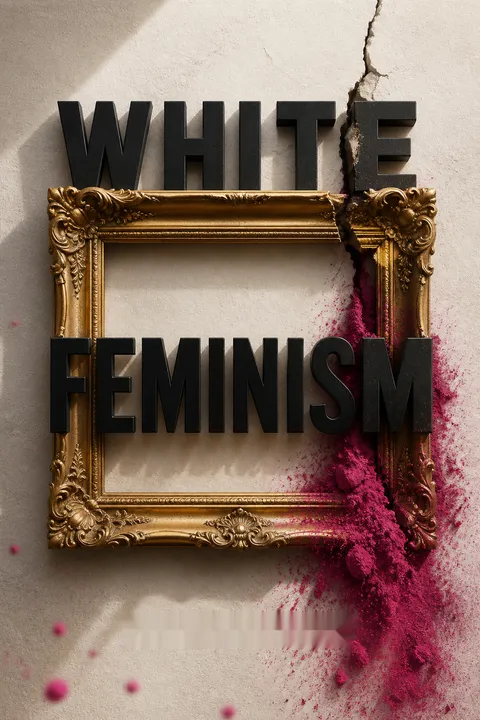


Key Takeaways
Define feminism by who gains power, not who gets a seat at the table.
Look beyond individual identity. Beck defines white feminism as an ideology that seeks gender equality through individual advancement within existing hierarchies, rather than changing who holds power and resources. It is a way of thinking, not a label reserved for white women, so people of any background can reproduce it. Its promise is seductive: a promotion, a business, or personal independence can feel like progress for everyone, even when the rules remain unchanged.
Beck opens with a workplace memory that exposes those rules. A colleague admired a magazine cover of rapper Nicki Minaj, then dismissed her as low-status. The casual insult revealed how race, class, and sexuality could still disqualify someone from a polished, corporate version of feminism, regardless of her influence or achievements.
The distinction between identity and ideology is useful because it turns a debate about personal innocence into a question about institutional effects. Who sets priorities? Who receives resources? Who is expected to adapt? Those questions are harder to answer with a slogan, but they make the argument testable. The frame also preserves an important distinction: entering institutions can matter, especially for people historically barred from them. The problem is treating access as proof of equality when advancement leaves the institution's exclusions and labor arrangements intact.
A movement can win rights for women while excluding many women.
Watch who is missing. The history of suffrage shows how a cause can speak in universal terms while narrowing its beneficiaries. For the 1913 Washington suffrage procession, organizers worried that white Southern supporters would object to Black participants. They chose segregation, directing Black women to the rear. Journalist and activist Ida B. Wells refused that placement and joined her Illinois delegation instead.
Women won the constitutional right to vote in 1920, but Jim Crow laws, intimidation, and discriminatory voting rules continued to keep many Black women from the polls. The campaign's visible victory did not mean that every woman could exercise the right. Beck connects this history to later organizations that treated race, class, and poverty as side issues rather than part of gender equality itself.
This history illustrates a recurring problem in political coalitions: a broad label can hide a narrow bargain. A movement may gain support by asking its most powerful members to postpone conflict, but that strategy can make exclusion part of the victory rather than an accidental flaw. The lesson is not that coalition is futile. It is that unity needs procedures for resolving unequal priorities, or else the group's public consensus will mainly reflect whoever can most easily threaten to leave.
Treat childcare, wages, and safety as public systems, not private puzzles.
Stop privatizing structural failures. Beck argues that advice focused on personal confidence, negotiation, and career strategy can make discrimination look like an individual's problem to solve. Sheryl Sandberg's Lean In represents this approach: it offers women ways to advance at work, while the book argues that personal tactics cannot substitute for changing workplace rules, childcare access, or leave policies. The result can be a woman blaming herself for barriers built into the system.
The same logic appears in endless essays asking whether a middle-class woman should have children. Without affordable childcare or paid parental leave, the decision is framed as personal preference, although it is shaped by the costs and risks of care work. Beck's point is not that personal agency is useless. It is that private solutions cannot make public failures disappear.
Personal advice and structural reform answer different questions. Negotiating skills can help someone navigate a biased workplace, but they do not determine whether the workplace should have biased pay, inadequate leave, or no childcare support. Treating individual and institutional action as rivals weakens both: people need tactics now, and collective pressure to change the conditions that make those tactics necessary. A useful test for any empowerment advice is whether it helps someone cope with an obstacle or helps remove it.
Organize together when institutions turn basic rights into individual burdens.
Collective action creates leverage. In 1902, Jewish housewives in New York organized a boycott after kosher meat prices rose sharply. They spread the call through their neighborhoods, and the protest grew into public demonstrations. By the end of the month, the meat trust had reduced prices. Their action treated food costs as a shared problem, not a private budgeting failure.
In 1977, disability rights activists occupied a federal building in San Francisco for 26 days, demanding enforcement rules for Section 504, a law prohibiting disability discrimination in federally supported programs. They organized committees, arranged food and medical support, and drew help from groups including the Black Panthers. The secretary signed the regulations without weakening them. Both cases show people building power by acting together around needs institutions had neglected.
The examples show that collective action is not simply many people expressing similar feelings. It requires coordination, shared demands, and practical support that lets participants remain involved. The meat boycott used economic pressure; the sit-in sustained a physical presence until officials acted. Each tactic fit its setting. Collective methods also have costs and can exclude people unless organizers plan for access, care, and disagreement. Their strength lies not in being automatically virtuous, but in making isolated complaints harder to ignore.
Count the care work that makes other people's freedom possible.
Care is still labor. Economic systems often treat cooking, cleaning, childrearing, and elder care as natural household duties rather than work with measurable costs. That omission lets some women pursue paid careers by relying on other women to perform the care they cannot do themselves. In a national survey cited by Beck, 23 percent of domestic workers, and 67 percent of live-in domestic workers, were paid below the minimum wage.
Organizers such as Ai-jen Poo built campaigns around domestic workers' own accounts of their jobs. Their organizing helped secure a New York State Domestic Workers Bill of Rights in 2010, with provisions including overtime pay, days off, and protection from discrimination and harassment. The book's challenge is direct: professional advancement is not a shared feminist victory if it rests on underpaid, unprotected care work.
Making care visible changes the accounting system, not just the language. If household labor is omitted from economic measures, the apparent productivity of a business or a professional life can depend on work that those measures never credit. That insight also warns against an easy solution: paying for care does not guarantee fair treatment for caregivers. Valuing care requires both recognition and enforceable rights, as well as a serious question about who performs it and who can afford to benefit from it.
Make inclusion mean shared control, budgets, and agenda-setting.
Representation is not authority. In the 1920s, Panamanian feminist Clara González helped build an international women's organization with American activist Doris Stevens. Stevens promoted their partnership publicly, but González and other Latin American feminists had little influence over the agenda. Stevens rejected topics such as U.S. economic power in Cuba, even though those policies shaped Cuban women's working lives. Financial control also affected who could travel to meetings and shape decisions.
The same difference between welcome and power appears in Beck's account of women's colleges. Some colleges lacked clear admission policies for trans women, and a public campaign by applicant Calliope Wong helped push schools to reconsider. Mills College adopted a trans-inclusive policy in 2014, while students also called for practical access and financial inclusion. A public statement alone cannot remove barriers to participation.
Inclusion becomes substantive when people can change decisions, not merely appear beside them. Agenda-setting, budget authority, and access to meetings reveal whether a partnership shares power or borrows someone else's legitimacy. That standard is more demanding than counting faces, but it is also more informative. Shared authority will not eliminate conflict; different groups may disagree about strategy or priority. A credible process makes those disagreements discussable instead of using a universal mission statement to conceal who gets the final say.
Audit labor practices behind every feminist brand.
A cause can become a sales pitch. Beck traces how feminism moved from suffrage merchandise to conferences, clothing, and corporate lifestyle branding. At Cosmopolitan's 2014 Fun Fearless Life event, tickets cost $99 to $399, putting the career advice and networking beyond the reach of many women. The book notes that the median wealth of single Black women and Latinas at the time was $200 and $100, respectively, compared with $15,640 for white women.
That gap matters because a purchasable image of empowerment can look universal while requiring money to enter. It can also direct attention toward products and individual success instead of labor conditions and public policy. Beck's examples include corporate feminism presented through accessories, productivity advice, and elite networking spaces. A feminist label, she argues, tells readers little about who makes the product, who gets paid, or who benefits.
The key distinction is between a message and the arrangements that deliver it. A brand can make a cause more visible, and buying from a mission-driven business may feel meaningful, but neither action by itself proves that workers share the gains. The useful audit follows value through the chain: who performs the labor, who controls the money, and who can participate without paying for access? Commercial platforms can distribute ideas widely, yet their incentives tend to reward what is easy to package and sell.
Treat a first woman CEO as a beginning, not proof of reform.
One appointment cannot reset an institution. The book describes the glass cliff, a pattern in which women and people of color are more likely to receive leadership roles when organizations are already in crisis. They may then face unusually high pressure to repair a failing company with less time and less room for error than a conventional leader.
Deborah Dugan became the first woman to lead the Recording Academy in 2019. She later raised allegations about voting practices, financial conduct, and sexual harassment, was placed on leave, and was fired. Her claims became part of a legal dispute, not a settled finding. Beck uses the episode to question the idea that a new leader's presence alone repairs an institution. Simone Biles makes a related point in her criticism of USA Gymnastics: public statements matter less than concrete protection and accountability.
The glass cliff helps explain why a milestone appointment can be both real progress and a convenient shield for an organization. A leader's identity does not erase the limits of her authority, the board's influence, or inherited practices. At the same time, structural constraints should not become automatic immunity from scrutiny. The strongest assessment asks two questions together: what power did the leader actually have, and how did she use it? Representation matters, but it cannot stand in for evidence of changed decisions and protections.
Hold women leaders accountable when they protect abusive systems.
Gender does not guarantee solidarity. Beck examines cases in which women with authority allegedly failed to protect employees or survivors. Former Uber engineer Susan Fowler described reporting sexual harassment and being told that the accused employee's career should not be damaged. The company later fired employees after investigating numerous complaints. In another example, employees at the feminist-branded company Thinx described alleged mistreatment and harassment by its founder. The accounts were contested, but the contrast between public branding and reported workplace experience was stark.
These examples complicate the idea that women-led workplaces are automatically safe or fair. Abuse can be protected by management decisions, weak complaint systems, and loyalty to business growth, regardless of a leader's gender or feminist identification. Beck's standard is accountability for the systems leaders maintain, rather than praise or blame based only on who occupies the office.
Accountability is more useful when it tracks decisions and consequences than when it assigns virtue by identity. A fair analysis distinguishes documented outcomes, allegations, and unresolved claims, while still asking why reporting systems failed or whose interests they protected. This avoids two errors: assuming a woman leader must be progressive, and dismissing structural problems as the misconduct of one bad person. The organization itself deserves scrutiny, especially when growth, reputation, or a powerful employee appears to outweigh the safety of less powerful workers.
Build equality from survival needs upward, not corporate aspiration downward.
Start with what people need. Beck proposes a broader route to gender equality: make marginalized people visible, secure necessities such as food, water, and housing, strengthen wages and workplace protections, reform the justice system, and then expand access to education and small-business opportunities. The order matters. A degree or an executive role cannot replace food security, safe housing, or protection from workplace abuse.
The COVID-19 pandemic exposed the gap between corporate success stories and daily survival. Essential workers, many of them women and disproportionately women of color, faced infection risks while relief and workplace protections often failed to meet their needs. Beck contrasts this with policy goals such as paid family leave and stronger protections for domestic workers. The measure of progress is not how many women reach the top, but whether people can live safely and grow without being left behind.
This sequence resembles a practical test of whether a policy expands people's real options or merely offers an appealing symbol of opportunity. Material security can make education, entrepreneurship, and political participation more attainable. Still, needs should not be treated as a rigid staircase, as if people must wait for perfect security before pursuing ambition or leadership. The stronger reading is that reform should address immediate survival and long-term agency together, while refusing to define success solely by the number of people who can climb an existing hierarchy.
Analysis
Beck's central move is to change the unit of analysis. Instead of asking whether an individual woman is sincere, successful, or even progressive, she asks what a feminist practice does to the distribution of power. That shift connects stories that might otherwise seem unrelated: a suffrage parade that sidelined Black participants, a workplace that markets empowerment while relying on insecure labor, and a movement that treats care as a private choice. Across these cases, the recurring mechanism is not simply prejudice. It is the conversion of collective barriers into personal challenges, followed by the celebration of whoever overcomes them.
The book's historical range gives this argument force. Its examples show that exclusion can coexist with public claims of universal progress, and that collective organizing can produce material change where individual advancement cannot. The meat boycotts and disability rights sit-in are not ornamental anecdotes. They demonstrate different ways people build leverage when ordinary channels ignore them. The account also resists a simple insider-versus-outsider story: marginalized people can gain institutional roles, and those roles can matter, but presence alone cannot transform the structure around them.
The argument is strongest as a diagnostic lens, though its broad label can sometimes compress distinct histories and motives into one category. Individual advancement, consumer campaigns, and corporate leadership are not inherently empty; they can generate resources, visibility, or useful reforms. The more precise question is whether those gains are joined to accountable labor practices and wider access, or treated as sufficient evidence of progress. Similarly, the proposed priority order is compelling as a corrective to elite agendas, but it should not become a reason to postpone representation or self-determination until basic needs are solved.
The book ultimately asks readers to judge feminism by its consequences: who is protected, who does the work, who sets the agenda, and who gets to call a partial victory universal. That standard is less comfortable than celebrating a slogan or a first, but it is far more useful for recognizing change that reaches beyond the already advantaged.
Review Summary
White Feminism receives mostly positive reviews for its comprehensive examination of how white feminism excludes marginalized groups. Readers praise Beck's thorough research, historical context, and analysis of contemporary issues. Many find it eye-opening and recommend it as essential reading for understanding intersectional feminism. Some criticize the book's organization and writing style, finding it scattered or difficult to follow at times. Overall, reviewers appreciate the book's insights into systemic problems within feminism and its call for more inclusive, collective approaches to gender equality.
People Also Read






Glossary
White feminism
Individual advancement within hierarchyIn Beck's usage, white feminism is an approach to gender equality that seeks individual power and opportunity within existing systems, without adequately challenging racial hierarchy, class exploitation, or other forms of exclusion. It is an ideology, not a description limited to white women, and can be practiced by people of any identity.
Institutional polishing
Image improvement without structural changeA term Beck draws from Sara Ahmed to describe diversity work that improves an institution's public image while leaving its underlying inequalities intact. When the work succeeds, the organization appears more inclusive, but the changes may not redistribute authority, alter policy, or address the conditions that produced exclusion.
Neoliberal feminism
Self-optimization as gender politicsA form of feminist thinking that emphasizes personal agency, self-management, and individual achievement as routes to equality. In Beck's account, it can recast institutional obstacles as problems for individuals to solve through better choices or strategies, while leaving the systems that create those obstacles largely unchanged.
Glass cliff
Leadership appointment during crisisA pattern in which women or people of color are more likely to be appointed to senior roles when an organization is already struggling. The new leader may face difficult conditions, limited time, and severe scrutiny, then be blamed or removed if the organization does not recover, allowing a return to familiar leadership patterns.
FAQ
What's White Feminism: From the Suffragettes to Influencers and Who They Leave Behind about?
- Exploration of Feminism's History: The book traces the evolution of feminism in the U.S., from the suffragette movement to modern-day influencers, highlighting how it often centers on white women's experiences.
- Critique of White Feminism: Koa Beck critiques how mainstream feminism prioritizes individual success and assimilation into patriarchal structures, sidelining marginalized groups.
- Intersectionality and Inclusivity: Beck emphasizes the need for a more inclusive feminism that addresses the diverse experiences of all women, advocating for justice rather than just equality for some.
Why should I read White Feminism by Koa Beck?
- Timely and Relevant: The book provides a critical lens on contemporary feminist movements, especially in the context of urgent discussions about race, gender, and privilege.
- Challenging Norms: It encourages readers to reconsider what feminism means and who it serves, pushing for a broader understanding of gender equality.
- Personal and Political: Beck intertwines personal narrative with political analysis, offering a unique perspective on the challenges within feminist discourse.
What are the key takeaways of White Feminism?
- Understanding White Feminism: The book defines white feminism as focusing on the empowerment of white women while ignoring systemic issues faced by marginalized groups.
- Intersectionality is Crucial: Beck argues that true feminism must address the interconnectedness of race, class, and gender to create a more equitable society.
- Critique of Capitalism: The book discusses how capitalism co-opts feminist movements, reducing them to consumerism and individualism, undermining collective goals.
What are the best quotes from White Feminism and what do they mean?
- “White feminism is a state of mind.”: This highlights the mindset that prioritizes individual gain over collective liberation, urging a critical examination of beliefs within feminist spaces.
- “The politics of assimilation are vast and thorny.”: Reflects the complexities of conforming to dominant norms, critiquing it as a survival tactic that undermines true feminism.
- “We need a movement that addresses the reality of women’s lives rather than the aspiration of what they hope to be.”: Calls for a grounded approach to feminism that addresses systemic issues over individual success stories.
How does Koa Beck define white feminism in White Feminism?
- Narrow Focus on Gender: White feminism primarily addresses gender issues without considering intersecting factors like race and class, sidelining women of color.
- Capitalist Alignment: It often aligns with capitalist ideals, promoting individual success and corporate leadership as feminist progress.
- Lack of Accountability: White feminism frequently fails to hold leaders accountable for perpetuating oppression, focusing on personal success narratives.
How does White Feminism address the concept of passing?
- Personal Experience with Passing: Beck shares her experiences of passing as white and straight, discussing the privileges and perceptions it affects.
- Critique of the Narrative: Passing is critiqued as reinforcing power structures, questioning societal norms dictating acceptability.
- Intersection of Identity: Passing complicates understanding identity and privilege, essential for a more inclusive feminism.
What is the significance of the suffragette movement in White Feminism?
- Foundation of White Feminism: The suffragette movement focused on white women's rights, crucial for understanding contemporary feminist limitations.
- Exclusion of Women of Color: It sidelined women of color, reinforcing systemic racism within feminism, with lasting implications today.
- Legacy of Compromise: Suffragettes compromised with racist ideologies for support, shaping feminist discourse and priorities.
How does White Feminism critique the corporate influence on feminism?
- Commercialization of Feminism: Beck critiques how feminism is co-opted by corporate interests, reducing it to a marketing strategy.
- Individualism Over Collectivism: Corporate feminism promotes individual success stories, undermining collective action and solidarity.
- Need for Authenticity: Beck calls for authentic activism prioritizing marginalized voices, emphasizing grassroots organizing over corporate sponsorship.
How does White Feminism address intersectionality?
- Central to Feminist Discourse: Intersectionality is crucial for understanding diverse women's experiences, essential for true feminism.
- Critique of Mainstream Feminism: Mainstream feminism often fails to incorporate intersectional perspectives, leading to narrow gender equality understanding.
- Call for Inclusivity: Beck advocates for inclusive feminism recognizing all women's experiences, necessary for an equitable society.
What role does capitalism play in White Feminism?
- Profit-Driven Feminism: Feminism is commodified, with brands using feminist language to market products, neglecting inequality issues.
- Individual Success Metrics: Feminist success is often measured by women in leadership roles, overlooking systemic barriers.
- Exploitation of Labor: Capitalist structures exploit marginalized women's labor, celebrating a select few women's achievements.
How does White Feminism suggest we move forward?
- Collective Action: Emphasizes the need for collective action among diverse women to address systemic inequalities.
- Accountability and Transparency: Calls for greater accountability among feminist leaders to genuinely advocate for all women.
- Reimagining Feminism: Encourages reimagining feminism to prioritize marginalized women's needs, advocating for supportive policies.
What is the significance of the Women’s March in White Feminism?
- Initial Unity and Division: The Women’s March showed initial unity but quickly faced divisions over race and inclusivity.
- Platform for Intersectionality: It had potential for intersectional feminism but struggled to address all women's needs.
- Reflection of Broader Issues: Illustrates broader feminist issues, where marginalized voices are often sidelined for mainstream narratives.
Download PDF
Download EPUB
.epub digital book format is ideal for reading ebooks on phones, tablets, and e-readers.








