

Key Takeaways
The English Murakami is a collaboration, not a transparent copy.
A hidden production team. Readers may think they are encountering Haruki Murakami directly, but the English-language books were also shaped by translators, editors, publishers, magazine staff, agents, and designers. David Karashima follows the people who helped make that version possible, from Alfred Birnbaum translating early stories without a guaranteed publisher to editor Elmer Luke persuading Kodansha International to take a chance on A Wild Sheep Chase.
A second literary life. The title, sequence, cuts, cover, and distribution all influenced what readers found when they opened a book. The story is not that the author disappears into a crowd. It is that literary identity crosses borders through many hands, each making decisions that affect how the work is understood.
What's striking is how clearly this history resembles the production of a film or a scientific paper: a public name gathers attention, while consequential work is distributed across a team. That perspective complicates the romantic image of authorship without denying Murakami's central creative role. It also invites a useful question for any reader: which choices are being presented as the author's, and which belong to the people who carried the work into a new language and market? The collaboration is productive, but its visibility is unequal. Authors receive the most recognition, while translators and editors often remain background figures.
Choose translators for imaginative affinity, not merely linguistic credentials.
Birnbaum heard the humor. Alfred Birnbaum had lived across Japan, the United States, and Mexico, and had been drawn to art, surrealism, and Latin American fiction. He was not pursuing a conventional academic career when he encountered Murakami's short stories. Their humor and blend of the ordinary with the strange felt unusual to him, so he began translating them on his own.
Taste opened the route. Birnbaum brought a translated story and a proposal for A Wild Sheep Chase to Kodansha International. When the publisher initially balked at the novel's length, it asked him to translate Murakami's first two novellas instead. Birnbaum chose Pinball, 1973, then continued working toward the longer novel. His translations were lively and inventive, qualities that helped introduce Murakami to readers, even when they moved beyond strict fidelity.
Translation depends on more than decoding vocabulary. A translator must make choices about rhythm, humor, register, and what an unfamiliar reader can follow, so affinity with a writer's sensibility can be a genuine craft advantage. Birnbaum's background helps explain why he recognized a distinctive mixture that others might have dismissed as slight or odd. The risk is that affinity can become a license to reshape. A strong translator's voice can make a work travel, but it can also become difficult to separate the source author's effects from the translator's signature.
Treat every cut as a change in meaning, not mere cleanup.
Abridgment redirects attention. In the English A Wild Sheep Chase, dates that situated events in the 1970s were removed or recast. That made the story feel more current to its intended American readership, but also obscured historical clues, including the date of Yukio Mishima's failed coup attempt and suicide. The English title and references were likewise adapted for readers expected to recognize American cultural cues.
Structure changes, too. For Hard-Boiled Wonderland and the End of the World, Birnbaum and Luke cut roughly a hundred pages, including extended scenes involving the Girl in Pink. They also used past tense for one narrative strand and present tense for the other to distinguish voices. The edits may improve pace, but they alter characterization, emphasis, and the reader's experience of the original.
This is a useful corrective to the idea that translation is a neutral channel. Editing is interpretation: a deletion can change a character's moral weight, while a tense choice can create atmosphere not carried by the source grammar. The team's choices also show the pressure of imagined readers, not just actual ones. Their belief that American audiences wanted contemporary, tightly plotted fiction may have been reasonable, but it was still a prediction. Accessibility and fidelity are not simple opposites, and the most responsible editions make consequential changes visible.
$46,000 bought Murakami a launch, not instant bestseller status.
Investment created an opening. Kodansha International budgeted $46,000 to promote A Wild Sheep Chase in the United States. The campaign included advance copies, newspaper advertising, and outreach to book clubs. The Literary Guild selected the novel, an unusual boost for a translated work. A company memo later reported 8,500 copies sold beyond the 3,000 copies sold through the club, despite a much larger announced print run.
Attention outlasted sales. Reviews in major outlets introduced Murakami as a fresh, contemporary voice, and foreign publishers quickly showed interest. The book was not an immediate commercial triumph, but it gave the team a credible starting point. Luke understood that the publisher had money to spend but lacked the prestige and industry connections of established American houses, so the team borrowed attention through reviewers, booksellers, and trusted contacts.
The launch illustrates why cultural markets reward more than advertising spend. Money can buy visibility, but reviewers, book clubs, and booksellers help convert visibility into trust. In sociology, this is often described as the accumulation of different forms of capital: financial resources do not automatically become reputation. The modest sales alongside strong critical attention are not a contradiction; they are different signals with different timelines. Still, the case cautions against treating favorable coverage as proof that readers have arrived. A campaign can open a door without determining who walks through it.
A New Yorker byline gave Murakami cultural leverage beyond sales.
A powerful signal. After A Wild Sheep Chase appeared in English, editor Elmer Luke helped place Murakami's stories with The New Yorker. The magazine published four stories by 1992, translated by Birnbaum and Jay Rubin. For Murakami, publication there carried a kind of authority that Japanese sales figures alone did not provide in the United States. It helped him believe that his work could find an audience abroad.
Gatekeepers shape the picture. The magazine's editors made substantial changes, including shortening sexual passages and adding early references to Tokyo to orient readers. Murakami accepted some of these requests, while restoring changes when stories appeared in book form. The magazine supplied prestige and reach, but its editorial standards also influenced which version of his work its audience encountered.
The magazine functions here as a cultural signal: readers and publishers can use a respected institution's selection as a shortcut for judging unfamiliar work. That can help a writer cross a language barrier, especially when local sales figures carry little meaning abroad. Yet signals are never neutral. The same institution that confers legitimacy also selects, edits, and frames the work. The result is a productive tension: access to a larger audience may require accommodation, but the terms of that accommodation can shape the work's public identity.
Don't confuse one editor's taste with the audience's appetite.
A confident misjudgment. When Kodansha International planned Murakami's next English-language releases, editor Elmer Luke argued against Norwegian Wood. He found it sentimental, too focused on young characters, and unlikely to connect with American readers. Birnbaum also disliked its softer tone and translated it without much enthusiasm. The novel had already become a phenomenon in Japan, but the English-language team believed Murakami's surreal, comic work was a better introduction.
The audience disagreed. Norwegian Wood was eventually published by Knopf, and it became Murakami's most widely sold book around the world. His wife, Yoko, had supported the novel when Luke doubted it. The episode shows how a gatekeeper's taste can be mistaken for a market forecast, particularly when unfamiliar audiences are imagined as more uniform than they are.
This is a compact lesson in the difference between aesthetic judgment and prediction. An editor may be right that a book departs from an author's established strengths, yet wrong about whether readers will want that departure. Luke's reservations were grounded in craft and market experience, not carelessness, which makes the error instructive rather than foolish. Forecasts become especially fragile when they rely on stereotypes about what foreign readers find too local, too young, or too sentimental. Testing assumptions through actual readers is often more reliable than treating an editor's taste as a proxy for an entire market.
Change publishers when distribution caps a writer's reach.
A larger hub mattered. Murakami had built a foundation with Kodansha International, but he worried that its distribution could limit his growth in the United States. While living at Princeton, he met Knopf publisher Sonny Mehta, who offered to publish a collection of stories. Murakami also chose Amanda Urban as his agent, gaining a representative with broad publishing connections. Luke helped him navigate the transition, even though it meant losing his own role in the partnership.
The move was coordinated. Murakami's path depended on more than finding a prestigious imprint. Luke served as a temporary go-between, Yoko helped manage the demands around the writer, and the agent and editor connected the work to publishers and magazines. Murakami later described New York as a crucial center for reaching the wider English-language market.
The move resembles a scale transition in business: an early partner helps establish a product, while a larger network can provide distribution that the first partner cannot. Loyalty matters, but loyalty to an organization need not outweigh an author's practical needs. The episode also shows that representation is not merely contract negotiation. Agents, editors, and trusted intermediaries coordinate information and access. The tradeoff is concentration of power: a major publisher can widen reach, while also gaining more influence over schedules, packaging, and the form in which work reaches readers.
The Wind-Up Bird turned accumulated credibility into a global foothold.
A larger literary claim. Published in English in 1997, The Wind-Up Bird Chronicle brought together Murakami's surreal everyday worlds with a sustained engagement with Japan's wartime history. New Yorker excerpts and a profile helped frame it as a serious, ambitious novel. Critics disagreed about whether its scale was powerful or unwieldy, but the book attracted influential writers and readers who had not paid close attention to Murakami before.
The English text was shaped again. Translator Jay Rubin combined three Japanese volumes into one English book and removed about 25,000 words from his complete translation. The publisher had worried about length and salability. The abridged edition became an important career step, although Murakami and readers continued to question the altered transition between its second and third sections.
The novel's reception shows how a major work can change the category in which an author is read. Murakami was no longer presented only as a witty, accessible voice; historical violence and formal ambition became central to the story about his work. But the breakthrough arrived through an edited version, which complicates any clean tale of recognition. The book's success does not prove that the cuts were necessary, just as criticism of the cuts does not erase the edition's impact. Commercial legibility and textual integrity can coexist uneasily.
Keep the backlist visible; new readers often enter through old books.
Careers compound through availability. Murakami's publishers found that each new book could lift sales of earlier titles, especially in paperback. Gary Fisketjon described a rare pattern: the Vintage editions of Murakami's books kept selling more from year to year as readers moved from one title to another and recommended them to friends.
The United Kingdom built a shelf. Harvill Press acquired earlier novels and reissued them with a consistent design, aiming to bring out a book about every six months. Bookseller relationships and prominent placement helped move Murakami from a cult favorite to a widely available author. The work of translation began the journey, but a visible, growing catalog helped readers stay with it.
A backlist turns a single discovery into a path. In network terms, each available title gives a satisfied reader another chance to deepen engagement and recruit someone else. This helps explain why a writer's career may grow through repeated encounters rather than one spectacular launch. Availability is not the same as merit, however, and the catalog reflects prior decisions about what gets translated, repackaged, and kept in print. The backlist can compound attention, but it can also make a narrow selection of an author's work stand in for the whole.
Analysis
Karashima's central achievement is to shift the unit of literary history from the solitary author to the chain of people and institutions that make an author legible abroad. The English-language Murakami emerges through decisions at several scales: Birnbaum's ear for humor, Luke's editorial interventions, The New Yorker's authority, Knopf's distribution, and the accumulated visibility of paperback editions. The case is unusually concrete because the book follows not only public reviews but also letters, drafts, marketing budgets, and disputed recollections.
That evidence also complicates any tidy origin story. A Wild Sheep Chase received a substantial campaign without becoming an immediate bestseller. Norwegian Wood was judged a poor fit by a knowledgeable editor, then became Murakami's most widely sold work. The Wind-Up Bird Chronicle helped establish his international standing, yet its English edition was abridged and reshaped. Success here is neither a simple reward for literary quality nor proof that market adaptation was correct. It is an outcome produced by risk, taste, timing, access, and the availability of texts.
The book's most important tension is ethical as much as commercial. Editing can make a work comprehensible and compelling in another language, but the same act can hide historical cues, alter character, or narrow what readers encounter. Claims about what an American audience would tolerate are presented as influential judgments, not universal truths. The detailed history therefore encourages a more precise question than whether a translation is faithful: who made which choices, for which imagined readers, and with what consequences?
The focus is deliberately limited to the English-language route, which became a foundation for wider reach but cannot represent every translation or national reception. That limitation is productive when kept in view. Rather than offering a universal formula for international success, Karashima shows how a particular literary identity was built, revised, marketed, and sometimes contested. Murakami's global reputation is not a solo performance. It is a collaboration whose best-known name conceals much of the work.
Review Summary
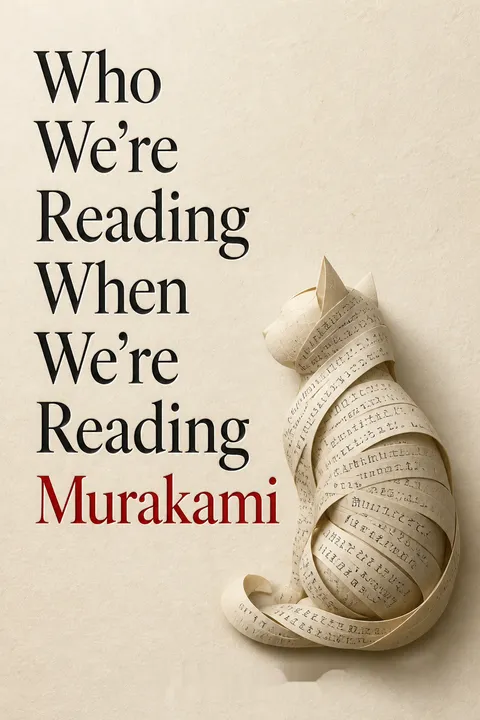
Readers found Who We're Reading When We're Reading Murakami to be an interesting look behind the scenes of translating and publishing Murakami's work in English, particularly for the US market. Many appreciated the insights into the translation process and publishing industry, though some felt it was too narrowly focused on the US. The book covers Murakami's early career through 1998, detailing the work of his translators, editors, and publishers. While some wanted more analysis or examples, most Murakami fans found it an engaging and informative read.
People Also Read






Glossary
Kodansha English Library
Japan-only English editionsA Kodansha International paperback series aimed mainly at English-language learners in Japan. It published early English translations of Murakami, including Pinball, 1973 and Hear the Wind Sing. These books were distributed domestically rather than broadly in English-speaking markets, so their first translations did not initially reach most overseas readers.
Murakami lite
Murakami's realist modeA scholarly label used in the book for Norwegian Wood and other work seen as relatively realistic and emotionally accessible compared with Murakami's stranger, more fantastical novels. The category helps explain why editors debated which book should introduce him to English-language readers, but it also risks reducing a varied body of work to a market-friendly contrast.
social capital
Useful professional connectionsIn the book's publishing context, social capital means the relationships and networks that help a writer or publisher reach reviewers, booksellers, editors, and other industry figures. Kodansha International had promotional money for A Wild Sheep Chase but fewer established American connections than major publishers, so its team sought allies who could lend access and attention.
symbolic capital
Recognized cultural prestigeSymbolic capital is reputation or status that others recognize as legitimate. In Karashima's account, a review in a major publication or selection by a respected book club could give a translated novel authority beyond its sales. Such recognition helped make Murakami seem worth attention to readers and publishers who had not encountered his work.
first-look deal
First review of new workAn arrangement that gives a publication the first opportunity to consider a work before it is offered elsewhere. Murakami signed a contract giving The New Yorker first refusal on English translations of his stories. The arrangement helped formalize the magazine's continuing relationship with his work, while giving its editors a role in deciding what stories reached its readership.
work-for-hire
Translation rights retained by authorThe book uses this term to describe Murakami's unusual English translation agreements. Rather than the translator retaining the copyright to the translated text, Murakami retained translation rights, leaving translators without control over later uses of their versions. This arrangement could let the author authorize revisions or replacement translations, but it also reduced translators' ownership and bargaining power.
backlist
Earlier books still availableA publisher's backlist is the set of previously published books that remain available for sale. The book shows why it mattered for Murakami: new releases could draw readers to earlier novels, while paperback reissues and consistent presentation kept those books visible. A growing backlist gave readers multiple routes into the author's work.
FAQ
What's Who We're Reading When We're Reading Murakami about?
- Focus on Translation: The book explores the translation process of Haruki Murakami's works into English, emphasizing the roles of translators, editors, and publishers.
- Cultural Exchange: It delves into the cultural exchange between Japan and the West, showing how Murakami's voice is adapted for different audiences.
- Personal Stories: David Karashima shares anecdotes and interviews with key figures in Murakami's publishing journey, providing a behind-the-scenes look at the literary world.
Why should I read Who We're Reading When We're Reading Murakami?
- Insight into Murakami's Success: The book offers valuable insights into how Murakami became a global literary phenomenon.
- Understanding Translation: It provides a comprehensive look at the art of translation, making it essential for aspiring translators and literature enthusiasts.
- Engaging Narratives: Karashima's engaging writing style and personal stories make the book accessible and enjoyable.
What are the key takeaways of Who We're Reading When We're Reading Murakami?
- Role of Translators: Translators are cultural mediators who influence how stories are perceived, not just language converters.
- Cultural Nuances: Understanding cultural nuances in translation is crucial, as certain elements may not resonate with foreign audiences.
- Collaborative Effort: The narrative showcases the collaborative nature of publishing, involving editors, agents, and publishers.
What are the best quotes from Who We're Reading When We're Reading Murakami and what do they mean?
- “When a work of fiction touches someone, it becomes contagious.”: Literature connects people across cultures and experiences, emphasizing storytelling's transformative nature.
- “The people who make translations possible.”: Highlights the unsung heroes of literature—translators and editors—who make diverse voices accessible.
- “A book not so much about 村上春樹, the Japanese writer, but rather about ‘Haruki Murakami,’ the English variant of his moniker.”: Points to the complexities of identity in the global literary landscape.
How does Who We're Reading When We're Reading Murakami address the challenges of translating Murakami's works?
- Cultural Context: Discusses the difficulties of translating cultural references unfamiliar to Western readers.
- Maintaining Voice: Emphasizes the challenge of preserving Murakami's unique voice and style in translation.
- Collaboration with Authors: Highlights the importance of collaboration between translators and authors for authentic translations.
Who are the key figures involved in translating Murakami's works?
- Alfred Birnbaum: One of the first translators of Murakami's works into English, known for his lively translations.
- Elmer Luke: An editor at Kodansha International, played a significant role in promoting Murakami's works in the U.S.
- Jay Rubin: A prominent translator known for his meticulous approach, contributing to the academic understanding of Murakami's literature.
How did Murakami transition from Japanese to international acclaim?
- Initial Publishing Success: Early works like A Wild Sheep Chase garnered attention in Japan, setting the stage for international success.
- Strategic Publishing Moves: Murakami's move to Knopf, a prestigious U.S. publisher, marked a significant career turning point.
- Cultural Exchange: His translations facilitated a dialogue between Japanese and Western literary traditions, broadening his appeal.
What role did translation play in Murakami's success?
- Critical for Accessibility: Translation made Murakami's works accessible to non-Japanese readers, reaching a wider audience.
- Collaboration with Translators: Murakami's relationships with translators like Alfred Birnbaum and Jay Rubin shaped the English versions of his works.
- Cultural Nuances: Translators faced challenges in conveying cultural references and subtleties inherent in Murakami's writing.
What are the challenges of publishing Murakami's works in the West?
- Market Perceptions: The Western literary market often views translated works with skepticism, affecting sales and marketing strategies.
- Short Story Collections: Murakami's short story collections faced difficulties in gaining popularity in the U.S. market.
- Cultural Misunderstandings: Japanese cultural nuances in Murakami's works can lead to misunderstandings by Western audiences.
How did Murakami's relationship with his editors influence his writing?
- Supportive Environment: Editors provided a supportive environment that allowed Murakami to explore complex themes and narratives.
- Editorial Feedback: Constructive feedback from editors helped refine his works for international audiences.
- Trust and Loyalty: The loyalty between Murakami and his editors fostered trust, enabling creative risks.
What impact did The Wind-Up Bird Chronicle have on Murakami's career?
- Critical Acclaim: The novel received widespread critical acclaim, solidifying Murakami's status as a major literary figure.
- Increased Sales: Its success boosted sales of Murakami's earlier works, expanding his readership.
- Cultural Conversations: The novel sparked discussions about Japan's historical context, deepening Murakami's literary significance.
How does Who We're Reading When We're Reading Murakami contribute to understanding Murakami's literary significance?
- Comprehensive Overview: Provides a detailed account of Murakami's journey, offering insights into his writing process and cultural impact.
- Contextual Analysis: Situates Murakami within Japanese literature and global publishing, highlighting cultural exchanges.
- Engagement with Themes: Encourages readers to engage with themes like identity, memory, and the human experience in Murakami's works.
Download PDF
Download EPUB
.epub digital book format is ideal for reading ebooks on phones, tablets, and e-readers.








