

Key Takeaways
Treat exhaustion as a call to wholeheartedness, not another scheduling failure
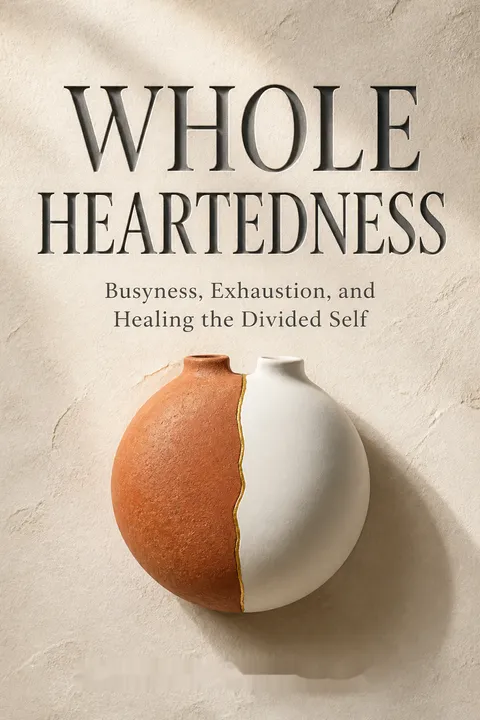
A different diagnosis. Chuck DeGroat recalls poet David Whyte asking a monk what counters exhaustion. The answer was not simply more rest, but wholeheartedness: living with less division between inner feelings, public roles, work, faith, and relationships. DeGroat recognizes himself in the opposite pattern: preaching grace while driving himself through perfectionistic work. Even a nap can leave the mind racing if the underlying life remains split between the self presented to others and the self kept hidden.
Rest still matters. The argument is not that sleep, vacations, or manageable workloads are dispensable. Rather, rest alone cannot repair a life powered by shame, frantic approval-seeking, and inner conflict. Wholeheartedness names a deeper kind of rest, one that grows as people become more honest about what they feel and need, and less invested in performing an acceptable self.
The distinction between fatigue and exhaustion is useful because it prevents a single remedy from being asked to solve different problems. Sleep deprivation calls for sleep; chronic self-betrayal may call for changed commitments, honest conversation, or treatment. This resembles the difference between recovery from exertion and recovery from moral distress, where people feel forced to act against their values. Still, wholeheartedness should not become a new standard for flawless inner alignment. Some days remain divided because caregiving, illness, or economic pressure leaves few choices. The insight is most humane when it invites attention and realistic change, rather than blaming exhausted people for failing to feel whole.
Recognize perfectionism as shame seeking approval, not dependable self-improvement
The engine beneath striving. Drawing on Brené Brown's research, DeGroat distinguishes perfectionism from ordinary effort. Perfectionism is an attempt to earn acceptance by appearing beyond criticism. A person may work late, polish an image, or announce a flaw before anyone else can point it out, hoping to control judgment and secure reassurance. The pattern often begins as a search for belonging, but success rarely settles the fear of being inadequate.
A culture that feeds it. DeGroat describes clients whose polished public selves concealed loneliness, relationship trouble, and dissatisfaction. He also points to advertising that deliberately cultivates perceived needs, turning insecurity into demand for a better body, purchase, or achievement. Brigid Schulte's research, as reported in the book, found 40 percent of American workers felt overworked. Busyness can therefore look like individual failure while being reinforced by workplaces and markets that reward constant availability.
This account explains why achievement can intensify insecurity instead of curing it: approval is temporary, so the person must keep producing evidence of worth. It also connects private distress to systems that monetize attention and reward visible output. A useful distinction is between high standards chosen for meaningful work and perfectionism driven by fear of rejection. They can look similar from the outside, but the motive and cost differ. The framework should not reduce every ambitious person to shame, however. Craft, duty, and excellence can be genuine values. The diagnostic question is whether mistakes remain tolerable, or become verdicts on the person's right to belong.
Approach your inner critic with curiosity before trying to silence it
A guard turned bully. DeGroat presents the Inner Critic as a harsh inner voice that often formed to prevent rejection, failure, or punishment. Its warnings may once have helped a child navigate demanding caregivers, but can become relentless in adulthood. In one case, Jack, raised under pressure to uphold a prominent family name, stole money from the family business and was rejected by his family. In therapy, he imagined speaking with his critic and learned that its aggression had grown from an effort to protect him from shame.
Compassion changes the exchange. Instead of attacking or obeying the critic, Jack asked what it feared and recognized its exhaustion. Self-compassion, in DeGroat's account, means meeting imperfection with care rather than using self-criticism to preempt other people's judgment. This does not excuse harmful behavior. It makes it possible to understand the fear underneath a reaction and choose a response less governed by it.
The protective interpretation makes self-criticism easier to examine without endorsing it. In clinical terms, a behavior can be understandable in origin and still damaging in consequence. That distinction is especially valuable for people who confuse self-kindness with avoiding responsibility. Compassion may reduce threat enough for reflection, while shame often narrows attention toward concealment or retaliation. The account also suggests a practical test: what catastrophe does the critic believe it is preventing? Its prediction may be outdated, but hearing it can reveal what a person still fears. This approach is not a substitute for professional help when self-harm, trauma, or severe distress is involved.
Read bodily reactions as clues to a story you may not consciously remember
The body can cue the past. DeGroat explains that implicit memories are learned emotional and bodily patterns that may operate without a clear, conscious narrative. He recounts Judy, who froze after a loud firework at fourteen. The sound had echoed an early frightening event: when Judy was an infant, a nearby gas-line burst startled her mother, who accidentally dropped her. Judy had no conscious memory of that incident, yet the later sound triggered an intense response.
Notice before interpreting. Most reactions are less dramatic, but old expectations can surface as tension, anger, or panic in ordinary situations. DeGroat describes Denise, whose persistent anxiety and irritation began to make more sense as she connected them with childhood shame and a parent's critical voice. Attending to sensations and emotions can create room to ask what is happening, rather than assuming the reaction is irrational or simply a character flaw.
The emphasis on bodily signals accords with the broader idea that memory is not only a story recalled in words; learned associations can shape attention and response. That perspective can soften self-blame and prompt useful questions about context. It also calls for restraint. A present-day sensation does not prove a specific buried event, and memory can be suggestible, especially under pressure to find a hidden cause. The safest use of the idea is exploratory rather than forensic: notice a reaction, consider several explanations, and seek qualified clinical support when distress is substantial. Curiosity can help without turning every discomfort into evidence of trauma.
Practice holiness as becoming whole, not climbing toward flawlessness
A reversal of the ladder. DeGroat challenges a religious model in which people must prove themselves worthy through discipline and moral performance. He reads Jesus' Beatitudes as turning attention toward the poor in spirit, those who mourn, and the meek, rather than celebrating the already impressive. In this Christian interpretation, purity of heart means an undivided life, not a spotless public image. Holiness is less an ascent achieved by the spiritually accomplished than a process of receiving grace amid human limits.
Grace does not erase responsibility. DeGroat points to the biblical critique of worship that ignores injustice: religious practice cannot substitute for care of people who are harmed or excluded. He presents Jesus' call to examine one's own anger and conduct as difficult inner work, not permission to blame others. Holiness becomes a life of growing integrity and peacemaking, grounded in belonging rather than in the exhausting need to prove that one deserves it.
This reading makes religious language less vulnerable to perfectionism by linking holiness to integrity and repair rather than status. It also places inner transformation beside public ethics: a person cannot credibly claim spiritual wholeness while ignoring harm. The perspective is particular to DeGroat's Christian theology, not a neutral definition binding every tradition. And the language of surrender can be misused if it encourages people to tolerate abuse or remain in unsafe settings. A sound application preserves both sides of the argument: accept human imperfection, and take concrete responsibility for conduct, justice, and boundaries.
Descend from borrowed ambitions toward the desire beneath them
The mountain of small wants. DeGroat distinguishes everyday desires, such as approval, security, or a better job, from a deeper longing he calls Desire. In his Christian framework, that deepest longing points toward communion with God and a more integrated life. The everyday wants are not inherently bad; the problem begins when they carry the whole burden of identity and happiness. His term contemplative descent describes turning away from relentless self-management and attending to the deeper life beneath those demands.
Letting go takes time. DeGroat invites readers to pause, breathe, notice inner voices, and ask where they are emotionally. He cautions that loosening attachments can bring anxiety, sadness, or a sense of emptiness, because familiar busyness may have been serving as protection. The practice is not abandoning family, work, or ordinary pleasures. It is learning to hold them without asking them to provide ultimate security or worth.
The distinction between a goal and the meaning attached to it is psychologically fruitful. Wanting a secure job is ordinary; believing that no one can be safe or worthy without one is a much heavier claim. This helps reveal when a reasonable pursuit has become an all-purpose solution to insecurity. The spiritual language of a single deep Desire gives the process coherence for Christian readers, though people outside that theology may describe the deeper orientation differently, through values, connection, or purpose. Either way, detachment is not indifference. It is a way to care about important things without letting them dictate the whole self.
Let every inner part speak without handing it the controls
A system of inner parts. DeGroat adapts Internal Family Systems, a therapy model that treats the mind as containing distinct parts rather than one uniform voice. The Self is the compassionate, curious center capable of listening. Protectors manage risk and keep painful feelings at a distance. Exiles are vulnerable parts carrying hurt or shame. Firefighters rush to numb distress when it breaks through, sometimes through destructive behavior. These parts are understood as attempts to cope, not as proof that a person is bad.
Listen, then lead. DeGroat describes an obsessive part of himself that worked to prevent failure and rejection. When he approached it with curiosity, he found fear beneath the control and could respond with compassion. The aim is not to let every impulse dictate behavior, nor to excuse harm. It is to understand what a part is trying to do while allowing the steadier Self to guide choices. Severe trauma or dangerous behavior calls for qualified therapeutic care.
The parts model can make ambivalence legible: one side wants connection, another fears exposure, and a third tries to shut down the conflict. Naming those motives can create a pause between feeling and action. Its metaphorical clarity is also a risk if treated as literal brain anatomy or as a complete account of every mental health condition. The framework works best as a therapeutic lens, not a diagnosis that people apply indiscriminately to themselves or others. Its ethical strength lies in joining compassion with agency: a protective impulse deserves understanding, while the person remains responsible for what they do.
Build awareness, personal story, and safe relationships into healing
Three supports for integration. DeGroat brings together awareness, story, and relationship as mutually reinforcing parts of healing. Awareness means noticing feelings, images, and bodily cues instead of reacting automatically. Story means connecting present patterns with the experiences that shaped them. Relationship means allowing a trusted person, therapist, or spiritual companion to hear that story with care. The process matters because people can be wounded in relationships and may need safe connection to develop different expectations.
A practical sequence. When a familiar reaction appears, pause long enough to name it. Ask what it reminds you of and what the feeling may be trying to protect. Then, if appropriate, share the experience with someone trustworthy. DeGroat argues that telling a story and being heard can change how it is understood. This is not a demand to disclose everything to everyone; safety, timing, and the listener's capacity matter.
The three supports resist the fantasy that insight alone is sufficient. Awareness without a story can leave a person observing symptoms without context; storytelling without a safe listener can reinforce shame; supportive relationships without reflection may repeat old patterns. The combination resembles learning processes in which new experience updates old expectations. Yet not every relationship is safe, and disclosure is not automatically healing. Trust should be earned, and professional support may be needed when a history is complex. The practical contribution is not a formula but a useful check: is change happening in attention, in the meaning assigned to experience, and in the quality of connection?
Use prayer, worship, and community to rehearse belonging and repair
Rhythms that gather attention. DeGroat presents Christian practices as pathways to communion rather than religious boxes to check. Daily contemplative prayer creates quiet for noticing inner life. Weekly worship retells a shared story through confession, assurance, teaching, Communion, and blessing. The yearly cycle of Advent, Lent, Easter, and Pentecost gives recurring shape to waiting, limitation, loss, renewal, and shared mission. Liturgy, in this account, means the people's work of participating in worship, not merely watching a service.
From ritual to public life. These practices are meant to reconnect people with God, themselves, and one another, then send them toward acts of reconciliation. DeGroat argues that community exposes self-protective habits that solitude may leave untouched. Simply attending church is not enough, and he recognizes that churches can perpetuate shame and division. The goal is a community that practices belonging, confronts harm, and carries its commitment to wholeness beyond the sanctuary.
Ritual offers a counterweight to the attention economy because repeated communal actions can give a week and a year a shared structure beyond work and consumption. Its value is not confined to religious belief: music, meals, remembrance, and collective service can also help people experience belonging through embodied practice. DeGroat's account rightly distinguishes participation from passive attendance. The challenge is that traditions do not automatically produce inclusion; rituals can reinforce hierarchy when leaders control who belongs or whose suffering counts. Their measure is therefore not only emotional comfort, but whether the community becomes more truthful, hospitable, and capable of repair.
Analysis
The book's most useful move is to reinterpret exhaustion as a problem of dividedness rather than as a simple shortage of hours. Its examples make that distinction concrete: the competent professional whose public success hides shame, the critic that tries to prevent rejection, and the person whose body reacts to cues connected with earlier experience. These cases support a compassionate alternative to the familiar command to try harder. Instead of treating a difficult reaction as an enemy, the reader is invited to ask what it protects and what kind of connection or repair might help.
The argument gains force from bringing psychology, poetry, and Christian contemplative practice into conversation. The Internal Family Systems vocabulary offers a workable metaphor for inner conflict, while the book's Christian account supplies a narrative of belonging and communion. The practices are deliberately modest: breathe, notice, name, listen, and seek trustworthy company. Their value lies less in instant relief than in creating space between a trigger and a response.
Some distinctions need care. The book's brain discussion uses models such as the triune brain and contrasting hemispheres to make inner conflict accessible. These are simplified metaphors, not literal maps of separate brain systems or proof that one hemisphere dominates modern culture. Likewise, a bodily reaction can be meaningful without reliably revealing a specific hidden memory. The strongest version of DeGroat's proposal does not depend on these claims being exact neuroscience. It rests on the more modest proposition that relationships and experience shape patterns, and that attention, reflection, and safe connection can help people respond differently.
The Christian framing is central, not decorative. Readers outside that tradition can still use the account of shame, self-compassion, and integration, but may not share its claims about God as the deepest source of the self. Across those differences, the book's enduring challenge is to resist both self-perfection and passive self-acceptance. Wholeness requires mercy toward the divided self, alongside responsibility for the effects of its actions and for the conditions that keep people depleted.
Review Summary
Wholeheartedness receives overwhelmingly positive reviews, averaging 4.18/5. Readers praise its integration of psychology, neuroscience, theology, and poetry to address exhaustion and inner division. Many found it life-changing, particularly its core insight that the antidote to busyness isn't rest but wholeheartedness. Reviewers appreciate the reflective exercises and broad range of sources. Some critics note excessive psychological jargon, weak practical solutions, or overly Catholic-leaning practices. Most recommend reading it slowly and engaging deeply with its exercises for maximum impact.
People Also Read








Glossary
Wholeheartedness
Living with less inner divisionA way of living in which inner experience and outward roles are less split apart. In the book, wholeheartedness is deeper than taking a break: it means becoming more honest about one's feelings, desires, and limits, and living from a more integrated self. DeGroat presents it as a path toward genuine rest and more generous relationships.
Inner Critic
A harsh protective voiceAn internal voice that judges, warns, or pressures a person to avoid failure, rejection, or shame. DeGroat describes it as a protector that may have developed to help someone cope with earlier expectations or criticism. Its protective purpose can become harmful when it turns into relentless self-attack or drives constant performance.
True Self
The compassionate inner centerDeGroat's term for the deepest, most integrated self, which he understands within a Christian framework as grounded in God's presence. It is characterized by curiosity, compassion, calm, and capacity for connection. In the book's practical exercises, the True Self is the observing center that can notice inner voices without being taken over by them.
Internal Family Systems
Therapy for inner partsA psychotherapy model developed by Richard Schwartz that understands the mind as containing multiple parts with different roles and concerns. DeGroat adapts its language of Self, Protectors, Exiles, and Firefighters to describe inner conflict and coping. The model encourages curiosity and compassion toward parts while keeping the Self responsible for guiding behavior.
Protectors
Parts that manage perceived dangerIn Internal Family Systems, Protectors are parts that try to prevent painful experiences, such as rejection, shame, or failure. They may appear as a critic, a helper, or a highly competent worker. DeGroat emphasizes that their intentions may be protective even when their strategies become exhausting, controlling, or damaging.
Exiles
Vulnerable parts carrying painIn Internal Family Systems, Exiles are vulnerable parts associated with painful experiences, feelings, or memories that other parts try to keep out of awareness. DeGroat describes them as carrying hurt or shame and needing care rather than suppression. Contact with an Exile can feel intense, so he stresses remaining grounded and seeking therapeutic help when needed.
Firefighters
Parts that rapidly numb distressIn Internal Family Systems, Firefighters respond when painful feelings break through by trying to reduce distress quickly. DeGroat gives examples of behaviors such as cutting, bingeing, or sexual acting out. He treats these parts as misguided attempts to help, not as excuses for harm, and emphasizes that dangerous behaviors require appropriate support.
Contemplative descent
Turning inward from strivingDeGroat's name for moving away from the drive to climb toward achievement, control, and approval, and toward attentive engagement with one's deeper inner life. The descent involves noticing desires and attachments, accepting limits, and becoming open to spiritual connection. It is not a one-time act of abandoning work or relationships, but a gradual practice of loosening their grip on identity.
Shalom
Flourishing and restored wholenessA Hebrew term DeGroat uses for a vision of flourishing, peace, and wholeness in relationships and community. In the book, shalom is more than the absence of conflict: it includes restored connection, justice, and shared well-being. DeGroat presents it as a Christian calling that involves both inner integration and efforts to repair divisions in the wider world.
About the Author
Other books by Chuck DeGroat



Download PDF
Download EPUB
.epub digital book format is ideal for reading ebooks on phones, tablets, and e-readers.








