

Key Takeaways
If life hurts, treat that pain as a signal to investigate, not conceal.
Appearances can deceive. Cohen begins with a tragedy from his early career: a charismatic professor who taught adults about self-esteem died by suicide. The professor had seemed successful, yet was suffering in ways his students could not see. The experience led Cohen to question the idea that a polished exterior proves a person is thriving. A life can look fine to everyone else and still feel unbearable from the inside.
Use distress as information. The book frames dissatisfaction as a reason to examine what is draining joy, whether that is work, a relationship, or a life that no longer fits. Its promise is practical change, one problem at a time, rather than settling for a life that feels smaller than it should.
The opening story gives the book's upbeat self-help premise a necessary seriousness: pain is not always visible, and success is not a reliable measure of well-being. Yet a painful life is not automatically a personal failure or a puzzle solvable through attitude alone. Depression, trauma, illness, and unsafe circumstances can require professional care and practical protection. The strongest use of Cohen's invitation is to take distress seriously, seek appropriate support, and ask what can change without assuming that every hardship has been chosen.
Take back authorship without mistaking guidance for rescue.
Borrowed authority has a cost. Cohen argues that people lose ground when they treat a lover, boss, celebrity, spiritual teacher, or institution as the source of their worth. Help and expertise can matter, but no admired person can live another person's life for them. He illustrates the danger with Mickey Mantle, who came to see his struggle with alcoholism as a barrier to respecting himself, despite his fame and public acclaim.
Listen inward, then choose. Cohen calls his inner-guidance metaphor KNOW: an imagined station broadcasting personal insight, which can be obscured by other people's expectations. He encourages readers to notice intuition and make significant choices from their own values, rather than automatically copying role models or accepting someone else's script.
The useful distinction is between receiving guidance and surrendering judgment. Psychology's concept of autonomy, the sense that one's actions reflect one's own values, helps explain why borrowed approval often feels thin. At the same time, intuition is not an infallible signal. It can reflect fear, habit, or incomplete information, especially in high-stakes decisions. A sound practice is to treat an inner hunch as a prompt to investigate, then combine it with evidence, trusted counsel, and personal priorities.
Question inherited limits before building your life around them.
Old beliefs can become invisible rules. Cohen recalls a childhood warning that flushing while seated could cause an imaginary ailment. As an adult, he finally tested the belief and found no consequence. The joke points to a broader argument: ideas about gender, money, sex, health, and acceptable careers can be absorbed early and followed long after their origin is forgotten.
Test what can be tested. Cohen advises noticing which thoughts create fear or resignation, then examining whether they are facts, predictions, or inherited assumptions. He also challenges guilt-based beliefs that say a person deserves pain. The practical point is not that every limit is imaginary; it is that an unexamined belief should not automatically decide what someone attempts or accepts.
This resembles cognitive behavioral therapy, which helps people identify thoughts, examine the evidence for them, and test alternatives through action. The approach is powerful when a belief is specific and testable, such as assuming a request will always be rejected. Its limits matter too: poverty, discrimination, disability, and danger are not simply mistaken thoughts. Reframing can expand a person's options, but it cannot make external barriers disappear. The useful question is both what belief is operating and what conditions must also change.
Look past appearances, and refuse to let fear sell you scarcity.
A first impression is partial evidence. Cohen describes misjudging a seminar participant who seemed distracted, then learning she had worked through the night to attend. Her apparent lack of interest was actually exhaustion after considerable effort. He uses this reversal to warn against treating an interpretation as a fact.
Fear can manufacture shortages. During a tsunami warning on Maui, residents bought more rice than they needed. The warning passed, but their hoarding left stores short for weeks. Cohen also argues that a steady diet of disaster-focused news can make danger seem more common than it is. His advice is to pause before reacting, check who benefits from a scarcity claim, and seek information proportionate to the decision at hand.
The seminar story captures a basic lesson from social psychology: people routinely infer motives from behavior without knowing the circumstances. Scarcity can also become self-reinforcing when fear drives hoarding or rushed purchases. Still, not every warning is manipulation, and news can carry information needed for safety and civic action. A balanced response distinguishes a vivid anecdote from reliable evidence, checks sources, and asks whether the proposed action reduces a real risk or merely transfers anxiety into spending.
Audit where your attention and effort go before demanding more willpower.
Find the leak first. Cohen opens this section with a water meter reading four times its usual level. He later finds a leaking pipe in his yard. The lesson becomes a model for daily life: when energy, money, or pleasure keeps draining away, inspect the source instead of simply working harder to compensate.
Track what gives and takes. Cohen suggests listing regular activities and rating how much each adds to or drains from life, then identifying a step to expand the helpful ones and reduce the rest. He also urges readers to direct attention toward solutions, make fuller use of their talents, and notice recurring patterns. He claims that illness can reflect inner conflict; that claim should not be treated as a diagnosis or a reason to blame oneself for being sick.
The water leak makes an abstract idea concrete: effort cannot fix a system that is losing resources at its source. An activity audit can reveal overload, avoidable commitments, or neglected strengths. The book's stronger claims about people generating disease through thought are not supported as a general account of illness. Health is shaped by biology, environment, access to care, and chance, as well as behavior. Looking for patterns can support useful changes, but medical problems deserve appropriate medical assessment, not moral judgment.
Choose ambitions you would still want without an audience.
Approval has no finish line. Cohen uses a classroom puzzle about a frog repeatedly jumping half the remaining distance toward the end of a log. It never reaches the end. The image represents trying to satisfy someone whose standards keep moving. Cohen recognized this pattern in himself after a counselor observed that his father emphasized the small part he had done wrong rather than the much larger part he had done well.
Separate desire from audition. The same test applies to careers, fame, status, appearance, and revenge: would the goal still matter if nobody were impressed? Cohen tells of Robert, who left medical school after realizing he wanted to teach, despite family investment in his becoming a doctor. Choosing a goal for its own sake, he argues, is more sustaining than using it to earn approval.
This connects with research on social comparison: measuring personal worth against other people can make satisfaction depend on a moving target. Cohen's question about whether a goal would matter without an audience helps reveal the difference between intrinsic motivation and status-seeking. However, external recognition and financial security are not shallow by definition; they can meet real needs. The sharper test is whether a reward supports a chosen life or has become the only proof that the life is worthwhile.
Make your yes trustworthy by making your no clear.
A false yes creates friction. Cohen describes a secretary who repeatedly agreed to pick up a printer cartridge, then misplaced the address, forgot the payment card, and failed to complete the errand. She was capable at her job but did not want the task and feared saying so. The mismatch wasted time and left her employer unable to make another plan.
Use boundaries as information. Cohen recommends pausing before agreeing, being honest when the answer is no or maybe, and setting limits around time, work, money, sex, and emotional availability. He argues that directness can help both people: a rejected job arrangement, for example, may free each person to find a better fit. A boundary is not punishment; it makes clear what someone is willing to take part in.
Clear consent and boundaries are central to healthy relationships because they let people respond to the actual offer rather than guess at hidden reluctance. Self-determination theory also emphasizes that autonomy supports motivation and well-being. Still, saying no is not equally easy or safe in every context. Employees, caregivers, and people dependent on others may face genuine consequences for refusing. The principle is most useful when paired with attention to power: find the clearest, safest way to communicate a real limit.
Offer support without confiscating someone else's choices.
Helping can become control. Cohen tells of his mother adding tomato slices to his salad after he had already asked her to stop. The comic scene illustrates a familiar form of overhelping: the giver continues because giving eases their own discomfort, not because the receiver wants more.
Support agency instead of taking over. Cohen advises asking what kind of help is wanted, allowing other people to learn from their own decisions, and delegating tasks rather than carrying everything alone. He distinguishes assistance from rescue, while making room for intervention in clear emergencies, such as drunk driving or abuse. His broader point is that people need respect as well as kindness, and the helper's role is not to manage every outcome.
This distinction aligns with autonomy-supportive care: people are more likely to grow when support respects their perspective and leaves meaningful choices in their hands. It also protects helpers from burnout by separating compassion from total responsibility. There is an important limit: a person's choices may affect children, dependents, or others at risk. Respecting autonomy does not require passivity in the face of abuse or imminent danger. Asking what would help is a strong default, not a substitute for safeguarding when safety is at stake.
Schedule soul-renewal before your calendar consumes it.
Busyness can hide a cost. Cohen describes overbooking his own teaching schedule until he felt detached from the work and depleted by travel. He realized that a career devoted to peace and joy was not serving its purpose when he could no longer experience either. He urges readers to distinguish activity that leaves them energized from activity that merely fills the day.
Make room for delight. The book treats rest, meaningful work, body care, nature, relationships, and play as necessities, not leftover rewards. Cohen recalls monkeys repeatedly swinging into a pond simply for fun, and argues that adults also need activities without a productivity target. He suggests reviewing obligations, making time for practices that restore energy, and pursuing passions in ways that respect other people's needs.
The chapter challenges a culture that often treats busyness as evidence of importance. Research on burnout similarly points to the costs of chronic demands without adequate recovery, while play and restorative time can help people reconnect with curiosity. Cohen's emphasis on passion is energizing, but passion alone cannot resolve low wages, unsafe workplaces, or caregiving burdens. Renewal is not only a private scheduling problem; organizations and communities shape whether people have time and resources to recover.
Do not mortgage today's joy to a future version of success.
The route is part of the reward. After buying a beautiful home in Hawaii, Cohen was so busy traveling and managing work that his caretakers enjoyed the property more than he did. A conversation with one of them prompted him to spend time noticing the landscape and taking pleasure in the place he had already chosen. He also contrasts local drivers rushing along Maui's winding Hana Highway with visitors who stop to enjoy its scenery.
Keep goals in their place. Cohen argues that money, possessions, planning, and achievement can serve a life, but should not replace living it. He recounts a Mexican fisherman who already enjoys family, rest, music, and village life, while a visiting businessman proposes decades of expansion so he can retire into that same routine. The question is not only where the plan leads, but what it costs along the way.
The fisherman story exposes a common planning error: treating present satisfaction as a prize available only after enough accumulation. Behavioral research on adaptation suggests that people often adjust to new rewards, so a larger achievement may not deliver lasting contentment by itself. Yet long-range planning matters for health, security, and dependents. The more useful balance is not to reject ambition, but to make sure the plan creates a life that can be inhabited now, rather than postponing all enjoyment until an uncertain finish.
Analysis
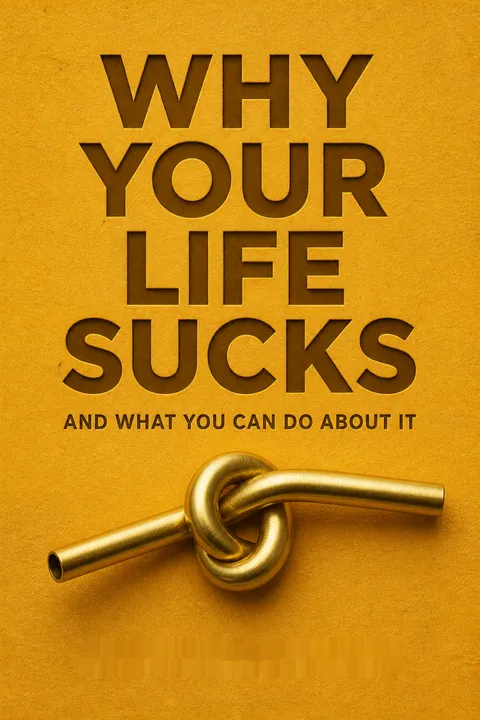
Why Your Life Sucks is a spiritually inflected self-help book organized as ten explanations for diminished well-being. Its structure is diagnostic but informal: each section begins with a story, turns the story into a principle, and offers a practical correction. Cohen's strongest recurring insight is that suffering can be compounded by habits that are changeable: outsourcing decisions, chasing approval, saying yes under pressure, overhelping, and neglecting rest. His vivid props, from a leaking pipe to an endlessly shortfalling frog, make those patterns easier to notice and remember.
The book is most useful when read as an invitation to recover agency within real constraints. It is less reliable when agency becomes a universal explanation. Cohen sometimes suggests that thought or expectation determines health, safety, prosperity, and fate. That moves beyond empowerment into claims that can make people feel responsible for illness, abuse, or economic hardship. Biological vulnerability, social structures, chance, and other people's actions matter. Intuition can offer important personal information, but it is not a substitute for evidence or professional expertise.
A careful adaptation therefore preserves the book's practical questions while resisting its most absolute assurances. Is this goal genuinely mine? What drains my energy? Am I helping because help was requested? What would an honest no make possible? These questions do not promise that the universe will arrange a perfect outcome. They can, however, clarify choices, improve relationships, and reduce avoidable self-betrayal. The book's lasting value lies less in its metaphysical certainty than in its repeated demand to notice when life has become a performance, then make a concrete, self-respecting change.
Review Summary
Why Your Life Sucks received mixed reviews, with an average rating of 3.87/5. Many readers found it humorous, insightful, and motivating, praising Cohen's straightforward approach and practical advice. Some appreciated its unique perspective on self-help, while others criticized it as repetitive or unrealistic. Positive reviewers highlighted the book's ability to change their outlook on life, while critics found it overly simplistic or potentially harmful. The book's unconventional title attracted readers, but its content divided opinions on its effectiveness as a self-help guide.
Glossary
KNOW
Inner guidance metaphorCohen's shorthand for an imagined inner source of guidance, pictured as a radio station that can be tuned in or drowned out by outside expectations. He uses it to encourage attention to intuition, felt responses, and personal values. It is a spiritual metaphor in the book, not a validated source of perfect information.
energy vampires
Draining relationship patternCohen's label for people whose repeated demands for attention, time, or material support leave others depleted, especially when offers of help are met with resistance or renewed demands. He recommends maintaining limits and not reinforcing helplessness. The term describes a pattern of interaction, rather than a clinical diagnosis or a permanent identity.
busyholism
Compulsive busynessCohen's term for habitual overactivity that is treated as normal or admirable even when it exhausts a person or keeps them from facing feelings. He compares it to an addiction and encourages examining both the activities chosen and the mindset brought to them. The term is rhetorical, not a formal clinical diagnosis.
soul-starvation
Neglected inner nourishmentCohen's description of a life that may be materially full or constantly active while lacking experiences that restore inner vitality. He associates this condition with neglecting rest, play, meaningful work, physical care, relationships, and spiritual practice. His proposed response is to deliberately make room for activities that renew a sense of aliveness.
The disease to please
Approval-seeking self-abandonmentCohen's phrase for a pattern of putting other people's wishes ahead of one's own in order to secure approval or avoid conflict. It can appear in family, romantic, religious, school, and work settings. The book's remedy is to distinguish genuine generosity from fear-driven compliance and to practice expressing personal preferences honestly.
people-trophy collecting
Borrowed status through relationshipsCohen's term for seeking self-worth by associating with people perceived as more famous, wealthy, attractive, or influential. Examples include pursuing a partner for status, displaying connections to celebrities, and using intimacy to gain proximity to fame. The underlying issue is treating another person's reputation as a substitute for one's own sense of worth.
About the Author



Download PDF
Download EPUB
.epub digital book format is ideal for reading ebooks on phones, tablets, and e-readers.








