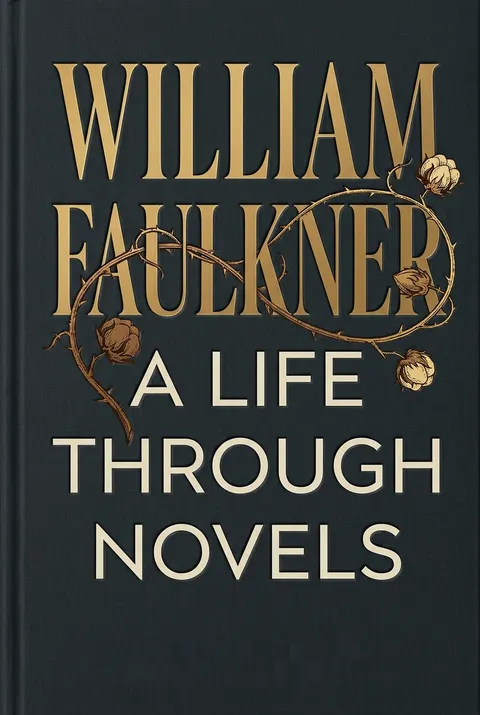


Key Takeaways
Treat Faulkner’s novels as life’s traces, not coded diary entries.
Life in another form. André Bleikasten argues that Faulkner’s fiction preserves traces of his life, but does not simply report it. Family stories, Southern history, lost ambitions, and private distress are transformed by invention. Faulkner even built public identities from fiction: he claimed wartime flying experience despite never flying in combat, and shifted among the roles of poet, hobo, gentleman farmer, and horseman.
Masks become material. His characters contain fragments of many possible selves, not one identifiable authorial double. Quentin Compson, Gavin Stevens, and others help Faulkner explore experiences he could not state directly. The novels both reveal and conceal their maker. Biography therefore illuminates the writing, but cannot serve as a master key that unlocks every character or scene.
What’s striking is how this approach treats fiction as a kind of transformed autobiography rather than either confession or escape. Narrative identity is often built through stories that revise experience, and Faulkner’s many masks make that process unusually visible. The method also has a limit: reading every character as a piece of the author can flatten the independent lives of the people he invents, especially women and Black characters. Bleikasten’s strongest claim is not that the novels tell us exactly who Faulkner was, but that they show how he made a self through writing.
Read Mississippi as the wound Faulkner interrogates, not picturesque scenery.
A region built on violence. Faulkner’s Mississippi was shaped by Indigenous dispossession, cotton wealth built on slavery, Confederate defeat, and the restoration of white rule after Reconstruction. Jim Crow laws and racial terror persisted through his lifetime. The state remained deeply poor, and Black residents faced segregation, disenfranchisement, and lynching. This history is not decorative background. It supplies the conflicts and inherited myths his fiction examines.
Not a pastoral refuge. Faulkner drew on his home because he knew it, but his finest novels do not simply praise an old-fashioned South. They test its legends against the violence and injustice beneath them. This sets his fiction apart from the Agrarians, writers who idealized rural Southern life and defended its old order. Yet Faulkner’s own loyalty to his community sometimes made his criticism incomplete.
The book’s insistence on history counters a familiar reading of Faulkner as merely a stylist of a vanished South. Place here is inseparable from land theft, slavery, and the political work of white memory. This resembles counter-memory: accounts that expose what a community’s preferred story leaves out. Still, regional critique is not the same as escape from regional values. Faulkner’s attachment gives his fiction its intimacy and its blind spots, making the novels especially valuable as records of a culture arguing with itself.
Track the past as an active force inside every present.
A county remembers. Beginning with Flags in the Dust, Faulkner built Yoknapatawpha County, an invented Mississippi landscape populated by families and characters who return across novels. Repeated names, inherited land, old grudges, and family stories make generations overlap. The past is not safely finished; it shapes what people believe they can do now.
Memory edits the record. In Flags in the Dust, an old woman’s repeated tale of a family’s wartime exploits grows grander with each telling. In Absalom, Absalom!, Quentin Compson and his roommate Shreve try to reconstruct the Sutpen family’s rise and ruin from scraps, gossip, and uncertain testimony. Their effort shows how history becomes a story, and how a story can keep shaping the people who inherit it.
This recurring county behaves less like a setting than a social memory system. Its stories are passed between generations, but transmission never means perfect preservation: details shift, family myths harden, and silence becomes part of the inheritance. That insight connects literary form to intergenerational memory, where descendants can bear consequences without having witnessed the original event. The complication is important: a past that persists can explain present behavior without excusing it. Faulkner’s repetitions make inheritance visible while leaving room to resist it.
Let fractured narration make you do the work of knowing.
Form creates uncertainty. The Sound and the Fury gives the Compson family’s collapse through four sharply different sections. Benjy registers sensations without understanding their causes; Quentin’s memories tangle with his last day; Jason speaks with blunt certainty; and an outside narrator lets readers reassess what they have heard. Each voice offers evidence, but none provides the whole account.
No single witness wins. As I Lay Dying spreads a family journey among fifteen narrators and fifty-nine brief monologues. Absalom, Absalom! layers the versions of Rosa Coldfield, Mr. Compson, Quentin, and Shreve. These novels make readers assemble events while noticing each narrator’s limits. Their difficult structures are not puzzles with one clean solution. They dramatize the gap between experience, memory, and what can be told.
The novels turn reading into an exercise in epistemology: readers must ask not only what happened, but who can know it and what their telling leaves out. That resembles the evaluation of conflicting testimony in history or law, where credibility depends on motive, evidence, and context rather than confidence alone. The method rewards active reading, but difficulty is not automatically depth. A fractured account matters when its gaps reveal something about power, memory, or perception, not simply because it withholds information.
Let a failed telling reveal what a novel cannot contain.
A story resists completion. The Sound and the Fury began from a stark image of a girl watching a funeral from a tree. Faulkner tried to tell the story through one brother, then another, before adding an outside perspective. Even the finished novel did not settle the matter for him: fifteen years later, he added a further account of the Compson family. Each attempt reveals more, while confirming that no version can fully contain the loss at its center.
Failure generates form. In Absalom, Absalom!, Quentin and Shreve invent possible scenes to bridge gaps in the family record. In As I Lay Dying, characters’ words expose what language cannot make whole. For Bleikasten, these works succeed not by solving their mysteries but by making incompletion meaningful. A novel can show the limits of knowledge without pretending those limits have disappeared.
This is a useful distinction between productive incompletion and mere vagueness. In science, a model is valuable partly because its simplifications expose what it cannot explain; Faulkner’s narrative failures similarly make absence part of the evidence. The reader sees how a story is assembled, not just what it claims. There is a risk in celebrating failure too readily: obscurity can become an alibi for weak structure. Bleikasten’s case is persuasive because the gaps are shaped by particular losses, family secrets, and competing acts of remembrance.
Expose how racial and sexual rules turn bodies into battlegrounds.
Bodies carry social law. In Sanctuary, Temple Drake is trapped in a world of sexual violence, voyeurism, and corrupted justice. Light in August follows Joe Christmas, whose uncertain racial identity makes him a target for both personal hatred and communal violence. His murder does not restore order; it reveals how that order depends on exclusion. In Go Down, Moses, generations of the McCaslin family expose slavery, sexual exploitation, and the lasting consequences of their entangled lineage.
No innocence survives the system. Faulkner repeatedly links racial hierarchy, male power, and religious ideas of purity. Women and Black people are often treated as objects through which white men defend status or settle inherited anxieties. His novels refuse the comforting idea that violence comes only from monsters outside ordinary society. The rules themselves help produce it.
The novels make social hierarchy legible through bodies: who may touch, possess, punish, or classify whom. That connection resembles biopolitics, the study of how institutions govern people through decisions about sex, reproduction, race, and life itself. Faulkner’s imagery can be disturbing, but the disturbance is part of the critique. A necessary caution is that characters subjected to power can still be reduced to symbols of a white author’s concerns. Their agency and particularity deserve attention alongside the system the novels expose.
Build a voice by imitating, revising, and outgrowing your models.
Apprenticeship begins in borrowing. Before Faulkner became a novelist, he drew and wrote poems, often echoing poets such as Swinburne, Verlaine, and Eliot. His early prose also shows the influence of writers he admired. In New Orleans, Sherwood Anderson encouraged him to use his knowledge of Mississippi, while their friendship gave him a close view of a working writer.
A place becomes an artistic system. Faulkner’s first novels were uneven, and Flags in the Dust was rejected and heavily cut before publication as Sartoris. The struggle helped him see that his local world could sustain a larger body of work. From 1928 to 1932 he wrote The Sound and the Fury, As I Lay Dying, Sanctuary, and Light in August. He learned through practice, then transformed his sources into a distinctive fictional world.
The career described here complicates the myth of the isolated, fully formed genius. Faulkner’s voice grew through reading, imitation, feedback, rejected manuscripts, and repeated revision. This is close to craft learning in fields such as music, where copying models first builds technical fluency before individual choices become legible. The crucial step is not originality at any cost, but a change in what borrowed techniques can do. The book also shows that talent alone did not guarantee a living; artistic development depended on time, work, and economic survival.
Separate the writer’s disciplined work from his destructive drinking.
Work and excess coexisted. Faulkner wrote while supporting a growing family and repeatedly struggled with debt. He took Hollywood assignments for income, even though he disliked the studios and often saw his scripts altered or discarded. At home, he protected writing time with striking discipline, sometimes producing novels rapidly and revising them carefully. His daughter said he wrote sober, then drank afterward.
Do not romanticize the cost. Alcoholism ran through the family and became increasingly dangerous for Faulkner. Benders, blackouts, injuries, hospital stays, and marital conflict marked his life. The book resists a simple story in which addiction fuels genius: writing was his vocation, but drinking repeatedly damaged his health and relationships. His ability to work despite illness is not evidence that the illness was necessary to the work.
The separation matters because cultural stories often turn addiction into a badge of artistic authenticity. Here the evidence points to a more complicated pattern: sustained labor required concentration, while drinking often followed the work or interrupted ordinary life. That distinction discourages imitation without diminishing the achievement. It also avoids treating illness as a moral failure. The biography shows the cost to family and health, yet the work itself cannot be explained by pathology; neither suffering nor sobriety alone accounts for literary power.
Judge Faulkner’s racial politics by both his novels and public record.
The writer saw more than the citizen. Faulkner’s novels, especially Light in August and Go Down, Moses, expose the violence and inheritance of racism. After winning the Nobel Prize in 1949, he became a public voice on race, criticizing segregation and calling for Black equality. Yet he argued against rapid, federally enforced integration, urging white Southerners to change gradually and locally.
Good intentions had limits. Faulkner sometimes repeated racial stereotypes and treated Black people paternalistically. He feared that direct federal intervention would provoke violence, and his appeals for patience placed much of the burden on those denied rights. The biography presents a real contradiction: his fiction could interrogate Southern injustice more sharply than his public arguments did. Neither side cancels the other.
This tension is more revealing than either a clean defense or a simple condemnation. Literary imagination can expose structures that a writer’s political loyalties still protect; artistic insight does not automatically produce consistent civic judgment. At the same time, calls for gradual change often preserve the comfort of those already in power, even when framed as prudence. Faulkner’s novels remain valuable witnesses to racial violence, but their moral force should not be used to erase his paternalism or the limits of his public advocacy.
See the final novels as farewell, not a return to former greatness.
The last pages look backward. The Town and The Mansion revisit the Snopes family, but Bleikasten finds them more uneven than The Hamlet, with the old rhetorical power appearing in flashes. The Reivers, published in 1962, changes the mood. An elderly narrator recalls a boyhood escapade involving a stolen car, a horse race, and a journey to Memphis. The boy’s grandfather teaches him to accept responsibility for what he has done.
A gentle exit. Unlike the earlier novels of family catastrophe and historical violence, The Reivers offers a comic, forgiving portrait of Jefferson. Its grandfather-to-grandchild storytelling makes the book a farewell to the fictional world Faulkner built. In July 1962, after decades of illness, drinking, and repeated falls from horses, Faulkner died following another fall. The final novel closes with warmth, but not with a claim that the past’s conflicts have been solved.
The final novel’s humor is not merely a retreat from the darker books. Its frame of a grandfather telling a child a story makes literary inheritance itself part of the farewell. That frame also softens the county: readers receive a more hospitable community than the one exposed in the novels of racial and economic conflict. The contrast is worth keeping in view. A warm ending can offer emotional closure without repairing historical injustice, and the book’s last kindness should not be mistaken for a final verdict on the South.
Analysis
Bleikasten’s central achievement is to make literary form do biographical work without treating fiction as documentary evidence. Faulkner’s invented county, recurrent families, and shifting narrators become a second archive, one that records the pressures of Southern history while resisting a single authoritative account. The method is especially strong when it links a formal choice to a lived problem: fragmented narration to uncertain memory, recurring names to inherited history, or the multiple versions of a family story to the instability of communal myth.
That method also creates a productive tension. A life through novels can explain why certain subjects return, but it can tempt a reader to interpret every character as a disguised author. Bleikasten generally resists that reduction by attending closely to language, structure, and perspective. His readings are most persuasive when the work exceeds biographical explanation, as in the competing accounts of the Sutpen family. The novels do not simply encode Faulkner’s experience; they expose how experience becomes story and how stories acquire authority.
The biography’s account of Mississippi is equally necessary. Faulkner’s achievement depends on a place burdened by slavery, racial terror, dispossession, and poverty, not on a picturesque regional identity. Yet the man’s attachment to that place complicated his political judgment. His novels could question the South more deeply than his public arguments could, especially when he defended gradual change against federal intervention. Bleikasten does not resolve this contradiction, and the unresolved quality is appropriate: aesthetic insight is not identical to political courage.
The book’s career arc is therefore not a simple rise from failure to fame. It follows a writer who learned through imitation, built a durable fictional world, and produced extraordinary experiments while facing financial pressures, addiction, and public misunderstanding. The later work and public persona show the costs of success as well as its rewards. Faulkner’s life and fiction illuminate each other most clearly when neither is allowed to explain the other away.
Review Summary
The reviews are mixed. One reader gives 2/5 stars, criticizing the book for lacking biographical depth and failing to show how Faulkner's life influenced his work. They argue it's more literary criticism than biography. Another reader rates it 5/5, praising it as an advanced, detailed study of Faulkner's life and works, including summaries and critical reception of each novel. They recommend it for readers already familiar with Faulkner's writings, suggesting other biographies for newcomers.
People Also Read

Glossary
Yoknapatawpha County
Faulkner’s fictional Mississippi countyA fictional county modeled on the geography and history of Lafayette County, Mississippi. Faulkner populated it with recurring families, towns, and characters, allowing separate novels and stories to form a connected imaginative world. Its history reaches from Indigenous dispossession and slavery through the twentieth century, while its returning characters show how local memory and inherited power shape the present.
apocryphal county
fiction rooted in actual placeFaulkner’s description of his invented county as fictional but grounded in Mississippi’s real geography and history. “Apocryphal” emphasizes that Yoknapatawpha is not an official or factual county, while its places, social structures, and historical wounds draw on the world Faulkner knew. The term captures the books’ blend of documentary texture and imaginative freedom.
Southern Renaissance
Southern literary revivalA flowering of Southern writing that began in the 1920s and continued through the 1950s. The movement produced influential novelists, short-story writers, and poets as the South entered a more modern era. Bleikasten distinguishes Faulkner from writers who idealized the old agrarian order: his strongest novels turn the region’s memory and mythology into subjects of sustained criticism.
Negative Capability
remaining open to uncertaintyA concept associated with the poet John Keats, used in the book to describe a capacity to remain with mystery, doubt, and unresolved questions without forcing a final explanation. Applied to Faulkner’s fiction, it helps explain why competing narrators and incomplete histories matter. The novels often gain force by sustaining uncertainty rather than supplying a single authoritative account.
Snopes trilogy
three novels tracing the SnopesesThe collective name for The Hamlet, The Town, and The Mansion, which follow the rise of Flem Snopes and the spread of his family through Yoknapatawpha County. The books combine stories of social change, economic manipulation, and rural comedy. Though linked by characters and place, they differ in tone and structure, and Bleikasten considers The Hamlet the strongest of the three.
Download PDF
Download EPUB
.epub digital book format is ideal for reading ebooks on phones, tablets, and e-readers.








