

Key Takeaways
Wilmington's 1898 'riot' was a planned coup, not spontaneous racial violence
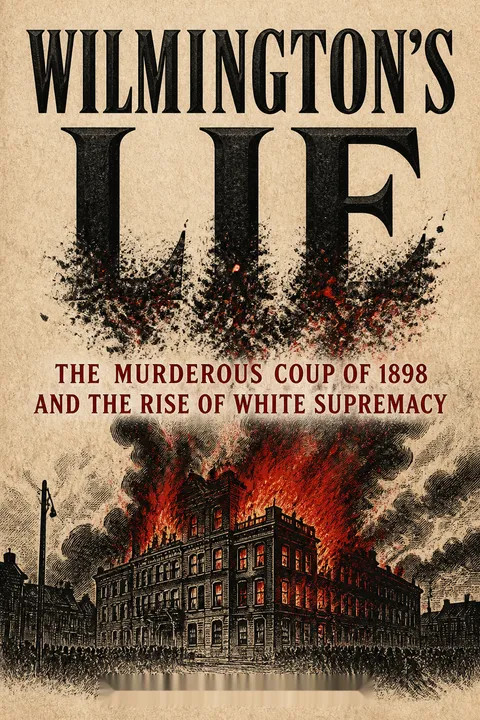
A coup called a riot. In 1898, Wilmington was a majority-Black city with a multiracial government. White Democrats organized to remove that government and suppress Black political power. Their effort included months of propaganda, voter intimidation, ballot fraud, armed patrols, and a timetable for seizing city offices after the November election. On November 10, armed whites burned the Black-owned Daily Record, attacked Black residents, and installed coup leader Alfred Moore Waddell as mayor. The violence was not an accidental eruption. It was part of a deliberate political operation.
The name mattered. Calling the violence a riot suggested two sides had lost control. The evidence Zucchino assembles instead shows a coordinated attack by a powerful group against Black citizens and elected officials. That distinction changes who appears responsible, and what the violence was meant to accomplish.
What's striking is how closely the evidence fits the political meaning of a coup: organized actors seize governing power outside lawful procedures, then claim authority after the fact. The label riot can make violence sound like a mutual breakdown, obscuring the unequal capacity to plan, arm, and govern. Historical terminology is not cosmetic. It shapes which questions readers ask, such as who coordinated events, who benefited, and which institutions failed to intervene. The account also cautions against treating every violent episode as centrally directed. Here, the planning is unusually well documented in the perpetrators' own correspondence and recollections.
Treat Black political gains as rights to defend, not temporary concessions
Citizenship was contested. After the Civil War, freed people in Wilmington faced violent policing, stolen wages, and laws that restricted their movement and rights. Abraham Galloway, an escaped slave who became a Union spy and state senator, helped organize Black resistance. He demanded education, fair treatment for Black soldiers, family support for recruits, and the vote. In 1868, Black men voted under North Carolina's new constitution, and Galloway won election to the state senate.
A community took root. Over subsequent decades, Black residents built businesses, churches, schools, newspapers, and professional networks. By the 1890s, Black men held public jobs and served on Wilmington's police force and city council. The growth was meaningful but incomplete: white control of employment, courts, and violence remained formidable. The political gains were real, which helps explain the intensity of the backlash.
The postwar history resists the familiar story that legal freedom automatically produces equal citizenship. Rights mattered because people organized to make them usable, from Galloway's recruitment work to the institutions built by Wilmington's Black residents. Political science distinguishes formal access from effective power: a ballot is not meaningful if officials can intimidate voters, reject registrations, or falsify counts. The book also shows why community institutions matter beyond elections. Businesses, churches, and newspapers create resources for collective action. Their presence can provoke resistance from those who regard equality as a threat to inherited status.
Make the threatened group look dangerous, and repression can masquerade as protection
A manufactured emergency. Democratic leaders, especially party chairman Furnifold Simmons and newspaper editor Josephus Daniels, portrayed Black voting and public office as threats to white rule. Their campaign spread stories of Black criminality and supposed plans for rape, arson, and revolt. Daniels amplified sensational or fabricated reports through his newspaper and cartoons, including imagery aimed at white voters who could not read. Yet local crime statistics showed no rise in sexual assaults. In New Hanover County, just one rape and one seduction were reported between July 1896 and July 1898.
Fear became permission. The false picture of an imminent Black uprising encouraged white voters to accept armed patrols and violence as self-defense. The claims did not need to be credible to everyone. Repetition made them politically useful, especially when Black citizens were denied the same access to newspapers and public platforms.
This is a clear case of threat construction: political actors frame a group as both powerful enough to endanger society and unfit to exercise power. That contradiction is useful because it justifies extraordinary control while denying the target group legitimacy. Media research likewise shows that repetition and emotional framing can shape perceptions even when underlying events are rare. But the book's evidence also invites a careful question: how do historians establish the reach of particular stories among different audiences? Daniels's circulation figures and the campaign's organization help, while individual readers' responses are harder to reconstruct.
Manly's editorial became a pretext for violence, not its underlying cause
A dangerous rebuttal. In August 1898, Black editor Alexander Manly challenged a white speaker who called for lynching Black men accused of approaching white women. Manly argued that white men also pursued Black women, and that consensual relationships between Black men and white women were being falsely described as rape. His editorial attacked the sexual double standard that helped sustain white supremacy.
Outrage was timed. White leaders could have responded immediately, but Simmons urged them to delay, believing the controversy would help Democrats closer to Election Day. White newspapers republished and distorted the editorial, turning Manly into a symbol of alleged Black insolence. He was threatened, his paper lost advertisers and its office, and white leaders demanded that he leave town. Manly escaped before the attack. The campaign had targeted Black political power well before his editorial appeared.
Manly's story illustrates a familiar pattern in political violence: a targeted person is blamed for provoking the response designed to silence them. The distinction between cause and pretext is crucial. His words were used to mobilize outrage, but the campaign's plans to suppress Black voting and remove Fusionist officials predated the crisis around his editorial. A nuanced reading can recognize that Manly's rhetoric was confrontational without treating confrontation as equivalent to armed coercion. Those who control weapons, institutions, and the press bear a different responsibility from a journalist defending his community.
Terror works through jobs, ballots, newspapers, and guns, not guns alone
Pressure at every level. White employers threatened to fire Black workers who registered to vote. Red Shirts and other armed men rode through Black neighborhoods, beat voters, and warned families away from the polls. At the same time, Democratic organizers challenged Black voters and stuffed ballot boxes. In Wilmington, the campaign also sought to frighten white Republicans who held local office. A handbill warned six prominent white Fusionists that they would suffer for their support of Black political power.
The machinery mattered. White merchants restricted gun sales to white Democrats, while Wilmington's white militia prepared rapid-fire weapons. In the statewide 1898 election, fewer than half of roughly 100,000 eligible Black voters cast ballots. The result was not simply a victory at the polls. It was a system of coercion that made participation dangerous, manipulated the count, and weakened the officials who might have protected voters.
The campaign's effectiveness came from combining coercion with ordinary administration. Threats from employers and election officials could suppress participation without a visible attack at every polling place. This resembles institutional pressure in other settings: people comply when the cost of dissent is distributed across income, safety, and access to public services. The combination also complicates simple accounts of voter suppression as either violent or legal. Here, intimidation and procedural manipulation reinforced one another. The figures cannot tell exactly why each person stayed home, but the documented threats make a neutral explanation implausible.
In Wilmington, armed state forces joined mobs to kill and disarm Black residents
Violence followed the script. On November 10, a white mob burned the Daily Record office and moved into the predominantly Black Brooklyn neighborhood. At North Fourth and Harnett Streets, white gunmen opened fire on Black men gathered near a saloon. Accounts differed about the first shots, but witnesses later testified that whites fired first, and many Black victims were shot in the back. The Wilmington Light Infantry and Naval Reserves entered the streets with Colt and Hotchkiss rapid-fire guns. Governor Daniel Russell authorized the militia to preserve order, giving white supremacist commander Walker Taylor power to deploy it.
The victims were not an invading army. Black residents were searched, driven from their homes, and pursued by armed men. The state commission identified thirteen Black men killed and listed nine others whose identities were uncertain. It estimated that at least sixty Black people died.
The state militia's presence blurred the boundary between public authority and partisan force. That is a central danger in political crises: official uniforms can lend legitimacy to violence rather than restrain it. The account carefully exposes the difference between rumors of an uprising and observable actions by armed white groups. It also preserves uncertainty where the record is incomplete, particularly around the exact number of dead and the identity of victims. That restraint strengthens the central finding rather than weakening it: a precise final count is not necessary to establish organized lethal violence.
The coup dismantled Black civic life by expelling leaders and replacing workers
Power was seized and emptied. After forcing Wilmington's mayor and aldermen to resign, white leaders installed Waddell and an all-white council. They targeted Black professionals, business owners, ministers, and political organizers for banishment. The state commission later documented twenty-one people forcibly expelled, fourteen Black and seven white. The commission estimated that about 2,100 Black residents fled during and after the violence.
Economic exclusion followed. The new city government dismissed Black police officers, firefighters, and municipal workers. A White Laborer's Union pressed businesses to replace Black workers with white laborers. Some employers found that white workers could not match the skills or productivity of the Black workers they displaced, but many still complied. The commission found no evidence of widespread seizure of Black property. The coup's clearest documented aims were political exclusion, forced departure, and the transfer of jobs.
The aftermath shows that political violence can work through population change and employment, not only through immediate casualties. Removing leaders weakens a community's capacity to organize; replacing workers changes who receives wages and public authority. The commission's finding about property is an important corrective to an overbroad account of dispossession. It does not minimize the destruction of livelihoods or homes through forced flight. Instead, it separates claims supported by records from claims that cannot be verified, a distinction that makes historical accountability more credible.
Federal silence let terror harden into law and disenfranchisement
Impunity had consequences. Black leaders and exiled white Republicans appealed to President McKinley and federal officials, but no federal intervention stopped the coup or protected the victims. A Justice Department investigation struggled to find witnesses willing to testify against white perpetrators. The inquiry eventually collapsed without indictments. No one was convicted for the killings or the overthrow of Wilmington's government.
The ballot was then restricted by statute. North Carolina's 1900 suffrage amendment imposed literacy and poll-tax requirements, while a grandfather clause exempted men whose ancestors had voted before 1867. Since Black men had been barred from voting before that date, the exemption protected many white voters while disqualifying Black men. Registered Black voters in the state fell from 126,000 in 1896 to 6,100 in 1902. Political terror was followed by legal exclusion.
The sequence matters: coercion can change political power quickly, while laws can make that change durable and appear neutral. The grandfather clause used ancestry as a proxy for race, demonstrating how formally equal rules can produce deliberately unequal access. Federal inaction also shaped expectations. When perpetrators face no consequences, later actors can treat the tactic as available. The book's account makes the limits of legal remedies visible, but it does not imply that law is irrelevant. Rather, law depends on institutions willing and able to enforce rights against powerful local interests.
Challenge the archive: Wilmington's victors recast a planned coup as civic rescue
The first draft favored the victors. White newspapers called the killings a response to a Black riot. A white supremacist pamphlet published in 1936 repeated that story, and school textbooks described the Ku Klux Klan as restoring order. Black residents had fewer opportunities to preserve diaries, records, and testimony, especially while fleeing for safety. The Daily Record's office was burned, destroying much of its archive.
Research changed the account. Black historian Helen Edmonds challenged the white narrative in 1951. A North Carolina commission later reviewed documentary evidence and concluded that the coup was a planned conspiracy to overthrow an elected government through violence and intimidation. Its findings also rejected claims of widespread city corruption and identified serious gaps in the historical record. The story changed because researchers questioned whose accounts survived, and what those accounts were designed to conceal.
Historical archives are not neutral containers. They reflect who had the safety, literacy, money, and institutional access to create records. In this case, perpetrators left extensive accounts, while many targets were killed, displaced, or silenced. That imbalance does not make reconstruction impossible, but it requires triangulation: compare newspapers, official records, private letters, and testimony, then mark what remains uncertain. The correction of the Wilmington story also shows how public memory is produced through textbooks, monuments, and local institutions, not simply through the discovery of new facts.
Compare voting restrictions by their design and impact, not their labels
The pattern resurfaced. The epilogue connects Wilmington's history to later North Carolina voting restrictions. After the Supreme Court's 2013 Shelby County decision weakened federal preclearance, the state adopted a voter ID law that reduced early voting, same-day registration, and other practices used disproportionately by Black voters. In 2016, a federal appeals court struck down the law, finding that its provisions targeted African Americans with unusual precision. State legislators later pursued a constitutional voter ID requirement, approved by voters in 2018.
The comparison is about method. The book does not claim that modern laws and the 1898 massacre are identical. It shows how claims of election integrity can accompany rules that burden particular voters, and how legal oversight can affect what governments attempt. The historical parallel is a reason to examine evidence, consequences, and political intent rather than accept a policy's stated purpose at face value.
Historical analogy is strongest when it identifies a recurring mechanism without collapsing distinct eras into one. The continuity here is the strategic framing of restrictions as neutral safeguards, alongside evidence that their burdens fall unevenly. The differences matter too: modern courts, civil-rights organizations, and federal statutes provide avenues of challenge that were unavailable or ineffective in 1898. A policy's effects alone do not always prove discriminatory intent, and stated intent alone does not settle its impact. Both deserve scrutiny, particularly when lawmakers study voting data before changing access.
Analysis
Wilmington's Lie is not only a reconstruction of a massacre. It explains how a political order can be dismantled by joining propaganda, economic pressure, electoral manipulation, organized violence, and retrospective storytelling. The sequence is the argument. White supremacists first represented Black citizenship as a threat, then used that claim to make coercion seem defensive. Once voters were intimidated and a multiracial government removed, state law converted a temporary seizure of power into a durable racial hierarchy.
The book's most important historical correction is that the violence was neither spontaneous nor an equal conflict. Wilmington's Black residents were not ruling the city, and the cited crime data do not support the alleged emergency used to justify armed action. The documented planning, the assault on the Daily Record, the militia's deployment, and the forced resignations show a campaign with political objectives. At the same time, the account distinguishes what can be established from what remains uncertain, especially the final death toll and some victims' identities. That discipline matters because correcting a lie does not require inventing certainty.
The narrative also shows that political power rests on more than officeholding. Black businesses, professional networks, churches, newspapers, jobs, and the ability to vote made a community capable of asserting citizenship. The coup attacked this infrastructure as well as individual leaders. Its legacy is therefore both institutional and intimate: exile, lost work, disrupted families, and the silencing of people who survived.
Finally, the book treats memory as part of the struggle. White accounts dominated public narratives for decades, while later scholars and a state commission reconstructed the event from an unequal archive. The modern comparison is persuasive when it focuses on recurring mechanisms of voter restriction, not when it suggests that legal and political conditions never change. The lasting lesson is to investigate who benefits from an alleged emergency, whose rights are treated as expendable, and whether the official story matches the evidence.
Review Summary
Wilmington's Lie is a powerful, well-researched account of the 1898 white supremacist coup in Wilmington, North Carolina. Readers praise Zucchino's thorough research, compelling narrative, and ability to connect historical events to present-day issues. Many express shock at learning about this overlooked part of American history and its lasting impact on race relations. The book is described as timely, important, and emotionally challenging, offering crucial insights into the rise of white supremacy and the undermining of democracy through violence and propaganda.
People Also Read







Glossary
Fusion
Republican-Populist political allianceFusion was the uneasy political partnership between Republicans and Populists in North Carolina during the 1890s. It brought together Black voters, Republicans, and many white farmers and laborers opposed to Democratic control. Fusionists won statewide elections in 1894 and 1896, allowing Black men to regain public offices and local political influence. Their success prompted an organized white supremacist campaign to break the coalition.
White Supremacy Campaign
1898 Democratic power campaignThe White Supremacy Campaign was the Democratic Party's 1898 effort to regain control of North Carolina and eliminate Black political influence. Led by party chairman Furnifold Simmons and newspaper editor Josephus Daniels, it used racist propaganda, threats, voter intimidation, ballot fraud, and armed groups. In Wilmington, its objectives extended beyond winning the election to removing the multiracial city government and suppressing Black civic power.
Red Shirts
Armed Democratic vigilantesRed Shirts were armed white men who organized as a militant force for the Democratic Party during North Carolina's 1898 white supremacist campaign. Their red shirts or jackets made them visible at rallies and during rides through Black neighborhoods. They intimidated Black voters, threatened and assaulted people who supported Republicans, and joined the armed violence surrounding Wilmington's coup.
white-capping
Voter intimidation by assaultWhite-capping refers to attacks by white men on Black residents, often at night, to frighten them away from registering or voting. In the 1898 campaign, Red Shirts and other white vigilantes invaded homes, beat or whipped Black men, and demanded promises not to vote or encourage others to vote. The term names the physical intimidation used to suppress political participation.
Black Belt
Eastern North Carolina Black-majority regionThe Black Belt in this account refers to eastern North Carolina counties with large Black populations, including counties where Black residents formed a majority. The region's Black voters could influence elections and win public office, especially when aligned with white Populists and Republicans. Democratic leaders described it as the Negroized East and organized the 1898 campaign to break that political influence.
grandfather clause
Ancestry-based voting exemptionThe grandfather clause exempted men from literacy or poll-tax requirements if they, or specified ancestors, had been eligible to vote before 1867. Because Black men had generally been denied the vote before that date, the exemption protected many white voters while excluding Black voters. North Carolina adopted the device as part of its 1900 suffrage amendment, after Wilmington's coup and the 1898 campaign.
Secret Nine
Clandestine Wilmington coup plannersThe Secret Nine was a group of prominent white Wilmington men who met privately before the 1898 coup. Led by wealthy businessman Hugh MacRae, its members helped plan armed patrols, coordinate political pressure, and prepare to remove the Fusionist city government. Their covert planning was part of a broader white supremacist effort that also involved party organizers, militia members, Red Shirts, and newspaper editors.
Wilmington Declaration of Independence
Ultimatum to Black WilmingtonThe Wilmington Declaration of Independence was the name given to a document presented by white supremacist leaders at a mass meeting on November 9, 1898. It demanded that the Daily Record stop publishing and that editor Alexander Manly leave Wilmington, while asserting white control over the city. The document threatened force and was followed by the burning of the paper, killings, and the overthrow of the city government.
Talented Tenth
Educated Black leadership idealThe Talented Tenth was a term used for accomplished, educated Black men expected to lead their communities and challenge racial discrimination. The book applies it to figures such as Alexander Manly, who edited a Black daily newspaper and pressed for civic improvements and political rights. The term reflected an influential turn-of-the-century belief that Black advancement could be driven by a distinguished educated leadership class.
FAQ
What's Wilmington's Lie about?
- Historical Account of 1898: Wilmington's Lie by David Zucchino details the violent coup in Wilmington, North Carolina, where white supremacists overthrew a multiracial government.
- Rise of White Supremacy: The book explores how this event marked a turning point in the rise of white supremacy in the South, leading to systemic disenfranchisement of black citizens.
- Personal Stories and Context: Zucchino weaves personal narratives of key figures to illustrate the broader social and political dynamics of the period.
Why should I read Wilmington's Lie?
- Relevance to Current Issues: The book provides insights into the historical roots of racial violence and political disenfranchisement, relevant to today's discussions on race and democracy.
- Engaging Narrative Style: Zucchino combines thorough research with compelling storytelling, making it accessible and engaging for readers interested in history and social justice.
- Educational Value: It sheds light on a lesser-known but pivotal moment in American history that shaped race relations in the South.
What are the key takeaways of Wilmington's Lie?
- Understanding Racial Violence: The book illustrates how racial violence was used to maintain white supremacy and control over black populations in the post-Reconstruction era.
- Political Manipulation: It highlights the manipulation of political narratives by white leaders to incite fear and justify violent actions against black citizens.
- Legacy of the Coup: The events of 1898 set a precedent for future racial violence and disenfranchisement, influencing policies and attitudes towards race in America for generations.
What are the best quotes from Wilmington's Lie and what do they mean?
- Frederick Douglass Quote: “The white man’s happiness cannot be purchased by the black man’s misery.” This quote emphasizes the moral implications of systemic racism.
- Democratic Politician Admission: “We stuffed ballot boxes. We shot them.” This reflects the violent tactics used to suppress black political participation.
- Racial Hierarchy Mindset: “The Negro shall know his place.” This phrase underscores the pervasive mindset of racial hierarchy enforced through violence and intimidation.
Who are the key figures in Wilmington's Lie?
- Abraham Galloway: An escaped slave and Union spy, Galloway became a prominent leader advocating for black rights in Wilmington.
- Colonel Alfred Moore Waddell: A former Confederate officer and leading orator of the white supremacy campaign, Waddell played a crucial role in inciting violence during the coup.
- Josephus Daniels: The editor of the News and Observer, Daniels was instrumental in shaping public opinion through racially charged editorials.
What events led to the coup in Wilmington?
- Political Tensions: Rising tensions as black citizens gained political power through the Fusionist movement, uniting black and white Populists against the Democratic Party.
- Economic Hardship: A severe recession in the 1890s led to discontent among white farmers, who turned to the Democratic Party, rallying against black political power.
- Racial Demagoguery: White leaders used fearmongering tactics to incite white voters against black citizens, framing them as a threat to social order.
How did the media influence the events of the coup?
- Inciting Fear: Newspapers like the News and Observer published sensationalist stories that exaggerated threats posed by black citizens, stoking racial tensions.
- Shaping Public Opinion: The media served as a mouthpiece for white supremacist rhetoric, framing the narrative around the need for white dominance.
- Disseminating Propaganda: The media actively participated in the white supremacy campaign by distributing handbills and articles that called for violence against black citizens.
What were the immediate consequences of the coup?
- Disenfranchisement of Black Voters: The coup led to the systematic disenfranchisement of black voters in Wilmington and across North Carolina.
- Violence and Terror: The events resulted in the deaths of numerous black citizens and instilled a culture of fear that suppressed black activism.
- Long-term Racial Segregation: The coup set the stage for Jim Crow laws and the institutionalization of racial segregation.
How does Wilmington's Lie connect to contemporary issues?
- Racial Injustice: The book draws parallels between historical and contemporary racial injustices, highlighting ongoing struggles against systemic racism.
- Political Polarization: It reflects on how political manipulation and fearmongering tactics continue to be used to divide communities.
- Legacy of Violence: The events of 1898 serve as a reminder of the violent history of race relations in America, urging readers to confront these legacies.
What role did the federal government play during the coup?
- Lack of Intervention: The federal government, under President McKinley, failed to intervene during the violence, allowing the coup to unfold without accountability.
- Political Priorities: The government prioritized issues related to the Spanish-American War over domestic racial violence.
- Post-Coup Investigations: Federal investigations were minimal and largely ineffective, with no significant prosecutions of those involved in the violence.
What were the long-term effects of the Wilmington coup?
- Systematic Disenfranchisement: The coup led to laws that disenfranchised black voters, such as literacy tests and poll taxes.
- Cultural and Social Segregation: The events entrenched segregation in Wilmington and across North Carolina, leading to Jim Crow laws.
- Legacy of Violence: The coup set a precedent for racial violence in the South, inspiring similar movements in other states.
What lessons can be drawn from Wilmington's Lie?
- Importance of Vigilance: The book serves as a reminder of the need for vigilance in protecting civil rights and democratic institutions.
- Understanding Historical Context: Recognizing the historical roots of systemic racism is crucial for addressing contemporary issues of race and inequality.
- Role of Community: The responses of black leaders and communities highlight the importance of solidarity and collective action in the face of adversity.
Download PDF
Download EPUB
.epub digital book format is ideal for reading ebooks on phones, tablets, and e-readers.








