

Key Takeaways
Build performance by pairing confidence with humility, results with relationships
Four forces belong together. Winning Well means sustaining excellent results without treating people as expendable. The model combines two inner qualities, confidence and humility, with two outward priorities, results and relationships. Confidence helps a manager use strengths, speak honestly, and set boundaries. Humility means seeing strengths and shortcomings accurately, admitting mistakes, and making room for challenge.
Watch for imbalance. A User pursues results through control and fear. A Pleaser prioritizes being liked over performance. A Gamer pursues status and self-protection instead of team outcomes. The Winner holds both sides together. The authors’ Bronx call-center story shows why: an intervention improved attendance and results, but the gains vanished after the visiting leader left because the team had not learned to lead the work themselves.
The model is useful because it treats humane leadership and high standards as complements, not competing styles. Its four labels also make recognizable patterns easier to discuss without beginning with blame. The deeper test is whether the team can keep performing when the manager is absent, a distinction that separates enabling leadership from personal heroics. The categories are best used as a situational mirror, not fixed personality diagnoses. A manager may become controlling during a crisis or overly accommodating with a particular employee; identifying the behavior creates room to change it.
Manage the behaviors customers value, not the dashboard's applause
A score is a signal. A metric represents work; it is not the work itself. A service rating can indicate customer experience, but it cannot substitute for resolving a customer’s problem. The authors describe a call center where the official measures tracked attendance and schedule adherence, yet representatives independently checked company and competitor social pages and dug deeper into customer issues. Their commitment to genuinely helping people exceeded what the scorecard measured.
Measure what drives value. Identify what customers actually need, the behaviors that create it, and how often results should be checked. A team trying to improve blood pressure would change diet and exercise, not take readings every few minutes. Overchecking business measures can provoke panic, volatile performance, gaming, and short-term fixes that damage other outcomes.
This is a practical warning about proxy measures. Once a number becomes the target, people can improve the number while leaving the underlying service unchanged. The remedy is not to abandon measurement, but to pair outcome indicators with observable behaviors and customer evidence. The call-center example also shows that intrinsic standards can exceed formal incentives. Still, managers should not assume that employees’ good intentions guarantee consistent quality. Measurement remains valuable when it detects patterns, protects customers, and prompts inquiry rather than replacing judgment.
Turn decisions into clear ownership, deadlines, and proof of completion
Clarity prevents expensive guesswork. Before acting, make expectations specific and ask people to explain what they understood. A district manager once assumed her team would prepare an action plan after a senior leader’s visit. They thought they would create it together on a later call, costing a week. A simple check for understanding would have exposed the mismatch immediately.
Make meetings produce action. The Winning Well Meeting Formula asks who will do what, by when, and how everyone will know it is done. Decisions also need a clear owner: one person, a vote, group consensus, or chance. Separate decisions about the destination from decisions about the method. A meeting should have a real purpose, the necessary participants, and a clear next step, not merely consume everyone’s time.
This approach addresses a quiet source of organizational waste: people can agree in a meeting while imagining different assignments, deadlines, or decision rights. Asking participants to restate the plan makes hidden assumptions visible without assuming bad intent. Explicit ownership is especially valuable in interdependent work, where one person’s completed task may still leave the next person waiting. The method does require judgment: not every minor exchange needs formal process. Its value is greatest when a task has consequences, dependencies, or a history of being misunderstood.
Address poor performance early, specifically, and without humiliating people
Accountability is a mutual commitment. It is not punishment for its own sake. The INSPIRE method structures a short conversation: initiate respectfully, notice a behavior, give specific evidence, probe for context, invite a solution, review the commitment, and enforce the standard. For example, instead of calling someone unreliable, describe the meeting time and their arrival time, ask what happened, and agree on what must change.
Consistency protects the whole team. Managers who tolerate poor performance can convince strong contributors that their effort does not matter. When coaching, training, clear expectations, and repeated follow-up do not resolve a serious mismatch, termination may be necessary. The authors advise checking organizational policy and employment law, then keeping the conversation direct and dignified. A person’s poor fit for one role does not define their entire worth.
The method is strong because it separates observable conduct from judgments about character. Asking what happened can uncover barriers, misunderstandings, or training needs before a manager reaches for discipline. It also preserves the possibility of improvement while keeping standards real. Consistency matters: a single conversation rarely changes an established pattern. The approach is not a substitute for fair procedures, documentation, or legal guidance, especially in high-stakes employment decisions. Humane accountability is not gentleness without consequences; it is clarity without degradation.
Delegate outcomes with a deadline and a scheduled return
Give people room to think. Delegating a process tells capable employees how to work; delegating an outcome tells them what success must accomplish and lets them choose the route. The authors describe a customer-service representative who followed scripts so rigidly that a customer mistook her for a bot. Rules can support consistency, but they cannot anticipate every human situation.
Close the assignment loop. Define the desired result, agree on a finish date, and schedule a time to review the completed work. For a long project, add an interim check-in. This prevents the manager from silently expecting instant completion while the employee balances other priorities. It also reduces the urge to micromanage. If someone lacks the required skill, train them explicitly; do not disguise training as delegation.
Outcome-based delegation is a form of bounded autonomy: the manager defines the purpose and limits, while the employee retains judgment about execution. That balance can improve ownership and surface better methods than the manager’s default. The scheduled return is particularly effective because it turns accountability into part of the assignment rather than a later act of chasing. Autonomy is not appropriate in every task, however. Safety-critical work, inexperienced employees, and strict regulatory processes may require more detailed procedures and closer checks.
Release motivation by knowing people, trusting them, and stretching their abilities
Managers cannot install motivation. They can learn what matters to employees and create conditions in which employees bring their own energy to work. A teacher named David struggled to encourage a student until he learned the student’s story, goals, and reasons for trying to change his life. Listening first made support more relevant than generic pep talks.
Show trust through behavior. Set ambitious goals, share opportunities, admit uncertainty, and let employees solve problems together. When someone asks for an answer, ask questions that help them think instead of automatically taking over. The authors also urge managers to notice potential beyond an employee’s current reputation. A sales representative repeatedly rejected for a more challenging role succeeded once a mentor helped decision-makers see his capabilities rather than his old image.
The insight aligns motivation with agency: people are more likely to invest when they can connect work to their own aims and exercise judgment. Trust is not merely a reassuring statement; it is visible in who gets responsibility, information, and room to learn. Stretch work can help people grow, but it should be scaffolded rather than used as a sink-or-swim test. Personal curiosity also needs boundaries. Managers should learn enough to support someone’s work without treating private disclosure as a condition of belonging.
Diagnose the real problem with employees before prescribing a fix
Symptoms can mislead. A nurse manager saw patient comfort scores fall and could have told nurses to move faster or act friendlier. Instead, she narrowed the problem to comfort, found repeated complaints about missing blankets, and traced the cause to a scheduling conflict created by another manager. Her team could not fix the issue alone, so she brought the right decision-maker a practical explanation and proposed options.
Use disciplined inquiry. Ask what differs from expectations, what has stayed the same, and why the gap exists. Estimate how likely the problem is to recur and how serious the impact would be before spending time on it. Define success before generating solutions. Invite affected employees into the discussion, test changes on a small scale, and evaluate what happened rather than searching for someone to blame.
The case illustrates systems thinking: a visible failure may originate in a different team’s priorities, so blaming the nearest employee can worsen the problem. Separating symptoms from causes is also a guard against action bias, the urge to do something quickly just to relieve discomfort. The authors’ impact calculation helps teams compare problems, though probability estimates are often uncertain and should not create false precision. The most defensible decisions combine data, frontline knowledge, and a willingness to revise the diagnosis.
Connect routine tasks to a purpose employees can explain themselves
The reason gives work direction. A task without a credible reason can feel like meaningless repetition. The authors use the image of a worker digging and refilling the same ditch to show how disconnected activity drains spirit. Managers should be able to explain how daily work serves customers, the team’s mission, or a larger outcome, and employees should be able to explain that connection in their own words.
Question the work itself. If a task has no legitimate contribution, clarify it, redesign it, or remove it. A team manager can ask which activities feel valuable and which do not. This is not an invitation to invent an inspiring story for every assignment. It is a way to uncover whether people lack context or whether the work truly needs to change.
Purpose is most persuasive when it is specific enough to guide choices. A generic claim that every task matters can sound like management propaganda, especially when employees see waste or conflicting priorities. Inviting people to explain the connection creates a useful test of shared understanding and can reveal problems leaders have missed. Meaning also varies by person: the same job may represent service, craft, security, or learning. A strong mission connects these motives without pretending they are identical.
Protect focused time because an endless workload still permits one priority
Attention is finite. The authors call this reality “infinite need, finite me”: work can always expand beyond the hours and energy available. Identify what matters most to the organization, then choose the day’s MIT, or most important task, and do it before opening the floodgates of messages and interruptions. The Rule of One means giving one task full attention rather than pretending to work effectively on several at once.
Treat energy as a work resource. A nonprofit executive blocked two 90-minute periods each day for focused work, and the practice improved the office’s ability to concentrate. The authors also recommend rest, exercise, and matching demanding work to personal energy patterns. Asking “How can I?” can shift a stuck manager from complaint toward a possible next action.
The practical value here is not a perfect productivity ritual, but deliberate protection of scarce attention. Selecting one priority forces a trade-off that many managers avoid by keeping every task mentally active. Focus periods work best when teams agree on what counts as a true interruption and when leaders respect their own policy. A daily MIT can also become simplistic if urgent coordination or care work is invisible. The priority should guide a day, not become another score employees are shamed for missing.
Recognize useful behavior sincerely, and let play energize sound work
Praise must fit the person and the work. Recognition is most credible when it is relevant, specific, and meaningful to its recipient. A hotel’s staff appreciation meal was placed beside dumpsters, while another manager praised an employee for a project she had not done. Both examples show that good intentions cannot compensate for inattention. Learn whether someone prefers public recognition, a private thank-you, or another form of appreciation, and connect praise to the contribution.
Make room for appropriate fun. A rival swim coach put fish in a new coach’s pool, turning competitive tension into shared laughter. Play can loosen a room and strengthen connection, but it cannot repair broken processes or cover real conflict. Sarcasm at someone else’s expense risks shame and silence. Fix the problem first, then have fun together.
Recognition is a form of information: it tells a team which contributions count. If praise is inaccurate or detached from meaningful work, it teaches cynicism rather than motivation. Individual preferences matter, but so does perceived fairness across the team. Play adds value when it is voluntary enough to feel safe and connected to the group, not imposed as a test of loyalty. The distinction between humor that includes people and humor that targets them is especially important when the speaker has authority.
Make credibility visible by telling the truth and owning mistakes
Trust depends on observable choices. A leader who hides a personal reality from a team while asking for openness may appear less trustworthy, even if the concealment began as self-protection. The authors argue for direct communication rather than over-polished spin, while taking care to explain difficult news with respect. When a manager makes a mistake, a plain apology, responsibility, and corrective action are more credible than excuses.
Do not copy harmful pressure. A stressed leader’s controlling behavior can travel down the hierarchy as each manager assumes someone below will soften the message. Employees can also give a manager useful feedback about the impact of their behavior. The authors’ final test of leadership is not a title or a finished product, but whether people become more capable through working with the manager. People, not the manager’s image, carry the lasting influence.
The emphasis on visible accountability is persuasive because teams judge credibility through patterns, not declarations. A leader who admits an error makes it safer for others to report problems before they grow. Candor still requires judgment: transparency does not mean disclosing confidential information or unloading unprocessed anxiety onto employees. The same standard applies upward. A manager can challenge a boss more effectively by connecting concerns to organizational outcomes and offering a workable alternative. The legacy test turns leadership from self-presentation toward the capacity built in others.
Analysis
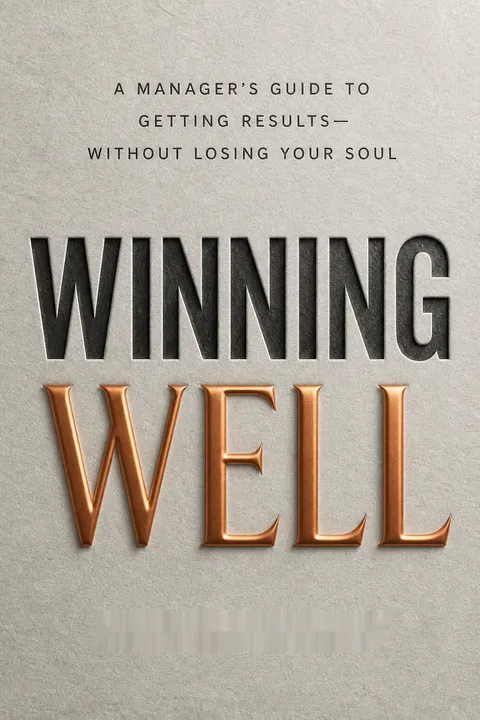
Winning Well is a practical response to a familiar management trap: organizations demand measurable performance, while managers are often left to choose between pressure and popularity. Hurt and Dye reject that false choice. Their model argues that enduring results require confidence and humility inside the manager, and relationships and outcomes in the work. The book’s strongest contribution is not a single technique but its repeated insistence on making management observable. Expectations should be restated, decisions should have owners, delegated work should have a return point, and feedback should name behavior rather than attack identity. These practices replace mind-reading with shared evidence.
The book also treats employee energy as operational capacity, not a decorative benefit. Trust, meaningful work, recognition, and room to solve problems are presented as conditions for execution. That claim is compelling because it links dignity to concrete work design: people who understand the purpose and have authority to act can contribute judgment rather than merely comply. Yet the connection is not automatic. A warm climate cannot compensate for inadequate staffing, contradictory incentives, or a strategy that does not serve customers. Nor does a focus on relationships mean that every employee will become engaged or suitable for every role. The authors’ own emphasis on accountability and fit helps keep the argument from collapsing into sentiment.
The book’s many stories make its advice memorable, although the number of tools can feel abundant enough to become another managerial checklist. The most useful way to apply them is selectively: identify the bottleneck, choose a practice that addresses it, and observe whether results and relationships improve together. In that sense, Winning Well is less a promise of effortless harmony than a discipline of refusing easy extremes. It asks managers to produce results without making fear their main instrument, and to care about people without making comfort an excuse for avoiding standards.
Review Summary
Winning Well receives mostly positive reviews, with readers praising its practical advice and actionable strategies for managers. Many find it a valuable reference guide for handling various management situations. Reviewers appreciate the book's focus on balancing results and relationships, as well as its accessible writing style. Some highlight its usefulness for both experienced and aspiring managers. While a few critics note that the content isn't groundbreaking, most agree it offers solid principles for effective leadership and team management.
People Also Read








Glossary
Winning Well
Sustainable humane performanceThe authors’ approach to management: sustain excellent performance over time while treating people with dignity. It combines confidence and humility as internal values with attention to both results and relationships. It rejects short-term gains produced through fear, exhaustion, or control, because those methods weaken the people needed to keep delivering.
Four Types of Managers
Four management patternsA framework describing managers according to their emphasis on results and relationships, alongside confidence and humility. Users prioritize results and control, Pleasers prioritize being liked, and Gamers focus on status and self-protection. Winners combine high expectations with healthy relationships. The categories are intended to help diagnose behaviors, not permanently label people.
INSPIRE method
Structured accountability conversationA seven-step method for discussing a performance concern: Initiate respectfully, Notice the behavior, provide Specific Support, Probe for context, Invite a solution, Review the commitment, and Enforce the standard. It aims to make the conversation brief, specific, and respectful while ensuring the employee understands what must change and how follow-up will occur.
Winning Well Meeting Formula
Meeting action commitmentsA closing practice for decision-making and problem-solving meetings. Participants establish who will do what, by when, and how the group will know it is complete. The formula turns discussion into visible ownership and follow-through, particularly when work depends on one person communicating completion to another.
infinite need, finite me
A limit on available attentionThe recognition that potential work is effectively endless, while each person has limited time and energy. The phrase encourages managers to stop trying to complete everything and instead choose the work that matters most. It underpins the authors’ advice to prioritize, focus, rest, and accept that some tasks must be deferred or dropped.
MIT
Most important taskThe single most important task a manager chooses to complete on a particular day. It should connect to the organization’s priorities and the team’s desired outcomes. The practice is to identify it before the day becomes dominated by messages and interruptions, then give it focused attention.
Rule of One
One task, full attentionA focus practice that rejects the pretense of effective multitasking. When working on a priority, the manager reduces notifications and competing demands, gives the task full attention, and changes focus deliberately. The authors suggest agreed periods of protected work, with exceptions for genuine emergencies.
FAST model
Focused results frameworkA framework for pursuing ambitious results through four practices: Focus on the most consequential priorities, Acknowledge progress and competing demands, Stretch people and assumptions, and Think carefully about risks, stakeholders, and unintended effects. It aims to build momentum without overwhelming people or rushing past important considerations.
VOICE approach
Prepare to speak effectivelyA method for helping employees communicate their ideas: Visualize the delivery, Organize the main points, Inquire into others’ perspectives, Consider what they say, and Energize the presentation. It is designed to improve preparation and presence, especially for people who struggle to be heard in meetings.
DARN method
Report problems upwardA structure for informing a manager about a problem: Disclose what happened and its cause, accept Accountability rather than blame, describe the Response already taken, and identify Next Steps and any help needed. It encourages early, solution-oriented communication instead of delaying bad news.
6x3 communication strategy
Repeat through multiple channelsA communication practice for important information: repeat the message at least six times through three or more channels. The authors use it to reinforce change and clarify priorities, recognizing that a single email or meeting rarely ensures that everyone has heard, understood, and remembered a message.
Download PDF
Download EPUB
.epub digital book format is ideal for reading ebooks on phones, tablets, and e-readers.








