

Key Takeaways
Travel to feel a place, not collect its approved landmarks
A guide to attention. Bourdain describes his work as storytelling rather than a complete or neutral report. He tries to convey how a place affected him, through food, people, atmosphere, and memory. Laurie Woolever explains that the book was assembled from his television transcripts, essays, notes, and recollections from friends and family after his death. That makes it a collection of vivid encounters, not a comprehensive travel manual.
Move at human speed. In Paris, Bourdain recommends wandering, eating, resting, and leaving room for chance instead of racing through a checklist of monuments. The practical advice is useful as a mood and method, but prices, routes, and business details change. Treat the book as a prompt for what to notice, then verify current logistics elsewhere.
What's striking is that the book makes its partiality explicit. Travel writing often implies that a destination can be captured by enough facts, but this account treats feeling as evidence of a different kind: situated, selective, and revealing. That honesty is a strength, though it does not make the perspective comprehensive. A celebrity visitor still sees through a particular lens, and a reader benefits from asking whose daily life remains outside the frame. The practical consequence is simple: use the guide to sharpen curiosity, not to outsource judgment.
Let food reveal a place's history, labor, and layered identity
A meal carries history. In Salvador, bright colonial streets and lively music sit alongside Pelourinho's role in the Atlantic slave trade. The book notes that nearly five million enslaved Africans were taken to Brazil, with 1.5 million arriving in Bahia. That history helps explain why Bahian cooking bears such strong African influence, including its use of dendê, a red palm oil.
Follow the ingredients. Macau's cuisine reflects centuries of Portuguese travel and exchange with China, India, Africa, and Brazil. In the United States, Gullah cooking preserves African food traditions through seafood, rice, okra, peanuts, and other ingredients. These meals are not merely local specialties. They are traces of migration, power, adaptation, and memory.
Food can function as a material archive: ingredients, techniques, and meal customs preserve movements of people that official narratives may flatten. That makes the table an unusually accessible entry point to history. The limit is equally important. A celebrated dish cannot stand in for an entire culture, and a pleasurable meal can obscure the coercion or inequality that shaped it. The strongest reading holds both truths together: savor the particular food, while asking whose labor and history made it possible.
Find the local meal before chasing the famous restaurant
Start where people eat. Bourdain often uses markets and informal restaurants to learn what a place cooks and values. In Phnom Penh, a first visit to Central Market means encountering breakfast soup, dried fish, woodsmoke, and the everyday ingredients sold to local shoppers. In Ghana, a chop bar serves hearty meals built around soup, meat or fish, and a starch such as rice balls.
Notice the food system. Singapore's hawker centers bring many independent food stalls together in covered public spaces. They developed from street vending and now operate under rules for food handling and basic facilities. A stall's specialty, the customers who return, and the queue itself can tell a traveler more than a polished menu. A buka is a casual Nigerian eatery, often run by women, where regulars ask the proprietor to serve another helping.
Everyday food reveals more than taste. It shows how people organize work, manage cost, and make public space hospitable. Singapore's hawker centers illustrate that street food is not simply an informal alternative to restaurants. It can become civic infrastructure, with public regulation supporting a dense ecology of small vendors. Still, a busy stall is not automatically safe or representative. Curiosity works best alongside local advice, attention to conditions, and respect for the fact that a working market is not a stage arranged for visitors.
Test your prejudices by meeting the place they misread
Let surprise correct the stereotype. Before visiting Vienna, Bourdain associated Austria with childhood dislikes, including a barber who gave him an unwanted haircut and a film he disliked. He also had little interest in the country's famous pastries. Yet a visit during Krampus Day, a festival featuring the fearsome companion to Saint Nicholas, opened a route into local culture that suited his dark humor. The city and its food gradually won him over.
Try the unfamiliar honestly. His travels repeatedly unsettle assumptions about what counts as appealing food, from Sichuan pepper's mix of heat and numbing sensation to organs eaten in Mumbai. The point is not to force enthusiasm. It is to distinguish a genuine preference from a borrowed idea about what a place or its people must be like.
The Vienna story illustrates a useful form of disconfirmation: an expectation changes when experience supplies a memorable counterexample. In psychology, contact across cultural boundaries is most useful when it is sustained and personal, rather than a quick encounter reduced to spectacle. Travel cannot guarantee that depth, and discomfort by itself is not proof of growth. The more reliable practice is to stay curious while preserving boundaries, then revise a judgment only when the evidence warrants it.
Read beauty alongside the history that made it possible
Look past the scenery. Cambodia's temples and landscapes are inseparable from a recent history of mass violence. The book describes how the Khmer Rouge seized Phnom Penh in 1975, forced city residents into the countryside, and killed more than 1.7 million people. Angkor Wat's grandeur, meanwhile, represents an older Khmer civilization whose scale Bourdain found impossible to capture in photographs.
Remember what remains. In Laos, the United States flew more than half a million missions during a secret war. About 30 percent of the bombs failed to explode, and the book reports that unexploded ordnance has killed or maimed 20,000 people since the conflict. A beautiful destination can therefore also be a landscape still shaped by political decisions and unfinished harm.
Pairing visual beauty with political history resists the tourist habit of turning a country into scenery. It also changes what counts as seeing: the traveler attends not only to monuments, but to the structures and hazards history leaves behind. There is a further obligation here. Suffering can become another consumable spectacle if visitors seek dramatic stories without listening to residents or supporting their priorities. Historical context is most useful when it deepens respect for local agency, rather than merely intensifying a traveler's emotions.
Name the limits of your gaze, then make room for local voices
A storyteller is not a whole country. In the Kenya episode that Bourdain identifies as his last recorded narration, he directly raises the question of who gets to tell a place's stories. His answer is that the account is his, not Kenya's, and that Kenyan stories still need to be heard. The admission does not solve the imbalance, but it makes the narrator's position visible.
Listen for another view. Producer Nari Kye's account of filming in South Korea shows how a travel program could also become a personal return. She had grown up ashamed of her Korean heritage in the United States. During the trip, her grandfather recounted escaping south during the Korean War, sharing family history she had never heard. His voice changes the meaning of the visit from sightseeing to inheritance.
What's powerful is the distinction between representing a place and claiming to represent it completely. That distinction resembles the idea of situated knowledge: every account comes from a position, and naming that position makes its boundaries easier to see. Yet self-awareness is not the same as shared authority. A visitor's humility matters most when it creates space for local people to narrate their own experience, rather than serving as a flattering feature of the visitor's persona.
Treat publicity as a force that can help and disrupt
Attention has consequences. The book calls the surge of customers after a business appears on Bourdain's show the Bourdain effect. Toronto restaurateur Jen Agg recalls that a producer asked her to stage a bone luge, in which a drink is poured through a roasted marrow bone. It was not a regular feature of her restaurant, and she felt uncomfortable performing it on camera.
A segment becomes a business decision. After the episode aired, customers repeatedly requested the bone luge, and the restaurant made substantial money from it. The book also notes that exposure could overwhelm a small restaurant or alter the character of a neighborhood institution. Media attention is not an abstract compliment. It can change a business's workload, clientele, and relationship with its regulars.
This is a compact case study in attention economics. A television segment can convert a private specialty, or even a one-time performance, into a repeatable product. The resulting income is real, but so is the shift in who controls the story and how the business must respond to demand. Travelers also distribute attention through social media. A considerate visitor can ask before photographing, avoid treating staff as performers, and support the broader neighborhood rather than concentrating every purchase at one famous address.
Ask whether wildlife tourism protects nearby communities, too
Conservation involves people. In Tanzania, Bourdain describes a conflict between lions protected for wildlife tourism and Maasai herders whose cattle and goats are central to their livelihoods. Animals can generate substantial tourism income, while local people may receive less attention from visitors and bear the costs of sharing land with predators.
Build local support. Kenya's Lewa Wildlife Conservancy protects rhinos and other animals. The book reports that its rhino population rose from 15 to 169, and describes local trackers, anti-poaching work, community outreach, and free conservation education for thousands of schoolchildren. These details suggest that protection is more durable when it involves people who live beside the wildlife, rather than treating them as obstacles to a scenic experience.
The ethical question is not simply whether a reserve saves animals, but how its costs and benefits are distributed. Conservation depends on ecological knowledge, funding, and durable relationships with neighboring communities. A model that excludes residents may protect a habitat in the short term while generating justified opposition over land, access, or livelihood. Tourism can help finance protection, but visitor spending is not automatically equitable. The crucial measure is whether local people have meaningful influence and share in the gains.
Let encounters change your sense of who you are
Travel can return a person to themselves. Nari Kye describes filming in South Korea as a turning point. Raised in the United States, she had tried to hide Korean traditions to fit in. Meeting family, making kimchi with older women, and hearing her grandfather's account of fleeing the north helped her recognize her heritage as central to her identity. She later made Korean language and culture part of her work and family life.
A return can test old feelings. Bourdain revisited Malaysia after a decade, partly to find out whether the unsettled state of mind he remembered still hurt. The book also follows his and his brother Christopher's search into family connections with Uruguay, where the archival clues produced questions as well as answers. Travel does not guarantee revelation, but it can give people a new setting in which to examine memory.
These stories resist the idea that travel transforms everyone through exposure alone. Change comes through relationships, remembered histories, and opportunities to interpret experience after the journey. The Korean episode is especially revealing because the transformation is not simply an outsider appreciating another culture. It is a person reclaiming a culture that had felt like a liability. That distinction matters: travel is most meaningful when it expands a person's understanding without turning another community into a tool for self-discovery.
Explore your own city as if you had just arrived
Familiarity can hide whole neighborhoods. While planning a New York chapter, Bourdain admitted that he knew some foreign destinations better than his own city's outer boroughs. He then explored Queens, the Bronx, Brooklyn, and Staten Island, finding food cultures he had barely encountered. In Queens, Xi'an Famous Foods offered hand-pulled noodles and a family interpretation of Shaanxi cooking. In the Bronx, 188 Cuchifritos served Puerto Rican specialties including fried off-cuts and plantains.
Apply the traveler's method at home. Ask what people in another neighborhood actually eat, where they shop, and what histories shaped the businesses around them. This does not require exoticizing local communities. It requires acknowledging that a city is larger than the familiar routes and tastes of any one resident.
The home-city lesson challenges a common asymmetry: distance makes unfamiliar places seem worthy of close attention, while proximity encourages the assumption that everything nearby is already known. Urban sociology offers a useful correction: a city is not a single culture but a set of overlapping worlds, often divided by transit, class, language, and habit. The traveler’s curiosity can reveal those worlds, provided it remains respectful. The goal is not to collect neighborhoods as discoveries, but to notice whose presence and history familiarity has made invisible.
Analysis
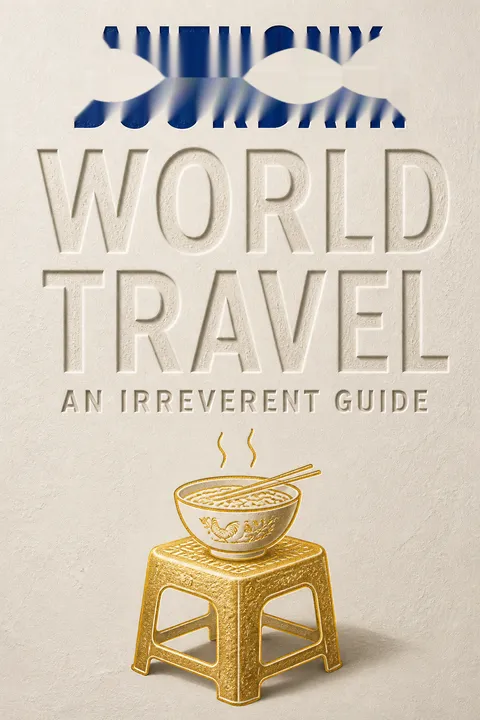
World Travel is less a handbook than a record of attention. Its country-by-country structure promises orientation, but its real organizing principle is Bourdain's appetite: a meal leads to a cook, a cook to a neighborhood, and a neighborhood to the histories and power relations beneath the menu. That movement gives the book its narrative force. Food is not a decorative travel accessory here. It is a practical route into labor, migration, class, memory, and belonging.
The book's most valuable tension is between the authority of the traveler and the limits of that authority. Bourdain is candid about telling his own story, not a definitive story of Kenya or any other place. Yet his celebrity gives his preferences unusual power. The Toronto account of the bone luge makes that power tangible: an edited television moment can alter a restaurant's business and identity. The work's self-awareness does not erase this imbalance, but it gives readers a way to notice it.
The guide also refuses the fantasy that beauty is politically innocent. The temples of Cambodia, the unexploded bombs of Laos, and wildlife tourism in Tanzania all complicate the pleasures of looking. This is where the book moves beyond restaurant recommendation. It asks what history a landscape contains, who gets to enjoy it, and who pays for that enjoyment. The strongest chapters make those questions inseparable from the sensory experience.
Its limits are part of its form. The author's perspective is selective, the practical details can become outdated, and a destination cannot be reduced to its most memorable meal. The book itself acknowledges the need for fuller guides and local stories. Read in that spirit, its enduring contribution is not a list of places to visit. It is a practice: arrive curious, notice ordinary life, trace what food and scenery conceal, and remain alert to the people whose accounts are still missing.
Review Summary
World Travel receives mixed reviews. Many readers are disappointed, expecting more of Bourdain's signature storytelling but finding a travel guide format instead. The book compiles quotes from his shows with basic travel information. Some appreciate the collection of Bourdain's thoughts and recommendations, while others feel it lacks cohesion and depth. Essays by friends and family are highlights for many. Fans miss Bourdain's voice but debate whether this posthumous work does justice to his legacy. Overall, reactions range from appreciation to frustration.
People Also Read




Glossary
Bourdain effect
Publicity-driven surge in customersThe increase in customers a restaurant or other local business can receive after being featured on Anthony Bourdain's television program. The attention may bring income and wider recognition, but it can also overwhelm a small operation, alter its atmosphere, or turn a once-local business into a destination for visitors.
paladares
Privately run Cuban restaurantsPrivately owned and operated restaurants in Cuba, often based in the proprietor's home. The book contrasts them with state-owned restaurants, describing paladares as places that often offer better food and service. They became legal in 1993 but remain subject to government rules, taxes, and limitations on staffing and seating.
hawker centers
Communal centers for food stallsCovered public spaces in Singapore that bring independent food vendors together in regulated stalls. They developed from a street-hawker culture that sold meals and other goods in public spaces. The centers provide basic facilities and food-handling rules while preserving a wide variety of inexpensive, specialized cooking.
buka
Casual Nigerian food stallA casual, often open-sided Nigerian restaurant that serves hearty local meals and may specialize in particular dishes. The book notes that bukas are generally operated by women and are also called Mama Put restaurants, a name associated with regular customers asking the proprietor to add another helping.
About the Author
Other books by Anthony Bourdain

Download PDF
Download EPUB
.epub digital book format is ideal for reading ebooks on phones, tablets, and e-readers.








