

Key Takeaways
Name religious harm as trauma, even when no one struck you.
Harm can be cumulative. Jamie Lee Finch argues that religious trauma can emerge from repeated exposure to frightening doctrines, shame, punishment, and strict control, especially when a child cannot question or leave. The harm may be psychological and relational even without a single dramatic incident of physical violence. Finch uses Religious Trauma Syndrome, or RTS, for the difficulties some people experience while leaving authoritarian religion and dealing with the effects of indoctrination. She describes anxiety, low self-worth, perfectionism, trouble trusting feelings, and loss of community as possible effects. Her own childhood and adult experiences ground the argument, but she stresses that survivors' histories differ and that her account does not represent every Christian or every Evangelical church.
Naming changes the frame. Finch describes the relief people can feel when their unexplained distress is recognized as connected to their religious upbringing. That recognition does not require proving that parents or pastors intended harm. The effects of a teaching and the intentions behind it are separate questions.
What's valuable here is the distinction between an event's outward appearance and its impact on the person who lived it. Trauma-informed practice asks about perceived safety, duration, and available escape, not only visible injury. That can help a survivor explain why years of fear or coercion mattered. Still, RTS is a useful descriptive framework, not a standalone diagnosis in major diagnostic manuals. The label can open conversation, but it should not replace individualized assessment or imply that all religious commitment is pathological. Finch's emphasis on context helps keep the concept specific to authoritarian, controlling experiences.
Teach children to trust their inner signals, not only external authority.
Self-doubt starts early. Finch describes being taught that human beings are inherently sinful, that the body and its desires are suspect, and that personal confidence risks becoming pride. In this framework, goodness comes from outside the self, through divine approval, rather than from developing judgment and self-respect. Finch recalls praying to have her desires removed and writing about herself as corrupt. For girls, the message could become especially bodily: purity culture presented sexual development as dangerous and tied a woman's worth to abstinence and future marriage. Finch connects these beliefs with her eating disorder and self-harm, describing attempts to make her body smaller and suppress its needs.
Agency needs practice. Children need room to notice feelings, ask questions, and learn boundaries. When these ordinary capacities are repeatedly treated as evidence of moral failure, self-trust can become difficult to develop.
Developmental psychology gives this point broader significance: autonomy grows when young people can test choices, receive guidance, and remain connected to caregivers even when they disagree. The alternative is not a child deciding everything alone, but a relationship in which inner experience can be discussed rather than automatically condemned. Finch's account also shows how gender rules can make abstract doctrines physically intimate, shaping how a girl interprets appetite, size, desire, and safety. The caution is that teachings about humility or self-restraint vary widely in practice. The relevant question is whether they support responsibility and care, or demand self-erasure.
Stop treating imagined eternal danger as harmless because it is invisible.
Fear can shape childhood. Finch remembers being taught about hell, the rapture, and the possibility that loved ones could die without salvation. At eight or nine, she panicked at the prospect of attending a Catholic service with neighbors because she feared being spiritually deceived. As a teenager, she wrote a poem imagining her friend dying and blaming her for not converting her. The danger was not physically present, but the consequences felt absolute, and the child was made responsible for preventing them through evangelism and obedience.
The threat had no exit. Finch describes nightmares, anxiety about her parents disappearing in the rapture, and guilt over failing to save others. Because children often cannot leave the family or community that teaches these beliefs, reassurance may not undo the fear when the underlying stakes remain unchanged.
The example highlights a basic feature of threat learning: the nervous system can respond to anticipated danger, not just immediate danger. A child repeatedly imagining eternal punishment may experience real distress, even though the feared event is theological rather than observable. That helps explain why telling someone that a doctrine is only an idea may not immediately calm a body trained to treat it as urgent. At the same time, distress alone does not establish a trauma disorder. The useful distinction is between acknowledging a real emotional response and making a clinical diagnosis, which requires more than a compelling story.
Read white Evangelical history alongside its language of morality and power.
Beliefs have a political history. Finch places her Southern Baptist childhood within a broader account of white Evangelicalism in the United States. She describes how some religious leaders reacted against scientific criticism and social reform, and how the modern Religious Right built influence through opposition to desegregation, abortion, gay rights, and secular education. She notes the Southern Baptist Convention's origins in an 1845 split over slavery, and cites the book's account that 81 percent of white Evangelicals voted for Donald Trump in 2016. These histories help explain why religious identity can also carry political loyalties and ideas about gender, race, and authority.
The category is not uniform. Finch distinguishes her focus on authoritarian white Evangelical subcultures from Christianity as a whole. She also acknowledges dissenting Evangelical voices and variation among believers, even while arguing that political power has often protected harmful institutions.
The historical lens keeps personal distress from being reduced to private family dysfunction. It asks how institutions define morality, whose interests their rules serve, and how those rules travel through schools, homes, and law. That approach is strongest when it treats history as context rather than a single-cause explanation. Evangelical communities are internally diverse, and political affiliation cannot by itself establish a person's theology or conduct. Finch's narrower focus on white American political Evangelicalism makes the critique more legible, while the cited historical examples show why that scope matters.
When protest and escape are blocked, freezing can become survival.
Threat responses vary. Finch explains the familiar fight-or-flight responses alongside a freeze response, in which a person becomes immobilized when resisting or escaping seems impossible. She connects this idea to children raised in tightly controlled religious environments: they may be unable to challenge adults, leave their homes, or express fear without being shamed. Her own response was often to stay, suppress distress, and appear obedient. She argues that repeated, unresolved threat can help explain why a person remains in a harmful community, rather than proving they consented to what was happening.
Survival is not agreement. Finch uses this perspective to challenge survivors' self-blame for not leaving sooner. A child with little practical power may adapt to the only environment available, even when that adaptation later brings emotional or behavioral costs.
This reframing matters because hindsight can make constrained choices look voluntary. Stress research and trauma-informed care both emphasize that perceived options shape behavior: a person who sees no safe route out may prioritize enduring the moment. The idea of freezing can therefore restore compassion to accounts of staying, silence, or compliance. It should not, however, become a universal explanation for passivity. People respond to danger in different ways, and the biology of trauma is more complex than a simple three-part menu. The framework is most useful as a question about agency, not a verdict about what every survivor experienced.
Treat bodily distress as information, not proof of spiritual failure.
The body remembers patterns. Finch describes panic attacks when she tried to return to church after leaving an abusive religious community, alongside anxiety, disordered eating, self-harm, sleep problems, and disconnection from pleasure. She draws on trauma writing to explain how reminders can trigger physical reactions even when a person no longer consciously believes the doctrines that once frightened them. She also discusses psychoneuroimmunology, a field examining connections between psychological processes, the nervous system, and immune function. Her central practical point is to notice bodily sensations and investigate what they may be communicating, rather than automatically interpreting distress as sin or weak faith.
Symptoms need care. Finch presents them as possible signals of unresolved stress, not as proof of a single cause. Medical symptoms still deserve qualified medical attention, alongside psychological support when appropriate.
The book's insistence that bodily symptoms deserve attention is persuasive and humane. Modern stress research supports links between chronic stress and physiological functioning, while somatic therapies help some people notice sensations they previously avoided. But the leap from a religious experience to a specific illness, or from emotional work to recovery from disease, requires evidence beyond personal testimony. A symptom can have many interacting causes. The safest application is neither to dismiss the body nor to treat it as an infallible diagnostic instrument: use its signals to prompt curiosity, and involve appropriate clinicians in assessing health concerns.
Let anger identify the injury before forcing yourself to forgive.
Grief needs acknowledgment. Finch argues that people leaving authoritarian faith may feel grief over losing God, purpose, community, and a familiar account of the world. They may also feel anger about coercion, rejection, or years spent suppressing their own needs. In her account, anger can mark recognition that a boundary was crossed; grief can follow once the loss is allowed to become real. Both emotions may feel forbidden to someone taught that anger is disobedience and forgiveness must come quickly.
Make room safely. Finch recommends supportive therapeutic and communal spaces where feelings can be expressed without punishment. She describes recovery as uneven: fear, guilt, and bodily reactions may persist even after a person no longer accepts the beliefs intellectually. Patience matters more than demanding instant closure.
This account resists a common social shortcut: treating forgiveness as the measure of whether someone has healed. In moral psychology, anger can help identify perceived injustice and motivate boundary-setting; it becomes harmful when it hardens into unexamined retaliation or consumes every other part of life. Finch's point is not that anger should dictate action, but that suppressing it can erase information about harm. Safe relationships make that distinction possible. The emphasis on grief also recognizes that leaving a faith can mean losing real attachment and community, even when the belief system itself felt dangerous.
Rebuild agency through safe relationships and choices small enough to own.
Recovery restores personhood. Finch draws on a recovery sequence associated with Marlene Winell: separation, confusion, avoidance, feeling, and rebuilding. These phases are not a tidy checklist. Leaving may bring relief and disorientation at once, especially when faith supplied a person's relationships, work, purpose, and rules for making decisions. Finch recalls being unable to name things she enjoyed and taking an online happiness course because she did not know how to access joy. Relearning preference can begin with ordinary decisions, made without waiting for external permission.
Support makes choices safer. Finch recommends communities, therapists, and healing practices suited to the individual. Her aim is not to replace one authority with another, but to help survivors develop self-trust, practical skills, and a sense of belonging that does not depend on submission.
The focus on small, self-owned choices translates recovery from an abstract identity project into daily practice. It resembles self-determination theory, which links well-being to autonomy, competence, and connection: a person needs room to choose, the ability to act, and relationships that do not punish independence. Finch's sequence also wisely allows avoidance and confusion rather than treating recovery as a straight climb. One helpful safeguard is to keep support collaborative. A therapist or community that prescribes the survivor's new beliefs too forcefully can reproduce the very loss of agency the process is meant to repair.
Reclaim your body and choices from any authority that calls them corrupt.
A new story takes shape. Finch describes storytelling and embodiment as ways to reconnect with a body and identity that religious teaching had framed as untrustworthy. Writing, speaking with others who understand the experience, and noticing sensations can help a survivor put past events into context and recover a personal voice. She recommends options such as trauma therapy, mindfulness, yoga, breathwork, and body-based practices, while recognizing that people need different forms of support. Her larger point is that the body is not an enemy to defeat, and that pleasure, sexuality, and personal desire need not be treated as evidence of moral failure.
Keep claims grounded. Finch recounts stories of physical conditions improving alongside narrative work, but these anecdotes cannot establish that storytelling cures illness. Reclaiming agency can matter without promising a medical outcome.
The title's central idea becomes practical here: recovery includes deciding what belongs to the self, rather than outsourcing every judgment to an institution. Narrative approaches can help people organize experience and make meaning, while body-based practices offer ways to attend to present sensations. Neither approach requires adopting Finch's spiritual language or assuming that every illness carries a hidden message. That distinction protects the insight from becoming another rigid doctrine. The strongest measure of progress is not a prescribed identity or cure, but greater freedom to interpret experience, seek care, set boundaries, and choose what brings safety and vitality.
Analysis
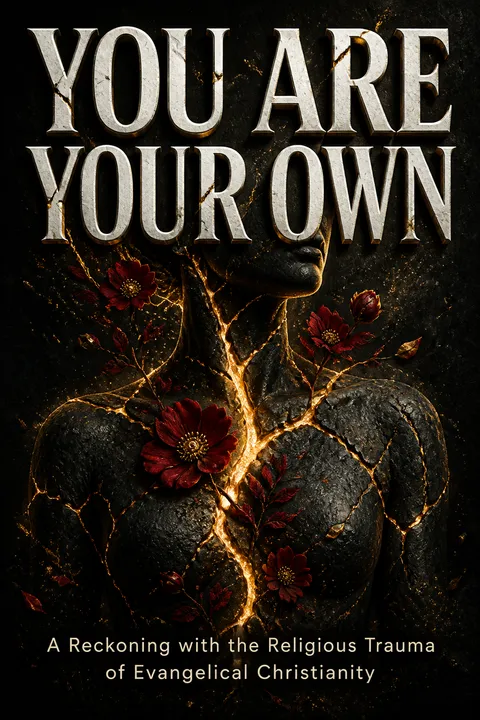
You Are Your Own works in two registers at once: it is a memoir of growing up in a conservative Evangelical setting, and an argument that certain authoritarian teachings can cause lasting psychological harm. The memoir supplies the book's strongest evidence. Finch's childhood terror of hell and the rapture, her shame around sexuality, and her difficulty identifying what she enjoyed make abstract doctrines legible as lived experience. Her account also demonstrates why leaving a belief system can mean losing a social world, a sense of purpose, and a framework for interpreting the body, not merely changing one's mind about theology.
The historical sections widen the frame by connecting white Evangelical influence to racial hierarchy, gender expectations, and political power. This connection is important because it resists explaining harm solely as the product of individual bad actors. At the same time, the argument is most convincing when it stays specific to the authoritarian white American subcultures Finch describes. Evangelicalism is diverse, and the memoir cannot establish that every believer, congregation, or doctrine produces the same effects.
The book's use of trauma language is both its central intervention and its main evidentiary challenge. Religious Trauma Syndrome gives readers a name for patterns they may have experienced without being able to connect them to their upbringing. It is best understood as a descriptive framework rather than a standardized standalone diagnosis. Finch draws on trauma research to explain how ongoing fear, constrained agency, and bodily distress can interact, but some claims about physical illness and recovery rest on personal stories and should not be read as proof of medical causation.
The most transferable contribution is therefore not a blanket judgment about religion. It is a method of attention: ask what a teaching does to a person's ability to trust, question, feel, and make choices, and consider the surrounding power relations. Finch's recovery account then offers a humane counterpoint to certainty and self-erasure: safety, grief, supportive relationships, and the gradual return of personal agency can help people construct a life that feels genuinely their own.
Review Summary
People Also Read





Glossary
Religious Trauma Syndrome
distress linked to authoritarian religionA term coined by psychologist Marlene Winell for difficulties associated with leaving an authoritarian, dogmatic religion and coping with the effects of indoctrination. Finch describes possible emotional, social, cognitive, and physical effects, including anxiety, low self-worth, isolation, and trouble trusting oneself. The book uses RTS as a descriptive framework; it is not a standalone diagnosis in major diagnostic manuals.
purity culture
abstinence-centered sexual teachingAn Evangelical movement, especially prominent in the United States from the 1980s through the mid-2000s, that promoted abstinence until marriage as a central moral standard. Finch describes its messages about virginity, gender roles, and sexual desire as shaping shame and distrust of the body, particularly for girls and women. Its influence and practices vary across religious communities.
penal substitutionary atonement
Jesus bears sin's punishmentA theory of Christian atonement prominent in the Evangelical communities Finch describes. It holds that Jesus took the punishment owed to human beings for sin, satisfying divine justice and restoring the relationship between humanity and God. Finch examines how this account can be experienced as placing punishment and sacrificial violence at the center of redemption.
rapture anxiety
fear of being left behindAnxiety arising from belief in the rapture, an end-times event in which Christians are taken to heaven while others remain on earth during catastrophe. Finch recalls fearing as a child that her family might suddenly disappear and she would face the apocalypse alone. The term describes a response to the belief, not a formal clinical diagnosis.
freeze
immobility under perceived threatA defensive response discussed in the book alongside fight and flight. When a person perceives danger but cannot successfully resist or escape, they may become immobilized or feel unable to act. Finch applies the concept to children and others with little power to leave a controlling environment, while emphasizing that staying does not mean the person consented to harm.
Separation, confusion, avoidance, feeling, and rebuilding
phases of religious recoveryA recovery sequence Finch attributes to Marlene Winell for people leaving harmful religion. It describes separation from the former environment, disorientation, avoidance of overwhelming material, renewed access to emotion, and rebuilding identity and meaning. The phases can overlap or recur; they are a guide to possible experiences, not a fixed timeline or required checklist.
dual consciousness
noticing inner and outer experienceFinch's term for attending both to what is happening internally and to what is happening in the surrounding environment. She presents this kind of awareness as a step toward reconnecting with bodily sensations and interrupting dissociation. The practice is observational rather than judgmental: noticing a reaction does not require immediately changing or explaining it.
Download PDF
Download EPUB
.epub digital book format is ideal for reading ebooks on phones, tablets, and e-readers.








