

Key Takeaways
Aim to grow functionally younger by reversing decay, not chasing immortality
A crucial distinction. Crowley and Lodge separate unavoidable aging from decline they call decay. Hair may gray and maximum heart rate may fall, but weakness, poor balance, and low energy are not simply the price of getting older. The authors argue that much of this decline is influenced by daily habits, especially inactivity, nutrition, and social withdrawal. Their estimates that a large share of functional aging is preventable are claims from the book, not guarantees for each person.
A personal turning point. After watching patients lose health before they had to, physician Henry Lodge shifted his focus from treating disease to helping people protect their capacity to live well. Crowley, then retired and anxious about aging, became his first practical test case. The book's ambition is not to stop time, but to make later decades more capable and enjoyable.
The distinction is useful because it replaces a vague fear of aging with specific capacities that can be trained: strength, endurance, balance, and participation in daily life. It also avoids the fantasy that people can remain biologically unchanged. The risk is that calling decline optional can make illness sound like a personal failure. Genes, disability, economic conditions, and chance all matter. The strongest reading is not that everyone controls their aging, but that avoidable decline deserves more attention than cultural expectations usually give it.
Schedule six movement days weekly; consistency beats heroic workouts
Make it routine. The book's central prescription is exercise on six days each week, with aerobic activity on four days and strength work on two. The authors frame exercise as a standing responsibility, not an activity reserved for days when motivation happens to show up. A regular time, a gym or other dependable place, and a class or workout partner can reduce the daily negotiation that makes people skip.
Start at your level. Crowley admits that he was not a natural athlete and initially found spinning class intimidating. He kept returning because the challenge became engaging. The point is not to copy his intensity: the book repeatedly warns beginners to start within their limits, build gradually, and consult a doctor before a demanding new program.
Treating exercise like an appointment is a practical response to a familiar problem: intentions compete with work, fatigue, and comfort. Routine makes the decision smaller. The book's six-day target is deliberately ambitious, but it should not be mistaken for a universal medical dose. A person with illness, pain, or limited mobility may need a different plan, and some movement is more attainable than none. The memorable principle is regularity; the exact schedule should be fitted to the person, not used as a test of character.
Build an aerobic base before asking your body for speed
Start long and easy. The authors recommend beginning with steady activity that raises the heart rate while still allowing conversation, then increasing duration and intensity as fitness improves. In their system, easy aerobic work develops endurance, while harder efforts challenge other energy systems. They encourage using a heart-rate monitor to gauge effort, while acknowledging that the common estimate of maximum heart rate, 220 minus age, is only a rough guide.
John's first step. One patient, retired and severely out of shape, began with short walks on soft sand. The next day left him sore, but he went back and briefly walked only a hundred yards. Over months, he built up to five miles a day, lost weight, and improved his blood pressure and cholesterol. The lesson is to progress rather than compete with someone else's starting point.
The progression from manageable effort to greater challenge is more durable than the common urge to make a dramatic first week. It also recognizes that fitness is built through repetition, not a single punishing workout. Heart-rate devices can make intensity more legible, but numbers are not a substitute for judgment, especially for beginners or people with medical conditions. The book's strongest practical safeguard is its insistence on gradual progression and medical advice when appropriate.
Train strength twice weekly to preserve balance, joints, and independence
Strength is practical. The authors argue that weights do more than build muscle. Resistance training also challenges the coordination between nerves and muscles that helps people stand, climb stairs, and recover from a stumble. They emphasize the legs, particularly the large muscles around the thighs, because weakness there can make everyday movement and fall recovery harder. The book cites annual bone loss of roughly 0.3 to 0.5 percent after age forty as one reason to take strength seriously.
Learn before lifting hard. Crowley recommends a trainer or reliable instruction, careful technique, and lighter loads at the beginning so joints can adapt. He recounts a nursing-home study in which very old residents improved their ability to move after weight training. The broader message is that age alone is not a reason to abandon resistance exercise, but pain, arthritis, and health conditions call for individualized guidance.
Strength training is framed here as maintenance of useful abilities, not decoration. That is a valuable shift: the payoff is carrying groceries, rising from a chair, and staying steady, not looking like a bodybuilder. The neural-coordination emphasis also explains why controlled, varied movements may matter beyond raw force. Still, the book's promise that weights can resolve joint problems is too broad to apply to every condition. Good instruction and appropriate adaptation are essential, especially for readers already experiencing pain or reduced mobility.
Skip crash diets; remove refined foods and control portions instead
Change the pattern. The authors reject repeated crash dieting and instead recommend regular exercise, fewer highly processed foods, and smaller portions. They stress that calories still matter for weight, while noting that food choices influence hunger and how easy it is to overeat. Their targets include sugary drinks, sweets, refined flour, white rice, potatoes, and fast food; they favor vegetables, fruit, whole grains, fish, and unsaturated fats.
A revealing meal. Crowley describes a fast-food combo of burger, fries, and soda that totaled about 1,430 calories. The point is not that every meal out has the same cost, but that portions and drinks can quietly turn one meal into much of a day's intake. Exercise is presented as a way to support health and metabolism, not as permission to eat without limit.
The emphasis on changing the food environment is stronger than another round of willpower-based dieting. If tempting foods are routinely bought and stocked, restraint has to be renewed at every meal; shopping choices can make the desired pattern easier. The book also correctly distinguishes weight loss from broader fitness gains. Its nutrition discussion, however, sometimes treats whole categories of foods as uniformly harmful and reflects the science debates of its era. Readers should retain the durable ideas, including portions and minimally processed foods, while avoiding rigid food rules.
Build relationships deliberately; isolation is a health risk, not a lifestyle
People are part of health. Lodge describes humans as social mammals whose emotional lives influence the body's stress and recovery systems. The authors use limbic resonance to describe how people affect one another's moods through attention, expression, and interaction. Their practical advice is to preserve close relationships, form new groups, and make room for affection, friendship, and shared activity.
Connection has consequences. The book points to studies associating isolation with worse health outcomes. It also describes a support group for women with metastatic breast cancer whose members met weekly and, in one reported study, lived longer than women without the group. These findings do not mean every social activity is medicine, but they support the authors' warning that retirement can remove colleagues and routines just when dependable companionship matters. Intimacy and touch remain valuable; sex itself is not compulsory.
The insight expands health beyond the individual body. A person can follow a workout plan yet lose important sources of identity, practical support, and emotional regulation when work or family roles change. The book's pack metaphor makes that interdependence memorable. Its striking survival claims should be read cautiously, since group studies cannot always isolate connection from other differences between participants. Even so, the practical case does not depend on a precise effect size: relationships make life more supported, shared, and worth engaging in.
Give retirement a role, a schedule, and a project beyond leisure
Retirement needs structure. Crowley initially treated retirement as an extended vacation and found himself lonely, guilty, and without the intensity of his former professional life. His collaboration with Lodge on this book gave him a demanding project, a partner, and a community of people invested in the work. The authors argue that retirement is not simply the end of employment; it is a transition that requires new commitments.
Keep contributing. Work, volunteering, mentoring, artistic practice, or organizing a group can provide responsibilities and relationships. Crowley describes a ninety-four-year-old former mentor who continued to take on public-interest projects and cared deeply about his boat. The activity need not reproduce a former career or earn money. Its value lies in giving a person a reason to show up and a place to matter.
This account distinguishes leisure from a life that feels inhabited. Rest and play matter, but an empty calendar can also remove the cues, social ties, and sense of contribution that once organized the week. The book's own writing partnership offers a vivid example of building a role rather than waiting for one to appear. Not everyone can choose when or whether to retire, and paid work is not automatically fulfilling. The useful question is what reliable commitments can replace the structure that disappears.
Plan retirement around reliable income, not the status you used to afford
Face the numbers early. The authors advise estimating dependable retirement income, treating uncertain sources conservatively, and building a lifestyle that costs less than that income. They suggest allowing for the possibility that income may fall, rather than assuming current spending can continue unchanged. Their caution is blunt: financial anxiety can overwhelm the benefits of improved fitness and a fuller social life.
Separate worth from spending. Crowley describes the difficulty of letting go of the status signals attached to a career, including the home, car, and habits that once reflected professional success. The authors argue that a smaller lifestyle can be satisfying if it is chosen deliberately, while spending beyond one's means can make later life precarious. Their practical advice is to plan with a partner, write down the assumptions, and seek independent financial guidance when needed.
The chapter treats money as part of health because uncertainty can shape housing, relationships, and the freedom to choose meaningful work. It also identifies a psychological trap: spending can become a proxy for identity long after the income that supported it has changed. A conservative plan is valuable, but the book's broad claim that money above poverty has little relation to happiness should not obscure the real security that adequate resources provide. The goal is not austerity as virtue; it is a life whose costs fit its actual means.
Track food, movement, and engagement so good intentions become visible
Make attention concrete. Crowley recommends a simple daily log recording what was eaten, what exercise happened, and what the person did with the rest of life. The log is not presented as a sophisticated measurement system. It is a reminder that choices accumulate, and that noticing them can make a person less likely to drift into the default of doing nothing.
A record creates accountability. Crowley first kept food records while working with a nutrition adviser, then continued on his own. He says that when he misplaced the log, his habits deteriorated. The authors extend the idea beyond weight or workouts: record social, creative, or other commitments that matter. This connects to their larger argument that caring is not just a feeling. It becomes visible through repeated actions and attention.
A log can turn an abstract resolution into feedback: what is actually happening, rather than what memory or self-image says happened. That makes it a modest tool for self-correction, not a moral scorecard. The book's inclusion of social and personal engagement is especially useful because health tracking often narrows attention to steps, calories, or weight. The limitation is that constant recording can become burdensome or obsessive for some people. A brief, humane record works best when it supports a life, rather than replacing one.
Keep alcohol modest, especially when retirement weakens your old routines
The book's narrow middle. Crowley recounts population studies suggesting health benefits from moderate drinking, but he also stresses the serious risks of heavier use. The limits he gives are two drinks a day for men and one for women, with a drink defined as five ounces of wine or one and a half ounces of spirits. He advises people who do not drink not to start for health reasons.
Watch for changing habits. The authors warn that retirement may remove routines and increase isolation, making it easier for drinking to become excessive. They also describe how alcohol can disrupt sleep and make exercise feel harder the next day. Their advice is to notice when a modest pleasure starts becoming a need, and to seek help if control is slipping.
This section is more balanced than a simple claim that alcohol is either protective or harmful: it recognizes pleasure, potential risk, and the danger of escalation. Its specific drink limits come from a 2004 discussion and should not be treated as a universal safe threshold. Population-level associations do not show that someone who abstains should begin drinking, a distinction the authors themselves make. The most enduring insight is behavioral: changing structure, loneliness, and stress can change a person's relationship with alcohol.
Analysis
Younger Next Year is a hybrid of medical explanation, behavioral prescription, and memoir. Its most effective move is to connect bodily maintenance with the social architecture of later life. Exercise is not merely a way to avoid disease. In the book's model, it provides routine, competence, optimism, and entry into shared pursuits. Retirement is not merely a financial event. It can dismantle the work-based network that previously supplied identity and obligation. The book therefore resists a narrow view of healthy aging as a list of clinical markers.
Its evolutionary story gives readers a memorable map: inactivity and chronic stress are interpreted as signals to conserve and decline, while exertion and engagement cue repair and growth. The C-6 and C-10 shorthand makes a dense cellular account easy to remember, but it should be treated as a teaching device, not a literal two-switch model of aging. The text compresses complex biology into a persuasive narrative, sometimes presenting hypotheses, correlations, and broad population estimates with more certainty than the evidence described in the book warrants. Its claims about preventable decline are motivational, but could imply that illness is always avoidable.
The practical program is clearest when read as a direction rather than a rigid prescription: move regularly, build fitness progressively, maintain strength, eat with more attention, and cultivate roles and relationships. The six-day exercise rule may motivate some readers while alienating others, particularly people whose health or circumstances require adaptation. A flexible interpretation preserves the book's central contribution: small, repeated signals matter more than declarations about what aging must look like.
The book's enduring strength is its insistence that physical capacity and social purpose belong in the same plan. Its weakness is that it sometimes treats the author's experience as broadly generalizable and understates structural barriers, disease, and individual variation. Read critically, it is not a guarantee of a younger body. It is a forceful case for refusing to equate retirement with withdrawal, and for designing later life around movement, contribution, and companionship.
Review Summary
Younger Next Year receives mostly positive reviews for its motivational approach to healthy aging. Readers appreciate the mix of scientific information and personal anecdotes, finding the advice on exercise, nutrition, and social connections valuable. Many report significant improvements in their health after following the book's recommendations. Some criticize the repetitive content and occasionally elitist tone. Overall, reviewers find the book inspiring and practical for those looking to maintain vitality in their later years, despite occasional disagreements with specific recommendations.
People Also Read







Glossary
Younger Next Year
Functional fitness across agingThe authors' name for the possibility of improving or maintaining useful physical capacity from year to year through exercise, nutrition, and engagement with life. It is an aspirational goal, not a claim that aging can be stopped or that everyone can preserve the same abilities into old age.
C-6 and C-10
Shorthand for inflammation and repairThe book's simplified labels for chemical processes associated with inflammation and repair. C-6 represents signals the authors link with tissue breakdown, while C-10 represents signals associated with recovery and growth. The authors acknowledge that this is a drastic simplification of many interacting proteins, not a literal pair of master chemicals controlling the entire body.
Limbic resonance
Emotional attunement between peopleThe authors' term for the reciprocal influence people have on one another's emotions through cues such as facial expression, voice, posture, and attention. In their account, people continually affect one another's moods and sense of safety. The concept supports their argument that social connection is a basic part of wellbeing, not an optional extra.
Kedging
A challenge that motivates trainingBorrowed from a sailing technique, kedging means setting a demanding goal and working toward it in order to regain momentum. The authors suggest that an ambitious trip, event, or new activity can give exercise a concrete purpose. The challenge should be motivating and achievable with preparation, rather than so extreme that it invites injury.
The Next Third
Life after midlifeThe authors' phrase for the extended period of life that follows the main career and child-rearing years. They use it to emphasize that retirement may last decades and should be planned as a substantial new phase, with physical activity, financial realism, relationships, and meaningful commitments.
adaptive micro-trauma
Small exercise-related tissue stressThe book's term for minor stress or damage to muscle during exercise that prompts the body to repair and adapt. The authors use it to explain why training can make tissue stronger over time. The idea does not mean that all pain or injury is beneficial; excessive strain can cause harm, and recovery is part of training.
Harry's Rules
The book's lifestyle principlesThe authors' label for a compact set of recurring recommendations covering regular exercise, aerobic and strength training, sensible spending, healthier eating, caring, and connection. The rules organize the book's argument that long-term health depends on repeated physical, practical, and social choices rather than medical treatment alone.
FAQ
What's Younger Next Year about?
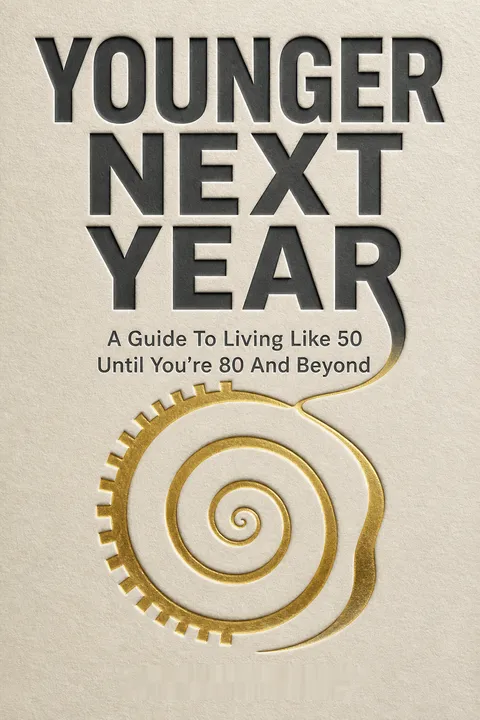
- Focus on Aging: Younger Next Year by Chris Crowley and Henry S. Lodge, M.D. is a guide to living vibrantly and healthily as you age, aiming to help you feel like you're 50 until you're 80 and beyond.
- Lifestyle Influence: The book emphasizes that aging is not a predetermined decline but a process that can be influenced by lifestyle choices, including exercise, nutrition, and emotional engagement.
- Biological Insights: It delves into the science of aging, explaining how lifestyle changes can alter the aging process on a cellular level.
Why should I read Younger Next Year?
- Transformative Impact: Many readers report life-changing results, adopting healthier habits and improving their vitality.
- Empowerment Through Knowledge: The book provides actionable advice and scientific insights that empower readers to take control of their health and well-being.
- Positive Outlook on Aging: It challenges the traditional narrative of aging as a decline, promoting the idea that you can actively improve your quality of life.
What are the key takeaways of Younger Next Year?
- Exercise is Essential: Regular aerobic exercise and strength training are crucial for maintaining physical health and preventing decay as you age.
- Nutrition Matters: Avoiding processed foods and focusing on a balanced diet rich in whole foods is vital for overall health.
- Emotional Connections: Building and maintaining strong relationships is just as important for health as physical exercise and nutrition.
What specific exercise recommendations are made in Younger Next Year?
- Aerobic Exercise: Engage in serious aerobic exercise four days a week, such as biking, jogging, or swimming, to elevate and maintain your heart rate.
- Strength Training: Incorporate strength training with weights two days a week to maintain muscle mass, bone density, and joint health.
- Heart Rate Monitoring: Use a heart rate monitor to ensure you are exercising at the right intensity, tracking progress, and maximizing benefits.
How does Younger Next Year address nutrition?
- Balanced Diet: Emphasizes a diet rich in whole foods, including fruits, vegetables, lean proteins, and healthy fats, to support exercise and overall health.
- Caloric Awareness: Stresses the importance of being mindful of caloric intake to maintain a healthy weight.
- Avoiding Processed Foods: Advises against consuming processed foods and sugars, promoting a diet that nourishes the body.
What is the Kedging concept in Younger Next Year?
- Definition of Kedging: Kedging involves setting a challenging goal and working hard to achieve it, similar to using a kedge anchor to pull a ship out of difficult situations.
- Application in Life: Encourages planning adventurous trips or activities that push your limits, making fitness goals more enjoyable.
- Importance of Commitment: Emphasizes the need for commitment to a new lifestyle, making health journeys fun and engaging.
What are Harry’s Rules in Younger Next Year?
- Exercise Six Days a Week: Commit to exercising six days a week for the rest of your life to maintain physical health.
- Aerobic and Strength Training: Engage in serious aerobic exercise four days a week and strength training two days a week to build endurance and muscle.
- Care and Connect: Care about your health and actively connect with others to enhance emotional well-being.
What role do emotional connections play in Younger Next Year?
- Biological Imperative: Emotional connections are a biological necessity for health, as humans thrive on relationships.
- Limbic Resonance: Explains how emotions are shared and amplified in social settings, enhancing well-being.
- Combatting Loneliness: Building and maintaining relationships can significantly reduce the risk of loneliness and related health issues.
How does Younger Next Year suggest dealing with the challenges of aging?
- Relentless Optimism: Encourages a mindset of optimism, viewing aging as a time of growth and opportunity.
- Adapt and Overcome: Suggests adapting to changes by finding new passions and interests that keep you engaged.
- Community Involvement: Involvement in community activities or volunteer work provides a sense of purpose and connection.
What are some success stories shared in Younger Next Year?
- John's Transformation: John lost sixty pounds and improved his health by committing to daily walks, showcasing the power of small, consistent changes.
- Emmet the Endurance Athlete: Emmet maintained a structured exercise program in his sixties, successfully competing in races and demonstrating the benefits of staying active.
- Chris's Personal Journey: Chris Crowley shares his own experiences of getting into shape later in life, illustrating the positive changes possible with commitment.
What are the best quotes from Younger Next Year and what do they mean?
- “You do not have to get old the way you think.”: Encourages readers to take control of their health and make choices for a vibrant life.
- “Exercise is the great key to aging.”: Highlights the transformative power of exercise for maintaining health and vitality.
- “Decay is optional.”: Emphasizes that much of what we associate with aging is not inevitable, encouraging a proactive approach to health.
How can I get started with the advice in Younger Next Year?
- Set Realistic Goals: Begin with achievable fitness goals based on your current activity level, gradually building up.
- Create a Routine: Establish a consistent exercise routine that includes both aerobic and strength training, treating it as a priority.
- Engage with Others: Find a workout buddy or join a class to stay motivated and accountable, making the process more enjoyable.
About the Author
Other books by Chris Crowley
Download PDF
Download EPUB
.epub digital book format is ideal for reading ebooks on phones, tablets, and e-readers.








