

Key Takeaways
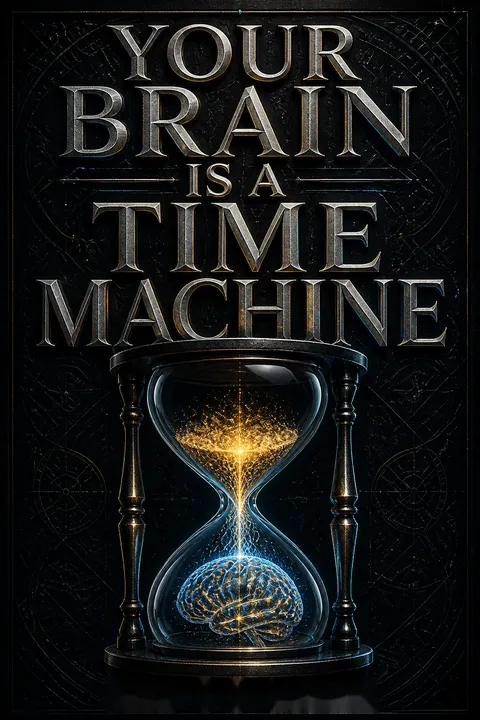
Your brain is a time machine built to predict, not merely remember.
Memory serves tomorrow. The brain does more than record experience: it uses what happened before to anticipate what may happen next. A rolling ball prompts an unconscious prediction about where it will bounce, while an animal surveying its surroundings gathers clues about food, danger, and mates. Remembering is useful because it makes those predictions better, not simply because the past is worth replaying.
Humans shape what comes. People can mentally project themselves far ahead, then act now to influence what they imagine. Making tools, planting crops, and storing food all depend on recognizing that present effort can change future conditions. In this sense, the brain is a time machine: it remembers, anticipates, and mentally rehearses possible events.
This account makes memory an active instrument rather than a mental archive. It also clarifies why memories can be selective or reconstructed: a system optimized for prediction needs useful patterns, not a perfect transcript. The framing connects cognition to control theory, where a system must estimate what comes next to act effectively. Still, future usefulness cannot explain every remembered detail. Some memories persist because they are emotionally vivid or socially meaningful, even when they offer no obvious practical forecast.
Stop searching for one brain clock; biology times different scales differently.
Different tasks need different clocks. The multiple clock principle is the idea that the brain and body use distinct timing mechanisms for different ranges and purposes. The circadian clock coordinates daily rhythms such as sleep and body temperature; it does not time the beat of music or a traffic light. Mice kept in darkness retain a daily rhythm, but their cycle drifts because their internal day is not exactly 24 hours.
One rhythm does not fit all. The suprachiasmatic nucleus helps coordinate daily timing, while other systems handle shorter intervals and other biological cycles. Some sea worms follow a roughly monthly reproductive rhythm that persists even when their daily clock is disrupted. Jet lag shows the cost of mismatched clocks: the watch resets instantly, but the body's rhythms need time to adjust.
The multiple-clock view is a useful antidote to the search for a single hidden stopwatch. Biological systems often solve problems through specialized components, and timing is no exception. It also explains why changing one rhythm can affect sleep without erasing a musician's ability to keep a beat. The caution is that separate mechanisms are not necessarily isolated. Circadian rhythms can influence attention and reaction time, so different clocks may remain functionally entangled even when their core timing systems differ.
Separate the time you track from the time you remember afterward.
Two judgments, two routes. Prospective timing means estimating duration while knowing in advance that time is being measured. Retrospective timing means estimating duration afterward, by reconstructing what happened. In a card-dealing experiment, people who knew they would estimate the duration later guessed an average of 53 seconds for a simple task and 31 seconds for a more demanding one, although both lasted 42 seconds. When they did not expect the question, their estimates were 28 and 33 seconds.
Memory changes the verdict. A dull airport wait can drag while it happens, then barely register in memory; a packed day of sightseeing may fly by but seem long in retrospect. During isolation in a cave, Michel Siffre underestimated his 179-day stay by 28 days. The brain's sense of duration depends on attention during an event and on what can be recalled afterward.
The distinction matters because the question “How long did that take?” can refer to two different mental operations. Prospective judgments draw attention toward time itself; retrospective ones lean on remembered events and changes in context. This helps explain why an enjoyable activity and an uneventful wait can trade places in memory. It also warns against treating personal duration estimates as neutral measurements. A clock can settle elapsed time, but it cannot settle how long an experience felt.
Neural activity can encode elapsed time without a ticking master clock.
A clock can be a changing state. State-dependent networks are neural circuits whose response depends both on the current input and on recent activity, including temporary changes in synaptic strength. Like ripples in a pond, the circuit's present state carries traces of what happened moments earlier. Researchers have found that activity patterns in neural populations can unfold in repeatable sequences, providing cues about how much time has passed.
Timing can be distributed. A population clock represents time through which group of neurons is active at a given moment, rather than through one cell counting ticks. In songbirds, cooling a brain area involved in song production slowed the entire song by as much as 40 percent. The timing appears to arise from the area's changing neural activity. Such findings support dynamic timing, though they do not establish one universal mechanism for every task.
This model treats timing as something a system can do with its own evolving state, rather than as a number read from an internal dial. The same principle appears in computing systems that use recent input to shape their next response. Its appeal is that it explains how a circuit can track duration and context together. The challenge is measurement: observing a reliable neural sequence does not prove it causes the behavior. Timing circuits may include several interacting mechanisms.
Sequence and spacing teach the brain what events mean.
Order becomes association. Temporal contiguity means that events occurring close together in time are easier to link. In classical conditioning, a dog learns that a bell predicts food when the bell reliably comes first; presenting the food before the bell does not produce the same learning. The brain also gives weight to causal order. Spike-timing-dependent plasticity, a learning rule that changes synaptic strength according to the order of neural firing, can strengthen a connection when one neuron consistently fires before another.
Timing carries meaning. In speech, tiny differences in the delay between a consonant's release and vocal-cord vibration help distinguish sounds such as “b” and “p.” Pauses and speaking speed can also clarify word boundaries or emotional tone. A magician can exploit the brain's assumptions by placing a misleading action close in time to a trick's reveal, making the wrong event seem causal.
Time is not merely a container for learning. It is evidence the brain uses to decide which events belong together and which may cause others. That makes temporal order a powerful tool in teaching, communication, and persuasion. But closeness is not causation. A bell may predict food without producing it, and a magician's flourish may attract attention without explaining the trick. Good reasoning therefore needs a second check: whether the supposed relationship holds when timing alone is not doing the persuading.
Your brain borrows space to estimate time, even when distance misleads.
Time gets a spatial map. People commonly describe time with spatial language, but the link also affects perception. In the kappa effect, greater distance between two events can make the interval between them seem longer, even when the actual duration is unchanged. In one experiment, two lights flashed eight seconds apart; estimates rose from about 6.5 seconds when the lights were eight inches apart to about 8 seconds when they were 32 inches apart.
The map varies by culture. English speakers often place the past behind and the future ahead. Aymara speakers, by contrast, may gesture forward when discussing the past, which is known, and behind when referring to the unknown future. The brain appears to use spatial understanding as a scaffold for time, but these differences show that the scaffold is flexible, not a literal picture of time's physical structure.
Spatial metaphors offer a practical way to think about something that cannot be seen directly. They also show how perception combines current signals with learned expectations: distance can influence duration because the brain has experience linking movement, space, and time. The cultural contrast is especially valuable because it prevents one familiar timeline from being mistaken for a universal mental design. These findings illuminate cognition, not physics. A psychological link between distance and duration does not establish that space and time behave identically in the universe.
Treat conscious experience as an edited report, not a live feed.
Awareness arrives assembled. The brain does not send every sensory change straight into consciousness as it occurs. Eye movements and blinks briefly interrupt visual input, yet the gaps usually go unnoticed because the brain stitches together a stable scene. It also combines sight and sound that reach the senses at different times, treating them as one event when they fall within a flexible temporal window of integration.
Later input can reshape earlier perception. In the cutaneous rabbit illusion, taps delivered at the wrist and then the elbow can feel as if they hopped along the forearm, with later taps changing how an earlier one is located. Conscious awareness is therefore not a frame-by-frame recording. It is a constructed account that can be delayed, smoothed, and revised to make events coherent.
The edited-report idea explains how perception can feel continuous despite interruptions and processing delays. It also helps distinguish a useful mental construction from a simple falsehood: the brain's version of events is selective, but often accurate enough for action. The important limit is that a coherent experience is not proof that every detail was perceived when it seemed to be. This matters in ordinary memory and in settings such as eyewitness accounts, where confidence and timing can diverge from accuracy.
A neural decision can begin before the feeling of choosing.
Intent is not always first. In one study, researchers recorded activity from patients who had electrodes implanted to investigate severe epilepsy. When patients chose when to press a key, patterns of brain activity predicted the movement up to 900 milliseconds before the press and about 700 milliseconds before the patients reported feeling that they had decided. The task was simple: choosing when to move a finger, not making a consequential life decision.
A feeling is not an explanation. These results challenge the idea that conscious intention always initiates action, but they do not show that complex choices are fully predictable or that people lack responsibility. The book presents free will as a contested concept, sometimes treated as an uncaused power and sometimes as the conscious experience associated with choosing. Distinguishing how a choice arises from how society should respond to it keeps neuroscience from settling a moral question by itself.
The experiment exposes a gap between the feeling of deciding and the neural activity that precedes movement. That gap is significant, but its interpretation depends on what counts as a decision and what counts as free will. A spontaneous finger press is not equivalent to weighing a job offer or refusing a harmful impulse. The finding is strongest as evidence that conscious awareness may not be the first step in every action, not as a complete theory of agency or accountability.
Relativity removes a universal now, but does not settle time's nature.
Physics unsettles the present. Special relativity shows that observers moving relative to one another can disagree about whether distant events happened simultaneously. This undermines the idea of one universal present and supports eternalism, the view that past, present, and future are equally real within spacetime. Presentism, by contrast, holds that only the present exists. The equations do not provide a simple answer to which view is correct.
Better clocks answer a different question. Pendulum clocks improved timekeeping enough to help solve the longitude problem: sailors could compare local noon with the time at a known location. Atomic clocks now support technologies such as GPS, but greater precision does not explain why time seems to flow. Nor does entropy fully resolve the mystery: its increase gives time a direction only if the universe began in an unusually low-entropy state, a condition physics still has to explain.
The book carefully separates measurement from interpretation. Relativity places real pressure on everyday intuitions about a shared present, but it does not directly show that the future is already fixed in the philosophical sense. The distinction is important because a successful equation can predict clock readings without answering what time is. The same restraint applies to entropy: it explains why many familiar processes have a direction, while leaving the universe's special starting condition as a deeper problem.
Use mental time travel to turn remembered experience into future preparation.
Memory can build a possible future. Mental time travel is the ability to revisit personal experiences and imagine oneself in future situations. Episodic memories preserve events from a life; semantic memories store general knowledge that helps make imagined scenes possible. People with severe damage affecting episodic memory can struggle not only to describe their past but to picture what they might do tomorrow.
Planning reaches beyond one life. In Japan, large stones inscribed with tsunami warnings preserved lessons for people who would live centuries later. Such messages turn remembered danger into preparation for strangers in the future. Some scrub jays also appear to adjust food caching to what they will need later, though scientists debate whether this demonstrates human-like mental time travel. Humans' distinctive capacity lies in the breadth and complexity of the futures they can imagine and plan for.
Mental time travel links personal memory to collective knowledge. A warning stone is more than a record: it is an attempt to move useful experience across generations that cannot meet face to face. This makes writing, teaching, and public warnings extensions of memory beyond the individual brain. Yet imagining a future is not the same as predicting it accurately. Good preparation depends on both the ability to simulate possibilities and the humility to revise plans when the world differs from the simulation.
Make distant consequences vivid to compete with immediate rewards.
The near reward wins easily. Temporal discounting is the tendency for a reward's subjective value to shrink as its delivery moves farther into the future. People may prefer a smaller payment now to a larger one later, even when waiting offers a better deal. The same bias can shape saving, health choices, and public policy. Credit cards can intensify it by separating the pleasure of buying from the immediate experience of handing over cash.
Imagine the future concretely. In one study, people given future-oriented cues, such as imagining a trip, became more willing to choose delayed rewards than participants making the same choices without those cues. Mental simulation can make a distant outcome feel less abstract, giving it more weight in a present decision. It is not a cure for short-term bias, but it offers a way to bring tomorrow's consequences into today's field of attention.
The practical implication is not simply to demand more willpower. Immediate rewards are psychologically vivid, while delayed costs often remain vague, so decision design can either widen or narrow that gap. Making a future outcome concrete can help, as can changing payment arrangements or defaults that otherwise favor the present. The technique has limits: a vivid imagined future may still be inaccurate, and some immediate needs are genuinely urgent. Better choices require both foresight and a realistic account of uncertainty.
Analysis
The book's central argument is that time is not a specialized topic tucked inside neuroscience. It is woven through the brain's ordinary work: learning sequences, coordinating movement, parsing speech, maintaining daily rhythms, remembering, and anticipating. Its most useful conceptual move is to distinguish several meanings of time that everyday language blurs. Clock time is a measure of change, subjective time is a constructed experience, and natural time concerns the contested question of what past, present, and future mean in reality.
That distinction lets the book move between scales without pretending that one explanation handles them all. A cell's daily rhythm, a neural circuit's response to a sound interval, and a person's recollection of a long wait are different timing problems. The account of neural dynamics is especially compelling because it replaces the intuitive image of a tiny internal clock with a system whose changing state can carry information about recent events. The model remains an active research question, not a finished explanation, and the book generally marks that boundary.
The philosophical tension is the book's deepest unresolved feature. Relativity challenges a universal present, while human experience strongly suggests that events unfold and choices remain open. The author resists both easy answers: physical equations do not prove the block universe, and subjective experience alone cannot establish that time objectively flows. That restraint is a strength. It also leaves a fruitful question: whether experience is merely a useful representation of temporal reality, or part of the evidence that any complete account of reality must explain.
The practical consequence is less metaphysical than cognitive. Humans can simulate distant outcomes, yet immediate rewards often dominate decisions. Memory, language, writing, and shared warnings extend individual foresight across generations, but they do not guarantee wise planning. The book ultimately presents temporal intelligence as an impressive but imperfect capacity: a mind able to travel beyond the present, still learning how to use that journey well.
Review Summary
Your Brain Is a Time Machine explores how our brains perceive and process time, combining neuroscience and physics. Readers found it informative, well-written, and thought-provoking, praising its accessible explanations of complex concepts. Many appreciated the interdisciplinary approach, linking brain function to physics theories of time. Some felt certain sections were dry or repetitive, while others found the philosophical implications fascinating. Overall, reviewers recommend it for those interested in time perception, consciousness, and the nature of reality.
Glossary
Natural time
Time's underlying natureThe concept of time as the dimension or medium in which events occur. Natural time is the focus of debates about whether only the present exists or whether past, present, and future are equally real. It is distinct from time measured by clocks and from the brain's experience of duration.
Clock time
Measured physical changeTime quantified by a clock, understood broadly as a reproducible physical process that can be used to measure change. Pendulum swings, quartz vibrations, and atomic transitions can all provide clock time. This measure is essential to science and daily life, but it does not by itself define time's underlying nature.
Subjective time
The felt passage of timeThe brain-generated experience of time passing and of how long an interval seems to last. Subjective time can diverge from clock time depending on attention, emotion, novelty, memory, and other conditions. A duration can feel long while it unfolds yet seem brief when remembered.
Multiple clock principle
Distinct systems time distinct scalesThe principle that biological timing relies on multiple mechanisms rather than one universal clock. Different systems handle different durations and tasks, such as daily circadian rhythms, subsecond speech timing, and longer biological cycles. These systems can influence one another without being the same clock.
Prospective timing
Timing with advance noticeEstimating elapsed time when a person knows in advance that duration will matter. Attention can be directed toward the interval as it unfolds, as when someone is asked to estimate how long a task lasts. Task difficulty and attention can substantially change these estimates.
Retrospective timing
Estimating time from memoryJudging how much time has passed without having known in advance that timing would be required. The estimate depends heavily on reconstructing what happened and how many changes or memorable events occurred. A busy, novel period may seem longer in retrospect than an uneventful one.
State-dependent networks
Circuits shaped by recent activityNeural networks whose responses depend on both current input and the circuit's changing internal state. That state can include temporary synaptic changes caused by recent neural activity. Because the present state retains traces of the recent past, it can help a network distinguish different intervals or sequences.
Population clock
Time encoded across neuronsA way of representing elapsed time through changing patterns of activity across a group of neurons. Different subpopulations are active at different moments, so the pattern as a whole can indicate when an event began or how much time has passed. No single neuron needs to act as a clock hand.
Presentism
Only the present existsA philosophical view that only the present moment is real. The past refers to events that once existed but no longer do, while the future refers to possibilities that have not yet become real. This view fits ordinary intuitions about change and an open future.
Eternalism
All times are equally realA philosophical view that past, present, and future moments are equally real, much as different places are equally real. It is associated with the block-universe interpretation of spacetime. Relativity supports this view for many physicists, but does not provide direct experimental proof of the philosophical interpretation.
Mental time travel
Revisiting past and imagining futureThe ability to mentally revisit personal events and project oneself into possible future situations. It draws on memory and knowledge to reconstruct experiences or simulate what might happen. The capacity supports planning and preparation, while also enabling people to dwell on past and future events.
Temporal discounting
Future rewards lose valueThe tendency for a reward's subjective value to decline as the delay before receiving it increases. It helps explain why people may choose a smaller immediate reward over a larger delayed one. Individual discounting rates vary and are associated with differences in financial, health, and behavioral outcomes.
Temporal window of integration
Window for combining sensory eventsThe interval within which the brain can treat signals from different senses as parts of one event. For example, sight and sound may arrive at different times yet be experienced as simultaneous. The window can adapt to recent experience, so perceived simultaneity is not a fixed readout of signal timing.
Spike-timing-dependent plasticity
Synapses change with firing orderA learning rule in which a synapse's strength changes according to the relative timing of activity in its connected neurons. When one neuron repeatedly fires before its partner, the connection may strengthen; firing in the reverse order may weaken it. This provides a neural mechanism sensitive to temporal cause and order.
FAQ
What's Your Brain Is a Time Machine about?
- Exploration of Time: The book examines the nature of time from neuroscience and physics perspectives, focusing on human perception and brain mechanisms.
- Interdisciplinary Approach: Dean Buonomano integrates insights from neuroscience, psychology, and physics to explore the interplay between mental constructs and the physical universe.
- Key Themes: It covers themes like subjective time experience, mental time travel, and philosophical debates like presentism vs. eternalism.
Why should I read Your Brain Is a Time Machine?
- Unique Perspective: The book offers a fresh take on time, blending scientific inquiry with philosophical exploration, challenging readers' understanding of time.
- Engaging Content: Complex ideas are presented in an accessible manner, making it suitable for both casual readers and those with a scientific background.
- Practical Insights: Readers can learn how their brains process time, enhancing understanding of memory, decision-making, and perception.
What are the key takeaways of Your Brain Is a Time Machine?
- Time is Multifaceted: Time encompasses natural, clock, and subjective dimensions, each influencing our experience and understanding.
- Neuroscience of Time: The brain functions as a time machine, crucial for remembering the past and anticipating the future.
- Philosophical Implications: The book explores presentism vs. eternalism, prompting reflection on reality and existence.
What are the best quotes from Your Brain Is a Time Machine and what do they mean?
- Saint Augustine's Paradox: "What then is time? If no one asks me, I know what it is. If I wish to explain it to him who asks, I do not know." This highlights the complexity of defining time.
- Brain as a Time Machine: "The brain is a time machine: a machine that not only tells time and predicts the future, but one that allows us to mentally project ourselves forward in time." It underscores the brain's role in navigating temporal dimensions.
- Time vs. Space Complexity: "Time is complicated, more so than space." This suggests that time's perception is shaped by biological and philosophical factors.
How does the brain perceive time according to Your Brain Is a Time Machine?
- Neural Mechanisms: The brain uses circuits like short-term synaptic plasticity and population clocks to process time.
- Subjective Experience: Perception of time can be distorted by attention, emotion, and cognitive load, affecting how time feels.
- Temporal Patterns: The brain interprets complex patterns, such as speech and music, by analyzing timing and duration.
What is the difference between presentism and eternalism in Your Brain Is a Time Machine?
- Presentism Defined: Only the present moment is real, with the past gone and the future undetermined, aligning with intuitive time flow.
- Eternalism Explained: Past, present, and future are equally real, forming a four-dimensional block universe, challenging linear time perception.
- Philosophical Implications: These theories impact views on free will and consciousness, with presentism supporting open futures and eternalism suggesting determinism.
How does Your Brain Is a Time Machine explain mental time travel?
- Definition of Mental Time Travel: The brain's ability to project into the past and future, crucial for planning and decision-making.
- Neural Basis: Circuits in the hippocampus are involved in memory formation and future scenario imagination.
- Evolutionary Advantage: Mental time travel aids adaptation and preparation for future challenges, key to human cognition.
What role does chaos play in our understanding of time in Your Brain Is a Time Machine?
- Chaos in Neural Networks: Chaotic systems produce unpredictable patterns, complicating their use as reliable clocks.
- Reproducibility of Patterns: Despite chaos, the brain creates reproducible activity patterns for timekeeping.
- Implications for Timing: Chaos raises questions about the reliability of internal clocks and temporal experiences.
How does Your Brain Is a Time Machine relate time perception to memory?
- Memory and Time: Memory is tied to time perception, allowing recall of past and anticipation of future events.
- Temporal Context: Memories are encoded with temporal context, influencing emotional responses and decision-making.
- Neural Mechanisms: Memory formation circuits also play a role in time perception, aiding navigation of temporal experiences.
What are the implications of the block universe theory presented in Your Brain Is a Time Machine?
- Eternalism vs. Presentism: The block universe theory supports simultaneous existence of all time moments, challenging presentism.
- Moral Responsibility: Raises questions about free will and accountability if all moments are equally real.
- Scientific Understanding of Time: Encourages reevaluation of time studies in physics and neuroscience, suggesting an evolved understanding of reality.
How does Your Brain Is a Time Machine address the concept of free will?
- Free Will as a Feeling: Free will is a subjective experience, arising after unconscious neural processes make decisions.
- Determinism and Responsibility: Even if choices are influenced by unconscious processes, accountability remains.
- Neuroscientific Evidence: Studies show decisions can be predicted by neural activity before conscious awareness, questioning choice nature.
How does Your Brain Is a Time Machine relate to the concept of time in physics?
- Physics and Time Perception: Concepts from physics, like relativity, challenge intuitive notions of linear and absolute time.
- Block Universe in Physics: Aligns with interpretations of physical laws, suggesting time as a static entity.
- Interdisciplinary Approach: Integrating physics with neuroscience encourages a holistic view of time, leading to new insights on reality.
Download PDF
Download EPUB
.epub digital book format is ideal for reading ebooks on phones, tablets, and e-readers.








