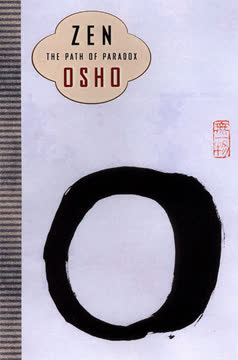
Key Takeaways
1. Zen's Core: Unconditional Acceptance
Zen is unconditionally value-free – if you make a condition, you miss the point.
Beyond Judgment. Zen teaches a radical non-judgmental approach to life, accepting "all is as it is." Unlike other religions that impose moral valuations of good and bad, Zen sees no inherent divinity or evil. This perspective liberates individuals from the fear and greed that often underpin conventional religious practices, which promise rewards in heaven or threaten with hell.
The Flaw of Bargain. The moment a condition is introduced, such as "Judge ye not, so that ye are not judged," the essence of Zen is lost. This transforms a profound statement of non-valuation into a self-centered bargain, driven by fear of judgment or desire for reward. True Zen is an end in itself, requiring no external motivation or consequence.
Acceptance as Transformation. Zen's total acceptance extends even to those labeled "thieves" or "murderers," viewing them simply as they are. This unconditional acceptance, rather than condemnation, creates the possibility for genuine transformation. The story of Shichiri Kojun and the thief exemplifies this: by treating the thief with respect and calling the stolen money a "gift," Shichiri fostered an environment where the thief could shed his old identity and become a disciple.
2. The Mind: Architect of Your Reality
All is a mind construct, that whatsoever we know is nothing but a mind-projection.
Belief Creates Reality. Zen posits that our perceived reality is largely a projection of our minds and belief systems. What we believe, we tend to see and experience, making our "reality" a relative and invented construct. This is akin to dreaming, where even absurd scenarios feel intensely real until we awaken.
The Power of Projection. Our minds are tremendously creative, capable of transforming thoughts into tangible experiences. Whether it's a saint seeing Krishna or a patient healing through positive suggestion, belief can manifest as reality. This principle is evident in phenomena like the placebo effect or the historical impact of collective beliefs, such as those instilled by leaders like Adolf Hitler.
Beyond Beliefs. To know what is truly real, Zen advocates dropping all belief systems—positive and negative. While hypnosis can offer "better dreams" by replacing negative beliefs with positive ones, Zen aims for "de-hypnosis," a state where all relative realities disappear. Only when the mind ceases its projections can the ultimate, unconditioned reality be perceived.
3. Desire: The Root of All Unrest
Desire, desiring, becoming. Always hankering for something – money, God, NIRVANA. Always hankering for something. Never being here, always being somewhere else: that is the fundamental disease, the disease called ’becoming’.
The Endless Cycle of Wanting. The fundamental disease of humankind, according to Zen, is desire—the constant state of "becoming" rather than simply "being." This incessant hankering for external objects, whether material wealth or spiritual enlightenment, creates a perpetual state of drunkenness and unawareness, preventing us from being rooted in the present moment.
Desire's Deception. Desire acts as a curtain over consciousness, obscuring truth. When one desire is fulfilled, the inherent emptiness quickly resurfaces, prompting the creation of a new, often bigger, desire. This endless cycle, illustrated by the Sufi story of the bottomless begging bowl, reveals that fulfillment of desires never truly satisfies; it merely postpones the confrontation with inner void.
Understanding, Not Fighting. Zen does not advocate fighting desire, as that would simply create another desire (e.g., desiring desirelessness). Instead, it calls for understanding the mechanism of desiring itself. Through this insight, the desire naturally dissipates, leading to a state of desirelessness, which is synonymous with godliness or nirvana.
4. True Compassion: Ego-less Flow
Compassion is unmotivated, it has not motive at all. It is simply because you have, you give – not that the other needs.
Beyond Kindness and Lust. Compassion, in Zen, is the ultimate flowering of consciousness, distinct from mere kindness or ordinary love. Kindness often stems from ego, seeking to feel superior, while conventional love can be a form of exploitation or lust. True compassion is unmotivated, a spontaneous overflow of energy that flows through an individual, rather than from them.
A Vehicle of the Divine. When the ego disappears, one becomes a hollow bamboo, a transparent vehicle through which divine energy flows. This is not an act of personal giving but an allowing of God's energy to pass through. The story of Bankei and the thief illustrates this: Bankei's non-judgmental acceptance and willingness to keep the thief, even at the cost of losing other disciples, stemmed from a profound, ego-less compassion that ultimately transformed the thief.
Intelligence Without Intellect. Compassion is characterized by tremendous intelligence, but it is non-intellectual. It involves knowing without thinking, seeing through intuition rather than logic or inference. This clear eyesight allows for immediate, sharp action without emotional entanglement, providing genuine help rather than sentimental, ineffective reactions.
5. Maturity: Liberating Your Authentic Self
Maturity means the understanding to decide for oneself, the understanding to be decisive on your own.
Shedding Inner Authorities. True maturity involves "killing" the internalized voices of parents, teachers, and societal leaders that keep us childish and dependent. These ingrained impressions prevent individuals from becoming grown-up, independent beings who live according to their own inner truth, rather than external expectations.
The Courage to Disobey. Society often fears mature individuals because they are unpredictable and prioritize their freedom over respectability or prestige. Disobedience, as exemplified by Adam's act of eating the fruit of knowledge, is not a sin but a courageous step towards developing one's own soul and individuality. It is a necessary phase for growth, leading to a "second childhood" of earned innocence.
Living Your Own Life. To achieve maturity, one must take life into one's own hands, shedding old tapes and living freshly, as if nothing has been taught. This means embracing risk, moving into the unknown, and being willing to sacrifice everything for freedom. Without this liberation, life remains unlived, and consciousness remains unborn, trapped in a state of perpetual childhood.
6. Truth: An Eternal Rediscovery
Truth is not something that is discovered for the first time; it is rediscovered again and again.
Beyond Discovery and Invention. Osho asserts that truth is neither a mere discovery (implying it's found for the first time) nor an invention (implying it's a mind-construct). Instead, truth is an eternal rediscovery. Humanity repeatedly forgets and then stumbles upon the same fundamental truths, mistaking them for novel findings.
The Mind's Role in "Truths." Scientific "truths" are often just facts, products of the mind's analytical process, and thus plural and ever-changing. Religious truth, however, is singular and ultimate, known only when the mind ceases to function. When the constructor (mind) is absent, its constructs disappear, revealing a pure, unadulterated reality.
Universal and Nameless. Across cultures and ages, mystics like Buddha, Jesus, and Eckhart have all rediscovered the same cosmic consciousness. Their expressions may differ due to language and cultural metaphors, but the underlying reality is identical. This truth is nameless, beyond linguistic labels, and cannot be argued or debated; it is self-evident when experienced directly.
7. Embrace Totality, Not Perfection
The day you are perfect, you are dead. Perfection is death, imperfection is life.
Life's Imperfect Flow. Zen rejects the ideal of perfection, viewing it as a concept that leads to neurosis, guilt, and a cessation of growth. Imperfection, conversely, is celebrated as synonymous with life, aliveness, and continuous evolution. To be imperfect means to be open, to have a future, and to experience the excitement of ongoing becoming.
Totality in the Moment. Instead of striving for an unattainable ideal, Zen encourages living each moment totally. If sad, be completely sad; if angry, be completely angry. This full immersion allows emotions to dissipate naturally, leading to greater maturity and capacity for happiness. Totality is an authentic, personal experience, unlike perfection which is often a borrowed, imitative ideal.
God as Evolving Potential. When Osho refers to us as "gods," he means we possess infinite potential, not static perfection. God, too, is an evolving concept, not a dead, perfect entity. The difference between humans and God lies in the degree of acceptance and totality: God embraces all imperfections and lives utterly in every moment, while humans often deny, reject, and remain fragmented.
8. Silence: The Ultimate Language of Truth
That which can be said is already untruth.
Language's Limitations. Language, being utilitarian and human-made, is inherently inadequate for expressing ultimate truth. It is dualistic, linear, and provincial, designed for the ordinary world, not the vast, subtle, paradoxical, and non-dual nature of existence. Like a net catching fish but not water, language captures facts but misses the elusive essence of truth.
The Power of Non-Verbal. Zen masters often employ non-linguistic methods—shouts, laughter, tears, even physical actions—to provoke disciples into direct experience. These "addresses" are not meant to convey information but to shatter mental constructs and awaken individuals from their sleep of words and philosophies, forcing them into immediate awareness.
"Ha! Ha! Ha! What's All This?" The master's laughter at those seeking enlightenment is a profound sermon. It ridicules the absurdity of searching for something that is already present, hidden by the very act of seeking. The instruction to "Go to the back of the hall and have some tea" symbolizes dropping the ego's desire to be "first" and cultivating awareness in the present moment.
9. Life's Paradox: The Unity of Opposites
Existence continuously contradicts itself, and out of contradiction is born the energy to live.
Dialectical Existence. Life thrives on paradox and contradiction, where opposites function as complementaries rather than enemies. The moving wheel needs an unmoving axle, a cyclone has a silent center, and life owes its existence to death. Understanding this inherent dialectic removes fear and anguish, leading to a state of enlightened awareness.
Beyond Dualistic Perception. The human mind, constrained by language and logic, tends to perceive reality in dualistic terms—day versus night, life versus death, love versus hate. However, in truth, these are not separate but intertwined, two aspects of the same energy. Hate can turn into love, and love into hate, demonstrating their fundamental unity.
The Whole is Greater. Existence is multi-dimensional and non-dual, a simultaneous whole that cannot be captured by linear, logical thought. Just as a flower's beauty is lost when its petals are separated, truth is lost when the wholeness of existence is divided into parts. Embracing this paradoxical unity allows one to see the interconnectedness of all things, transcending the limitations of conventional understanding.
10. "Going Home": The Joy of Inner Nothingness
Unless you come to know this inner non-being – anatta, non-existence, or death.... Zen people call it ’the great death’.
The Fear of the Void. Humanity constantly rushes outwards, engaging in "a thousand and one things," driven by a deep-seated fear of confronting its inner nothingness, or anatta. This bottomless abyss, the true core of our being, is often perceived as scary annihilation, prompting endless attempts to fill it with desires, possessions, and achievements.
The Futility of Filling. The Sufi parable of the begging bowl illustrates that no amount of external acquisition can ever satisfy the inner void. Every fulfilled desire quickly becomes meaningless, leaving the emptiness yawning once more. This cycle of desire and frustration continues until one realizes that the abyss is not a flaw to be filled, but one's very being to be accepted.
Liberation in Non-Being. The "great death" is the moment of profound blessing when one comes face-to-face with this inner non-being and rejoices in it. In this state, fear, desire, anxiety, and the pursuit of success or failure all disappear. This nothingness is not mere absence but the luminous source of all, bringing utter rest, equanimity, and a joy that transcends both happiness and unhappiness.
11. Religion: A Courageous, Living Rebellion
The organized religion is not the real religion. The unorganized, the rebellious, the unorthodox, the heretic religion is the real religion – has always been so.
Beyond Fear and Greed. Traditional religions, with their emphasis on sin, guilt, heaven, and hell, often exploit human fear and greed to create followers. This approach fosters a cowardly, dependent form of religiosity, where individuals seek salvation through external mediators or promises of reward, rather than through genuine inner transformation.
The Courageous Path. True religion, as taught by living masters like Buddha or Jesus, is a rebellious, unorthodox, and courageous jump into the unknown. It demands dropping all fear and greed, embracing insecurity, and finding one's own path. This is why young people are drawn to Osho's teachings, which emphasize life, love, and joy, rather than guilt and condemnation.
Learning from Mistakes. Instead of condemning "sins," Zen views them as mistakes—opportunities for learning and growth. The emphasis is not on avoiding errors out of fear, but on understanding their nature and not repeating them mindlessly. This approach fosters intelligence and self-awareness, leading to a genuine, individual religiousness that is alive, dynamic, and free from institutional dogma.
Last updated:
Review Summary
Zen receives an overall rating of 4.22 out of 5 stars. Readers praise Osho's accessible, thought-provoking approach to explaining Zen philosophy and its paradoxical nature. Many found the book transformative and mind-opening, appreciating how it teaches living in the present moment without attachment. Some criticisms include the rambling, sermon-like style that reflects its origins as transcribed lectures, occasional repetitiveness, and contradictions between Osho's anti-dogmatic message and his promotion of Zen's superiority. Several reviewers recommend multiple readings for deeper understanding.
Similar Books