

Key Takeaways
When every new pleasure fades, investigate the one who is seeking.
Temporary relief is not a cure. Spira argues that people commonly seek happiness through objects, relationships, activities, and preferred states of mind. Getting what is wanted, or avoiding what is feared, can bring real relief. But when the desired condition changes, dissatisfaction tends to return, renewing the search. The book’s image of the Prodigal Son gives this cycle a story: after exploring the world for fulfilment, the son turns back toward the home he had left.
Turn from the object to the seeker. The proposed inquiry is not to reject ordinary pleasures, but to ask whether they can provide lasting peace. When seeking stops satisfying, investigate the nature of the one who feels incomplete. Spira presents that change of attention as the beginning of the inward-facing path.
What's useful here is the distinction between pleasure and the expectation that pleasure can permanently settle a deeper unease. Behavioral science likewise distinguishes an immediate reward from durable well-being, though the book offers a metaphysical explanation rather than a behavioral one. Its account can help expose compulsive chasing, but it should not turn every desire into a spiritual error. Food, intimacy, safety, and meaningful activity matter in ordinary life. The question is whether a passing experience is being asked to do more than it can, not whether worldly experience is worthless.
Notice the knowing that remains while every experience changes.
Experience changes; knowing seems constant. Thoughts, moods, bodily sensations, and perceptions come and go. Spira invites readers to notice that each is known, and to attend to this knowing rather than only to what is known. He compares awareness to a screen that remains present while scenes change. The analogy points to a distinction in experience: the content varies, while the fact that it is experienced appears continuous.
Try the observation directly. Compare a present sensation with a remembered feeling, or notice how attention moves from sound to thought to sight. Each object differs, but each is known. Spira takes this continuity as a clue to awareness’s essential nature. The claim is not that a person’s memories or personality never change, but that knowing itself is not another changing object among them.
This is strongest as an exercise in phenomenology, careful description of what experience is like. It shifts attention from the objects of consciousness to the fact of experiencing, a distinction that can make habitual mental activity easier to observe. Yet a stable sense of knowing does not by itself prove that awareness is an eternal entity. Memory, attention, and the feeling of continuity can be studied as changing processes too. Holding the book’s claim as an invitation to inspect experience, rather than a settled scientific conclusion, preserves its practical force without confusing introspection with proof.
Ask whether you are aware, then rest before answering.
Use a question as a pointer. Spira recommends questions such as “Am I aware?” or “What knows this thought?” Their purpose is not to produce a clever answer. They turn attention away from a particular thought or sensation and toward the knowing in which it appears. The brief pause before answering “yes” becomes an opportunity to notice awareness without treating it as an object.
Inquiry gives way to resting. The book calls this self-enquiry, an examination of the nature of the one who knows experience. It can begin as an active question, but its intended direction is toward less mental activity, not more analysis. If the question becomes a puzzle to solve, it has missed its purpose. The inquiry asks the reader to check a familiar fact directly, rather than imagine a special state.
A question can reorganize attention without supplying new information. In that respect, this practice resembles techniques in contemplative traditions that use a prompt to interrupt automatic thought and direct awareness toward the act of noticing. Its simplicity is an advantage: no elaborate setting or belief is required to ask the question. But the pause may feel blank, distracting, or emotionally charged for some people. It is better understood as an optional attentional experiment than as a universal remedy, and it need not replace psychological support when distress calls for it.
Let meditation release attention instead of forcing the mind quiet.
Stop treating stillness as a task. Many meditation methods direct attention toward an object, such as the breath. Spira’s Direct Path instead invites attention to relax its grip on objects and settle into the knowing of experience itself. In his account, awareness cannot be reached by directing the mind toward it, because awareness is already the basis of that direction. Meditation is therefore described as ceasing an effort, not achieving a particular mental condition.
Effort may be a starting point. For someone who feels identified with a separate self, inquiry can initially seem like a practice performed by that self. Spira allows for that stage: use the effort that seems necessary, while noticing whether the effort can soften. His clenched-hand analogy suggests that what feels natural may be a maintained tension, and that opening can begin by releasing it.
The distinction between regulating attention and relaxing the effort to control it is valuable. Many people assume meditation succeeds only when thoughts stop, which can turn practice into another performance test. This approach offers a different measure: whether a person can notice experience without immediately trying to rearrange it. Still, focused practices have legitimate uses, including training attention and calming arousal. The book’s language of effortless being should not invalidate those methods or create a new demand to be effortless. A technique is useful when it serves the practitioner, not when it wins an argument about the highest practice.
See the separate self as a role, not a thing to destroy.
A role can feel like a person. Spira compares the separate self to an actor so immersed in a character that the role seems to be the actor’s whole identity. The character represents the limited self, while the actor represents awareness. In the analogy, the character cannot independently become the actor; recognizing the actor’s presence reveals what the character was made from all along.
Recognition, not annihilation. The book does not recommend attacking or erasing the ego. It argues that trying to destroy a separate self can reinforce the belief that it exists as an independent entity. Instead, readers are asked to examine what they call “I” and distinguish passing thoughts, memories, and sensations from the knowing of them. The self’s familiar patterns may continue, but they need not define the whole of identity.
The role metaphor usefully loosens identification without requiring self-hatred. It also echoes a distinction found in psychology between a person’s changing self-story and the wider capacities that support reflection and choice. However, everyday identity is not merely a mistake: roles, relationships, and personal history organize responsibility and social life. A contemplative shift can reduce the feeling that every thought defines the self, but it does not erase the practical need to make decisions or acknowledge harm. The metaphor is most helpful as a way to gain perspective, not as a reason to deny ordinary personhood.
Let awareness be a refuge without denying what hurts.
Awareness is described as undisturbed. In Spira’s account, fear, pain, or agitation may be present in experience without altering the awareness that knows them. He uses the screen analogy again: a dramatic scene changes what appears, not the screen on which it appears. From this perspective, peace is not a mood that must be manufactured. It is an inherent quality of awareness, available even when circumstances are difficult.
Distinguish the claim from a cure. The book’s promise is spiritual and experiential: recognizing awareness can change a person’s relationship to distress. It does not establish that pain is unreal, that illness should be ignored, or that circumstances do not need to change. Spira’s language of perfect health refers to awareness, not a guarantee about the body. The distinction matters whenever inward peace might otherwise be used to dismiss real suffering.
This idea can create psychological distance from distress: a person may experience an emotion without treating it as the totality of the self. That resembles the practical value of decentering, the ability to notice thoughts and feelings as events rather than commands. But the stronger assertion that awareness itself is untouched, eternal, and inherently joyful is a philosophical interpretation, not an established medical finding. Compassion requires both forms of attention: noticing the space around pain and responding to the pain’s causes. A refuge becomes harmful if it teaches people to endure what should be addressed.
Look beyond the witness to the awareness within every experience.
The witness is only a beginning. Awareness may first seem like an observer behind thoughts and sensations. Spira describes a deeper recognition: experience is not separate from the knowing of it. A thought is known as thought, a feeling as feeling, and a perception as perception; the book argues that none has an independent reality apart from awareness. Its screen analogy develops accordingly: the screen is not merely behind the image, but is what the image consists of.
Separation gives way to intimacy. This movement challenges the idea that awareness is a private spectator looking out at a separate world. Spira links the collapse of that divide with love and beauty, understood as experiences in which the boundary between observer and observed softens. The claim extends the practice beyond retreating from experience: ordinary experience itself can be recognized as inseparable from awareness.
This is the book’s most consequential philosophical move: awareness is not simply a witness but the reality of what is witnessed. It can reshape how a reader interprets the boundary between self and world, and why certain experiences of beauty feel less divided. The screen comparison makes the thought accessible, but an analogy cannot demonstrate that physical objects are literally made of awareness. Materialist and non-dual accounts interpret experience differently. The passage is best approached as a contemplative lens that can be tested for its effect on perception, while remaining open about what it can establish about the external world.
Let longing point toward its source, not just its next object.
Desire may reveal a deeper need. Spira treats the desire for happiness, peace, and love as more than a demand for particular experiences. In his view, the longing itself hints at the completeness from which the separate self feels cut off. He compares the restless mind to a current searching the ocean for water: the sought-for quality is already present at the source of the search.
Turn longing into inquiry. This does not mean every desire should be suppressed. Rather, when obtaining one more thing only postpones dissatisfaction, ask what the desire is really seeking. The book connects this inward turn to both meditation and prayer: attention settles toward its source, while devotion is understood as love returning to where it began. The metaphor recasts longing as a possible guide, not merely a problem to satisfy or eliminate.
The idea that a desire can point beyond its immediate object offers a useful way to reflect on motivation. Wanting approval, for instance, may carry a wish for belonging or security, and naming that underlying need can widen the available responses. Spira interprets the deepest longing as evidence of an already-present spiritual reality, which goes beyond what psychological observation alone can confirm. That difference need not cancel the metaphor’s usefulness. The practical question is whether inquiry makes a person more honest and less compulsive, or whether it becomes a reason to distrust ordinary needs.
Return to the world with awareness, not as an escape from it.
The inward turn is only half the work. Spira explicitly distinguishes recognizing awareness from fully integrating that recognition with daily experience. If awareness is treated as separate from the body, relationships, or the world, spirituality can become withdrawal or denial. The book points toward a further process in which thinking, feeling, acting, and relating are brought into alignment with the insight that awareness is not apart from experience.
Keep ordinary life in view. This volume focuses on discovering awareness and its purported peace, while acknowledging that reintegration is beyond its scope. The distinction offers an important caution: a quiet inner state is not, by itself, proof of wisdom in conduct. The inward practice is meant to change how experience is understood, not to make the world irrelevant. Its full test lies in whether the recognition can coexist with embodied, responsible participation.
This qualification protects non-dual practice from becoming a sophisticated form of avoidance. In psychology, insight and behavioral change are distinct: understanding a pattern does not automatically alter how someone treats others or responds under pressure. The book’s emphasis on reintegration recognizes that gap, even as it leaves the practical process largely outside this volume. Readers can preserve the distinction by assessing contemplative insight alongside ordinary markers such as care, accountability, and willingness to engage. These do not prove a metaphysical view, but they help show whether the view is serving a life rather than replacing it.
Analysis
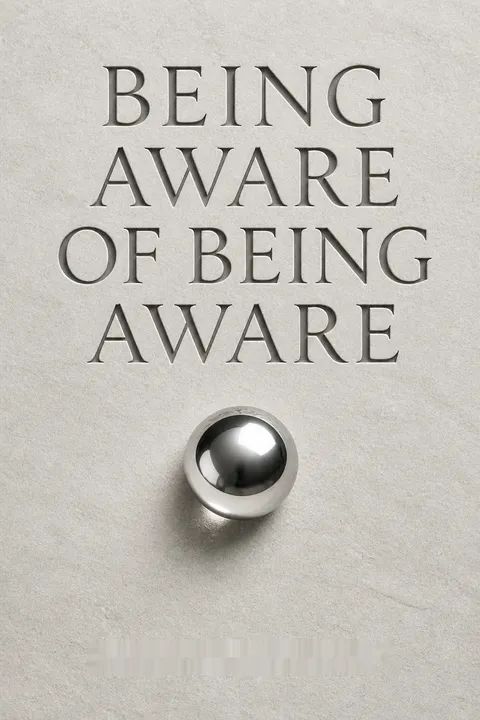
Being Aware of Being Aware is a short contemplative philosophy built around a single reversal: instead of searching experience for a lasting source of fulfilment, examine the knowing in which experience appears. Its structure is cumulative. It begins with dissatisfaction as evidence that external rewards do not permanently settle the search, then guides attention toward awareness, describes awareness as peaceful and self-knowing, and finally interprets the apparent individual as awareness taking a limited form. The book relies on repeated analogies, especially the screen, actor, and ocean, to make an abstract position experientially imaginable.
Its strongest contribution is procedural rather than evidentiary. Readers are given a simple inquiry, asking whether awareness is present, and invited to notice the pause before turning that question into conceptual analysis. That makes the book less a conventional argument than a guided examination of experience. Its central distinction between awareness and the objects of awareness can be useful even for readers who reject its larger metaphysics. It offers a way to observe thoughts and feelings without immediately equating them with identity.
The book’s claims require different levels of confidence. That experience is known, and that attention can shift toward the act of knowing, are directly examinable. Claims that awareness is eternal, that all experience is made of awareness, or that awareness is inherently fulfilled are interpretations that introspection alone cannot compel every reader to accept. The text sometimes moves from a compelling description of experience to a universal claim about reality without separating those steps. A careful reading can preserve its invitation while recognizing that boundary.
The author also identifies a practical danger: insight can become an excuse to reject embodied life. That admission is important because a doctrine of unchanging awareness could otherwise minimize pain, social responsibility, or the need for change. The book’s own answer is that inward recognition is incomplete without renewed engagement with experience. Its promise is best treated neither as a proven cure nor as a demand to abandon ordinary life, but as a disciplined experiment in attention whose value depends partly on how it informs conduct.
Review Summary
Being Aware of Being Aware by Rupert Spira is highly regarded for its clear and accessible explanation of non-duality and awareness. Readers appreciate Spira's ability to convey complex concepts simply, using relatable metaphors. The book is praised for its transformative potential and its focus on direct experience rather than intellectual understanding. While some find it repetitive, many consider it a profound exploration of consciousness. Critics note religious references and oversimplification, but overall, the book is seen as a valuable guide to meditation and self-discovery.
Glossary
Direct Path
Inquiry into awareness itselfSpira’s name for an approach that examines the nature of the knowing subject directly, rather than seeking fulfilment through objects or pursuing awareness as a future state. It uses questions and contemplative attention to turn away from experience’s contents and toward awareness. In the book’s account, the path culminates in recognizing awareness as already present.
self-enquiry
Investigation of the knowerA contemplative inquiry into what knows thoughts, feelings, sensations, and perceptions. Questions such as “Who am I?” or “Am I aware?” redirect attention from an experience to its knowing. Spira emphasizes that the inquiry is not meant to build an intellectual theory; at its deepest, the questioning quiets and becomes resting in awareness.
self-abidance
Resting as awarenessA term for remaining with the non-objective experience of being aware, rather than directing attention toward an object or trying to create a special state. In Spira’s account, self-abidance is the quieting of inquiry into the recognition of awareness as one’s essential nature. It is presented as the maturation of self-enquiry, not a separate achievement.
self-remembering
Recognizing what is presentSpira uses this term for awareness’s apparent recognition of its own nature. It does not mean recalling a forgotten event. It means noticing what is already present but overlooked when attention is absorbed in thoughts, sensations, and perceptions. The recognition is described as familiar and immediate, rather than as the acquisition of unusual knowledge.
inward-facing path
Attention turned toward its sourceThe contemplative movement away from the contents of experience and toward the knowing in which they appear. “Inward” does not mean looking inside the body. It means investigating the nature of the mind or awareness itself. Spira presents this turning as the core of meditation and prayer, while distinguishing it from practices focused on an external or internal object.
avidya
Overlooking awarenessA Sanskrit term usually translated as ignorance or mistaken knowledge. Spira uses it not to mean lack of intelligence, but the apparent failure to recognize awareness as the essential reality of experience. In his account, this overlooking gives rise to identification with a limited, separate self and the accompanying search for lasting fulfilment.
FAQ
What's "Being Aware of Being Aware" about?
- Exploration of Awareness: The book delves into the nature of awareness, emphasizing the experience of being aware as the most intimate and familiar aspect of our existence.
- Direct Path to Peace: It presents a path to lasting peace and happiness by turning the mind inward, away from external experiences, towards the essence of awareness.
- Non-Dual Understanding: Rupert Spira explores non-dual teachings, suggesting that awareness is the fundamental reality underlying all experiences.
- Meditative Approach: The book is structured around contemplations and meditations that guide readers to recognize their essential being.
Why should I read "Being Aware of Being Aware"?
- Self-Discovery: It offers insights into understanding one's true nature beyond the mind's activity and external experiences.
- Inner Peace: The book provides a pathway to accessing inherent peace and happiness by recognizing the nature of awareness.
- Spiritual Growth: It is beneficial for those interested in spiritual development and understanding non-dual teachings.
- Practical Guidance: Rupert Spira's contemplations and meditations offer practical steps for integrating these insights into daily life.
What are the key takeaways of "Being Aware of Being Aware"?
- Awareness is Fundamental: Awareness is the continuous, unchanging element in all experiences, and recognizing this can lead to peace and fulfillment.
- Direct Path to Self: The book emphasizes a direct path to self-awareness, bypassing traditional practices that focus on external objects.
- Meditation as Non-Activity: True meditation is not about doing but about being, allowing the mind to rest in its natural state of awareness.
- Overcoming the Separate Self: The book discusses the illusion of the separate self and how recognizing awareness dissolves this illusion.
What are the best quotes from "Being Aware of Being Aware" and what do they mean?
- "Being aware of being aware": This phrase encapsulates the essence of the book, highlighting the practice of turning attention inward to recognize awareness itself.
- "Peace and happiness are not, as such, objective experiences": This quote suggests that true peace and happiness are inherent qualities of awareness, not dependent on external circumstances.
- "The mind believes that awareness resides within the body": This challenges the common belief that awareness is limited to the body, proposing instead that awareness is infinite and unbounded.
- "Meditation is the disentangling of awareness from its own activity": This emphasizes that meditation involves freeing awareness from the distractions of thoughts and perceptions.
How does Rupert Spira define awareness in "Being Aware of Being Aware"?
- Non-Objective Experience: Awareness is described as a non-objective experience, meaning it is not something that can be observed or measured like other experiences.
- Self-Aware Nature: Awareness is inherently self-aware, knowing itself without the need for external validation or observation.
- Unchanging Reality: It is the unchanging reality that underlies all changing experiences, remaining constant regardless of the mind's activity.
- Source of Peace: Awareness is the source of imperturbable peace and unconditional joy, qualities that are always present but often overlooked.
What is the "Direct Path" as explained in "Being Aware of Being Aware"?
- Pathless Path: The Direct Path is described as a pathless path, meaning it doesn't involve a journey or practice but a recognition of what already is.
- Immediate Recognition: It involves the immediate recognition of awareness as the essence of the mind, bypassing traditional meditative practices.
- Self-Recognition: The path focuses on self-recognition, where awareness recognizes itself without the need for external objects or experiences.
- Effortless Being: It emphasizes effortless being, where the mind rests in its natural state of awareness without striving or seeking.
How does "Being Aware of Being Aware" address the concept of the separate self?
- Illusion of Separation: The book describes the separate self as an illusion created by the mind's identification with thoughts and perceptions.
- Awareness as True Self: It suggests that the true self is awareness itself, which is infinite and unbounded, unlike the limited separate self.
- Dissolution of Ego: Recognizing awareness leads to the dissolution of the ego, the false sense of a separate, independent self.
- Source of Suffering: The belief in a separate self is identified as the source of psychological suffering, which can be alleviated by recognizing awareness.
What is the role of meditation in "Being Aware of Being Aware"?
- Non-Activity: Meditation is described as a non-activity, where the mind ceases its usual activity and rests in awareness.
- Self-Remembering: It involves self-remembering, where awareness recognizes itself, free from the distractions of thoughts and perceptions.
- Effortless Practice: True meditation is effortless, requiring no control or direction of the mind, but a simple resting in being.
- Path to Peace: Meditation is the path to accessing the inherent peace and happiness of awareness, beyond the mind's fluctuations.
How does "Being Aware of Being Aware" relate to traditional spiritual practices?
- Beyond Traditional Practices: The book suggests moving beyond traditional practices that focus on external objects, towards direct self-recognition.
- Essence of All Traditions: It presents the essence of non-dual understanding found at the heart of all great spiritual traditions.
- Complementary Approach: While it emphasizes the Direct Path, it acknowledges the value of traditional practices as preparatory steps.
- Universal Message: The teachings are universal, applicable to anyone seeking peace and fulfillment, regardless of religious or spiritual background.
What is the "inward-facing path" in "Being Aware of Being Aware"?
- Turning Inward: The inward-facing path involves turning the mind away from external objects and towards its own essence of awareness.
- Self-Abidance: It is described as self-abidance, where the mind rests in the experience of being aware, free from distractions.
- Path of Discrimination: This path is also known as the path of discrimination, distinguishing between the true self and the illusory separate self.
- Direct Experience: It leads to the direct experience of awareness, revealing the peace and happiness inherent in our true nature.
How does "Being Aware of Being Aware" explain the nature of happiness?
- Inherent Quality: Happiness is described as an inherent quality of awareness, not dependent on external circumstances or experiences.
- Temporary Fulfillment: While external objects may provide temporary fulfillment, true happiness is found in recognizing awareness.
- Beyond Objective Experience: Happiness is not an objective experience but the natural state of the mind when it rests in awareness.
- Source of Longing: The longing for happiness is seen as a memory of our true nature, drawing the mind back to its essence.
What practical advice does "Being Aware of Being Aware" offer for daily life?
- Be Aware of Being Aware: Practice being aware of being aware, allowing the mind to rest in its natural state of awareness.
- Turn Inward: Regularly turn attention inward, away from external distractions, to recognize the presence of awareness.
- Recognize Illusions: Recognize the illusion of the separate self and the limitations it imposes on peace and happiness.
- Embrace Effortlessness: Embrace the effortless nature of true meditation, allowing peace and happiness to emerge naturally.
The Essence of Meditation Series
About the Author


Download PDF
Download EPUB
.epub digital book format is ideal for reading ebooks on phones, tablets, and e-readers.








