

Key Takeaways
Notice the unchanging “I am” beneath every changing experience.
Begin with what remains. Spira asks readers to notice the simple fact of being present before adding descriptions such as tired, lonely, successful, or a parent. These descriptions change; the basic sense of existing accompanies them all. He calls this underlying presence our essential being, not a special state to acquire but the familiar awareness in which each experience is known.
The book’s central claim is that recognizing this being reveals a peace and fulfilment that do not depend on circumstances. Like a tune heard in different rooms, the surrounding conditions change while the fact of hearing remains. Spira takes this observation beyond psychology: he argues that this same being is shared by everyone and is the ground of existence.
The starting point is deliberately modest: notice what is present before constructing a personal story about it. That makes the teaching testable as an exercise in attention, even for readers who do not accept its larger spiritual claims. Philosophers of experience likewise distinguish immediate awareness from the concepts used to describe a person. The distinction can loosen a rigid self-image, though it does not prove that awareness is literally eternal or universal. The book is strongest when it invites direct inspection, and most debatable when it treats that inspection as evidence for a complete account of reality.
Stop asking experience to deliver the peace your being already is.
Notice the search for completion. Spira describes the separate self, or ego, as the sense of being a limited person formed when awareness identifies with changing thoughts, feelings, bodily states, and roles. Feeling incomplete, this self seeks security through possessions, relationships, activities, or even spiritual practices. Each may bring relief, but none can guarantee lasting satisfaction because each depends on conditions that change.
The book does not say that ordinary pleasures or spiritual disciplines are worthless. It argues that they cannot provide permanent peace if peace is made dependent on them. A useful question is: what is this purchase, achievement, or experience expected to make whole? Spira’s proposed turn is to examine the one who feels the lack, rather than treating the next external solution as the final answer.
This account connects spiritual seeking to familiar cycles of reward and disappointment: a desired outcome briefly soothes a lack, then another condition becomes necessary. Seeing that pattern can reduce compulsive striving without requiring a rejection of ambition or pleasure. The important qualification is that not every unmet need is an illusion. Hunger, unsafe housing, illness, and exclusion call for practical responses, not simply a change in self-understanding. The book addresses existential dependence on changing experiences; readers should not use that claim to dismiss concrete needs or another person’s suffering.
Do not turn a passing feeling into your whole identity.
Separate feeling from identity. A mood can be intense enough to seem like the whole self. Spira points to the difference between noticing sadness and concluding that one is nothing but sad. Feelings, sensations, and thoughts arise and pass; the awareness in which they are noticed remains present. Recognizing that distinction does not require suppressing the feeling or pretending it is pleasant.
The same approach applies to bodily discomfort and changing roles. A person may be ill, tired, or grieving without those experiences exhausting everything that person is. Spira compares experience to a temporary colouring of being: it affects how life feels, but does not alter the underlying capacity to be aware. His practical suggestion is to stay in contact with that capacity while allowing the feeling to be there.
This resembles psychological decentering, a way of treating thoughts and emotions as events in the mind rather than as complete descriptions of the self. Such distance can create room to respond instead of react. The analogy has limits: emotions often carry information about unmet needs, danger, or injustice, so they should not automatically be treated as mere distractions. The useful middle ground is to acknowledge a feeling fully while resisting the conclusion that it defines the whole person. That preserves the book’s invitation to openness without turning detachment into denial.
Look for the knower, not another thing to know.
Turn toward the subject. Spira invites readers to ask what knows a thought, sound, or bodily sensation. The answer is not another thought or sensation, since those too are experienced. He calls the knowing element awareness, and argues that it cannot be located as an object in experience. A camera can photograph its surroundings, but not its own act of seeing in the same way; awareness is intimate precisely because it is not observed from a distance.
In this context, “empty” means empty of particular objects, not blank or unconscious. The instruction is to notice awareness rather than search for a hidden spiritual object. Spira suggests that attention can relax from its usual preoccupation with sights and thoughts, allowing the already-present fact of knowing to become more apparent.
The distinction between what is observed and the act of observing is a powerful inquiry because it interrupts the habit of treating every inner event as a final answer to who one is. It also echoes phenomenology, which studies the structures of experience rather than only the things experienced. Still, the fact that awareness is difficult to objectify does not settle what awareness is, or whether it exists independently of the body. The exercise can be useful without requiring certainty about those metaphysical questions.
Use the bare sense “I am” to turn attention back to its source.
Stay with the simplest knowing. Before defining the self by age, occupation, mood, or relationship, there is the bare recognition of being. Spira uses “I am” as a pointer to that recognition. The phrase is not meant as an affirmation of a preferred identity; it directs attention toward the awareness that exists before further labels are added.
A brief practice follows from this idea. Pause, notice that being present is already known, and let attention settle there without trying to picture or describe it. If thoughts or sensations continue, the practice does not require removing them. The book presents this self-inquiry as meditation in its simplest form: less a task performed to achieve a future state than a recognition of what is already happening.
A short verbal cue can give an otherwise abstract inquiry a practical handle. Repeating “I am” may function much like a mantra, but its purpose here is investigation rather than concentration on a sound. That distinction matters: the cue points beyond the words to the felt fact they indicate. At the same time, language can encourage expectations about what a successful meditation should feel like. A reader can treat the phrase as a prompt for curiosity, not a test that must produce silence, bliss, or a dramatic revelation.
First distinguish awareness from experience, then include experience again.
Use two complementary directions. Spira describes an inward-facing inquiry that distinguishes awareness from the thoughts, feelings, and perceptions it knows. This can help someone who feels entirely absorbed by experience. He then describes an outward-facing approach: allow experience back into attention without treating it as separate from awareness or as a threat to peace.
The first direction emphasizes discernment; the second emphasizes openness. Spira says the first is often helpful at the outset, because it reveals that a passing event need not define the self. The second turns that recognition toward everyday life, where activities and relationships can be met without losing awareness of being. The aim is not to escape experience, but to become less divided against it.
The movement from differentiation to inclusion offers a useful corrective to two common extremes: being swept away by every experience, or trying to withdraw from life altogether. In psychological terms, perspective-taking can make difficult emotions more bearable, while acceptance can prevent that perspective from becoming avoidance. The sequence is a contemplative map rather than a universal prescription; some people may need grounding, therapy, or practical support before subtle self-inquiry is useful. Its strength lies in presenting withdrawal and engagement as complementary capacities rather than competing ideals.
See other beings as sharing the same being you call “I.”
Extend recognition beyond the self. Spira argues that the awareness known inwardly as “I am” and the existence encountered outwardly as “it is” are expressions of one indivisible being. On this view, people and objects do not possess entirely separate, self-sufficient existence. They are distinct forms of a shared reality, rather than isolated things with no underlying connection.
Spira links this recognition to love and beauty. Love, in his account, is not only affection between two separate people; it is the felt easing of separation. Seeing the world as a manifestation of shared being can also make ordinary objects and nature appear newly meaningful. These are metaphysical claims, not measurements supplied by the book, but they express its ethical invitation: meet others as more than objects outside oneself.
The idea that perceived separateness is not the whole story has ethical force. It can support empathy by making another person’s welfare feel less remote, and it offers a spiritual interpretation of experiences people describe as love or awe. Yet metaphysical unity does not automatically produce fair treatment; people can believe in oneness while preserving unequal institutions. Nor must care depend on proving that all beings are literally one. The claim is most useful when it deepens attention and responsibility, rather than replacing the concrete differences and needs that relationships require people to recognize.
Expect recognition to come in glimpses, then practice returning.
Let familiarity deepen. Spira says many people first notice their essential being briefly, then find ordinary habits of attention drawing them back into worry, roles, and plans. He compares this gradual acquaintance to meeting someone whose significance becomes clearer over repeated encounters. Each return to being can make the next one more familiar, until awareness is less easily eclipsed by the demands of experience.
He calls becoming established in one’s true nature the shift from occasional recognition to a steadier ability to remain aware amid activity. Old reactions may still appear, like a moving boat that continues after its engine stops. Their appearance does not necessarily erase the recognition; it may simply take time for habitual patterns to lose momentum. Returning is not failure. It is the practice the book emphasizes.
This gradual account makes room for the gap between insight and habit. In learning theory, understanding a principle and applying it under pressure are different achievements; repeated practice helps knowledge become available in real conditions. That is a helpful way to interpret the book’s emphasis on returning. Still, its language can make progress sound like a single inward destination. For some readers, steadiness may depend as much on sleep, health, relationships, or professional care as on meditation. Those conditions need not compete with contemplative practice.
Judge realization by ordinary openness, not visions or special states.
Do not chase spiritual fireworks. Spira redefines enlightenment as the revealing of being, not the creation of a superior self. Unusual sensations, expansive moods, or periods of mental quiet may occur, but he treats them as temporary experiences rather than proof of realization. The point is not to become a special person; it is to recognize the awareness that was present before, during, and after any experience.
This also means meditation need not produce a visible change each time. Spira’s proposed sign is a growing capacity to meet experience without depending on it for peace or trying to push it away. Such a claim shifts attention from spectacular private events toward how one lives. The book’s language is absolute, but its practical warning is clear: do not mistake an intense state for lasting understanding.
This is a valuable safeguard against spiritual status games, where unusual experiences become credentials and ordinary distress is hidden to preserve an image of attainment. Emphasizing how a person meets daily life is more grounded than ranking private sensations. A further test is how a teacher or practitioner responds to criticism, vulnerability, and responsibility, not merely whether they report inner calm. The book offers a contemplative standard, not an independent method for evaluating conduct, so ethical behavior remains essential when spiritual insight is claimed.
Let non-separation reshape how you meet conflict and the living world.
Make the insight relational. Spira connects the recognition of shared being with less defensiveness, more kindness, and greater harmony with people and nature. If the self is not an isolated entity whose security must be defended at every turn, conflict may be approached with more openness. The same view encourages seeing the world as more than a collection of resources or objects for personal use.
The book therefore gives self-inquiry consequences beyond private calm. Its inward question, who or what is aware, leads toward an outward question: how might life change if others are not ultimately separate from the being present here? Spira presents this recognition as a basis for compassion and justice. It is an aspiration, however, not a detailed political program or a guarantee that insight alone resolves conflict.
The move from inner practice to social responsibility is one of the book’s most ambitious steps. Contemplative traditions often treat attention as ethically consequential: what is seen as worthy of attention is more likely to receive care. That connection is plausible, but a sense of unity does not specify how to distribute resources, repair harm, or handle competing claims. Those tasks require evidence, institutions, and listening to people with different experiences. Non-separation can motivate such work, but it cannot substitute for the difficult choices through which justice is made concrete.
Analysis
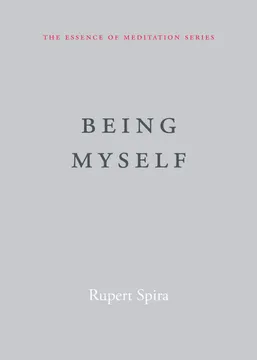
Being Myself is a sequence of contemplative invitations built around one question: what remains when the changing contents of experience are noticed without being treated as the whole self? Spira’s answer begins as a phenomenological observation, the immediate sense of being aware, and develops into a non-dual metaphysics: awareness and the world are expressions of one being. That progression gives the book its emotional force, but it also marks the line readers should examine carefully.
The practical argument is more modest than the metaphysical one. A person can test whether identifying completely with a feeling intensifies distress, and whether pausing to notice awareness changes the relationship to that feeling. The book’s distinctive promise is that this shift need not depend on producing a special meditation state. The ordinary sense of “I am” is already available, including in difficult moments. Repeated recognition, rather than spiritual achievement, is presented as the way insight becomes part of daily life.
The larger claim that awareness is eternal, universal, and the ground of the world does not follow automatically from the fact that experience is known. It is a philosophical and spiritual interpretation, supported in the book by analogies and references to religious traditions, not established by introspection alone. Readers can still use the exercises without accepting every conclusion. This distinction protects the book from two opposite errors: dismissing useful inquiry because its metaphysics is contested, or treating a compelling inner experience as proof of a universal theory.
The book’s ethical promise also deserves this distinction. If perceived separation softens, compassion may become more natural, but recognition alone does not settle questions of justice or repair. The strongest reading therefore holds two ideas together: investigate the felt sense of self directly, and judge the consequences of that inquiry in ordinary conduct. The work is most persuasive not as a final explanation of consciousness, but as a disciplined invitation to notice how identity is built, how suffering gathers around it, and whether a less defensive way of living becomes possible.
Review Summary
Being Myself by Rupert Spira receives overwhelmingly positive reviews, averaging 4.64/5. Readers praise its clarity, simplicity, and accessible exploration of non-dual teachings and self-awareness. Many find it transformational, appreciating Spira's ability to articulate complex spiritual concepts through vivid analogies and inclusive references spanning Sufism, Christianity, and Vedic philosophy. Some note repetition with his earlier works, particularly Being Aware of Being Aware. It is frequently recommended for both newcomers and seasoned spiritual seekers, with chapters described as ideal for quiet, contemplative reading.
Glossary
aware being
awareness present as beingSpira’s term for the awareness that knows experience and is recognized inwardly as the simple fact of being. It is not a special mental state or a quality owned by a separate person. In the book’s account, it is present through changing thoughts, feelings, sensations, and perceptions, while not being defined by any one of them.
separate self or ego
identity formed through limitationThe apparent individual self that arises when awareness is identified with the changing qualities of experience, such as moods, bodily conditions, roles, and relationships. Spira associates this identity with vulnerability, a sense of lack, and efforts to defend or complete oneself. He does not present it as an independently existing entity, but as an assumed limitation of being.
I am
unqualified awareness of beingThe bare recognition of existence before it is qualified by descriptions such as age, gender, mood, occupation, or relationship. Spira uses “I am” as a pointer toward awareness knowing itself, rather than as a statement about a personal identity. His contemplative instruction is to notice this simple knowing and let attention settle there.
pure knowing
knowing without objectSpira’s description of awareness considered apart from the particular thoughts, feelings, sensations, and perceptions it knows. “Pure” does not mean morally perfect, and “empty” does not mean unconscious or blank. The terms indicate that awareness is not itself one more object within experience, even though all objects are known through it.
inward-facing path
distinguishing awareness from experienceA contemplative approach that turns attention away from the contents of experience to recognize awareness as the knower rather than as any particular thought, feeling, sensation, or perception. Spira presents it as especially useful when someone is absorbed in experience and feels defined by it. It is a discriminating movement, not a rejection of experience as worthless.
outward-facing path
including experience without separationA contemplative approach in which experience is welcomed rather than treated as separate from or opposed to awareness. After recognizing awareness as distinct from particular experiences, a person can meet thoughts, relationships, and the world without being wholly identified with them. Spira associates this inclusive orientation with love, openness, and less conflict between meditation and daily life.
sat chit ananda
being, consciousness, happinessA Sanskrit expression Spira interprets through the terms being, knowledge or consciousness, and peace or happiness. In his use, it conveys that knowing one’s own being is not merely an intellectual discovery but the recognition of an innate peace and fulfilment. The book treats these as the nature of awareness, rather than temporary emotional states caused by circumstances.
enlightenment
recognition of original beingSpira uses this term for the revealing of one’s essential being when it is no longer overlooked or confused with the changing contents of experience. It is not, in his account, an achievement that creates a new or superior person, nor is it defined by unusual sensations. It is recognition of what was already present, followed by a possible gradual stabilization in that recognition.
establishment in our true nature
stable recognition amid experienceThe growing ability to remain aware of essential being while thoughts, feelings, activities, and relationships continue. Spira describes this as a deepening beyond occasional glimpses: habitual identification may still arise, but it increasingly loses its power to obscure awareness. The phrase refers to stabilization in recognition, not withdrawal from ordinary life or the elimination of every difficult emotion.
The Essence of Meditation Series
About the Author


Download PDF
Download EPUB
.epub digital book format is ideal for reading ebooks on phones, tablets, and e-readers.








