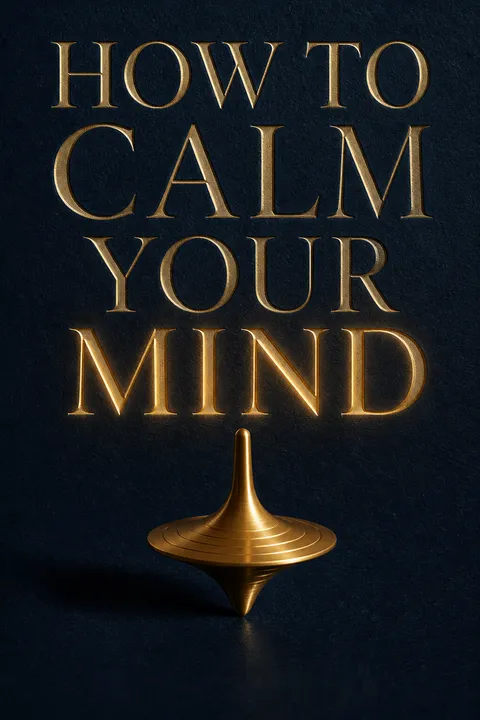


Key Takeaways
Make calm the infrastructure that keeps productivity from consuming you
A warning onstage. Chris Bailey built his career around productivity, then suffered a panic attack while speaking to an audience of about one hundred. He was already meditating, exercising, and making time for self-care, yet chronic stress had accumulated beneath those good habits. The missing piece, he concluded, was calm: a pleasant, low-arousal state with less anxiety, not a life without effort. Calm and anxiety sit on a continuum, so cultivating calm can make a person more resilient when stress arrives.
Not a substitute for care. Bailey’s practical strategies target everyday anxiety and burnout, not clinical disorders. If anxiety prevents normal functioning, professional help matters. The central shift is to treat calm not as a reward after work, but as a condition that supports attention, presence, and sustainable effort.
The opening story usefully separates visible self-care from the less visible conditions producing distress. A relaxing ritual cannot compensate indefinitely for an overloaded life, just as a brief recovery break cannot repair an unsafe work system. Calm is also framed as active capacity, not passivity: the ability to respond rather than react. That distinction helps prevent a common misunderstanding, especially in achievement-oriented settings where rest can look like surrender. The clinical boundary is important, too. A self-help framework may help with ordinary strain, but serious or persistent symptoms deserve qualified assessment.
Give accomplishment a work window, not the keys to your identity
When achievement becomes selfhood. Bailey describes how praise and professional success reinforced his belief that he was exceptionally productive. Over time, work became more than something he did: it became evidence of who he was. He calls the resulting pattern the accomplishment mindset, a learned drive to achieve more that can make leisure feel wasteful and turn enjoyable activities into boxes to tick.
Contain the drive. Set productivity hours by choosing when to handle work with deadlines or practical demands. Treat the remaining time as deliberately personal, rather than as an unfinished workday. This boundary gives effort an endpoint and reduces the guilt of resting. It also changes the daily question from “Did I do enough?” to “Did I use work time intentionally, and did I let the rest of life happen?”
Identity built entirely on performance is fragile because jobs, health, and circumstances change. The book’s approach resembles role boundaries in organizational psychology: clear transitions can help people stop carrying one role’s demands into another. The tactic is strongest when the boundary is real, not merely a calendar label. Some workers cannot choose their hours or reliably disconnect, so personal scheduling alone may not solve the problem. Even then, naming work and nonwork periods can clarify what is being demanded and where a structural conversation is needed.
Inventory chronic stress before it quietly becomes your normal
Two kinds of pressure. Acute stress is temporary, such as a difficult presentation or a canceled flight. It can be intense, but usually allows recovery afterward. Chronic stress repeats or seems to have no end, as with persistent overload or unresolved conflict. Bailey argues that repeated stress, not every difficult moment, is the more dangerous route toward burnout.
Make the hidden visible. Write down stressors across work and home, including small digital habits such as repeatedly checking news or email. Then sort them into what can be prevented and what cannot. Bailey found that some of his own avoidable pressures included checking business metrics, social media, and news updates. Removing even a few recurring stressors can free attention and reduce the pressure accumulating in the background.
The inventory translates a vague feeling of being overwhelmed into a problem that can be examined. This resembles stressor appraisal in psychology: people respond not only to events, but to how controllable and persistent those events seem. The distinction between preventable and unavoidable pressure is useful, provided it does not imply that every stressor should be eliminated. Some demanding commitments carry purpose or connection. The practical question is whether their cost is sustainable, and whether recovery is sufficient. A recurring nuisance may look minor alone while consuming substantial attention in aggregate.
Treat burnout as evidence about the job, not just the worker
Three warning signs. Bailey draws on Christina Maslach’s research: burnout involves exhaustion, cynicism or detachment, and a diminished sense of effectiveness. Feeling tired alone does not describe the full pattern. Maslach’s “canary in the coal mine” comparison makes the social point: one burned-out employee may reveal a workplace problem shared by others, not a personal failure to cope.
Inspect the conditions. The six burnout factors are workload, control, reward, community, fairness, and alignment with personal values. Rate each area, identify the most damaging mismatches, and consider what can change. Bailey reduced consulting work that caused substantial travel stress and built regular contact with other independent workers. When core workplace problems are persistent and cannot be addressed, changing teams or jobs may be more realistic than adding another self-care task.
This workplace lens corrects the tendency to individualize a problem produced by workload, low autonomy, or unfair treatment. The six-factor model is especially practical because it turns “I cannot handle this” into more precise questions about the environment. It also supports action at different levels, from renegotiating responsibilities to leaving an unhealthy setting. Still, not every case of exhaustion proves a toxic workplace, and job changes are constrained by money, caregiving, and opportunity. The framework works best as a diagnostic aid, not as a verdict reached from one bad week.
Put an endpoint on more before it moves the goalposts
A goal without a finish line. Bailey calls the mindset of more the tendency to pursue greater success or accumulation regardless of context. It can pull in contradictory directions: more income, more free time, more fitness, and more leisure, all at once. A goal is useful when it has a point at which it makes a meaningful difference. Without that endpoint, “enough” keeps receding.
Notice the reward loop. Dopamine is described here chiefly as a driver of anticipation and pursuit, not as happiness itself. It can encourage people to seek the next achievement, purchase, or status signal before enjoying what they already have. Bailey cites research suggesting that people across income levels often say they would need roughly 50 percent more money to be happy. The practical response is not to reject ambition, but to choose which gains serve personal values and define what counts as sufficient.
The distinction between chosen ambition and automatic accumulation is central. Goals can organize effort, but unbounded goals turn success into a moving target, a pattern also visible in consumer markets that continually redefine what counts as desirable. An endpoint makes trade-offs discussable: the extra promotion may be worth less if it consumes the time it was meant to finance. The cited income finding should not be treated as a universal threshold for happiness. Costs of living and financial security differ widely. The durable lesson is to define sufficiency in context instead of inheriting someone else’s scoreboard.
Practice savoring now, instead of postponing enjoyment until success
Enjoy what has arrived. Savoring means deliberately attending to a positive experience and appreciating it, rather than immediately moving on to the next thing to acquire. Bailey draws on research suggesting that people often encounter more positive than negative moments, yet negative information attracts stronger attention. Savoring helps make ordinary good experiences more noticeable and memorable.
Turn attention toward pleasure. Make a short list of experiences worth enjoying, then give one of them focused attention each day. Savoring can mean lingering over a meal, feeling gratitude, recalling a good memory, or anticipating an event with pleasure. Bailey distinguishes this from simply acquiring more: a new possession or accomplishment does not automatically become enjoyable. Practicing appreciation helps balance striving with being present, without requiring someone to give up meaningful goals.
Savoring offers a concrete counterweight to the acquisition cycle because it trains attention, not just attitude. It also treats enjoyment as a skill that can be practiced, much like noticing details in a photograph rather than glancing at it. This makes the advice more useful than a vague command to feel grateful. There is a nuance: deliberate appreciation should not become another performance metric or a way to deny genuine hardship. Its value lies in widening attention so positive experience is not erased by threat, comparison, or the next task.
Lower your stimulation height by replacing, not merely resisting, superstimuli
Why the scroll wins. Superstimuli are exaggerated, highly stimulating versions of things people naturally find rewarding. Personalized feeds can deliver novel content that feels unusually relevant, while variable rewards make checking tempting. Bailey calls a person’s accustomed level of stimulation their stimulation height. The higher it rises, the less appealing ordinary tasks and quiet leisure may feel by comparison.
Run a practical reset. A stimulation fast is not a literal detox from dopamine. It is a temporary break from selected compulsive sources of stimulation, such as social media, digital news, or frequent email checks. Bailey’s monthlong experiment also limited alcohol and takeout, and replaced removed habits with exercise, reading, cooking, and in-person connection. A fast can begin with two weeks, clear rules, and chosen alternatives. The point is to lower habitual stimulation enough to rediscover calmer activities.
The compelling idea is environmental rather than moral: a person is not weak for finding a personalized feed hard to leave when the service is designed to hold attention. Replacing a habit also addresses the empty time and emotional cues that make simple abstinence difficult. The book is careful to reject the misleading implication that dopamine itself can be cleansed from the body. Its account of dopamine is necessarily simplified, however, and not every digital activity is harmful. A deliberate, time-limited experiment can reveal personal effects without turning a broad theory into a diagnosis.
Build calm through analog movement, human connection, and deliberate recovery
Return to embodied life. Bailey argues that the physical world often supports calmer attention than algorithmic digital environments. He highlights movement, time with people, meditation, and nourishing food as useful ways to relieve accumulated stress. Public-health guidance cited in the book recommends at least 150 minutes of moderate activity or 75 minutes of vigorous exercise weekly. The best movement is one a person can enjoy and sustain, whether that is walking, dancing, swimming, or a group class.
Choose richer contact. Face-to-face time can offer connection that scrolling does not. Meditation provides practice in noticing a wandering mind and returning attention to the breath. Bailey also recommends examining caffeine, alcohol, and highly processed food if they seem to worsen anxiety or energy swings. These are experiments, not universal rules: individual responses differ, and dependence or severe symptoms call for professional support.
This cluster of practices matters because it combines psychological and bodily routes to recovery. Movement changes the body’s state, social contact counters isolation, and meditation trains attention. Together, they offer more than passive distraction. The analog-digital distinction is useful as a default, but it is not an absolute: digital tools can connect distant families, support exercise, or provide access to care. The meaningful test is whether a tool supports an intention or captures attention for its own sake. Accessibility also matters, since health, disability, time, and money shape which practices are feasible.
Measure valuable work, not how depleted or busy you feel
Anxious attention costs capacity. Bailey uses the term attentional space for working memory, the mental capacity used to hold and manipulate information. A meta-analysis he discusses estimated that anxiety is associated with a roughly 16.5 percent reduction in working-memory capacity. He illustrates the possible consequence with a deliberately simplified calculation: if eight hours of work took proportionally longer, it would require about nine hours and nineteen minutes. That estimate is not a personal forecast, but it shows why anxiety can undermine knowledge work.
Count outcomes, not motion. A crowded inbox or a drained feeling can create the impression of productivity without showing whether important work advanced. Keep a daily accomplishments list, set priorities, and review what your effort produced. Calm supports productivity by making deliberate attention easier, not by making every task effortless.
The productivity argument is persuasive because it identifies a hidden cost: anxiety can consume the same mental resources required for planning, comprehension, and creative work. The arithmetic should remain illustrative, since attention and output do not map neatly onto a single linear percentage. More broadly, knowledge work is difficult to measure, so visible effort often substitutes for actual value. A results-focused review can correct that bias, but it should include collaboration, care, and maintenance work that may not produce a tidy deliverable. Calm helps create better conditions for work; it cannot guarantee outcomes.
Analysis
Bailey’s strongest move is to change the unit of analysis. Anxiety is not presented only as a feeling to suppress, nor productivity as a technique to optimize. The book links personal attention, workplace design, digital incentives, and bodily recovery into one account of how strain accumulates. Its narrative begins with a public panic attack and returns repeatedly to ordinary choices, such as checking metrics or filling leisure with stimulation. That movement makes an abstract argument legible: distress can be produced by a whole pattern of life, even when each habit looks defensible in isolation.
The book is especially useful where it refuses a purely individual explanation of burnout. The six work conditions give readers a vocabulary for describing organizational problems, while the stress inventory and stimulation fast translate broad theory into experiments. Its most memorable practical contrast is not work versus rest, but deliberate effort versus compulsive busyness. Savoring then supplies a counterpractice: attention can move from acquisition toward enjoyment without demanding that ambition disappear.
Some neuroscience is simplified for accessibility. Dopamine, serotonin, and the brain’s calm network are presented as tidy explanatory actors, although real behavior is more complex than a single chemical story. The author partly guards against overreach by saying dopamine is not inherently bad and by describing a stimulation fast as a break from habits, not a biochemical cleanse. The 16.5 percent productivity calculation is also an illustration based on a linear assumption, not a universal productivity forecast. The book’s advice is most powerful when treated as a set of testable adjustments rather than a rigid lifestyle doctrine. A person may need digital access, stimulants, or demanding work for reasons that cannot be removed by better habits. Structural constraints matter. Within those limits, the framework offers a valuable question: which parts of a day restore capacity, and which merely imitate progress? Calm is not an escape from responsibility. It is a way to meet responsibility without allowing every hour to become a demand for more.
Review Summary
How to Calm Your Mind received mixed reviews, with an average rating of 3.84 out of 5. Many readers found the book helpful, offering practical tips for reducing anxiety and increasing calm. Some appreciated Bailey's personal experiences and research-backed advice. However, others felt the content was repetitive or lacked originality. Critics noted that the book's perspective seemed limited to a privileged demographic. Despite these criticisms, many readers found value in the reminders about mindfulness, digital detoxes, and the importance of balancing productivity with mental well-being.
People Also Read







Glossary
Accomplishment mindset
Drive to achieve moreA learned pattern of attitudes that pushes a person to keep accomplishing and filling available time with activity. It can make rest feel wasteful, turn enjoyable experiences into tasks, and encourage people to judge their days by output. Bailey argues that it becomes harmful when it has no boundaries and spreads from work into personal life.
Mindset of more
Unbounded pursuit of moreA set of attitudes that makes greater accumulation or achievement the default goal, regardless of context. It can appear as wanting more money, status, productivity, possessions, or stimulation. Bailey argues that it often lacks a clear stopping point, so satisfaction is postponed as the desired target moves farther away.
Productivity hours
Bounded time for necessary workTime deliberately set aside for work that has practical demands or time pressure, including work at home when useful. During these hours, a person focuses on important tasks and accepts an accomplishment-oriented mindset. Setting an endpoint helps separate work from leisure and reduces the sense of being vaguely on call all day.
Stress inventory
Written map of stressorsAn exercise in listing the sources of stress across work and personal life, including small or hidden sources such as compulsive news and email checks. The list is then divided into stressors that can be prevented and those that cannot. Its purpose is to make accumulated pressure visible and identify changes that could reduce avoidable stress.
Burnout threshold
Personal capacity for chronic stressBailey’s model for the point at which accumulated chronic stress exceeds a person’s capacity to cope, increasing the risk of burnout. The threshold is not a fixed universal measurement. Reducing unnecessary stress and strengthening recovery can create more distance between current demands and the point of overload.
Six burnout factors
Work conditions linked to burnoutThe six work areas Bailey uses to assess conditions that can foster chronic stress: workload, control, reward, community, fairness, and alignment with personal values. A person can rate each area, identify mismatches, and decide whether they can be improved or signal a poor fit with the workplace.
Superstimuli
Exaggerated rewarding stimuliHighly processed or intensified versions of rewarding experiences that can capture attention and encourage repeated use. Examples in the book include personalized social feeds and other digital content designed around novelty. Their immediate stimulation may crowd out slower activities that provide greater satisfaction or connection.
Stimulation height
Usual level of mental stimulationA way to picture how much stimulation a person is accustomed to seeking through daily activities. Bailey suggests ranking activities from less to more stimulating, while recognizing that the ranking differs between people. Regular exposure to highly stimulating activities can make quieter work or leisure feel unusually dull.
Stimulation fast
Temporary break from compulsive stimulationA time-limited experiment in reducing selected activities that provide frequent, impulsive stimulation, such as compulsive social media, news, or email checking. Bailey stresses that this is not a literal detox from dopamine. The approach works by setting clear limits and replacing removed habits with more engaging, restorative activities.
Savoring
Deliberate enjoyment of positive experienceThe practice of paying attention to and appreciating a positive experience, helping convert it into a more lasting positive emotion. Savoring may focus on something happening now, a pleasant memory, or an anticipated event. Bailey presents it as a counterbalance to pursuing new acquisitions without enjoying what has already been gained.
Attentional space
Working memory for current thoughtBailey’s accessible name for working memory, the mental capacity used to hold and work with information in the moment. It supports reasoning, planning, comprehension, and problem-solving. Anxiety can occupy some of this capacity with worry and threat monitoring, leaving fewer resources for the task at hand.
Zeigarnik effect
Unfinished tasks stay mentally salientA memory tendency, named for psychologist Bluma Zeigarnik, in which unresolved tasks can remain more prominent in awareness than completed ones. Bailey uses the idea to explain why people may overlook daily accomplishments while fixating on unfinished chores or work. Keeping a record of completed efforts can counter this imbalance.
FAQ
What's How to Calm Your Mind about?
- Focus on Calmness: The book explores strategies to cultivate calmness in a world filled with distractions and anxiety, emphasizing the importance of finding presence and productivity during anxious times.
- Personal Journey: Author Chris Bailey shares his personal experiences with burnout and anxiety, providing a relatable backdrop for the concepts discussed.
- Practical Strategies: It offers actionable advice, including techniques like "stimulation fasting" and understanding the "accomplishment mindset," to help readers manage their mental health effectively.
Why should I read How to Calm Your Mind?
- Addressing Modern Anxiety: In today's fast-paced world, many people experience heightened anxiety. This book offers insights and tools to help navigate these feelings and find a sense of calm.
- Research-Based Insights: The author combines personal anecdotes with scientific research, making the content both engaging and credible. Readers can trust that the strategies presented are grounded in evidence.
- Improved Productivity: By implementing the book's strategies, readers can enhance their productivity while maintaining a sense of calm, making it a valuable resource for anyone feeling overwhelmed.
What are the key takeaways of How to Calm Your Mind?
- Calm vs. Anxiety: The book emphasizes that calm is the opposite of anxiety, and fostering calmness can help reduce anxiety levels. Understanding this relationship is crucial for mental health.
- Mindset of More: Bailey discusses the "mindset of more," which drives individuals to constantly strive for more accomplishments, often leading to burnout. Recognizing this mindset is essential for achieving balance.
- Stimulation Fasting: One of the main strategies is conducting a stimulation fast, where individuals step away from distracting digital stimuli to regain focus and calm.
What is the "accomplishment mindset" mentioned in How to Calm Your Mind?
- Definition: The "accomplishment mindset" is a conditioned set of attitudes that drives individuals to constantly strive for more achievements, potentially leading to chronic stress and burnout.
- Impact on Well-Being: While striving for accomplishments can be beneficial, an unchecked focus on achievement can diminish joy and lead to anxiety. It’s important to set boundaries around this mindset.
- Balancing Act: The book encourages readers to find a balance between ambition and savoring the present moment, which is key to maintaining mental health and productivity.
What is "stimulation fasting" and how can it help?
- Concept Overview: "Stimulation fasting" is a practice where individuals intentionally reduce their exposure to high-stimulation activities, such as social media and news, to reset the brain's tolerance for stimulation.
- Benefits: By engaging in stimulation fasting, readers can experience reduced anxiety, increased calmness, and improved focus. The practice allows for deeper engagement with meaningful activities.
- Implementation: Bailey suggests setting specific rules for the fast, such as limiting social media use or checking emails only a few times a day, to help individuals regain control over their attention.
How does How to Calm Your Mind define calm?
- Opposite of Anxiety: Calm is defined as a subjectively positive state characterized by low mental arousal and an absence of anxiety. It is the state we aim to achieve for better mental health.
- Continuum of States: The book explains that calm and anxiety exist on a continuum, meaning that fostering calm can help us build resilience against future anxiety.
- Practical Implications: Achieving calm involves actively investing in strategies that promote a calm state of mind, leading to improved productivity and overall well-being.
What are some practical strategies for achieving calm from How to Calm Your Mind?
- Mindfulness Practices: Engaging in mindfulness activities, such as meditation or deep breathing, can help cultivate a sense of calm by allowing individuals to focus on the present moment.
- Analog Activities: Spending more time in the analog world—such as reading, walking, or engaging in hobbies—can promote calmness by disconnecting from digital distractions.
- Savoring Experiences: Practicing savoring—taking the time to enjoy and appreciate positive experiences—can enhance feelings of calm and happiness.
What are the "six burnout factors" discussed in How to Calm Your Mind?
- Workload: This factor refers to the sustainability of the amount of work on an individual's plate. An excessive workload can lead to exhaustion and burnout.
- Lack of Control: Feeling a lack of autonomy and control over one’s work can contribute to burnout. It’s important to have the resources and freedom to shape one’s projects.
- Insufficient Reward: This factor highlights the importance of feeling rewarded for one’s efforts, whether through financial compensation or recognition.
How does How to Calm Your Mind address chronic stress?
- Chronic Stress Explained: Chronic stress is defined as a prolonged state of stress that can lead to burnout and various health issues, often stemming from unmanageable workloads and lack of control.
- Impact on Mental Health: Chronic stress can significantly impair cognitive performance and overall well-being, leading to anxiety, depression, and a diminished capacity for productivity.
- Taming Chronic Stress: Bailey provides strategies for identifying and reducing chronic stressors in life, advocating for a proactive approach to mental health.
What role does dopamine play in our daily lives according to How to Calm Your Mind?
- Dopamine's Function: Dopamine is a neurotransmitter that plays a crucial role in our brain's reward system, driving us to seek pleasure and novelty.
- Cycle of Distraction: The pursuit of dopamine can create a cycle of distraction, making it difficult to focus on meaningful tasks and leading to increased anxiety and stress.
- Balancing Dopamine Levels: Bailey suggests strategies to manage dopamine levels, such as engaging in less stimulating activities and practicing mindfulness.
What are some effective mindfulness techniques mentioned in How to Calm Your Mind?
- Meditation Practice: Simple meditation techniques, such as focusing on your breath, help cultivate a calm and present mindset.
- Breathing Exercises: Techniques like slow breathing and softening your gaze stimulate the vagus nerve and promote relaxation.
- Journaling: Reflecting on your day through journaling enhances mindfulness and self-awareness, leading to greater clarity and calm.
What are the best quotes from How to Calm Your Mind and what do they mean?
- "You are the sky. Everything else—it’s just the weather.": This quote emphasizes that our thoughts and feelings are temporary and do not define our true self, encouraging a sense of calm amidst life's challenges.
- "Calm isn’t about ignoring reality.": Achieving calm does not mean avoiding problems; rather, it provides the resilience needed to face challenges.
- "The more we strive for more, the less we enjoy what we have.": This quote encapsulates the essence of the "mindset of more," reminding readers that constant striving can lead to dissatisfaction.
About the Author
Other books by Chris Bailey


Download PDF
Download EPUB
.epub digital book format is ideal for reading ebooks on phones, tablets, and e-readers.








