

Key Takeaways
Build a personal toolbox for uncertainty, not a universal formula
Tools keep us upright. Obama begins with her father’s cane, an ordinary aid that helped him navigate worsening multiple sclerosis. It did not reverse the illness or make life predictable. It helped him keep moving. That practical meaning shapes the book’s central idea: each person needs tools for staying steady through change, whether those tools are habits, objects, attitudes, or trusted people. The inner light she describes is a person’s growing knowledge of their own worth and capacities, strengthened by learning to recognize those qualities in others.
Keep adapting your kit. Her father moved from cane to crutches, then to a motorized cart and an adapted van. Likewise, what steadies a person changes with circumstance. Obama offers no universal recipe. She describes years of practice, mistakes, and adjustment, inviting readers to identify what helps them regain perspective and discard what does not.
The cane is a vivid reminder that resilience need not mean overcoming a condition. Sometimes it means changing the conditions under which a person can participate. That idea connects personal coping with disability justice, which asks not only how individuals adapt, but also how environments can remove barriers. The toolbox metaphor is strongest when it avoids turning hardship into a private self-improvement project. A walk or a trusted friend can help someone endure uncertainty, but neither replaces accessible systems, fair institutions, or material support.
When catastrophe feels too large, complete one small, embodied task
Make the problem graspable. During the pandemic’s first months, Obama felt overwhelmed by illness, loss, and the limits of what she could do from home. Knitting gave her a narrow, physical task: move the yarn, form a stitch, repeat. Its rhythm quieted her racing thoughts enough for her to see beyond the crisis and recover a sense of perspective. The craft did not solve the pandemic or injustice. It helped her return to the work she could do, including preparing a speech urging people to vote.
Small starts can grow. In a conversation with Chicago students, she heard about a teenager whose pandemic videos led her to start a filmmaking business, and another student whose failed run for student council gave her confidence to organize local projects. A modest task can restore momentum without pretending the larger problem is small.
This is close to behavioral activation, a therapeutic approach that uses manageable, meaningful action to interrupt withdrawal and low mood. The useful mechanism is not knitting itself, but focused activity that gives attention a job and produces visible progress. That makes the advice adaptable to cooking, repairing, gardening, or practicing an instrument. There is a boundary worth keeping clear: small personal tasks are not a cure for depression, nor a substitute for treatment or collective action. Their value is often to restore enough agency to take the next step.
Treat fear as information, then test whether danger is real
Separate threat from novelty. As a child, Obama refused to perform beside a large stuffed turtle that frightened her. Her aunt did not remove it, but left the decision to her. Once Obama approached, she saw that the prop was harmless and was able to perform. The experience became an early lesson in checking what fear is signaling rather than obeying it automatically.
Practice while nervous. Years later, she used the same kind of examination when Barack considered running for president. Her worries about disruption and public scrutiny were real, but she recognized that much of her resistance came from fear of change. The book calls the ability to function while still feeling fear being comfortably afraid. That is not fearlessness. It is the practice of judging risk and moving forward when the danger is manageable.
The distinction between danger and unfamiliarity resembles exposure-based therapy, where gradual contact can teach the nervous system that some feared situations are survivable. The turtle story makes that process concrete: proximity supplied information that imagination could not. Yet the distinction must be applied carefully. For people facing racism, violence, or other real threats, fear can be accurate perception, not a mistaken reaction to novelty. Decoding fear should improve judgment, not pressure people to take risks that others can afford to ignore.
Give yourself the welcome you keep hoping to receive
Lead with gladness. Obama describes her friend Ron greeting himself warmly in the bathroom mirror each morning. The habit is funny, but its point is serious: he begins with recognition rather than an inventory of flaws. Obama contrasts this with the reflexive self-criticism many people bring to their appearance and performance.
Let warmth come first. Writer Toni Morrison described learning to greet children with visible pleasure instead of leading with corrections about clothes or behavior. Obama connects that lesson to a study in which teachers who welcomed students individually at the classroom door saw higher engagement and less disruptive behavior. Kindness does not require pretending everything is fine. It means giving a person, including oneself, a moment of acceptance before evaluation begins.
A warm greeting can function as a small cue of safety, making attention available for learning and interaction instead of self-protection. The idea also fits research on self-compassion, which suggests that treating mistakes with care can support persistence better than shame does. The point is not to replace honest feedback with relentless affirmation. It is to separate a person’s basic worth from a particular mistake or appearance. That distinction allows correction to be useful rather than a verdict on the whole self.
Stop borrowing other people’s mirrors to measure your worth
Notice who gets reflected. As a tall girl, Obama felt conspicuous and unsure how to use her strength. The gymnast Nadia Comăneci inspired her, but the sport’s equipment, coaching, and narrow ideas about an ideal gymnast did not suit her. Later, arriving at Princeton as a Black woman among mostly white male students, she experienced a different kind of visibility: being noticed as different, yet not fully recognized as belonging.
Name the outside pressure. The book links these experiences to W.E.B. Du Bois’s idea of double consciousness, the strain of seeing oneself through the judgments of a society that may devalue one’s identity. Obama draws confidence from her father’s steady sense of worth and from communities where people recognize one another. Self-belief helps, but it does not erase unequal treatment or the importance of representation.
This section joins inner confidence to social context rather than treating self-esteem as a purely private achievement. Du Bois’s concept helps explain why exclusion consumes attention: a person must do the task while monitoring how others may interpret them. Representation matters because examples expand what people can imagine, not because every individual needs a same-identity role model. The important nuance is that changing one’s self-talk cannot repair discriminatory institutions. Personal dignity can help someone resist a demeaning judgment, while institutional change remains necessary to stop producing it.
Make friendship deliberate before loneliness makes retreat feel natural
Take the social risk. Obama treats friendship as something people build by showing curiosity, asking to spend time together, and making room for regular contact. She describes finding a friend through a conversation at a hair salon, and another through their daughters’ school friendship. In both cases, a relationship began because someone moved beyond a polite first meeting.
Build a wider circle. Obama calls her close network her Kitchen Table: the people she trusts, enjoys, and relies on. She also uses the term social convoy for important relationships that accompany a person through life. The circle can include different people for different needs; no single friend has to do everything. The book cites a survey in which one-third of American adults had fewer than three close friends, and 12 percent reported having none.
Friendship is often described as an emotion, but this account emphasizes its infrastructure: invitations, repeated contact, shared rituals, and mutual care. That framing is useful because it turns connection into something people can cultivate rather than wait to stumble upon. Research on social support also links close relationships with better health and resilience. Still, the book’s preference for in-person contact should not make online ties seem inferior by default. For isolated people or marginalized communities, digital relationships can be genuine lifelines. The key question is whether a connection offers trust and reciprocity.
Choose a partner for shared work, not rescue or perfection
Let difference be real. Obama and Barack brought different habits into their marriage. She valued plans and punctuality; he preferred flexibility and room to think. Their families had different ways of expressing love, too. Rather than assuming one style was correct, they learned to explain how their histories shaped their reactions and to adjust how they handled conflict.
Build a life together. Their relationship involved fertility struggles, demanding careers, long absences, and couples counseling. Obama argues that partnership is not a permanent, perfectly equal split of effort. Needs and sacrifices shift over time, so both people must be willing to contribute and adapt. A partner cannot repair someone else’s life or become their only source of support. The aim is a shared home between two people who remain distinct, not a fantasy of effortless compatibility.
The strongest idea here is that lasting love depends less on sameness than on the ability to interpret difference without turning it into blame. That resembles relational work in family therapy, where partners examine the histories and patterns shaping a conflict, not only the immediate disagreement. The image of fairness changing over time is also more realistic than a fixed fifty-fifty ideal. However, flexibility is not a reason to tolerate harm or chronic one-sidedness. The account explicitly leaves room for leaving relationships that are unsafe, a crucial boundary around the language of commitment.
Raise children toward competence by trusting them with manageable responsibility
Give practice, not rescue. At five, Obama received an alarm clock and learned to manage her own morning routine. Her parents assigned age-appropriate chores and let her solve many conflicts herself. Her mother’s goal was to prepare her children to function independently, not to keep them dependent on adult help.
Fit guidance to the child. Obama’s own daughters responded differently to the same parental approach. One wanted more reassurance; the other was eager to manage herself. A tired evening when Obama threatened to quit being their mother revealed just how differently they interpreted her words. The lesson was to notice each child’s temperament and adjust expectations. Support still matters: children need adults who listen, set boundaries, and step in when needed, not a premature withdrawal disguised as independence.
The alarm clock is a small example of scaffolding: an adult supplies enough structure for a child to attempt a task, then leaves room for the child to master it. Developmental psychology supports the value of growing autonomy, but autonomy is built through reliable support, not abandonment. The book’s emphasis on individual temperament is especially important because identical rules can land differently with different children. Its practical challenge is calibration: adults must distinguish a useful struggle from a situation where a child needs protection or more help.
Share difference on safe terms, and let fuller stories widen belonging
Bring hidden chapters into view. Obama recounts a conversation with her longtime assistant Chynna, who worried that her boss might judge her because her father had been incarcerated. Sharing that history did not weaken their relationship. It helped Chynna understand herself more fully, and when she later spoke publicly, people with similar experiences contacted her. The book notes that more than five million U.S. children have had a parent in jail or prison, yet the experience is often kept private.
Turn difference into possibility. Poet Amanda Gorman’s years of working with a speech impediment shaped her close attention to sound and language. Her story illustrates how a perceived limitation can also become a source of skill. But Obama does not treat disclosure as compulsory: trust, timing, and the power dynamics of a workplace affect what is safe to share.
A personal story can reduce isolation by giving others language for an experience they thought they had to hide. This is one reason representation matters: a visible life can make another life feel more imaginable. The important qualification is the phrase on safe terms. Calls for authenticity can become demands that marginalized people expose painful histories to make colleagues comfortable or educate them. Disclosure should remain a choice, shaped by the speaker’s needs and the listener’s trustworthiness, not a test of courage or belonging.
Turn justified anger into disciplined action that can outlast outrage
Pause before reacting. Obama defines going high not as silence or passive politeness, but as the effort to turn anger, hurt, or fear into a considered response. After years of public attacks and stereotypes, she chose to focus on a clear message and a call for civic action rather than letting raw anger dictate her conduct. Writing and talking with trusted listeners helped her sort emotions into words and plans.
Spend energy strategically. Her advice is to treat time, attention, health, and credibility as limited resources. That can mean choosing which fights to take, resting, and refusing distractions that pull people away from their goals. The 2016 election offers a warning: more than 90 million eligible voters stayed home. A principle of integrity matters only when it is joined to concrete work, from voting to helping a neighbor.
This is a useful model of emotion regulation: feelings supply information and urgency, while planning determines what action can change the situation. It also challenges the online habit of confusing public reaction with durable impact. Yet disciplined conduct should not become a demand that marginalized people remain calm to deserve a hearing. Anger can reveal a real injustice and motivate collective resistance. The standard should be whether a response serves a purpose, not whether it appears respectable to those who benefit from the status quo.
Analysis
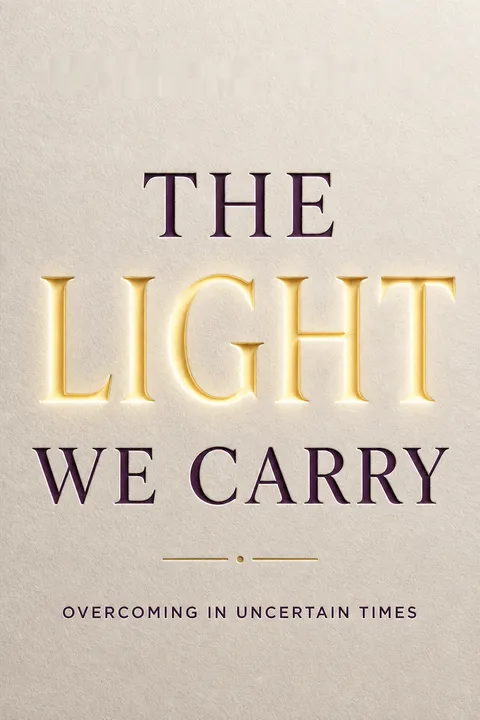
The Light We Carry is a memoir-shaped guide to living with uncertainty, built from family stories, public life, and a collection of practical metaphors. Its structure moves from inner steadiness to relationships and then to civic conduct. The recurring image of a tool gives the book coherence: a cane, knitting needles, a friendship circle, preparation for a speech, or a pause before reacting can each help someone regain balance. None is presented as a cure-all. The governing discipline is learning what works, when it works, and when it needs to change.
The book’s most valuable tension is between personal agency and unequal conditions. Obama’s stories show how self-trust, practiced competence, and supportive relationships can help someone act despite fear. Her account of being an outsider in elite and political spaces also makes clear that not every obstacle is internal. Racism, gender expectations, and institutional exclusion shape the cost of participation. This prevents the book from reducing resilience to positive thinking, though its language of personal tools can still be misread as asking individuals to adapt indefinitely to unfair systems. Its treatment of going high is similarly double-edged. Turning emotion into purposeful action can protect attention and make work sustainable. But calls for restraint have historically been imposed unevenly, especially on people whose anger is already stereotyped or dismissed. The book’s strongest answer is not to suppress anger, but to decide what form of response advances a goal. That distinction leaves room for protest, confrontation, and reform, while rejecting reaction as an end in itself.
The narrative also makes its advice credible by keeping it imperfect. The Obamas need counseling; the mother’s strategies do not fit every child identically; a public figure still worries about being good enough. These stories resist the illusion that achievement ends vulnerability. The result is less a prescriptive system than a humane practice: know what steadies you, seek people who see you, protect your resources, and keep acting without mistaking a small step for the whole solution.
Review Summary
The Light We Carry is highly praised for its inspirational and insightful content, blending self-help with personal anecdotes. Readers appreciate Obama's candid reflections on overcoming challenges, building relationships, and maintaining hope during uncertain times. Many found her writing style engaging and her advice practical. While some felt it wasn't as impactful as her previous memoir, most reviewers were moved by Obama's wisdom and authenticity. The book's themes of resilience, self-acceptance, and "going high" resonated strongly with readers, who found comfort and motivation in Obama's words.
People Also Read










Glossary
Comfortably afraid
Acting while nervousA way of responding to fear without expecting it to disappear. The person distinguishes genuine danger from the discomfort of unfamiliarity, then decides whether to proceed. The aim is not fearlessness, but the ability to remain alert and make considered choices while nerves are present.
Kitchen Table
Trusted circle of friendsObama’s name for the people beyond her family whom she trusts, enjoys, and relies on. The group offers emotional safety, perspective, and practical support. It can change over time and need not be one formal group; different friends can meet different needs without any one person having to provide everything.
social convoy
Relationships across a lifetimeA person’s important relationships understood as a group that travels with them through life. Like a convoy, these connections can offer protection, companionship, and help during difficult stretches. The idea highlights that social support is not limited to a spouse or one closest friend, and that relationships may shift as circumstances change.
the fearful mind
Inner voice rehearsing failureObama’s personification of the self-critical, self-protective voice that anticipates mistakes, rejection, and danger. It may be trying to prevent harm, but it can also discourage growth by treating every risk as catastrophe. Naming the voice makes it easier to notice its influence and choose whether its warning fits the situation.
despites
Obstacles turned into resolveThe setbacks, biases, and dismissals a person must confront, including conditions imposed by other people or institutions. Obama describes them as experiences that can become part of a person’s determination to continue, without claiming that hardship is fair or beneficial. Their value lies in the skills and resolve developed while responding to them.
going high
Turning feeling into actionA practice of pausing before reacting to provocation, then directing anger, hurt, or fear toward a purposeful response. It does not mean accepting injustice or avoiding conflict. It means trying to act with integrity and focus, choosing responses that can advance a goal and sustain continued effort.
code-switching
Adapting across social settingsChanging speech, behavior, appearance, or manner to fit the expectations of a particular environment. Obama describes it as a way to navigate communities and institutions with different cultural norms, sometimes opening access and connection. It can also be tiring or unfair when people are expected to hide parts of themselves to be accepted.
FAQ
What's The Light We Carry about?
- Personal Growth Focus: Michelle Obama explores themes of resilience, self-acceptance, and community. She reflects on her experiences and the tools she has developed to navigate life's challenges.
- Navigating Uncertainty: The book emphasizes finding strength and light within oneself, especially when faced with fear and adversity. Obama shares personal anecdotes illustrating her journey of "becoming."
- Community and Relationships: A significant aspect is the importance of friendships and support systems. Obama discusses how strong relationships help individuals feel seen and valued.
Why should I read The Light We Carry?
- Inspiration and Empowerment: Readers can find inspiration in Obama's candid reflections, encouraging them to embrace their own journeys. Her story serves as a reminder of the capacity to overcome challenges.
- Practical Tools: The book offers practical advice for managing fear and uncertainty, making it a valuable resource for mental resilience. Obama shares her personal toolbox of habits and practices.
- Cultural Relevance: Themes of community, connection, and self-acceptance resonate deeply, especially in light of recent global events. The book encourages engagement with one's identity and the world.
What are the key takeaways of The Light We Carry?
- Embrace Your Differentness: Obama emphasizes recognizing and embracing what makes you different, highlighting the power of self-acceptance.
- The Power of Small: Small actions can lead to significant changes in mindset and well-being. Obama shares her experience with knitting as a calming tool.
- Building Strong Relationships: The importance of friendships and community is a recurring theme. Obama notes that supportive relationships are crucial for navigating life's challenges.
What are the best quotes from The Light We Carry and what do they mean?
- "Nothing can dim the light that shines from within.": This quote encapsulates self-empowerment and resilience, reminding readers of their inner strength.
- "You are made, fundamentally, from the good.": Obama emphasizes inherent goodness, encouraging readers to recognize their value beyond others' perceptions.
- "We are each other’s harvest.": This quote speaks to the interconnectedness of humanity and the importance of community support.
How does Michelle Obama define "tools" in The Light We Carry?
- Practical Strategies: "Tools" are practical strategies and habits that help navigate life's uncertainties, providing support and stability.
- Personal Toolbox: Obama shares her adaptable personal toolbox, consisting of methods developed over time to maintain balance and confidence.
- Importance of Adaptation: Tools evolve based on circumstances and personal growth. Obama encourages readers to refine their own set of tools.
How does The Light We Carry address the theme of community?
- Importance of Connection: Community is essential for personal growth and resilience. Strong relationships provide support and validation.
- Building a Kitchen Table: The "Kitchen Table" metaphor represents a safe space for sharing experiences and support. Obama encourages cultivating such connections.
- Collective Strength: The book highlights that we are stronger together, with individual lights illuminating others' paths.
What personal experiences does Michelle Obama share in The Light We Carry?
- Family Background: Obama shares stories from her childhood, including her father's struggle with multiple sclerosis, shaping her understanding of resilience.
- Life in the White House: She reflects on her time as First Lady, discussing challenges and the importance of maintaining connections.
- Navigating Change: Obama discusses her journey from a corporate lawyer to a public figure, sharing challenges in finding her voice.
How does Michelle Obama suggest we overcome feelings of invisibility in The Light We Carry?
- Recognizing Your Light: Acknowledge your worth and unique qualities, crucial for overcoming feelings of invisibility.
- Building Supportive Relationships: Surround yourself with people who recognize and appreciate your light, creating a sense of belonging.
- Engaging with the World: Actively participate in communities and seek connections to combat invisibility, fostering presence and agency.
What role does self-acceptance play in The Light We Carry?
- Foundation for Growth: Self-acceptance is crucial for personal growth and resilience, recognizing and embracing unique qualities.
- Overcoming Self-Doubt: Silencing the inner critic and replacing negative self-talk with affirmations of worth is essential.
- Empowerment Through Acceptance: Embracing true selves empowers individuals to pursue goals and shine their light in the world.
How does Michelle Obama define resilience in The Light We Carry?
- Adaptability to Change: Resilience involves adapting to life's changes and challenges, being flexible and open to new experiences.
- Emotional Strength: It encompasses emotional strength, enduring hardships without losing hope, and maintaining a positive outlook.
- Support Systems: Support systems play a crucial role in building resilience, providing encouragement to overcome obstacles.
What strategies does Michelle Obama suggest for building community in The Light We Carry?
- Active Engagement: Engage actively with communities through volunteering or participating in local events, requiring effort and intention.
- Open Communication: Foster relationships through open communication, sharing experiences, and listening to others.
- Celebrating Differences: Embrace diversity within communities, enriching relationships and fostering understanding.
What is the significance of the title The Light We Carry?
- Symbol of Hope: The title symbolizes hope and resilience, representing the inner strength individuals possess.
- Collective Responsibility: It implies a collective responsibility to support one another, sharing light to uplift others.
- Personal Journey: Reflects Obama's journey of self-discovery and empowerment, embracing identity to navigate challenges.

Download PDF
Download EPUB
.epub digital book format is ideal for reading ebooks on phones, tablets, and e-readers.








