

Key Takeaways
Build an army by trusting junior leaders to think under fire
The test was local. In the summer of 1944, the US Army had grown from 160,000 soldiers in 1939 to more than eight million. Its decisive question was whether captains, lieutenants, and sergeants could lead in combat. At Ste. Mere-Eglise, Lieutenant Waverly Wray spotted a German counterattack forming and attacked its flank before it could reach the town. His initiative helped break the assault and protect the beachhead. The army’s success depended not only on generals’ plans, but on young leaders who could judge what the situation required.
Experience changed the answer. Wray was a veteran; many new officers arriving from the United States were bewildered by combat. Across the campaign, junior leaders learned under fire, and many were killed or wounded. Their skill was essential, but painfully costly to develop.
What's striking is how the book locates military capacity in the layer between strategy and the individual soldier. An organization can issue clear plans, but it cannot anticipate every battlefield circumstance; local judgment becomes a form of intelligence. That resembles modern ideas about decentralized decision-making, where people closest to a problem are often best placed to respond. Yet the story also warns against romanticizing improvisation. Wray's competence was built through prior combat, and many inexperienced leaders never got the chance to learn. Initiative works best when institutions prepare people, share information, and give them authority before crisis arrives.
Let battlefield evidence rewrite tactics before casualties do
The map was wrong. Allied intelligence failed to explain that Normandy’s hedgerows were raised earth banks enclosing small fields, often paired with sunken roads. Germans had trained to defend them and placed machine guns and mortars to cover the openings. American infantry, taught to move aggressively across open ground, often entered those fields straight into prepared fire. Mortars caused about three quarters of American casualties in Normandy.
The front improvised. Lieutenant James Coyle challenged a direct assault and found a route to the German flank, helping his platoon capture roughly 200 soldiers without losing a man. Tank crews and soldiers also developed ways to cut through hedgerows and communicate between tanks and infantry. The resulting tactics spread across the theater. The book’s pattern is practical: troops found solutions by testing ideas against the terrain, then sharing what worked.
The hedgerows show the difference between possessing information and understanding it. Aerial photographs existed, but interpreters misread what they showed, so the army prepared for the wrong kind of obstacle. In contemporary organizational learning, this resembles a failure of feedback: data has little value when assumptions prevent people from seeing its implications. Coyle’s decision illustrates the value of letting subordinates question orders with evidence. Still, battlefield experimentation carries an unusually high price. An organization should create ways to test and transmit lessons before people have to discover them through repeated injury and loss.
Mass production wins only when fuel, repair, and transport reach the front
Supply created movement. Allied ships and specialized landing craft kept men, vehicles, ammunition, and food flowing across the Channel. The LST, or landing ship tank, could unload heavy equipment directly onto the beaches. It helped sustain the invasion even before major ports were available. American mechanics also recovered and repaired damaged tanks, turning industrial capacity into usable strength.
Distance exposed the limit. After the breakout from Normandy, the armies raced across France faster than supplies could follow. The Red Ball Express used thousands of trucks to move provisions toward the front, but by September the advance had outrun even this improvised system. Patton requested hundreds of thousands of gallons of gasoline and received only a fraction. Units ran dry near the German border, while the Germans, now closer to home, could supply their defenses more easily. Abundance mattered only when transport connected it to the fight.
This is the book’s clearest correction to stories that treat war as a contest of courage or equipment. Industrial output matters only through a chain of transport, maintenance, fuel, and skilled labor. The same principle applies to emergency response and public services: a resource stored far from the point of need is potential, not capability. The supply crisis also complicates the celebration of rapid advance. Speed can produce its own fragility when supporting systems cannot keep pace. Strategic reach is therefore not simply how far a force can move, but how long it can remain effective at that distance.
Use air power to isolate an enemy, not to replace infantry
The skies reshaped the campaign. Allied fighters and bombers attacked German transport, fuel vehicles, bridges, and troop concentrations. Their presence made daytime movement dangerous and helped slow reinforcements. Ground observers in small Piper Cubs could spot German artillery positions, while improving radios let pilots, artillery, and tanks coordinate more closely. German soldiers remembered the fighter-bombers as a constant threat.
Air power had limits. German troops could survive bombing in dugouts and continue fighting from hedgerows. Poor weather repeatedly grounded Allied aircraft, giving the Germans chances to move. Even the massive bombing before Operation Cobra did not immediately open the front. Air attacks became most useful when coordinated with artillery and ground forces that could exploit the damage. The skies could isolate, disrupt, and suppress an enemy, but soldiers still had to cross fields, seize towns, and hold the ground.
The book presents air power as a system, not a magic weapon. Its value came from the interaction of aircraft, radios, observers, artillery, and troops on the ground. That is a useful model for any technology: its effects depend on the network that makes it actionable. Weather and terrain also matter. A capability that dominates under favorable conditions can become unavailable at the moment it is most needed. The account does not deny air power’s decisive contribution; it shows why claims of technological dominance become misleading when they ignore the people and conditions required to turn force into control.
Treat breakthrough plans as experiments, not guarantees
Cobra aimed to break the deadlock. On July 25, 1944, the Allies launched a vast bombardment against German defenses near St. Lo, followed by a ground assault. More than 16,000 tons of bombs and a huge artillery barrage hit the area. The attack also killed 111 American soldiers and wounded 490 when bombs fell short. On the first day, the surviving German defenses still resisted, and American units advanced with heavy losses.
The opening had to be used. The German position finally broke in the following days, allowing American forces to leave the hedgerow country and begin a more mobile campaign. The bombardment alone had not produced the breakthrough. Ground forces, artillery, tanks, air support, and German weakness had to combine. The operation illustrates the gap between a plan’s intended effect and what happens in battle. A powerful opening creates an opportunity, not a guaranteed result.
Cobra captures a recurring problem in high-stakes planning: a large, measurable input can create confidence without producing the desired outcome. Bomb tonnage looked like overwhelming force, but the first ground advance showed that destruction and control are different things. In engineering, a stress test is valuable partly because it reveals how a system fails; military plans also need feedback loops that allow commanders to revise their expectations. The friendly-fire casualties further show that coordination failures can be built into even carefully planned operations. The lesson is not to avoid ambitious plans, but to treat their assumptions as provisional.
Never confuse a bold attack with a sound strategic gamble
The Ardennes offensive depended on a chain of hopes. In December 1944, Hitler sent German forces through a lightly held American sector, aiming to cross the Meuse and reach Antwerp. Surprise initially worked. But the plan depended on bad weather grounding Allied aircraft, a slow American response, usable roads, and captured fuel. German units soon faced traffic jams, inadequate supplies, and American resistance at key crossroads.
The response turned crisis into defense. Allied commanders moved reinforcements quickly. On December 17 alone, 11,000 trucks carried 60,000 men and supplies toward the Ardennes. American soldiers held positions long enough to disrupt the German timetable, while airborne troops and other units reinforced critical points. The offensive failed to reach its objectives and exhausted Germany’s remaining strength. Hitler’s gamble was bold, but its success required too many favorable events to happen at once.
The Ardennes battle is a study in strategic assumptions. Surprise can create a temporary advantage, but it cannot erase the constraints of roads, fuel, weather, and time. The German plan was not absurd simply because it failed; its logic began with a genuine recognition that Germany needed a decisive result. Its weakness was that each necessary condition depended on another uncertain condition. This is a general problem in complex strategy: risk compounds across linked assumptions. The American recovery also depended on institutions, especially transport and command, not merely on individual bravery. Resilience is planned capacity as much as courage.
Lead visibly, but do not mistake courage for endless capacity
Example gave orders force. In Holland, General James Gavin landed with his paratroopers, carrying a rifle and moving toward the front despite a painful injury. His men saw a commander sharing their danger. Earlier, General Norman Cota showed pinned-down soldiers how to attack a defended farmhouse, then told them he could not do the job for every unit. Lieutenant Robert Cole’s bayonet charge at Carentan likewise helped turn a stalled advance into action.
Leadership had a human cost. The same junior officers who steadied their units were repeatedly killed or wounded. In the airborne divisions’ first month in Normandy, casualties approached 50 percent overall and were higher among junior officers. By the end of the Holland campaign, many of Gavin’s trained officers had become casualties. Visible leadership can build trust and help people act, but the army could not treat its best leaders as replaceable parts.
These episodes show why leadership is more than rank. People take greater risks when they believe a commander understands the danger and will not ask others to bear it alone. In social psychology, visible shared hardship can strengthen trust because it makes commitment observable. But the examples also expose a danger: heroic leadership can become an excuse for consuming leaders faster than an organization can replace them. Courage may solve the immediate problem while leaving the unit weaker tomorrow. A sound institution must honor personal example and also protect the people whose judgment makes the team effective.
Spend lives only for ground that changes the outcome
Some objectives were not worth their price. In autumn 1944, American forces repeatedly attacked the Hurtgen Forest, a dark, rugged area that hid German defenses and made coordination difficult. Nine American divisions and supporting units fought there over ninety days. The campaign caused more than 24,000 combat casualties, with another 9,000 men lost to illness or combat exhaustion. The Germans controlled dams upstream on the Rur River, so the forest could have been bypassed in favor of the more important objective.
Fort Driant offered another warning. Patton’s forces attacked the fortified position near Metz despite its deep tunnels and strong defenses. Repeated assaults failed at terrible cost, and the fort was ultimately bypassed before surrendering. The book distinguishes hard fighting from useful fighting: troops may show exceptional skill and endurance while an objective still offers too little strategic value to justify the losses.
The Hurtgen and Driant episodes raise the hard question of how commanders distinguish necessary sacrifice from sunk-cost persistence. Once a campaign has consumed lives, leaders can feel pressure to continue so earlier losses will not seem wasted. But past cost cannot make an unproductive objective more valuable. This connects military history to decision theory, where the relevant question is the future benefit of continuing, not the investment already made. The judgment is not easy in real time: information is incomplete, and bypassing a threat can carry risks. The book’s strongest criticism is that terrain and objective value deserved sharper scrutiny.
Turn wartime teamwork into schools, roads, medicine, and democratic alliances
The soldiers returned to civilian life. Ambrose’s epilogue follows former GIs who used the GI Bill to attend college, often taking heavy course loads to make up for time lost to war. He argues that veterans brought home habits of teamwork, organization, initiative, and responsibility. Their generation helped build highways and public works, advance medicine and technology, and support institutions such as NATO and the United Nations.
Victory did not end the story. The army’s citizen soldiers had fought because they had to, Ambrose argues, and unit loyalty mattered more to them than grand speeches about patriotism. Yet he also sees a deeper commitment to resisting dictatorship and protecting democratic life. Their experience shaped both postwar America and the occupation of Germany, whose success he measures by the emergence of a stable, prosperous democracy.
The epilogue shifts the book from battlefield effectiveness to civic inheritance. It suggests that teamwork, technical skill, and a sense of shared responsibility can travel from military service into civilian institutions. That is a compelling account of how experience shapes public life, but it should not be read as proof that one generation alone built modern America. Institutions also depend on people who did not serve, and military organization is not automatically democratic. The strongest version of Ambrose’s claim is narrower: veterans carried capabilities and political commitments into a society that could put them to constructive use.
Analysis
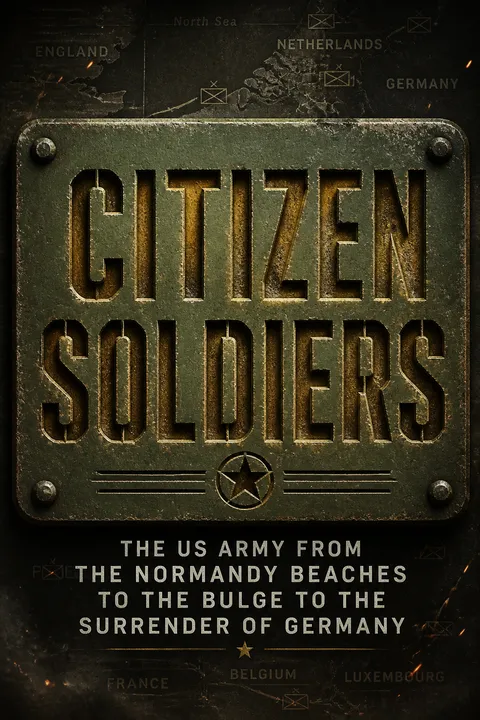
Citizen Soldiers is a narrative military history organized around a question of capacity: could a rapidly expanded American army produce leaders able to defeat a more experienced Wehrmacht? Ambrose answers through the ground-level experience of soldiers, following the army from Normandy’s hedgerows through the Ardennes and into Germany. The movement between individual episodes and operational history gives the campaign its scale without making it feel like a sequence of maps and dates.
The book’s central argument is that victory emerged from a combination of local initiative, industrial strength, logistical reach, and adaptation. None worked alone. Wray’s battlefield judgment mattered because soldiers could act on it. Sherman production mattered because mechanics repaired damaged tanks. Air superiority mattered because observers and radio links connected aircraft to ground forces. The repeated contrast between equipment abundance and fuel shortages makes logistics a strategic force, not background administration. Likewise, the costly failures at Driant and the Hurtgen show that endurance cannot redeem a mistaken objective.
Ambrose’s strongest method is testimony. Soldiers on both sides describe fear, improvisation, exhaustion, and moments of compassion, giving human dimension to enormous casualty totals. This approach also complicates simple stories of technological superiority or heroic command: American forces learned, suffered, and sometimes made serious mistakes. The emotional weight comes from ordinary people being asked to meet extraordinary demands.
The book’s frame has limits. Its focus on the American army gives less space to the contributions of other Allied forces and to the wider war’s civilian and political dimensions. Its epilogue makes a large claim about veterans shaping modern America, but that broad social transformation cannot be attributed to combat experience alone. Still, the book’s lasting insight is precise: a citizen army becomes effective not through numbers alone, but when people, institutions, and supplies can learn and work together under pressure.
Review Summary
People Also Read


Glossary
Jabos
Allied fighter-bombersA soldiers’ term for Allied fighter-bombers, derived from the German word Jager, meaning hunter, and bomber. In the campaign described here, aircraft such as the P-47 Thunderbolt attacked German vehicles, troops, and supply routes. Their daytime threat restricted German movement, but poor weather could ground them and give German forces room to maneuver.
Red Ball Express
Emergency truck supply routeAn improvised American truck transport system created in late August 1944 to move fuel, food, ammunition, and other supplies from Normandy toward rapidly advancing armies. Thousands of trucks and drivers worked long hours to keep the front supplied. The effort was enormous, but the advance eventually moved farther and faster than the transport network could support.
rhino tanks
Hedgerow-cutting ShermansSherman tanks fitted with metal blades made from salvaged steel, including scrap from German roadblocks. The blades let tanks cut through Normandy’s thick hedgerows rather than expose their vulnerable undersides while climbing over them. The improvised modification helped tanks support infantry attacks in terrain for which the standard Sherman had not been designed.
Operation Cobra
Normandy breakout offensiveThe American operation launched on July 25, 1944, to break through German defenses near St. Lo and escape the slow, costly fighting in Normandy’s hedgerows. It combined air bombardment, artillery, tanks, and infantry. The initial assault did not produce an immediate breakthrough, but the German line weakened over the following days, opening the way for a more mobile campaign.
LSTs
Ships unloading heavy equipmentLanding ship tanks were specialized vessels designed to bring heavy cargo, including tanks, trucks, guns, and supplies, close to shore and unload it directly. During the Normandy campaign, they proved essential to sustaining Allied forces while major ports were unavailable. Their capacity helped make large-scale supply over open beaches possible.
Market-Garden
Airborne Rhine crossing planThe September 1944 Allied operation that combined airborne troops seizing bridges in Holland with a ground advance intended to reach Arnhem and cross the Lower Rhine. The plan depended on closely timed movements and a single narrow route. Allied forces captured several objectives, but the ground advance did not reach the isolated British airborne troops at Arnhem in time.
About the Author
Other books by Stephen E. Ambrose



Download PDF
Download EPUB
.epub digital book format is ideal for reading ebooks on phones, tablets, and e-readers.








