
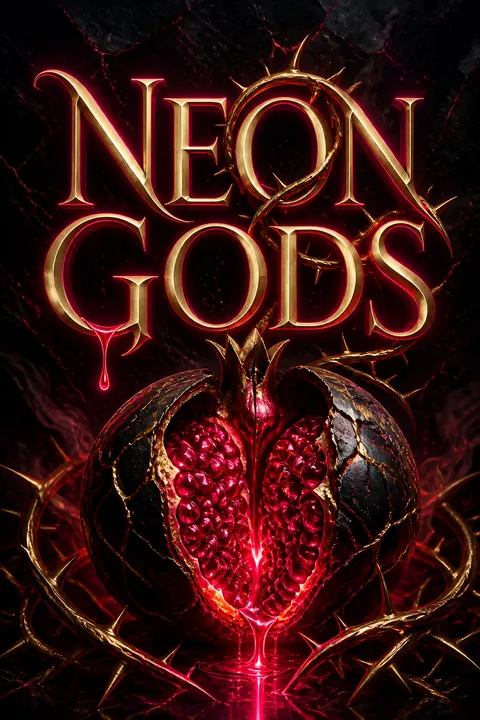


Plot Summary
The Hera Announcement
Persephone1 has spent years playing the cheerful, obedient daughter while planning to leave Olympus when her trust fund becomes available. At a glittering reception, her mother,3 Demeter,3 steers her toward Zeus,4 who publicly announces that Persephone1 will become his next wife. She knows the stories about his previous wives and recognizes that her mother3 has traded her freedom for influence.
Psyche5 helps her escape the party, but Persephone1 refuses to return home. Zeus's men4 pursue her through the winter streets, driving her toward the River Styx. With no phone, no coat, and no safe route back, she runs barefoot across Cypress Bridge, where the crossing tears at her body. On the far bank, she begs a waiting stranger2 to help.
The engagement turns Persephone's long-term escape plan into an immediate survival problem. Her bright public manner has functioned as camouflage, but Demeter's decision exposes the limits of a strategy built on being agreeable. The scene also makes marriage a political instrument rather than a private bond: Zeus announces ownership in public, while the watching crowd turns Persephone's coerced assent into a spectacle. Her flight is reckless, yet it is also the first choice she makes without her mother's permission. The river gives that choice physical cost, making escape less an abstract wish than a threshold she must painfully cross.
Across the Styx
Hades2 catches Persephone1 as she reaches his side of the river, then faces down the two men sent to retrieve her. The treaty dividing upper and lower Olympus prevents Zeus4 from simply crossing after her, so Hades2 takes her to his guarded home. Persephone1 discovers that the supposedly extinct Hades2 title belongs to a living man, and that Hermes8 and Dionysus9 know him well.
While Hades2 cleans glass from her bleeding feet and warms her, she tells her sisters5 she will not return. Their call confirms that Zeus4 is pretending to search for her, although his men already followed her to the bridge. Persephone1 realizes she has entered the lower city and placed herself beyond Zeus's4 immediate reach, but she has no money or plan for what comes next.
The river is both a border and a test of who can act outside Olympus's official story. Persephone crosses because the threat behind her outweighs the danger in front of her; Hades's rescue becomes possible only because she reaches his territory herself. His guarded response complicates the myth surrounding him: he uses force to protect her, but also immediately considers how her presence might serve his conflict with Zeus. Her sisters remain her emotional anchor, yet her insistence on staying away begins a painful separation from the family that has helped her survive. Safety arrives, but it is conditional and politically charged.
A Dangerous Bargain
With her birthday and access to her trust fund three months away, Persephone1 asks Hades2 to shelter her until she can leave Olympus. She proposes that their apparent relationship make Zeus4 reject her, then insists the arrangement should be real rather than a performance.
Hades2 resists, wary that her desperation compromises consent, but agrees to protect her and make their connection public on their own terms. He explains boundaries and a safe word before their first intimate encounter in his private playroom.
Persephone1 finds room there to explore desires hidden beneath her polished persona, while Hades2 keeps checking that she can stop the scene at any point. Their bargain gives her a place to stay and gives him a way to challenge Zeus,4 but it also begins to exceed both of their plans.
Their agreement is a negotiation over agency inside a situation neither character chose. Persephone refuses to mistake having few options for having no will; she names what she wants and insists that Hades treat her as a participant, not a rescued possession. Hades's hesitation is not simply reluctance to desire her. He recognizes the ethical danger of turning refuge into leverage. The safe word and repeated checks create a language for choice within a power exchange, sharply contrasting with the public engagement, where Persephone could not freely refuse. Their intimacy begins as strategy, but its careful negotiation makes emotional honesty possible.
A Public Claim
At Hades's2 next private party, upper-city guests gather to witness the woman Zeus4 intended to marry. Hades2 keeps Persephone1 beside him rather than putting her on the central stage, then touches her while another couple performs bondage before the room.
When Persephone1 asks for more, she rides Hades2 in full view of the guests, making her choice unmistakable. Eros,14 Aphrodite's son,14 warns that Zeus4 is furious, but Persephone1 refuses to soften her defiance.
Hermes8 and Dionysus9 explain that they carry information between the cities and that many members of the Thirteen will protect Zeus4 if conflict threatens their standing. Persephone1 sees that Hades's feared reputation is also a political tool, and that their public spectacle could provoke retaliation.
The scene reverses the engagement's public logic. In Zeus's ballroom, an audience watched Persephone be assigned a role; here, the same kind of attention amplifies a choice she has negotiated herself. That distinction does not make the spectacle simple liberation. Hades still directs the scene, and their performance is designed to wound Zeus, so agency and strategy remain entwined. Persephone's sharp response to Eros shows how quickly she can abandon the compliant image when it no longer serves her. The party also exposes Olympus's hypocrisy: its powerful guests secretly seek pleasures and freedoms that their public culture would condemn.
The Lower City Opens
Hades2 takes Persephone1 through the lower city, where people greet him with trust rather than the fear he expects. At Juliette's13 clothing warehouse, Persephone1 learns that Zeus4 drove the designer out of the upper city, yet her work still quietly reaches its elite clients.
Hades2 then shows Persephone1 a greenhouse where he once found refuge as a teenager, and a winter market alive with local businesses and shared resources. She sees how carefully he maintains the old carved columns and how his people look to him when supplies grow scarce.
When Persephone1 nearly faints after admitting she has barely eaten for days, Hades2 orders food and insists she rest. His care unsettles her because it is practical, attentive, and unlike the political attention she knows.
The lower city gives Persephone evidence that power can be exercised as stewardship rather than display. Hades's authority is visible in ordinary acts: preserving local history, supporting a displaced designer, and keeping people supplied. The contrast with the upper city is not simply wealth against poverty. It is a difference in what leaders notice and what they consider worth protecting. Persephone's collapse makes that contrast bodily. Her habit of neglecting herself has helped her keep moving, but Hades recognizes the cost before she does. Being cared for forces her to confront how thoroughly survival has replaced self-attention.
A Home Takes Shape
As weeks pass, Persephone1 explores Hades's2 house and the lower city, while their nights become more intimate and their public appearances keep Zeus's4 anger simmering. She asks to see Hades's2 scars in the light; he lets her touch the marks left by the fire that killed his parents, and she refuses to treat them as something shameful.
On a visit to a pet shop, they find three abandoned puppies. Hades2 adopts all of them, and Persephone1 names them Cerberus, Charybdis, and Scylla. Their home begins to feel like a place she might choose, not merely shelter she needs. Yet her plan still ends on her birthday, and both lovers understand that the approaching deadline threatens what they are building.
Domestic details make the romance's emotional stakes legible before either character fully names them. The puppies are not a cure for Hades's guardedness; adopting them is an action that contradicts his belief that caring is dangerous. Persephone's response to his scars offers a different kind of witness than the upper city's appetite for gossip: she sees the history on his body without reducing him to damage. At the same time, the birthday deadline preserves a real conflict. Their growing home life cannot erase Persephone's original desire for freedom, so affection raises the cost of choice rather than resolving it.
The Bridge Turns Violent
Zeus's4 pressure reaches Persephone's1 family when Eurydice7 calls from the upper city, pursued by a man who has cornered her near the river. Hades2 and Persephone1 race to Juniper Bridge, but Eurydice7 is already injured on the far bank. When her attacker grabs her, Hades2 crosses into Zeus's4 territory, shoots the man's wrist, and beats him until Persephone1 calls him back to himself.
Hades2 carries Eurydice7 home, knowingly violating the treaty that forbids him from crossing the river. The next morning, Zeus4 sends Hermes8 with a thirteen-hour ultimatum: return both sisters or face annihilation. Persephone1 realizes her flight has put Hades2 and the lower city in direct danger, while Eurydice7 must reckon with Orpheus's12 failure to answer her calls.
The rescue makes the treaty's neat political boundary collapse under the pressure of a body in danger. Hades's crossing is an act of protection, but the violence that follows reveals the cost of his own history and the risk of confusing justice with retaliation. Persephone's call stops him, giving her influence that is not based on status or seduction but on his trust in her. Eurydice's attack also widens the conflict beyond the central couple: Zeus can target family members to force obedience. The ultimatum converts private danger into a clock, leaving Persephone to decide whose safety she can preserve.
Persephone Returns Alone
After hearing Zeus4 threaten to destroy the lower city, Persephone1 asks Hermes8 to carry a message to Demeter.3 She leaves Eurydice7 in Hades's2 care and returns to Dodona Tower, where she lets Zeus4 believe she is again under his control. Her real negotiation is with her mother.3
Demeter3 admits she had planned to poison Zeus4 after Persephone1 married him, but agrees to a different bargain: Persephone1 will remain in Olympus and bring Hades2 to six upper-city events each year, with the appearance of an alliance between them.
In return, Demeter3 will help prevent the impending assault. Persephone1 accepts the loss of her planned escape because she will not let Hades's2 people pay for her freedom. She leaves him a note explaining that she loves him and is acting to protect him.
Persephone's return can look like surrender, but the scene's power lies in her choice to negotiate rather than be delivered. She uses the image of obedience to get close enough to Demeter to redirect the political outcome. The revelation that Demeter had her own plan complicates the simple opposition between loving mother and ambitious ruler: Demeter wanted to protect Persephone, but only after deciding her daughter's marriage was an acceptable risk. Persephone's bargain is costly because it gives up the clean break she had imagined. Her note, however, makes clear that she is not returning to Zeus; she is acting from love and responsibility.
Zeus Falls from Power
Believing Persephone1 has placed herself in Zeus's4 hands to save him, Hades2 heads to Dodona Tower, where Demeter's3 message reveals that several members of the Thirteen support him. He enters Zeus's4 office armed, intending to force an end to the threat. Zeus4 mocks his hesitation and attacks when Hades2 lowers the gun.
During their struggle, Zeus4 is pushed toward a broken window; Hades2 reaches to catch him, but Zeus4 slips from his grasp and falls to his death. Demeter3 appears afterward and helps conceal the circumstances, while warning Hades2 to honor the bargain he made through Persephone.1 Hades2 returns to the lower city believing Persephone1 is gone and that his actions have cost him the woman he loves.1
The climax refuses the clean satisfaction of revenge. Hades enters prepared to kill Zeus, yet cannot make himself execute him; the death comes through a struggle he does not fully control. That ambiguity matters psychologically. Hades can no longer imagine justice as a simple act of retaliation, and he must live with the possibility that others will interpret an accident as murder. Demeter's intervention prevents immediate political chaos, but it cannot settle his private guilt. The fall removes the tyrant, not the habits of power that made him dangerous, nor the emotional damage left in his wake.
Freedom Becomes a Choice
After Zeus's4 death, Persephone1 finds Hades2 at home with the puppies and apologizes for leaving without telling him. He admits he went after Zeus4 because he feared she would be trapped and harmed. Persephone1 tells him she loves him and chooses to stay, even though the original reason for her escape has changed.
She explains the six-event bargain with Demeter,3 and Hades2 accepts it as a small price for her safety and happiness. At the press conference naming Perseus16 as the new Zeus,4 Hades2 stands beside Persephone,1 facing the reporters despite his discomfort. He asks her to remain at his side in public and in private; she agrees, then accepts his invitation to move in for good.
The resolution returns to the question that began the story: whether Persephone can choose a life that belongs to her. She does not stay because her trust fund has become irrelevant or because Hades has rescued her into a new dependency. She stays after the immediate threat has changed, naming love as her reason. Hades, in turn, accepts a political compromise without treating it as ownership over her. Their public appearance marks a new arrangement with Olympus, but the emotional resolution is smaller and more intimate: two people who began by using appearances now choose to stand openly together.
Epilogue
Two weeks after Hades2 steps out of the lower city's shadows, he and Persephone1 prepare for a public scene in his playroom. This time, she takes the central dais by choice, while Hades2 checks that she is ready and reminds her that she can stop at any point.
She undresses before the watching guests, and he brings her pleasure under the lights before taking her from behind. Afterward, he carries her to his throne, where they share it, laughing and kissing as the audience's attention fades. Their public performance no longer exists to provoke Zeus4 or secure Persephone's1 escape. It belongs to the life they have chosen together.
The epilogue revisits the playroom, once a stage where Hades managed fear and Persephone helped provoke Zeus. The changed purpose of the scene is the point: Persephone now steps into the light without being pushed there by either political necessity or a partner's agenda. Hades still directs the encounter, but consent is not a brief safeguard at the beginning; it is part of their shared practice. The throne, formerly a symbol of solitary rule, becomes something they occupy together. Their erotic performance has not lost its theatricality. It has gained a private meaning that the audience can witness but cannot own.
Analysis
Neon Gods recasts the Persephone1 and Hades2 myth as a story about political consent. The central violation is not desire itself but the way powerful people claim the right to decide what another person wants. Zeus4 announces a marriage in front of witnesses; Demeter3 treats her daughter1 as leverage; even Hades2 initially sees Persephone1 as an opening against his enemy. The relationship changes when Persephone1 can negotiate, refuse, and revise the terms of intimacy. Her agency is not presented as isolation from others. She ultimately chooses connection while accepting obligations she had once hoped to escape.
The book's city structure gives that personal conflict material consequences. Olympus's elite preserve an appearance of order while relying on the lower city for pleasures, goods, and services they publicly disavow. Hades's2 authority, by contrast, is shown through routines of care: protecting supply lines, maintaining historic buildings, and knowing the people who keep his territory alive. His reputation is a defense, but it also hides his tenderness and leaves him misread even by people who depend on him.
The romance asks whether protection can exist without possession. Hades2 must learn that guarding Persephone1 does not give him the right to decide her future; Persephone1 must learn that leaving a system is not the only possible form of freedom. Their final commitment matters because it follows the removal of the immediate threat. Staying is no longer the price of survival or the consequence of a bargain. It is a choice they make after each has seen the other's fear, anger, and capacity to harm. The myth's underworld becomes not a place of punishment but a community where care can be practiced, imperfectly, in public and in private.
Review Summary
Neon Gods received mixed reviews. Many praised its steamy romance and engaging characters, particularly Hades. Some enjoyed the modern retelling of Greek mythology, while others felt the world-building lacked depth. Critics noted the book's focus on explicit scenes over plot development. Fans appreciated the consent and character dynamics. Common complaints included weak villains and insufficient mythological elements. Overall, readers found it an entertaining but flawed romance, with some considering it overhyped and others eagerly anticipating the next installment.
People Also Read









Characters
Persephone
The hidden strategistDemeter's3 middle daughter has learned to survive Olympus by appearing sunny, agreeable, and easy to manage. Beneath that polish, Persephone is observant and strategic, with a private appetite for risk and a strong desire to define herself beyond her family name. She plans for independence, but her instinct to protect her sisters5 repeatedly complicates the clean escape she imagines. With Hades2, she discovers a relationship where she can express desire and disagree without performing perfection. Her central tension is not simply freedom versus attachment; it is whether choosing connection can be an act of freedom rather than another form of captivity.
Hades
The guarded city rulerThe living holder of Olympus's supposedly extinct Hades title rules the lower city from behind a deliberately fearsome reputation. Hades is disciplined, suspicious, and deeply protective of the people who depend on him. He uses ceremony and carefully staged displays to deter threats, but his habits of control also conceal old grief and a fear of becoming like the man he opposes. Persephone1 challenges his assumption that distance is the safest form of care. He is drawn to her candor and appetite for play, yet his deepest struggle is allowing himself to be seen without turning protection into possession.
Demeter
The ambitious motherDemeter governs Olympus's food supply and has built her position through careful alliances and an image of benevolent competence. She loves her daughters, but that love coexists with a political instinct that treats their lives as pieces in a larger strategy. She is capable of planning for their safety while still making decisions for them without consent. Her relationship with Persephone1 exposes the gap between protection and control: Demeter believes she can manage danger on her daughter's1 behalf, while Persephone1 insists that safety without choice is another kind of cage.
Zeus
The untouchable kingZeus is Olympus's long-standing ruler, a charismatic public figure whose charm helps conceal his appetite for control. He expects loyalty, uses his authority to shape other people's choices, and treats resistance as a challenge to his power. Rumors surrounding his marriages and the immunity he enjoys make him dangerous even before he acts directly. His conflict with Hades2 is rooted in an older struggle over power and legacy. Zeus represents a political order where public admiration can shelter private cruelty, and where consequences depend on who has enough influence to demand them.
Psyche
The watchful sisterPsyche is one of Persephone's1 sisters and often keeps a low profile, watching more than she reveals. Her quiet manner is not passivity; she understands how quickly a public misstep can endanger an entire family. Psyche tries to help Persephone1 think through the consequences of fleeing, then supports her sister1 without insisting that she return to the life she hates. Her caution offers a counterweight to Callisto's6 open defiance and Persephone's1 tendency to act under pressure. She shows how concealment can be a survival skill, even when it leaves a person carrying fear alone.
Callisto
The fierce eldest sisterCallisto is the oldest of the Dimitriou sisters and the least willing to pretend that Olympus deserves her respect. She meets Demeter's3 control with open resistance and would rather make a scene than quietly accept an injustice. Her loyalty to her sisters1 is fierce, sometimes to the point of recklessness, and Persephone1 worries that Callisto's instinct to fight could expose the family to retaliation. Callisto's anger is not a pose. It is her way of refusing to let powerlessness pass as good manners.
Eurydice
The sheltered youngestEurydice is Persephone's1 youngest sister, imaginative, affectionate, and more trusting than the world around her warrants. Her relationship with the musician Orpheus12 reflects her hope that romance can remain separate from Olympus's political games. Persephone1 and her sisters5 try to protect Eurydice from the worst of their world, but their shelter cannot keep danger away forever. Eurydice's sensitivity is not weakness; it allows her to form deep attachments and to recognize when those attachments have failed her. She must learn to meet a harsher reality without losing the capacity to care.
Hermes
The sly messengerHermes carries messages and information between the upper and lower cities, moving through both worlds with unusual freedom. She is playful, intrusive, and difficult to pin down, often treating secrets as part of the entertainment. Her loyalty is complicated by her official role among the Thirteen, but she also has genuine affection for Hades2 and an appreciation for Persephone's1 sharpness. Hermes sees how power works because she travels between its competing centers. Her talent for mimicry lets her deliver another person's message with unsettling precision, while her independence keeps even her friends unsure of her next move.
Dionysus
The indulgent power brokerDionysus handles entertainment and the social currents that flow around Olympus's powerful families. He is known for excess, a quick wit, and a talent for appearing unserious even when he understands exactly what is at stake. His friendship with Hermes8 often brings him into Hades's2 home, where he treats the ruler with irreverent familiarity. Dionysus is a reminder that pleasure and politics are not separate in Olympus: parties can be recreation, cover, and information networks at once. Beneath his comic manner is a careful reader of danger.
Andreas
Hades's old guardianAndreas raised and advised Hades2 after the loss of his parents, then helped him learn how to rule the lower city. He is fiercely loyal, wary of Zeus4, and inclined to challenge Hades2 whenever ambition threatens to endanger the people under his protection. Their bond is close without being simple: Andreas is a guardian and mentor, but his memories of the past can make it difficult for him to see Hades2 as a man in his own right. His caution gives Hades2 a voice willing to say what no subordinate would.
Charon
The trusted right handCharon is Hades's capable security chief and the grandson of Andreas. He manages patrols, guards the bridges, and acts quickly when Hades's decisions put the lower city at risk. Though he sometimes chafes at being treated as overprotective, his judgment is steady and his loyalty is unquestioned. Charon embodies the practical infrastructure beneath Hades's fearsome public image: the cameras, staff, and careful planning that let the lower city function. He is more than a guard; he is one of the people who makes Hades's responsibilities survivable.
Orpheus
Eurydice's self-absorbed boyfriendOrpheus is a wealthy young musician who treats artistic inspiration as a license to follow his own impulses. He is drawn to Eurydice7 and sees her as a muse, but his attention to his career and appetites makes him unreliable when she needs him. Persephone1 distrusts him because she fears he will eventually turn her sister's7 affection into another source of material for himself.
Juliette
The exiled designerJuliette is a gifted clothing designer whose work once served the upper city's ruling class. After drawing Zeus's4 hostility, she finds refuge and a business in the lower city. She is perceptive, self-possessed, and unwilling to pretend she cannot read Hades's2 motives. Her work gives Persephone1 the clothes she needs, but Juliette also understands that appearance can carry political meaning.
Eros
Aphrodite's watchful sonEros is Aphrodite's14 handsome son and an operator who handles unpleasant work on her behalf. At Hades's2 gathering, he serves as a reminder that upper-city interests have eyes in the lower city. He recognizes the political danger of Persephone's1 choice but cannot easily shake her confident refusal to be managed.
Poseidon
The distant sea rulerPoseidon is one of Olympus's legacy rulers, associated with the docks and sea trade. He tends to avoid the daily political maneuvering that occupies Zeus4, which makes his position difficult to predict. His influence matters because control of trade and supplies can shift the balance between the upper and lower cities.
Perseus
The next ZeusPerseus is Zeus's heir16, positioned to inherit the title and its power. His presence represents the continuity of Olympus's legacy system, in which authority passes through families even as the people around them pay the price.
Georgie
Hades's kitchen heartGeorgie oversees Hades's2 kitchen and helps make his guarded household feel lived in. Warm, practical, and fond of feeding people, she welcomes Persephone1 into domestic routines that reveal a softer side of the lower city.
Plot Devices
The River Styx Treaty
A border with consequencesThe River Styx separates upper and lower Olympus, while a treaty restricts who may cross and what leaders can do across the boundary. Most people avoid the bridges because crossing is physically painful and politically dangerous. Persephone1 crosses while fleeing Zeus4, placing herself under Hades's2 protection. The treaty prevents Zeus4 from simply retrieving her, but it also limits Hades2. When Hades2 crosses to rescue Eurydice7, he gives Zeus4 a reason to threaten war. The river therefore makes geography an active political force: every crossing is a choice that can change who is safe and who is exposed.
The Thirteen
Power divided by legacyOlympus is governed by thirteen titles, some inherited and others secured through political or public power. Zeus4 dominates the group, while Demeter3 controls food supply, Hermes8 carries information, and Hades2 governs the lower city. The structure appears collective, but its balance is unstable because not every title carries equal authority. The Thirteen's rules can restrain Zeus4 when breaking them threatens his standing, yet members may close ranks to protect their own interests. This system turns personal decisions into citywide risks and explains why Persephone's1 marriage, Hades's2 hidden status, and the threat of supply cuts matter far beyond one family.
Public Reputation
A weapon made of appearancesIn Olympus, public image shapes access to power, marriage, and safety. Demeter3 cultivates a benevolent reputation, Zeus4 relies on charisma, and Hades2 amplifies the frightening stories attached to his title. Persephone1 has learned to appear bright and compliant, while Hades's2 parties turn sex into a public spectacle that can unsettle the upper city's expectations. Their displays are not merely theatrical. They send information through the gossip network and challenge Zeus's4 claim over Persephone1. The device works in both directions: it lets characters manipulate what others believe, but it also traps them when the performance becomes more visible than their private intentions.
Persephone's Trust Fund
A birthday escape horizonPersephone1 expects to gain access to her grandmother's trust fund on her twenty-fifth birthday. That date gives her a concrete route out of Olympus and explains why three months of shelter from Hades2 initially seem sufficient. The money represents independence from Demeter3 and from the political system that has shaped Persephone's1 life. Yet the deadline also pressures her to think of the relationship as temporary, even as she grows attached to Hades2 and his community. The fund is not a magic solution: leaving Olympus still requires help, and later Persephone1 must decide whether the freedom she imagined is worth the cost others may bear.
Negotiated Intimacy
Consent inside a power exchangeHades2 and Persephone1 use explicit boundaries, a safe word, and repeated check-ins to make their sexual arrangement something they choose rather than something imposed by circumstance. Their playroom lets Hades2 express the dominant role associated with his public reputation, while Persephone1 tests desires she has hidden beneath her social persona. The contrast with her coerced engagement is central: in the ballroom, she cannot safely refuse Zeus4; with Hades2, she can ask for more, challenge his decisions, and stop the scene. As their attachment deepens, the negotiated structure becomes a way to practice trust, not simply a means of producing erotic spectacle.
FAQ
Synopsis & Basic Details
What is Neon Gods about?
- Modern Myth Retelling: Neon Gods is a contemporary romance that reimagines the Greek myth of Hades and Persephone in a modern, urban setting.
- Escaping a Forced Marriage: The story centers on Persephone Dimitriou, who is forced into an engagement with the powerful and dangerous Zeus, and her desperate attempt to escape this fate.
- A Deal with the Devil: Persephone seeks refuge in the lower city and makes a bargain with the enigmatic Hades, a man shrouded in myth and rumored to be a monster, to tarnish her reputation and make her undesirable to Zeus.
Why should I read Neon Gods?
- Intriguing Characters: The book features complex characters with hidden depths, particularly Persephone and Hades, whose relationship evolves from a strategic alliance to a passionate connection.
- Dark and Sensual Romance: Neon Gods offers a blend of dark themes, power dynamics, and intense sexual tension, making it a compelling read for fans of adult romance.
- Unique World-Building: The reimagining of Olympus as a modern city with a clear divide between the upper and lower classes provides a fresh and engaging backdrop for the story.
What is the background of Neon Gods?
- Modern Olympus Setting: The story is set in a contemporary city called Olympus, which is divided into an upper and lower city separated by the River Styx, creating a stark contrast in wealth and power.
- Greek Mythology Inspiration: The novel draws heavily from Greek mythology, with characters named after gods and goddesses, and their roles and relationships mirroring the original myths.
- Political Intrigue: The city is ruled by the Thirteen, a group of powerful individuals, and the story explores the political machinations and power struggles within this elite circle.
What are the most memorable quotes in Neon Gods?
- "You're in my territory now. You're welcome to try to steal her back, but the consequences for breaking the treaty will be on your head.": This quote highlights Hades's possessiveness and his willingness to challenge Zeus, establishing the power dynamic between them.
- "I'm going to lay more than one finger on her. It's funny, don't you think? That she'd rather welcome every depraved thing I want to do to that tight little body than let you touch her.": This quote showcases Hades's dark humor and his desire to provoke Zeus, while also revealing his growing possessiveness over Persephone.
- "If I agree to this, you're mine for the next three months. You'll belong to me. You'll obey.": This quote establishes the terms of the bargain between Hades and Persephone, highlighting the power dynamics and the sensual nature of their agreement.
What writing style, narrative choices, and literary techniques does Katee Robert use?
- Dual POV: The story is primarily told from the alternating perspectives of Persephone and Hades, allowing readers to understand their individual motivations and desires.
- Sensual and Provocative Language: Robert employs vivid and explicit language to describe the sexual tension and encounters between the characters, creating a highly charged atmosphere.
- Foreshadowing and Symbolism: The author uses subtle foreshadowing and recurring symbols, such as the River Styx and the black veil over Hades's statue, to enhance the story's themes and create a sense of mystery.
Hidden Details & Subtle Connections
What are some minor details that add significant meaning?
- The Black Veil: The black cloth covering Hades's statue in the upper city symbolizes his absence and the mystery surrounding him, which contrasts with the open displays of the other Thirteen.
- The River Styx: The river's physical barrier and the pain of crossing it represent the deep divide between the upper and lower cities, and the difficulty of escaping one's predetermined path.
- Hades's Scars: The scars on Hades's body, particularly his hands, hint at a violent past and the personal cost of his position, adding depth to his character beyond his intimidating persona.
What are some subtle foreshadowing and callbacks?
- Persephone's Fascination with Hades's Statue: Her repeated visits to the statue foreshadow her eventual meeting with the real Hades and her attraction to the forbidden.
- Zeus's Dead Wives: The rumors surrounding Zeus's previous wives foreshadow the danger Persephone faces in marrying him, and her fear of becoming another victim.
- Hermes and Dionysus's Knowledge of Hades: Their casual familiarity with Hades hints at his hidden influence and the existence of a world beyond the upper city's control.
What are some unexpected character connections?
- Hermes's Role as a Messenger: Her position as a messenger for the Thirteen allows her to be a neutral observer and a source of information, connecting her to both the upper and lower cities.
- Dionysus's Connection to the Lower City: His role in distribution and his friendship with Hades reveal a hidden network of power and influence that operates outside the control of the upper city.
- Andreas's Loyalty to Hades: The old man's unwavering loyalty and protectiveness towards Hades, despite his retirement, highlights the deep bonds and history within the lower city.
Who are the most significant supporting characters?
- Minthe: As Hades's right-hand woman, she is fiercely loyal and protective, often acting as his enforcer and confidante, and her interactions with Persephone reveal a complex dynamic.
- Charon: As Hades's security chief and Andreas's grandson, he is a capable and dedicated member of Hades's inner circle, providing both physical protection and strategic advice.
- Juliette: A former designer for Hera, she provides Persephone with clothing and a sense of understanding, highlighting the hidden talents and stories within the lower city.
Psychological, Emotional, & Relational Analysis
What are some unspoken motivations of the characters?
- Persephone's Need for Control: Beneath her desire for freedom, Persephone seeks control over her own life and choices, which is why she is drawn to the power dynamics of her relationship with Hades.
- Hades's Fear of Vulnerability: Despite his power and control, Hades is driven by a fear of vulnerability, which is why he initially resists his feelings for Persephone and tries to maintain a distance.
- Demeter's Ambition: Demeter's actions are driven by her ambition and desire for power, which often overshadow her love for her daughters, leading her to make calculated decisions that prioritize her own goals.
What psychological complexities do the characters exhibit?
- Persephone's Internal Conflict: She struggles with the desire for freedom and her responsibility to her family, often torn between her personal desires and the expectations placed upon her.
- Hades's Internal Struggle: He battles with his desire for revenge and his growing feelings for Persephone, often torn between his need for control and his vulnerability.
- Zeus's Narcissism: He displays a deep-seated narcissism and a need for control, which drives his actions and his inability to accept rejection or challenge.
What are the major emotional turning points?
- Persephone's Crossing of the River Styx: This act is a turning point, marking her transition from a life of control to one of autonomy and desire, and setting her on a path of self-discovery.
- Hades's Confession of His Past: When he reveals the truth about his parents' death, it marks a shift in his relationship with Persephone, allowing her to see his vulnerability and understand his motivations.
- Persephone's Decision to Return to the Upper City: Her choice to return to the upper city to protect Hades and his people is a major emotional turning point, highlighting her love and selflessness.
How do relationship dynamics evolve?
- From Bargain to Connection: The relationship between Persephone and Hades evolves from a strategic bargain to a deep and passionate connection, blurring the lines between pretense and reality.
- Challenging Power Dynamics: Their relationship challenges traditional power dynamics, as they both navigate their desires and vulnerabilities, creating a more equal partnership.
- Mutual Trust and Respect: Despite their initial mistrust, Persephone and Hades develop a deep level of trust and respect for each other, which allows them to navigate the complexities of their relationship and the challenges they face.
Interpretation & Debate
Which parts of the story remain ambiguous or open-ended?
- The Future of Olympus: The ending leaves the future of Olympus uncertain, with the power vacuum created by Zeus's death and the shifting alliances among the Thirteen.
- The Extent of Demeter's Influence: The true extent of Demeter's power and her long-term goals remain ambiguous, leaving readers to question her motivations and the consequences of her actions.
- The Long-Term Impact of the Bargain: The long-term impact of Persephone and Hades's bargain on their relationship and their individual paths remains open-ended, leaving readers to wonder about their future together.
What are some debatable, controversial scenes or moments in Neon Gods?
- The Power Dynamics: The power dynamics between Persephone and Hades, particularly in the early stages of their relationship, can be interpreted as both consensual and coercive, sparking debate about the nature of their agreement.
- The Public Displays: The public displays of their relationship can be seen as both empowering and exploitative, raising questions about the nature of consent and the impact of public perception.
- Persephone's Choices: Her decision to return to the upper city and make a deal with her mother can be seen as both a selfless act of love and a betrayal of her own desire for freedom, sparking debate about the nature of sacrifice.
Neon Gods Ending Explained: How It Ends & What It Means
- Zeus's Death and its Impact: The death of Zeus creates a power vacuum in Olympus, leading to a shift in the political landscape and the rise of Perseus as the new Zeus.
- Persephone and Hades's Future: The ending suggests a future where Persephone and Hades are together, but it also acknowledges the challenges they will face in navigating their relationship and the complexities of their world.
- A New Beginning: The ending is not a traditional happily ever after, but rather a new beginning, with the characters having to forge their own path and create their own rules in a world that is constantly changing.
Dark Olympus Series Series








About the Author



Download PDF
Download EPUB
.epub digital book format is ideal for reading ebooks on phones, tablets, and e-readers.








