

Key Takeaways
Rome's farms flourished just as its western empire began to break
A confident final address. In 399, a Roman poet praised a new golden age under an emperor who was a teenager and a general who faced fierce rivals. Within a decade, Rome was sacked by Gothic forces. Older histories treated this as the final scene of a long decline, but archaeology tells a different story. Surveys of pottery fragments found that rural settlement, and therefore agricultural output, reached its peak across much of the Empire in the fourth century, shortly before the West's political collapse.
The evidence overturned Gibbon. Deserted fields, fewer inscriptions, and debased coins had been read as signs of economic ruin. The authors argue that these clues were misinterpreted: some fields were never farmed, inscriptions fell as local political competition shifted to imperial offices, and inflation did not erase landowners' real wealth.
The contrast separates economic performance from political durability. Archaeology is especially valuable here because it tests sweeping decline narratives against evidence from ordinary settlements, not just elite texts. Yet prosperity is not a complete measure of social health: output can rise while wealth concentrates, and a productive countryside can coexist with brittle institutions. The more useful lesson is not that Rome was secretly flourishing in every respect, but that economic vitality alone cannot guarantee that a state can manage shocks, distribute power, or retain political loyalty.
Follow wealth outward: imperial provinces can eclipse the original core
Power follows profitable exchange. Rome's Italian heartland initially prospered by exporting wine and oil to newly conquered territories. Over time, provinces developed their own agriculture, and costly transport made local products cheaper than Italian imports. Prosperity shifted outward. The modern West followed a different but related path: commercial leadership moved from Italian city-states to northern Europe, then Britain, and finally the United States as new export industries, labor pools, and markets emerged.
People made the shift real. The Gallic Ausonius rose from a provincial family to high imperial office; Jamsetji Tata learned from the British cotton trade, then built manufacturing in India. Their stories show how imperial networks can create opportunities beyond their original centers. The authors call this an imperial life cycle: integration enriches the core and its periphery, while helping new centers of wealth emerge.
This is a powerful corrective to histories that treat the imperial center as the only engine of change. Trade routes and investment can build capabilities in places initially regarded as suppliers or margins. The comparison also highlights different forms of mobility: Roman prosperity rested largely on agriculture, while modern production could move through factories, shipping, and finance. The mechanism is persuasive, though not automatic. Geography, technology, institutions, and coercion all shape which regions capture the gains, and some peripheral regions remained poor despite their connection to imperial markets.
Treat empire as a changing network, not a fixed map
Integration outlasts the capital. By the late Roman period, Rome was no longer the practical command center. Courts and armies operated nearer the Rhine, Danube, and Persian frontier, while common law, taxation, and elite culture held distant provinces together. Provincial landowners sought roles in the imperial bureaucracy, so its expansion reflected local ambition as much as central control. The result was an inside-out empire, whose working centers had shifted toward its edges.
The modern parallel is looser. The Western powers did not form one state, but after World War II they built shared institutions, including NATO, the World Bank, and the IMF, around common economic and political interests. The authors argue that this dense integration made the West function like an imperial system, despite its lack of a single emperor or capital.
The network perspective helps explain why a state can change profoundly without vanishing at the first loss of central control. Shared rules, financial links, and elite interests can preserve cooperation across distance. It also clarifies a limitation in the analogy: Rome imposed common rule through conquest, whereas the modern West is a contested association of sovereign states with unequal influence. Calling both systems empires draws attention to hierarchy and integration, but can obscure differences in consent, law, and the ability of members to leave.
Watch new wealth become organized political power at the frontier
Demand changed Rome's neighbors. Roman armies bought food, animals, and materials from communities beyond the Rhine and Danube. A surviving wooden record documents a Roman merchant buying a cow from Stelos, a frontier seller. Centuries of such demand helped support denser settlements, larger populations, and trade in Roman goods. But the new wealth was unevenly distributed. Military leaders who controlled trade, subsidies, and raiding could hire more warriors and acquire better weapons.
Small alliances grew durable. In the fourth century, leaders such as the Alamannic overking Chnodomarius commanded large confederations that could regroup after defeat. Rome responded with a mix of military force, payments, trade privileges, and political bargaining. Contact did not make the frontier peoples simply Roman; it helped create stronger actors able to negotiate with, and sometimes challenge, Rome.
The frontier is not a passive border in this account. It is an economic zone where demand, technology, and competition reshape who can organize force. This resembles a broader political-economy pattern: new resources often strengthen groups able to control their distribution, rather than benefiting everyone equally. The Roman example also cautions against treating trade as inherently pacifying. Exchange can bind rivals together, but it can also finance military capacity. The outcome depends on who captures the surplus and what institutions mediate the contest.
Explain Rome's fall as interacting pressures, not a single invasion
Several strains converged. Northern Europe grew more populous and productive, gradually shifting the continent's balance of power away from the Mediterranean. In the east, a resurgent Persian Empire forced Rome to maintain large armies and divide imperial command. Then Hunnic expansion displaced groups including the Goths, creating a migration crisis Rome struggled to control. As fighting damaged provinces and outsiders took territory, Western tax revenues and military capacity shrank.
Loyalty followed protection. Some Roman landowners began cooperating with Gothic or other successor rulers when the imperial center could no longer defend their property. In the East, Rome survived for longer, but war with Persia left both empires exhausted before Arab armies conquered much of the Eastern Empire's richest territory. The unravelling took centuries and had different outcomes in each half, rather than one sudden collapse.
The account is strongest when it treats collapse as a cascade: pressures interact, reduce institutional capacity, and make subsequent shocks harder to absorb. That is more useful than a single-cause story about decadence or migration. It also preserves contingency. The Huns mattered, but their impact depended on earlier military commitments, revenue structures, and political divisions. The Roman case cannot establish that every complex power must fall in the same way; it shows how a system can become vulnerable when its resources are committed, its borders destabilized, and its governing coalitions lose confidence.
Do not equate today's labor migration with Rome's armed land seizures
The situations differ fundamentally. Late Roman migrants often arrived as organized armed groups competing for land, the main source of wealth in an agrarian economy. Modern Western states have generally admitted migrants to meet labor needs, while contemporary economies can expand rather than merely divide a fixed stock of farmland. The authors argue that aging populations and low birth rates make workers from poorer regions increasingly important to Western economies.
Benefits are uneven, not imaginary. The book cites an IMF estimate that a 1 percent increase in an advanced economy's immigrant population can raise long-term GDP by about 2 percent. Migrants also fill essential jobs: more than a third of doctors working in Britain's NHS trained abroad. The gains do not reach everyone equally, however. Additional labor can restrain wages in some jobs, making training, language support, and fair labor rules consequential.
The distinction blocks an emotionally potent but historically misleading comparison. Similar words such as invasion and influx can conceal radically different legal status, economic structure, and use of force. The authors also avoid claiming that immigration benefits every worker equally, an important qualification in debates where national GDP is often mistaken for household welfare. The policy question is therefore twofold: whether labor is needed, and how institutions share the gains and manage local pressures. History can correct the analogy, but it cannot settle every distributional dispute.
Globalization moved production outward while concentrating Western gains
Factories followed cheaper labor. From the 1980s, container shipping, communications technology, and looser trade rules made it easier for companies to move labor-intensive production to developing economies. Large rural-to-city migrations had already created enormous pools of workers, often with basic education. The result was faster growth in parts of the former periphery and cheaper goods for Western consumers, while many Western firms regained profitability.
The rewards divided at home. In the United States, the authors report that real incomes for the bottom half of households largely stagnated over four decades, while the top 10 percent saw incomes rise by about a third. Asset owners and highly educated professionals benefited from investment and expanding global firms; many workers faced lower-paid service jobs. At the 1999 Seattle trade summit, developing countries also challenged Western control of trade negotiations, showing that economic change was becoming political power.
This account links globalization's international and domestic consequences instead of treating them as separate debates. A supply chain can raise total efficiency while shifting bargaining power from workers to owners, or from established economies to new producers. That distinction matters because aggregate growth does not explain who feels secure enough to support the system. The book's broad contrast between winners and losers is illuminating, although local outcomes vary by industry, policy, and region. Trade alone does not dictate inequality; labor protections, taxation, and education help determine how its gains are distributed.
China's rise calls for coalition-building, not nostalgic confrontation
A real peer competitor emerged. Unlike the Soviet Union, whose military ambitions exceeded its economic base, China combined rapid growth with substantial industrial capacity and resources for investment. The authors describe its rise as the return of a major power previously outside the postwar Western system. As developing economies also gained influence, Western dominance faced pressure from both a peer competitor and a more assertive periphery.
Hardball can hurt the player too. The book points to the US-China trade dispute: tariffs intended to pressure China raised costs for Americans, reduced exports, and were associated with an estimated 300,000 lost US jobs. The authors recommend choosing disputes carefully, cooperating where possible, and building broader alliances with countries such as India, Brazil, and South Africa instead of assuming any one Western nation can dictate terms.
The argument distinguishes a rival's rise from an attack that must be reversed. That distinction is valuable in strategic thinking: preserving influence can require adapting institutions and alliances, not merely displaying force. Yet cooperation should not be confused with passivity. A durable coalition may need credible defenses and clear limits when a partner violates agreed rules. The deeper question is whether Western governments can offer rising states meaningful participation, rather than asking them to endorse an order whose benefits and decision-making remain concentrated elsewhere.
Debt postpones the reckoning when citizens stop trusting the tax bargain
A fiscal contract supports consent. The term means the implicit exchange in which citizens accept taxes because the state provides services, security, and legal protection. Modern Western states promise far more than Rome did, from healthcare to pensions. Slower productivity growth, rising age-related spending, and offshore wealth constrain the revenues available to meet those promises. By 2019, the book puts combined US public and private debt above 300 percent of GDP.
Borrowing can conceal a mismatch. Debt used for productive investment may expand future income; borrowing simply to preserve current consumption may not. If taxes rise while services deteriorate, citizens may decide that compliance no longer pays. Rome's landowning elites shifted allegiance when the center stopped protecting their interests. Modern states are not on the same path by definition, but a broken sense of reciprocity can weaken tax collection and political legitimacy.
The fiscal-contract idea connects public finance to political sociology: taxation is not merely extraction, but depends on beliefs about fairness, competence, and mutual obligation. Debt can smooth shocks and fund valuable investment, so its size alone is not a measure of imminent collapse. The key diagnostic is what borrowing buys, who benefits, and who is expected to repay it. This framing usefully redirects debate from an abstract debt number toward the credibility of the state and the distribution of its burdens.
Preserve Western institutions by sharing power at home and abroad
Restoration is not a realistic goal. The book's conclusion is that the West cannot recover its old share of global dominance by closing borders or forcing the periphery back into subordinate roles. At home, it calls for a renewed fiscal bargain, with greater contributions from those who benefited most from globalization and stronger public services. Suggested tools include taxes on wealth, affordable housing, and international action against tax avoidance.
A wider order needs genuine partners. The authors urge Western states to give rising powers more voice in global institutions and to cooperate with China where interests overlap. They point to a 2021 agreement by 130 countries on a 15 percent minimum corporate tax, estimated to raise governments' revenues by $150 billion a year, as one example of coordination. The aim is not to preserve every Western advantage, but to carry forward accountable institutions and the rule of law.
The conclusion turns the historical analogy into a political choice: an old hierarchy can be defended at escalating cost, or its institutions can be made more inclusive. The latter is not sentimental charity. It can create legitimacy among citizens whose cooperation is essential to public finance and among states whose participation is essential to international coordination. The hard part is domestic politics: beneficiaries of existing arrangements can block redistribution, while voters may distrust institutions that have failed to deliver. Inclusion requires visible, credible changes, not just reassuring language.
Analysis
The book's central contribution is a causal model of imperial change, not a prediction that the modern West will repeat Rome's fate. Integration creates wealth beyond the core; new wealth strengthens actors who can convert it into political influence; a rival power or external shock then tests institutions already stretched by earlier commitments. In Rome, agrarian wealth, slow transport, and landholding elites shaped that process. In the modern West, mobile capital, industrial supply chains, mass politics, and public debt produce different mechanisms, even when some pressures rhyme.
The comparison is most persuasive when it identifies mechanisms rather than equating events. The pottery evidence challenges the assumption that political collapse must follow a long economic decline. The migration chapters likewise show why surface resemblance is weak evidence: a displaced armed confederation seeking land is not equivalent to a state-managed labor migration. These distinctions help the reader reason beyond familiar decline stories.
The most debatable move is describing the Western alliance as an empire. The term usefully foregrounds hierarchy, resource flows, and uneven rule-setting, but may blur the difference between Roman conquest and modern arrangements among formally sovereign states. The authors acknowledge that difference, yet the analogy can still tempt readers to treat diverse economies and institutions as one system with one center. Similarly, relative decline in global output is not proof of absolute impoverishment or political collapse. It is a change in weight, not necessarily a catastrophe.
The book's practical insight is therefore less about predicting an endpoint than identifying a choice under constraint. A state can respond to diminished dominance by trying to restore the old distribution of power, or by redesigning domestic obligations and international institutions to retain cooperation. Rome shows that adaptation may preserve cultural and institutional elements even when an imperial structure dissolves. The modern case adds a possibility ancient Rome lacked: growth, redistribution, and negotiation can enlarge the pool of winners. Whether that possibility is realized depends on political choices, not historical analogy alone.
Review Summary
Why Empires Fall draws parallels between ancient Rome's decline and the current challenges facing Western powers. While some readers found the comparisons insightful, others felt they were stretched. The book's analysis of Roman history and modern geopolitics received praise, but its economic arguments and policy recommendations were more divisive. Critics noted the writing could be dense at times. Overall, readers appreciated the ambitious scope and thought-provoking ideas, even if not all were convinced by the central thesis.
People Also Read






Glossary
imperial life cycle
Growth shifts power outwardThe recurring process in which an expanding empire creates wealth through economic integration, including in its provinces and neighboring regions. As peripheral societies grow richer, some actors turn that wealth into political or military power, eventually challenging the original center. The process can cause relative decline at the core without requiring immediate economic or civilizational collapse.
inner periphery
Closely integrated frontier zoneRegions outside an empire's formal core that are strongly connected to its economy, often through trade, labor, military supply, or transport routes. Roman frontier communities sold goods to the legions and bought Roman products; modern examples include regions tied closely to Western export markets. Their integration can stimulate prosperity and new political organization.
outer periphery
Distant, weakly connected regionsAreas beyond an empire's core and inner periphery that have comparatively little direct trade or institutional contact with it. They may still be affected by distant demand, migration, or political shocks, but their economies are less deeply integrated. In the Roman case, groups from the outer periphery could move into the inner zone and destabilize relations with the empire.
inside-out empire
Empire centered near its edgesThe authors' description of the late Roman Empire after its practical centers of government and military command shifted closer to frontier regions. Rome remained symbolically important, but distant capitals and courts better served the empire's strategic needs. Shared law, taxation, and elite culture maintained unity even as political activity moved away from the original center.
exogenous shock
Pressure from beyond the systemA disruptive event originating outside an empire's immediate political and economic structures. The book uses Hunnic expansion, possibly intensified by steppe drought, to explain why groups such as the Goths moved toward Roman territory. The shock did not act alone: its effects depended on the empire's existing military burdens, alliances, and capacity to absorb newcomers.
fiscal contract
Taxes exchanged for public provisionThe implicit relationship through which citizens accept taxation because the state supplies valued services, security, legal protection, or other public goods. Modern Western states have broad fiscal contracts that include healthcare, education, and pensions. If taxes rise while services fail, citizens may lose confidence, evade taxes, or withdraw support from the political system.
Bretton Woods
Postwar Western economic orderThe financial and institutional system organized at a 1944 conference, including the IMF, the World Bank, and rules for expanding trade. The arrangements helped stabilize postwar exchange and preserved substantial Western influence over global finance and commerce. The authors argue that formal decolonization did not end Western economic dominance, because many new states remained dependent on Western markets and capital.
FAQ
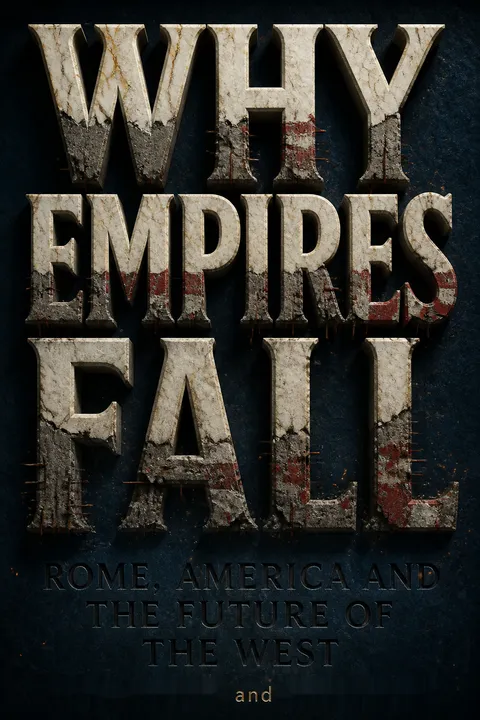
What's Why Empires Fall: Rome, America and the Future of the West about?
- Exploration of Decline: The book examines the rise and fall of empires, focusing on the Roman Empire and its parallels with modern Western powers, particularly the United States.
- Economic and Political Dynamics: It argues that empires generate their own decline through economic transformations that empower peripheral regions, leading to challenges against the imperial core.
- Lessons for the West: Authors Peter Heather and John Rapley suggest that understanding the fall of Rome can provide insights into the current challenges faced by Western nations.
Why should I read Why Empires Fall?
- Historical Insights: The book offers a deep dive into historical patterns of imperial rise and decline, making it relevant for understanding contemporary geopolitical dynamics.
- Comparative Analysis: It provides a comparative framework between ancient Rome and modern Western empires, helping readers draw parallels and learn from history.
- Engaging Narrative: The authors combine rigorous scholarship with engaging storytelling, making complex historical events accessible and thought-provoking.
What are the key takeaways of Why Empires Fall?
- Imperial Life Cycle: Empires undergo a life cycle that begins with economic development, leading to wealth generation that eventually empowers peripheral regions to challenge the core.
- Economic Transformation: The book emphasizes that economic changes initiated by empires can lead to their own decline, as seen in both Rome and the modern West.
- Political Choices Matter: The future of the West will depend on the political and economic choices made by its leaders and citizens in response to current challenges.
What are the best quotes from Why Empires Fall and what do they mean?
- "You can’t just ‘make America great again’.": This quote highlights the complexity of reversing economic decline and suggests that simplistic solutions ignore deeper structural issues.
- "Empires come into being to generate new flows of wealth.": This emphasizes the foundational role of economic growth in the establishment of empires, which can later lead to their downfall.
- "The future of the West will depend on which political and economic choices its citizens and leaders take.": This underscores the importance of active engagement and decision-making in shaping the future trajectory of Western societies.
How does Why Empires Fall compare the Roman Empire to modern Western empires?
- Economic Parallels: Both empires experienced significant economic growth that initially solidified their power but later led to challenges from newly empowered peripheral regions.
- Political Structures: The book discusses how the Roman Empire evolved from a conquest state to a more integrated system, similar to how modern Western nations operate within a global framework.
- Crisis Management: It illustrates how both empires faced crises at their peaks, suggesting that understanding these historical moments can inform current responses to modern challenges.
What role does economic inequality play in the decline of empires according to Why Empires Fall?
- Wealth Concentration: The book argues that as empires grow, wealth becomes concentrated in the hands of a few, leading to social unrest and challenges to authority.
- Political Discontent: Economic inequality fosters political discontent, which can empower peripheral groups to challenge the imperial core, as seen in both Rome and modern contexts.
- Need for Adaptation: The authors suggest that empires must adapt to changing economic realities to avoid decline, emphasizing the importance of addressing inequality.
How does Why Empires Fall address the concept of migration and its impact on empires?
- Migration as a Response: The book discusses how migration often occurs as a response to external pressures, such as the Huns pushing the Goths into Roman territory.
- Cultural Exchange: It highlights the cultural and economic exchanges that occur as migrants settle in new areas, which can both enrich and challenge existing power structures.
- Imperial Response: The authors analyze how empires respond to migration, often with hostility, which can exacerbate tensions and lead to conflict.
How does Peter Heather define the concept of "exogenous shock" in Why Empires Fall?
- External Forces Impacting Stability: Heather defines "exogenous shock" as significant external events or pressures that disrupt the stability of an empire.
- Historical Examples: The book provides historical examples, such as the Huns' invasions, which forced the Roman Empire to divert resources and attention away from internal governance.
- Contemporary Relevance: Heather argues that modern empires face similar exogenous shocks, such as large-scale migration and geopolitical tensions, which can destabilize their structures.
How does Why Empires Fall address the internal political divisions within empires?
- Impact on Cohesion: Heather argues that internal political divisions weaken an empire's ability to respond to external threats.
- Historical Examples: The book provides examples from the Roman Empire, where elite divisions over governance and resource allocation contributed to its decline.
- Lessons for Modern Governance: The author suggests that contemporary political systems must address internal divisions to maintain stability.
What are the implications of the rise of new superpowers, like China, as discussed in Why Empires Fall?
- Shift in Global Power Dynamics: Heather discusses how the rise of China represents a significant challenge to the existing Western hegemony.
- Need for Adaptation: The book emphasizes that Western nations must adapt to this new reality by reevaluating their strategies and alliances.
- Historical Context: By comparing the rise of China to the historical rise of barbarian groups during the Roman Empire, Heather illustrates that such shifts require careful navigation.
How does Peter Heather suggest modern Western nations can learn from the fall of the Roman Empire?
- Understanding Vulnerabilities: Heather encourages modern nations to recognize their vulnerabilities, particularly in terms of internal cohesion and external pressures.
- Importance of Negotiation: The book highlights the need for effective negotiation and adaptation in the face of change.
- Caution Against Complacency: Heather warns against complacency, suggesting that the lessons of history should inform current policies.
What is the significance of the title Why Empires Fall?
- Exploration of Decline: The title encapsulates the book's central theme of investigating the reasons behind the decline of powerful empires throughout history.
- Lessons for the Future: It suggests that understanding the factors leading to imperial decline can provide valuable lessons for contemporary societies facing similar challenges.
- Historical Context: The title also reflects the authors' intent to draw parallels between historical events and modern geopolitical dynamics, emphasizing the cyclical nature of history.
Download PDF
Download EPUB
.epub digital book format is ideal for reading ebooks on phones, tablets, and e-readers.








