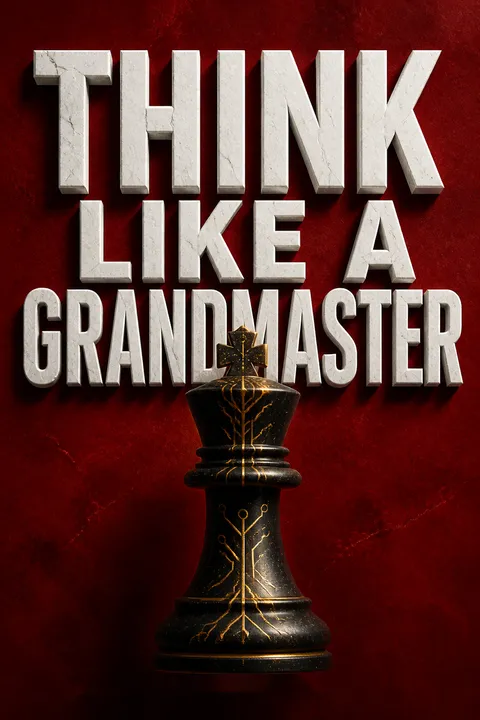


Key Takeaways
Think in stages: assess the board before calculating the move
Start by understanding the position. Kotov describes grandmaster thinking as more than hunting for a clever move. First clarify what has happened: the material balance, the opening structure, familiar precedents, and the activity of each side’s pieces. Then assess weaknesses, open lines, central control, and whose plans are advancing. This groundwork tells the player what the position demands.
Calculate after planning. Once the position is understood, choose a strategic direction, anticipate the opponent’s plan, and identify candidate moves. Only then calculate concrete variations. Kotov’s sequence is a practical model, not a rigid ritual: general assessment narrows the search, while calculation tests whether the plan survives contact with the opponent’s best reply.
This sequence resembles a good diagnostic process in medicine or engineering: gather evidence, form a model, then test an intervention. It reduces the chance of calculating a brilliant line that solves the wrong problem. The stages also help distinguish strategic judgment from tactical proof, two skills that can blur together under pressure. Still, chess thought is not purely linear. A forcing check may overturn an initial assessment immediately, so the process works best as a loop: evaluate, calculate, update, and evaluate again.
List candidate moves, then search each branch without wandering
Define the search first. A tree of analysis is the branching map of possible moves and replies. Its trunk is the move under consideration; branches are the opponent’s responses, and smaller branches are the continuations. Before calculating, identify the candidate moves for both sides. Then examine the important branches once, rather than repeatedly jumping between lines and losing track of what has been checked.
Missing a move can decide everything. In a position from Ragozin and Boleslavsky, Ragozin examined five defensive candidates but overlooked 24 b4, a move that would have saved the game. Kotov’s point is not to calculate every legal move. It is to search widely enough to include the serious options, then go deep enough to compare them accurately.
This is a chess version of search pruning: spend effort on plausible routes, not every imaginable route. It also explains why an exhaustive-looking calculation can still fail. The neglected option is often not hidden deep in a variation; it is absent from the initial list. Kotov’s rule to examine branches once is a useful defense against circular thought, but it should not become dogma. A new opponent move changes the position, so the analysis must be rebuilt from the new evidence.
Train calculation by solving annotated positions before seeing the answers
Practice under realistic limits. Kotov improved by studying complicated positions from tournament games, stopping before the published analysis, and calculating without moving the pieces. He spent substantial time on a position, wrote down his lines, and then compared them with the annotator’s. The exercise exposed missed options and helped him distinguish useful calculation from aimless variation-hopping.
Turn mistakes into material. Kotov says that harsh reviews of his own games revealed weak middlegame understanding and unreliable analysis. He reports winning the master title in 1938 and the grandmaster title in 1939 after a period of intensive study. He also recommends solving positions from diagrams and reviewing time trouble and oversights. The lesson is to practice the thinking process, not merely replay the moves.
The method has a close connection to deliberate practice: a learner attempts a task, receives feedback, identifies a specific gap, and tries again. Hiding the notes matters because recognition is easier than independent recall. Writing down variations makes the comparison more honest, since memory tends to edit out errors after the fact. Kotov’s personal improvement supports the value of sustained work, though one player’s trajectory cannot establish that the same training produces the same result for everyone.
Evaluate weaknesses dynamically, not as permanent defects on a static board
Break the position into elements. Kotov’s positional assessment considers open files and diagonals, pawn structure and weak squares, piece placement, space, and control of the center. The player then combines these factors into an overall judgment. A weak pawn or square matters, but its importance depends on whether the opponent can actually attack it or use it as an entry point.
A weakness can be useful bait. In some King’s Indian positions, Black’s d-pawn appears vulnerable because it stands on an open file. Yet a knight may block the file, while Black’s pieces gain activity elsewhere. Conversely, a single outpost can become decisive: Botvinnik’s games show how a piece established on d5 can restrict the opponent and support pressure. Structure must be read in motion, not counted like a list of flaws.
This dynamic approach avoids a common analytical trap: treating positional features as independent points on a scorecard. In complex systems, a weakness can be compensated by activity, and a strength can become irrelevant if it has no route into the game. The same logic appears in strategic planning, where a resource matters only in relation to an objective. The challenge is that dynamic assessment is harder to teach than static rules. Concrete variations remain necessary to show whether a supposed weakness is exploitable.
Build short plans from the center, and change them when facts change
Plan for an objective, not a slogan. Kotov argues that a game rarely follows one flawless plan from opening to finish. A player instead pursues a series of connected goals, such as occupying a square, opening a file, or improving a piece. After each goal, the board is reassessed. If the opponent’s move changes the conditions, the plan must change too.
The center sets the route. With a closed center, flank attacks often become possible because the central pawns block counterplay. With an open center, piece activity and open lines gain importance. A mobile pawn center can advance to drive back enemy pieces, while the defender tries to blockade or undermine it. Kotov warns that simply developing pieces without deciding what the position calls for can leave a player passive and cramped.
Short-horizon planning is a form of adaptive control: choose an action, observe the response, and revise the next step. It is more realistic than pretending a complicated game can be scripted in advance. The central structure functions like a constraint on available routes, not an automatic verdict about who is better. That distinction matters because the same pawn formation can invite different plans depending on piece placement, king safety, and timing. Plans guide calculation; they do not replace it.
When victory feels certain, check the obvious threats again
Confidence can dull attention. Kotov recounts reaching a winning position against Smyslov and then overlooking a rook check that turned the game around. The danger was not a lack of chess knowledge. It was the assumption that the attack had already succeeded. He also describes blunders caused by automatic habits, such as moving an attacked piece without checking whether a capture or counterattack is stronger.
Return to the actual board. The Blumenfeld Rule is Kotov’s practical safeguard: write down the intended move before playing it, look again at the position, and inspect it as if seeing it for the first time. Ask whether the king faces an immediate threat, a piece is hanging, or a simple reply refutes the plan. Do not rely on an opponent to miss the same resource you have overlooked.
The advice is a form of metacognitive interruption: pause the habitual response and inspect the situation afresh. That is useful wherever confidence, fatigue, or urgency narrows attention. The instruction to look like a beginner is especially effective because it directs attention toward basic threats that expertise can sometimes suppress. No checklist eliminates error, and an overly long inspection can waste scarce time. The practical aim is a brief, consistent safety check, especially after a forcing sequence or when the position appears won.
Study typical positions deeply instead of memorizing every opening line
Build usable chess erudition. Kotov uses this term for accumulated knowledge of openings and recurring middlegame positions, including plans and previously tested ideas. He advises players to know a limited number of opening systems thoroughly rather than trying to master every variation. In his own repertoire, the Sicilian Scheveningen offered strategic counterplay, while the Slav required more concrete knowledge of sharp lines.
Learn the position behind the move. Studying games by strong players helps identify typical pawn structures, useful piece placements, and plans that fit a given position. Kotov stresses that this is not mechanical memorization: a remembered game is a precedent that can guide judgment, not proof that the same move must work again. Preparing for a particular opponent also means studying their games and understanding which positions suit their style.
This approach aligns with expertise research that emphasizes pattern recognition built from meaningful examples. A player who understands why a move works can adapt when the exact position differs; a player who remembers only a sequence is vulnerable to novelty. The limitation is that opening knowledge ages, especially when analysis deepens. The durable asset is therefore not a frozen repertoire but the ability to recognize strategic structures and test remembered ideas against the current position.
In endings, organize a winning scheme and bring the king forward
Think in formations. In an ending, a sequence of individual moves may matter less than the arrangement that the pieces must reach. Kotov points to Capablanca’s habit of shifting pieces into a productive formation before the win became obvious. In a Lasker-Pillsbury ending, Lasker used patient piece maneuvers to exploit weaknesses and eventually win a pawn. Repeating moves can be useful when it improves the position or makes the opponent defend accurately.
Change gears from the middlegame. Endings demand knowledge of basic theoretical positions, careful decisions about which pieces to exchange, and active use of the king. A king that was sheltered during the attack must often move toward the center when the danger has passed. Kotov’s advice is to avoid needless haste: secure the useful formation, improve the king, and only then advance or exchange.
The emphasis on formations captures a central feature of endgame reasoning: small improvements accumulate because there are fewer pieces to create distractions. The king’s changing role is a clear example of context-dependent value. A piece that must hide in one phase becomes an active resource in another. Still, patience is not passivity. A player who repeats moves without improving anything merely gives the defender time. Each maneuver should strengthen the position, restrict a reply, or clarify the route to progress.
Choose a practical move before the clock turns calculation into panic
The best move must also be playable. Kotov distinguishes a position’s theoretical demands from the realities of tournament time. In a game against Taimanov, Keres chose a pawn recapture that led to a more manageable position rather than a knight recapture that promised an advantage but opened complicated lines. The choice reflected the practical cost of analysis, not ignorance of the stronger possibility.
Spend time where it changes the result. Kotov warns against wandering between variations until time trouble forces a careless decision. A sound, clear continuation can be preferable when the alternative requires extensive calculation and offers uncertain practical returns. Yet time pressure is not an excuse for an oversight. Reviewing how time was spent, and reconsidering the position after the opponent moves, helps make practical judgment deliberate rather than a last-minute escape.
This is a useful distinction between objective optimization and decision quality under constraints. In many fields, the theoretically best option is not best if it cannot be evaluated reliably before a deadline. The key is to price complexity honestly, rather than using practicality to justify avoidance. A simpler move is sensible when it preserves the position and reduces risk; it is not sensible merely because calculation feels uncomfortable. Time management is part of the move, not an administrative detail outside the game.
Analysis
Kotov’s central contribution is to make chess thought inspectable. Rather than treating grandmaster skill as mysterious intuition, he breaks it into practices: reconstruct the position, assess its features, select candidates, calculate replies, form a plan, and audit the move before playing. The book’s many tournament stories give these practices consequence. An omitted candidate loses a game; a missed check turns a win into defeat; a quiet endgame maneuver matters more than a spectacular combination. The result is a manual for improving the quality of attention, not just the quantity of chess knowledge.
Its most productive tension is between discipline and flexibility. Kotov advocates orderly analysis, including examining branches once, but also insists on revising plans when the opponent changes the position. Those ideas fit together if the tree is treated as a temporary model, not a permanent script. Every reply supplies new information and calls for a fresh scan. This resembles bounded rationality: strong decisions do not require examining every possibility, but they do require a defensible way to select which possibilities deserve attention.
The book also presents expertise as partly trainable. Kotov’s own progress followed severe self-review and deliberate calculation exercises, while his accounts of Botvinnik, Keres, Smyslov, and others show different temperaments succeeding through different methods. This guards against the idea that one style is mandatory. The limitation is that the book’s prescriptions arise from elite tournament practice of its era, and some opening knowledge has since been transformed by computer analysis. Yet engines have not removed the human problems Kotov describes: deciding what to analyze, using limited time, evaluating plans, and resisting complacency. The lasting lesson is methodological: make thought explicit enough to improve, but flexible enough to respond to the board.
Review Summary
Think Like A Grandmaster receives mixed reviews, with an overall positive reception. Many readers praise its insights into a grandmaster's thought process, planning strategies, and time management. The book's advice on calculation methods and chess concepts is highly valued, particularly by developing players. However, some critics find it outdated, rigid in approach, or difficult for beginners to follow. Despite these criticisms, many consider it a foundational text in chess literature, offering valuable lessons applicable beyond the game itself.
People Also Read


Glossary
Tree of analysis
Map of possible variationsA branching representation of the moves considered during calculation. The initial candidate move forms the trunk, the opponent’s possible replies form major branches, and later continuations create smaller branches. The image helps a player track which lines have been examined and avoid repeatedly switching between variations.
Candidate moves
Moves worth calculatingThe limited set of moves a player judges important enough to analyze in a position. Candidate moves may be forcing, strategically relevant, or necessary defensive options. Selecting them is a crucial part of calculation: overlooking a serious candidate can matter more than analyzing a chosen line deeply.
Blumenfeld Rule
Final blunder-check procedureA safeguard attributed by Kotov to chess psychologist Benjamin Blumenfeld. Before playing, write down the intended move, return attention to the actual board, and inspect the immediate position for simple threats, hanging pieces, and tactical replies. The pause is meant to counter mistakes caused by becoming absorbed in distant variations.
Dizziness due to success
Complacency in a winning positionKotov’s label for the loss of vigilance that can occur when a player believes victory is near. A confident player may stop checking for the opponent’s resources and overlook a simple reply. Kotov illustrates the danger with his own game against Smyslov, where an apparently decisive attack allowed a countercheck that reversed the result.
Pawn islands
Separated pawn groupsGroups of pawns that are not connected to one another by neighboring pawns. A position with more islands can be harder to defend because the groups may become separate targets, particularly in an ending. Kotov uses the idea to qualify older claims about pawn majorities and to explain why pawn structure matters beyond the count of pawns.
Conditioned reflexes
Automatic chess responsesKotov’s term for habitual reactions developed through repeated experience, such as automatically moving a piece when it is attacked. These responses can speed up familiar decisions, but they can also conceal unusual tactical possibilities. A player should notice when habit is substituting for checking the concrete position.
Chess erudition
Accumulated position-specific knowledgeKotov’s term for a player’s working knowledge of opening theory and recurring middlegame positions. It includes remembered plans, strategic methods, and useful precedents from earlier games. This knowledge can save calculation time, provided the player applies it by understanding the current position rather than copying a familiar move mechanically.
Key positions
Typical opening structuresPositions within an opening that reveal its recurring strategic problems and plans. Kotov, following Bronstein’s terminology, treats them as reference points for understanding an opening beyond memorized move sequences. Studying such positions helps a player recognize where pieces belong, what each side is trying to achieve, and how the middlegame may develop.
FAQ
1. What is "Think Like A Grandmaster" by Alexander Kotov about?
- Chess Thought Process: The book explores the mental processes and methods used by top chess grandmasters to analyze positions, make decisions, and plan during games.
- Practical Training Manual: It serves as a practical guide for players aiming to improve their analytical skills, positional judgment, and overall chess understanding.
- Personal and Soviet Experience: Kotov shares insights from his own journey to grandmaster, as well as methods and advice from leading Soviet players like Botvinnik, Tal, and Smyslov.
- Systematic Approach: The book introduces structured techniques for analyzing variations, selecting candidate moves, and forming effective plans in chess.
2. Why should I read "Think Like A Grandmaster" by Alexander Kotov?
- Improve Analytical Skills: The book provides concrete methods to analyze chess positions more deeply and accurately, a skill essential for advancing in chess.
- Learn from Grandmasters: Kotov distills the thinking habits and training routines of world-class players, offering readers a chance to emulate proven approaches.
- Avoid Common Pitfalls: It addresses psychological errors, time trouble, and blunders, helping readers recognize and overcome these issues in their own play.
- Structured Self-Improvement: The book offers practical exercises and self-training techniques, making it a valuable resource for players seeking systematic improvement.
3. What are the key takeaways from "Think Like A Grandmaster"?
- Tree of Analysis: Kotov introduces the concept of the "tree of analysis," emphasizing disciplined, systematic calculation of variations without unnecessary repetition.
- Candidate Moves: The importance of identifying and evaluating all reasonable candidate moves before deep analysis is stressed as a hallmark of strong play.
- Positional Judgment: The book teaches how to break down positions into elements (open lines, pawn structure, piece activity, space, and center) and synthesize them for accurate assessment.
- Planning and Flexibility: Kotov explains how to form and adapt plans based on the evolving demands of the position, rather than sticking rigidly to a single idea.
4. How does Kotov’s "tree of analysis" method work, and why is it important?
- Systematic Calculation: The "tree of analysis" is a visual and mental model for calculating chess variations, where each move branches into possible replies, forming a tree-like structure.
- One-Time Branch Analysis: Kotov advises analyzing each branch only once to avoid time-wasting and confusion, building confidence in your calculation.
- Candidate Move Selection: Before calculating, players should list all plausible candidate moves, ensuring no critical options are overlooked.
- Efficiency and Accuracy: This method helps players avoid the common error of jumping back and forth between lines, leading to more efficient and accurate decision-making.
5. What advice does "Think Like A Grandmaster" give on selecting candidate moves?
- Comprehensive Enumeration: Always identify all reasonable candidate moves in a position before starting deep analysis, as missing one can mean missing the best move.
- Balance Quantity and Quality: Avoid both analyzing too many irrelevant moves and too few; focus on moves that fit the position’s demands.
- Opponent’s Candidates: Consider not only your own candidate moves but also your opponent’s, at every stage of the variation.
- Training Intuition: Systematic practice in finding candidate moves develops intuition, making the process faster and more reliable over time.
6. How does Kotov recommend improving analytical ability and calculation skills?
- Self-Training Exercises: Practice analyzing complex positions from master games without moving the pieces, then compare your analysis to published notes.
- Blindfold and Diagram Reading: Solve studies and positions without a board to strengthen visualization and calculation.
- Timed Analysis: Set time limits for analyzing positions to simulate tournament conditions and improve speed.
- Critical Self-Review: After games, review your analysis, identify errors, and work to correct recurring calculation mistakes.
7. What are the main elements of positional judgment in "Think Like A Grandmaster"?
- Open Lines and Diagonals: Control of open files and diagonals is crucial for piece activity and attacking potential.
- Pawn Structure and Weaknesses: Understanding isolated, backward, and passed pawns, as well as weak squares and color complexes, is key to both attack and defense.
- Piece Placement and Coordination: The effectiveness of your pieces depends on their activity, cooperation, and ability to exploit or defend weaknesses.
- Space and Center Control: Gaining space and controlling the center allows for greater maneuverability and restricts the opponent’s options.
8. How does Kotov suggest forming and adapting plans during a chess game?
- Assessment First: Begin by accurately assessing the position’s elements and synthesizing them into a general evaluation.
- Short-Term and Long-Term Plans: Formulate both immediate and overarching plans, adjusting as the position changes.
- Flexibility: Be ready to change your plan if the position or your opponent’s actions demand it; stubbornly sticking to a flawed plan can be disastrous.
- Manoeuvring and Provocation: Use manoeuvring to provoke weaknesses and create new targets for your plan.
9. What psychological pitfalls and errors does Kotov warn about in "Think Like A Grandmaster"?
- Dizziness Due to Success: Overconfidence when winning can lead to careless blunders; vigilance must be maintained until the game is over.
- Conditioned Reflexes: Automatic, habitual moves can be dangerous if not checked against the specifics of the position.
- Blind Spots: Even strong players can overlook simple threats or attacks due to mental fatigue or fixation on certain ideas.
- Time Trouble: Poor time management leads to errors; Kotov stresses the importance of efficient analysis and decision-making under time constraints.
10. What training methods and exercises does Kotov recommend for self-improvement?
- Analyzing Master Games: Study complicated positions from grandmaster games, pausing at critical moments to analyze without notes, then compare with published analysis.
- Solving Studies and Puzzles: Regularly solve tactical and endgame studies, ideally without a board, to sharpen calculation and visualization.
- Blumenfeld’s Rule: Before making a move, write it down and check the position for simple threats or blunders as if you were a beginner.
- Self-Critique and Review: After tournaments, critically review your games, especially losses, to identify and address recurring weaknesses.
11. How does "Think Like A Grandmaster" address the study of openings, middlegames, and endings?
- Focused Opening Repertoire: Kotov recommends specializing in a few openings and knowing them deeply, rather than superficially covering many.
- Key Middlegame Positions: Study typical middlegame structures and plans arising from your chosen openings, learning both attacking and defensive methods.
- Endgame Schemes: Emphasize understanding endgame schemes and principles, such as piece activity, king centralization, and the importance of not rushing.
- Transition Awareness: Always consider how the opening leads to the middlegame and how the middlegame transitions to the endgame.
12. What are the best quotes from "Think Like A Grandmaster" and what do they mean?
- "When analyzing complicated variations, examine each branch of the tree once and once only." – This highlights the importance of disciplined, non-repetitive calculation for efficiency and accuracy.
- "A single plan is the sum total of strategic operations which follow each other in turn and which each carry out an independent idea that arises logically from the demands of a given position." – Kotov emphasizes that planning is a dynamic, evolving process, not a rigid blueprint.
- "Doflot hurry." – Especially in the endgame, patience and careful maneuvering are often more effective than rushing to force events.
- "Train your fantasy." – Creativity and imagination in finding unusual or unexpected moves are skills that can be developed through practice and study.
- "The inability of an experienced master to cope with the clock should be considered as faulty as making an oversight in analysis." – Kotov equates poor time management with analytical errors, stressing its importance in practical play.
Download PDF
Download EPUB
.epub digital book format is ideal for reading ebooks on phones, tablets, and e-readers.








