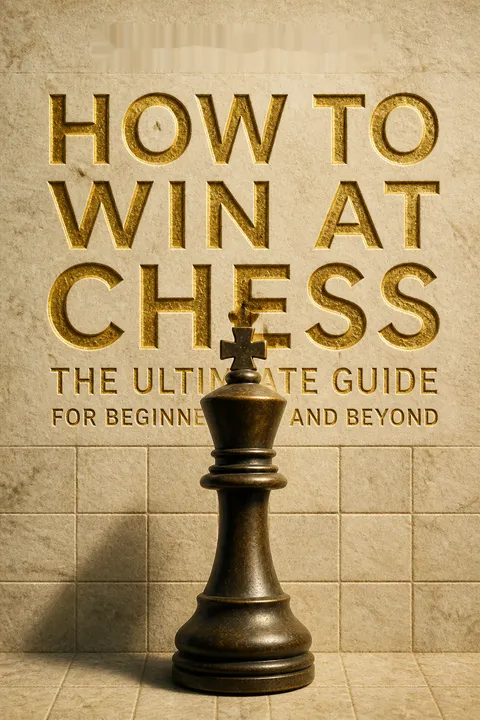


Key Takeaways
Win the king, not the scoreboard, and never resign too early
The real objective. Chess is won most often by checkmate, when the king is under attack with no legal escape. A player can also win when the opponent resigns, runs out of time, or abandons the game. Material matters because it can help create a win, but a huge pile of pieces does not end the game by itself. One example in the book shows a player checkmated despite having a towering material lead.
Keep playing at beginner level. World champion Viswanathan Anand resigned a hopeless game against Magnus Carlsen rather than spend hours awaiting an inevitable loss. That etiquette is for elite play. At ordinary levels, opponents blunder, miss checkmate, or stalemate a winning position, so a bad position can still become a draw or win.
The distinction between means and ends is unusually clear here: material is a resource, while checkmate is the actual terminal condition. That resembles many competitive settings where a measurable proxy, such as territory or possession, can distract from the objective that decides the contest. Persisting is rational when the opponent still has to execute. The limit is practical: continuing a clearly lost game can consume time and attention, so the useful rule is not endless resistance, but avoiding premature surrender when meaningful chances remain.
Open with central pawns, active pieces, and a king moved out of danger
Three opening priorities. The book's opening advice is to contest the center, develop knights and bishops toward useful squares, and castle to protect the king. Central pieces tend to have more routes and influence than pieces stranded at the board's edge. Castling also brings a rook closer to the center. These priorities are more useful to a learner than memorizing long move sequences without understanding their purpose.
Principles meet resistance. White often begins with e4 or d4, while Black must answer White's plan and build a safe position of its own. The ideal sequence rarely happens exactly as planned because both players compete for the same squares. The four-move Scholar's Mate illustrates the temptation to send the queen out early: it can trap an unaware opponent, but a prepared defense leaves White's queen exposed and wastes time.
These priorities work as a compact decision filter: each move should improve access, coordination, or king safety. That is a stronger learning tool than treating an opening as a password to recite, because it remains useful when an opponent leaves familiar theory. The advice is a starting heuristic, not a law. Tactical threats can justify delaying castling or moving a piece twice, but beginners benefit from needing a concrete reason to depart from sound development.
Learn a few opening positions deeply instead of collecting opening names
Repetition builds usable knowledge. Rozman recommends choosing a consistent opening repertoire so familiar positions recur and the player learns their plans, dangers, and typical responses. For White, the London System offers a similar setup against many Black replies. Players choosing e4 need plans against different defenses; the Vienna System addresses e5, while the Alapin variation meets the Sicilian. For Black, the Caro-Kann or Scandinavian can answer e4, while the Queen's Gambit Declined is a principled response to d4.
Fit matters more than fashion. A universal setup can save study time, while more varied openings create different kinds of positions and demand broader preparation. Gambits, which offer a pawn for activity or attacking chances, can be effective, but Black's gambits are often especially risky. An opening should suit the player's appetite for study and style, not merely imitate a champion.
This is a useful model of expertise as depth before breadth. Repeated exposure lets a player notice recurring structures and plans instead of spending every game rediscovering the first moves. The same logic appears in deliberate practice: a constrained repertoire creates feedback that can be compared across attempts. Yet familiarity can turn into autopilot. The book's own warning about setup openings matters: repeat the structure, but keep asking what the opponent's last move changed.
Scan for forcing moves before reaching for the comfortable move
A tactical search habit. CCA is Rozman's checklist for considering checks, captures, and attacks before choosing a move. These forcing actions narrow the opponent's replies, making calculation more manageable. The checklist applies defensively too: after an opponent moves, ask what they threaten and which forcing replies they have. It is a search order, not a promise that every check or capture is good.
Patterns make the scan faster. A fork attacks multiple targets at once; a pin restricts a piece because moving it exposes something more valuable; a skewer attacks a valuable piece to uncover another behind it. Discovered attacks appear when one moving piece reveals a threat from another. Intermediate tactics include removing a defender and inserting a forcing move before the obvious recapture. Rozman urges extensive puzzle practice to make these patterns recognizable during games.
The checklist externalizes attention. Under pressure, a player can fixate on the threatened piece and overlook a more urgent counterthreat; a repeatable scan interrupts that tunnel vision. This resembles checklists in high-stakes work, where simple prompts reduce omissions without replacing judgment. The critical distinction is between finding candidate moves and evaluating them. A check can be pointless, and an apparent fork can win nothing if every target is protected.
Exploit weak squares and space, not just undefended pieces
Position has value beyond material. A weakness is a piece or square that lacks sufficient protection. Attacking a loose knight may win material; targeting poorly defended squares near a king can create a mating attack even when the attacker is behind in points. Pawn placement matters because pawns protect diagonally. If a king's nearby pawns occupy mostly one color, the unguarded squares of the other color can become routes for enemy pieces.
Space changes mobility. Space means control of squares in the opponent's half of the board. More space can restrict enemy movement and give one's own pieces room to maneuver. Pawn blockades create closed positions; exchanges create open lines that favor long-range pieces such as bishops. A cramped side may benefit from trading the pieces that restrict its movement, while the side with a space advantage often wants to preserve its active forces.
This shifts evaluation from counting objects to asking what the position permits. Space is not a score on its own; it matters because restricted pieces have fewer useful choices and attacks have fewer obstacles. That distinction guards against a common mistake in strategic thinking: treating a positional feature as valuable in isolation. A space advantage can also become overextension if pawns advance without support, so activity and vulnerability must be assessed together.
Use pawn structure to choose plans and judge each piece in context
Pawns set the terrain. Pawn structure describes how pawns are arranged; pawn breaks are advances intended to open lines or undermine an opposing formation. A pawn chain can gain space, while isolated, backward, or doubled pawns may become targets, though none is automatically weak. A passed pawn has no opposing pawn able to stop its advance. In endgames, advancing one passed pawn can draw the enemy king away while the remaining pawns become vulnerable elsewhere.
Piece value is conditional. Bishops thrive when lines are open; knights can hop over blockades and become powerful on protected outposts. Rooks gain strength on open files or when doubled together. The queen is a formidable attacker but needs support and can be misplaced if brought out too early. These roles also affect exchanges: the same bishop-for-knight trade can be good or bad depending on the pawn structure and what each piece is doing.
The important conceptual move is to treat pawns as architecture rather than disposable points. Their placement determines which routes exist, which pieces are effective, and where future breaks can occur. The book wisely resists rigid rules about doubled pawns or bishop superiority, because local conditions can reverse the general tendency. A further discipline follows: evaluate not only the current structure, but what opening a file or advancing a pawn will expose.
Learn endgame technique before trusting an advantage to win itself
Conversion requires precision. In a king-and-pawn ending, the king often needs to support the pawn from in front, while opposition can prevent the opposing king from advancing. A passed pawn can act as a decoy, drawing the other king away. With a queen or rook against a lone king, the attacker must know a mating method rather than chase checks aimlessly. The book explains the ladder technique for two major pieces and uses king coordination for rook mates.
The material count can mislead. A bishop or knight alone cannot force mate against a bare king. Opposite-colored bishop endings are often drawable, and a rook-and-pawn ending may be held with the Philidor defensive method, which uses the rook to restrain the enemy king and check the advancing king. In queen endings, perpetual checks can save a player who is otherwise behind.
Endgames expose the difference between advantage and proof. With fewer pieces, each tempo and square carries more weight, so technique can convert a position that looks straightforward or preserve one that looks hopeless. The book's emphasis on known methods is especially valuable because confidence often rises precisely when a player has extra material. Still, practical play is not a tablebase: clocks, fatigue, and an opponent's resistance can turn theoretically simple endings into demanding decisions.
When behind, search for a draw before accepting defeat
Draws are active defenses. A draw can arise by agreement, by repeating the same position three times, by stalemate, after 50 moves without a pawn advance or capture, or when neither side has enough material to checkmate. Repetition can let a player under attack force a tie through repeated checks. Stalemate is different: the player to move has no legal move but is not in check. A careless attacker can therefore turn a winning position into a draw.
The odds depend on level. In the book's cited Lichess database, 43 percent of recorded master games were drawn, compared with 4 percent of games among players averaging 1600. Strong players find defensive resources and avoid blunders more consistently. At lower levels, both sides should watch for repetition, stalemate, and time trouble. A player with a winning advantage must also avoid giving the defender an easy escape.
A draw is not a failed win when the alternative is a loss. This reframes defense as a search for resources, not passive endurance, and explains why a material deficit does not settle a game. The striking rating gap also suggests that defensive skill is part of expertise, not an obscure rules lesson. Database rates depend on the selected games and rating population, however, so they are illustrative rather than universal probabilities.
Trade pieces only when the resulting position improves your chances
Point values are only a start. A bishop and knight are each conventionally worth three points, but an active knight embedded in enemy territory may be far more useful than an undeveloped bishop. A trade can damage pawn structure, open the king, remove an attacker, or create an outpost. In openings, keeping the tension between pieces that could capture each other may preserve options and avoid helping the opponent develop.
Explain the benefit first. Simplifying while ahead can make an advantage easier to convert; exchanging while behind often removes chances to complicate the game. A player under attack may welcome a queen trade if it ends the opponent's mating threat. Conversely, trading away one's most active attacker can kill a promising attack. Before exchanging, ask how the board changes for both sides, not merely whether the point totals match.
This is a compact lesson in contextual valuation. A piece's worth includes its activity, future access, defensive responsibilities, and relationship to the pawn structure. In economic terms, the nominal price is not the same as the value of an asset in a particular portfolio. The principle has a practical test: name the positional benefit before trading. That is not a guarantee of accuracy, but it makes impulsive exchanges easier to diagnose and learn from.
Improve through complete games, honest reviews, and repeated puzzle practice
Play, then investigate. The book presents full games as the central practice method. After each one, review the moves with a stronger player or an engine. An engine can identify strong alternatives, but the learner must work out why a move is better; a human coach can explain the recurring mistake. Reviewing openings, tactical misses, and endgame decisions turns a result into usable feedback.
Train recognition separately. Puzzles isolate patterns such as checkmate, forks, and pins, letting the player practice without the noise of an entire game. Rozman recommends solving large numbers, not stopping after a handful. Timed games add a separate skill: managing the clock. He is skeptical of weak bots as substitutes for people because bots may make unnatural errors, so practice should reflect the decisions encountered in real games.
The learning cycle is stronger than a simple instruction to play more: experience generates a record, analysis identifies a gap, and targeted puzzles rehearse the missing pattern. This resembles feedback-driven skill training, where repetition matters most when it is connected to correction. Engines are powerful but can become answer machines; understanding the reason behind an evaluation is essential. Practice should also match the goal: blitz develops fast decisions, but it cannot by itself teach the patience of long games.
Analysis
How to Win at Chess is a practical teaching manual that moves from rules and basic checkmates to openings, tactics, strategy, and endgames. Its central argument is not that chess can be reduced to a magic opening or a catalog of traps. Improvement comes from learning principles, recognizing recurring positions, and repeatedly applying judgment to real games. Rozman's accessible voice and examples make an enormous game feel navigable without pretending it is simple.
The book's strongest design choice is its layering. A novice first learns what ends a game and how pieces interact, then receives tools for more complex decisions. Repeated concepts, especially center control, king safety, piece coordination, and the forcing-move scan, acquire new meaning as the reader advances. The stories of Anand resigning to Carlsen, Steinitz's opponent leaving a game, and the author's own stalemate and tactical errors also make chess feel human: expertise does not eliminate emotion, time pressure, or mistakes.
Its most useful distinction is between material and position. Piece points help beginners compare exchanges, but the later chapters show why activity, pawn structure, king exposure, and available squares can outweigh a simple count. The same insistence on context animates its advice about openings and trades. This is a sound antidote to rote memorization, though the book's many named variations and tactical terms can still invite memorization if the reader treats examples as recipes.
The adaptation's practical message is to cycle between play and reflection. Opening principles guide early moves, tactical patterns help exploit immediate chances, positional concepts shape longer plans, and endgame methods convert or save results. The material is most valuable when used beside a board, since chess understanding depends on visualizing consequences. Its recommendations are explicitly aimed at beginners and intermediate players, not a complete opening encyclopedia or substitute for advanced study. That scope is a strength: it offers a map and a method, while leaving room for individual style and further exploration.
Review Summary
How to Win at Chess receives mostly positive reviews as an excellent beginner's guide, praised for its clear explanations, engaging writing style, and helpful illustrations. Readers appreciate Rozman's humor and accessible approach to teaching chess concepts. The book covers basics like rules, openings, tactics, and endgames, with links to online practice exercises. While some intermediate players found it too basic, most agree it's an ideal resource for newcomers to chess. A few criticisms mention the heavy focus on openings and limited depth for more advanced players.
People Also Read
Glossary
CCA
Forcing-move scanRozman's checklist for considering checks, captures, and attacks when deciding what to play. These moves can force an opponent to respond in limited ways, making calculation easier. The scan also applies to defense: a player should consider the opponent's forcing options before committing to a move.
Golden Moves
Opening prioritiesA model opening setup built around placing pawns in the center, developing knights and bishops to active squares, castling, and connecting the rooks. It is a teaching ideal rather than a fixed sequence, because an opponent's moves can prevent any exact setup.
Knight Opposition
Queen-guided king restrictionA method for mating with a king and queen. The queen is placed on a square from which it would attack the opposing king if the queen moved like a knight. This restricts the king's routes and gradually drives it toward the edge, while the attacker avoids stalemate by preserving legal escape squares until the king can help.
Passed Pawn
Unblocked promotion threatA pawn with no opposing pawn able to stop its advance toward promotion. It can force the enemy king or other pieces to spend time preventing it from queening. That diversion may let the pawn's owner attack targets elsewhere, making the passed pawn valuable even before it reaches the last rank.
Philidor Position
Rook-endgame drawing methodA defensive method in a rook-and-pawn ending. The defending rook cuts off the opposing king, then moves to the back rank when the pawn advances, allowing repeated checks that prevent progress. Correctly applied, the technique can hold a position that might otherwise appear lost.
Pawn Structure
Arrangement of pawnsThe placement and relationships of a side's pawns in a position. Structure determines which squares are defended, which files and diagonals are open or blocked, and where pawn advances may break through. Chains, isolated pawns, doubled pawns, and majorities are different structures with advantages and liabilities that depend on context.
Zugzwang
Harmful-move predicamentA position in which a player must move, but every legal move worsens the position. The term is especially useful in endgames, where a player may be forced to abandon a defense, allow a pawn through, or concede a key square simply because passing the turn is not allowed.
Zwischenzug
Forcing in-between moveA tactical move inserted before the obvious or expected continuation. It is often a check, capture, or threat that the opponent must answer. The interruption can improve the result of an exchange, win additional material, or prevent an opponent from carrying out a planned reply.
FAQ
What is "How to Win at Chess: The Ultimate Guide for Beginners and Beyond" by Levy Rozman about?
- Comprehensive Chess Guide: The book is a modern, accessible guide to learning chess, covering everything from the absolute basics to intermediate strategies and tactics.
- Step-by-Step Learning: It is structured to take readers from understanding the rules and piece movements to mastering openings, endgames, tactics, and strategy.
- Practical and Fun Approach: Levy Rozman, an International Master and popular chess educator, uses clear explanations, humor, and real-world examples to make chess approachable for all ages.
- For All Skill Levels: While focused on beginners and intermediate players (0–1200 Elo), the book also serves as a refresher for more advanced players seeking to solidify their fundamentals.
Why should I read "How to Win at Chess" by Levy Rozman?
- Demystifies Chess: The book breaks down intimidating chess concepts into digestible lessons, making it ideal for those who find traditional chess books overwhelming.
- Modern Teaching Style: Rozman leverages his experience as a YouTuber and online instructor to present chess in a relatable, engaging way.
- Practical Improvement: Readers gain actionable advice on practicing, analyzing games, and building effective study habits to improve at chess.
- Covers All Phases: The book addresses openings, middlegame tactics, endgames, and strategic thinking, ensuring a well-rounded chess education.
What are the key takeaways from "How to Win at Chess" by Levy Rozman?
- Learn by Doing: Consistent practice, game analysis, and solving puzzles are essential for improvement.
- Master the Fundamentals: Understanding piece movement, basic tactics (forks, pins, skewers), and key endgame techniques is crucial.
- Opening Principles Matter: Focus on controlling the center, developing pieces, and castling early rather than memorizing long opening lines.
- Strategy and Tactics: Recognize the difference between short-term tactical opportunities and long-term strategic planning, and use both to your advantage.
How does Levy Rozman recommend beginners start learning chess in "How to Win at Chess"?
- Start Simple: Begin with learning how each piece moves and the basic rules, including special moves like castling and en passant.
- Practice Basic Checkmates: Learn to checkmate with minimal pieces (e.g., king and queen vs. king, king and rook vs. king).
- Focus on Opening Principles: Control the center, develop knights and bishops, and castle early for king safety.
- Play and Analyze: Play complete games, review them (with a stronger player or engine), and solve simple puzzles to build pattern recognition.
What are the "golden moves" and opening principles in "How to Win at Chess" by Levy Rozman?
- Control the Center: Use your pawns and pieces to occupy or influence the central squares (e4, d4, e5, d5).
- Develop Pieces Efficiently: Bring out knights and bishops before moving the same piece multiple times or launching early attacks.
- Castle Early: Prioritize king safety by castling, usually within the first 10 moves.
- Avoid Early Queen Moves: Don’t bring your queen out too soon unless it’s part of a specific tactic (e.g., Scholar’s Mate, which is not recommended for long-term improvement).
How does "How to Win at Chess" by Levy Rozman explain the different ways to win and draw a chess game?
- Four Ways to Win: Checkmate, resignation by your opponent, winning on time (opponent’s clock runs out), and abandonment (opponent leaves the game).
- Draw Scenarios: Draw by agreement, threefold repetition, stalemate, the 50-move rule, and insufficient checkmating material.
- Practical Advice: Beginners are encouraged not to resign early, as opponents may make mistakes or run out of time.
- Understanding Draws: Recognizing draw mechanisms helps salvage games from losing positions and avoid accidental draws when winning.
What are the most important tactics and patterns covered in "How to Win at Chess" by Levy Rozman?
- Forks: One piece attacks two or more enemy pieces simultaneously, often leading to material gain.
- Pins and Skewers: Restricting the movement of enemy pieces by attacking along lines, with pins immobilizing a piece and skewers forcing a valuable piece to move.
- Discovered Attacks and Checks: Moving one piece to reveal an attack from another, often leading to devastating threats.
- Removing the Defender, Deflection, and Zwischenzug: Advanced tactics that involve eliminating key defenders, luring pieces away, or inserting forcing moves before the main threat.
How does "How to Win at Chess" by Levy Rozman teach chess strategy and positional understanding?
- Weaknesses: Identifying and exploiting undefended pieces, weak squares, and poor pawn structures in the opponent’s position.
- Space: Understanding the importance of controlling more squares in the opponent’s territory for piece mobility and attack potential.
- Open vs. Closed Positions: Recognizing when to open or close the position based on your pieces (e.g., bishops prefer open positions, knights thrive in closed ones).
- Long-Term Planning: Developing plans based on pawn structure, piece activity, and potential for creating passed pawns or outposts.
What are the recommended openings for beginners and intermediates in "How to Win at Chess" by Levy Rozman?
- For White: The London System (d4, bishop to f4) for its simplicity and consistency; the Vienna System (e4, Nc3) for e4 players; and the Alapin Sicilian (e4, c3) against the Sicilian Defense.
- For Black: The Caro-Kann Defense and Scandinavian Defense against e4; Queen’s Gambit Declined against d4; and setup-based openings like the King’s Indian/Pirc or Dutch Defense for universal application.
- Focus on Principles: Rather than memorizing deep lines, Rozman emphasizes understanding the ideas and plans behind each opening.
- Stick to a Few Openings: Consistently playing the same openings helps deepen understanding and improve results.
How does "How to Win at Chess" by Levy Rozman approach endgames and what are the must-know techniques?
- Basic Checkmates: Master king and queen vs. king, king and rook vs. king, and ladder mates with two rooks or queens.
- King and Pawn Endgames: Learn opposition, the concept of the “square,” and how to promote pawns with king support.
- Practical Endgames: Understand the importance of outside passed pawns, activity of the king, and the difference between theoretical and practical endgames.
- Rook and Queen Endgames: Know defensive techniques like the Philidor position and perpetual check, and how to convert material advantage into a win.
What is the CCA (Checks, Captures, Attacks) method in "How to Win at Chess" by Levy Rozman?
- Systematic Move Selection: Before making any move, always look for all possible checks, captures, and attacks for both you and your opponent.
- Forcing Moves First: Prioritize forcing moves (checks and captures) as they limit your opponent’s responses and can lead to tactical opportunities.
- Pattern Recognition: Regularly applying CCA helps develop tactical awareness and prevents missing critical threats or blunders.
- Defensive and Offensive Use: Use CCA both to spot your own opportunities and to anticipate your opponent’s threats.
What are the best quotes from "How to Win at Chess" by Levy Rozman and what do they mean?
- “Chess is a fascinating game, but our learning material can be quite intimidating.” — Emphasizes the need for accessible, modern chess instruction.
- “The search for a comprehensive, modern guide to chess was my inspiration for the book you currently hold in your hands.” — Highlights Rozman’s motivation to create a user-friendly resource.
- “While there is time on the clock and pieces on the board, there is the chance your opponent will mess it up by blundering pieces or getting themselves checkmated.” — Encourages perseverance and never giving up too early.
- “In chess, like in life, everything should be in moderation. You can enjoy something sweet now and then, but your diet shouldn’t be entirely sugar.” — Advises moderation in using risky tactics like gambits, advocating for a balanced approach to learning and playing chess.
Download PDF
Download EPUB
.epub digital book format is ideal for reading ebooks on phones, tablets, and e-readers.








