

Key Takeaways
Win by trapping the king, not by collecting the most pieces
The king sets the objective. Chess is not won by accumulating points or territory. The goal is checkmate: the opposing king is under attack and has no legal way to escape. A check can be answered by capturing the attacker, moving the king, or blocking a long-range attack. If none works, the game ends. The king itself is never captured; the game stops before that could happen.
A draw is a real result. A game can also end when neither side can force a win, including stalemate, when a player has no legal move but is not in check. Players may also agree to a draw, repeat a position, or reach certain material or move-count limits. In a tournament, a win is worth one point and a draw half a point.
What's striking is how the rules make chess a contest of constraint rather than conquest. Material matters because it helps create threats, but it is never the final score. That distinction is useful beyond chess: a team can possess more resources yet fail to achieve its actual objective. The draw rules also reward defensive ingenuity. A player in trouble can sometimes save half a point through repetition or stalemate, so a winning position still demands precision. The practical lesson is to keep asking whether a move advances the real objective, not merely whether it wins something.
Put pieces near the center, where each move reaches more of the board
The center multiplies mobility. The four central squares, e4, d4, e5, and d5, connect quickly to the rest of the board. A knight in a corner has only two possible destinations; from a central square it can have eight. Bishops gain access to longer diagonals, while rooks avoid the restrictions that come with the board's edges. Central pawns also control important squares and can obstruct enemy pieces.
Control need not mean occupation. Classical play places pawns in the center, while the hypermodern approach pressures the center from a distance and challenges the opponent's pawns. Either way, the point is to restrict enemy movement while giving your own pieces useful routes. An attack on the side of the board can often be met by striking at the center, where reinforcements must pass.
The center is valuable because it is a network hub: pieces stationed there can change direction and influence several fronts. This resembles centrality in transportation and communication networks, where a well-connected node offers options even when it does not dominate every route. The book's emphasis on central control is therefore stronger than a simplistic instruction to occupy four squares. Hypermodern play shows why. Still, central pieces can become targets, and an advanced pawn can be overextended. The durable principle is mobility and influence, not central occupation at any cost.
Develop minor pieces, castle, and delay exposing your queen
Make the opening do useful work. Early moves should bring knights and bishops into active positions, contest the center, open lines, and protect the king. Castling moves the king toward safety and brings a rook closer to the action. Repeatedly moving one piece while others remain undeveloped wastes time, unless the move answers a concrete threat. A queen brought out too soon can become a target for less valuable pieces.
Learn ideas before move lists. In the Ruy Lopez, White develops a knight and bishop while maintaining pressure on the center. In the Queen's Gambit, White offers a pawn to draw an opposing pawn away from the center and open routes for development. The book notes more than 1,300 named openings, but beginners benefit more from the underlying principles than from memorizing variations. En passant is a special pawn capture available only immediately after an adjacent pawn advances two squares from its starting rank.
Opening principles act like a compression algorithm: instead of memorizing thousands of positions, a player learns a few priorities that explain why many moves work. Development, king safety, and central influence are mutually reinforcing, which makes them more memorable than isolated opening recipes. The limits matter too. A move that appears to violate a principle can be correct if it wins material or prevents a serious threat. Principles are best used as a first filter, followed by calculation, not as rules that replace judgment.
Before every move, ask what your opponent threatens and what you leave undefended
Tactics exploit immediate weaknesses. A fork is one piece attacking two or more targets at once, often forcing the opponent to lose one. A discovered attack appears when a piece moves and uncovers an attack from a long-range piece behind it. A pin restricts a piece because moving it would expose a more valuable piece or the king; a skewer attacks a valuable piece first, then captures a less valuable one after it moves. A discovered check is especially forcing because it attacks the king unexpectedly.
Scan both sides of the board. Before committing to a move, check for threats to your king, queen, and loose pieces. Then inspect what the move uncovers or abandons. The book's basic advice is practical: threats demand attention, and captures offered by an opponent should be examined rather than accepted automatically. Many combinations succeed because one player notices a target the other has stopped defending.
This is chess's version of adversarial thinking: a decision is not judged only by what it accomplishes, but by how an opponent can exploit its side effects. The same habit appears in cybersecurity and engineering, where a system is tested from the perspective of someone trying to break it. A threat checklist can reduce blunders, particularly for beginners, but it cannot replace board-wide attention. A player can defend the obvious target and still miss a quiet discovered attack. The useful discipline is to examine consequences, not just intentions.
Use piece values as estimates, then judge their actual activity
Material has a rough exchange rate. The book assigns a pawn a value of one, a bishop or knight about three and a half, a rook five, and a queen nine. A rook traded for a bishop or knight means losing the Exchange, a gap of roughly one and a half pawns by this scale. These numbers help compare captures, but they are averages, not fixed prices.
Position changes the valuation. A bishop trapped behind its own pawns may contribute little, while a knight in a central outpost can be powerful. Two bishops often work especially well together because they cover both square colors. A sacrifice can also be sound if it exposes the opposing king, wins back material, or creates a decisive attack. The central question is not simply “What did I give up?” but “What does each surviving piece now do?”
The material scale is a decision aid, much like an economic price that summarizes typical value without capturing every circumstance. A piece's practical worth depends on its options, safety, and coordination with the rest of the position. That makes chess a useful lesson in avoiding metric fixation: the queen is usually worth more than a bishop, but not if the queen is trapped and the bishop controls the decisive squares. The scale is still helpful for beginners, provided it remains a starting estimate rather than a verdict.
Treat pawn formations as architecture: attack their supports, not just fronts
Pawns shape the battlefield. A pawn phalanx is a group of adjacent pawns on the same rank; it can control space but may be attacked from the side or rear. A pawn chain is a diagonal sequence in which pawns defend one another. Its front is often sturdy, so attacking the base can undermine the whole formation. Doubled pawns share a file and can be awkward to advance, although the opened file they create may help a rook.
Look for the pawn's future. An isolated pawn has no friendly pawn neighbors and can be a weakness, though a central one may also disrupt the opponent. A passed pawn has no opposing pawns ahead of it on its file or adjacent files, making promotion a threat. A player can blockade it by placing a piece in front, often a knight. Pawn majorities can be used to create passed pawns, while a minority attack tries to damage the opponent's structure.
Pawn structure is a form of stored history: each pawn move permanently changes what squares can be defended and which files may open. This makes pawn decisions less reversible than most piece maneuvers. The architectural analogy helps because the front line is not always the load-bearing point; a chain may collapse when its supporting base is attacked. Yet labels such as “weak pawn” can mislead when activity compensates for structural damage. The position must be assessed dynamically, with attention to whether a pawn can advance, be blockaded, or become a promotion threat.
Give every plan a concrete next move, then calculate the opponent's reply
Strategy sets direction; tactics create action. Strategy is a longer-term goal, such as controlling a file, improving a knight, or creating a passed pawn. Tactics are the immediate moves that win material, disrupt the opponent, or make progress toward that goal. A combination is a planned sequence of tactical moves, often involving a temporary sacrifice. It is not enough to imagine a desirable position; the player must test whether the opponent can prevent it.
Morphy demonstrates coordination. In a famous 1857 game against the Duke of Brunswick and Count Isouard, Paul Morphy developed his pieces rapidly while his opponents spent moves on pawns. He used threats to bring more pieces into play, then converted that activity into a king attack. The lesson is not to copy a particular move sequence. It is to connect each move to a broader plan while checking the opponent's strongest response.
The distinction between strategy and tactics resembles the difference between a project objective and its next executable step. Strategy without tactics stays aspirational; tactics without strategy can win a pawn while leaving the position worse. Morphy's game is memorable because development, threats, and attack reinforce one another rather than appearing as separate tricks. There is a useful caution: long-range plans are uncertain in a competitive setting because the opponent adapts. Strong planning therefore includes reassessment. An unexpected good reply is evidence about the position, not a reason to keep forcing the original idea.
When attacked, trade attackers, add defenders, or create a stronger threat
Defense has more than one shape. Trading pieces can reduce the force attacking your king. Bringing an extra defender to the threatened area can make the attack fail. A counterattack can also work, especially if it creates a more urgent threat, but only when the consequences are calculated. Merely attacking something elsewhere is not automatically a defense.
Anderssen's Immortal Game shows the risk. In 1851, Adolf Anderssen played a celebrated attacking game against Lionel Kieseritzky. Anderssen allowed material to be taken while keeping his pieces aimed at the opposing king, then finished with a mating attack. The example shows why material counts do not settle every position. It does not mean sacrifice is always brave or correct: the attack succeeds only when the exposed king cannot escape and the opponent cannot use the extra material effectively.
The three defensive options correspond to reducing pressure, increasing resilience, or changing the opponent's incentives. That is a broader strategic repertoire than the reflex to protect every threatened piece. Counterattack is the most psychologically appealing option, but it is also the easiest to misuse: a threat matters only if it is more urgent or harder to answer than the threat being faced. Anderssen's game is valuable as a demonstration of coordinated attacking force, not as permission to sacrifice on instinct. Calculation distinguishes purposeful risk from theatrical loss.
In the endgame, bring your king forward and watch for stalemate
The king changes jobs. When queens and many pieces have left the board, the king becomes an active piece rather than something to hide. It can support pawns, control escape squares, and help force a promotion. If ahead in material, simplifying through exchanges can make the advantage easier to convert, but careless simplification can still allow a draw.
Know the basic finishes. A rook or queen with its king can force checkmate against a lone king; two bishops can do so as well. A bishop and knight can force mate, but only with careful play and the king driven to a corner matching the bishop's color. Two knights cannot force mate against a lone king. Stalemate is a particular danger when a stronger side removes every legal move without checking the king. Opposition and zugzwang help explain how kings can gain or lose critical squares.
Endgames reward precision because fewer pieces mean fewer distractions, not fewer consequences. A single tempo can decide whether a pawn promotes or a king reaches a useful square. The king's change from protected asset to active participant is a reminder that the best use of a resource depends on the phase of a problem. Simplification is sensible when materially ahead, but it is not a mechanical rule: the resulting pawn ending may be drawn. The player must evaluate the destination position before trading, not assume that fewer pieces automatically mean an easier win.
Chess history moves from Persian chatrang to computers that beat champions
The game evolved over centuries. Chess's earliest clear ancestor, chatrang, appeared in Persia around the fifth or sixth century. The queen's powers expanded during the medieval period, transforming the pace and character of the game. In the twentieth century, Bobby Fischer's 1972 victory over Boris Spassky became a defining contest between an American challenger and Soviet chess dominance. Judit Polgár, trained intensively by her father, became a grandmaster at fifteen and reached the world's top ten.
Computers changed the contest. Deep Blue defeated reigning world champion Garry Kasparov in their 1997 rematch, after Kasparov had won their 1996 match. The result made chess a public test case for machine intelligence, though a chess engine's strength does not by itself settle what human intelligence is. Fischer Random, now often called Chess960, also challenged opening memorization by varying the starting arrangement of the pieces.
Chess history is a history of changing constraints: new piece powers, new schools of strategy, professional institutions, and eventually machines capable of defeating the best human players. Polgár's story also shows how performance reflects opportunity and training, while making visible how unusual women's access to elite competition has been. Deep Blue's victory is significant, but the book rightly leaves room between game-playing strength and general intelligence. A system can surpass people in a sharply defined domain without possessing their broader forms of understanding.
Record games so losses become evidence instead of recurring mysteries
Notation makes reflection possible. Algebraic notation records moves with piece letters and destination squares, allowing a game to be replayed and analyzed. A score helps a player locate the moment a plan failed, discuss the position with an opponent or teacher, and study games in books and databases. The book recommends combining instruction, stronger opponents, game analysis, and a deliberate study plan rather than expecting one resource to do everything.
Choose the kind of chess that keeps you playing. Clubs offer casual games, lessons, and tournaments; online platforms make opponents available across distances and time controls. Serious improvement can require years of work, but many people play simply for enjoyment. The book also describes school studies reporting gains in decision-making and analytical skills. Those claims are promising, though the extent to which chess skills transfer to unrelated subjects is not established by the examples presented here.
Recording games turns memory into data. Players tend to remember the drama of a loss and forget the quiet decision that caused it; a score makes review less dependent on hindsight. This is closely related to feedback practices in music and sport, where performance records help separate a correctable error from a vague sense of failure. The book's educational claims deserve a careful distinction: learning chess can exercise planning and calculation, but that does not automatically prove broad academic transfer. The strongest reason to study remains direct improvement and the pleasure of understanding the game.
Analysis
This is an introductory manual that moves from the rules and vocabulary of chess to strategy, tactics, endgames, and the culture surrounding competitive play. Its organizing idea is that successful play comes from coordinating pieces toward the king while repeatedly adjusting to threats. That idea links the technical chapters: central control creates mobility, development makes force available, tactical patterns convert pressure into gains, and endgame technique turns an advantage into a result.
The book is unusually broad for a beginner's guide. It covers special moves, notation, pawn structures, tournament formats, famous games, computers, and chess variants. That breadth makes it an inviting tour of chess, but it also means some subjects receive only a first introduction. A reader should not mistake a piece-value table or opening principle for a complete evaluation method. Chess positions are context dependent, and the book itself repeatedly illustrates this through active pieces, sacrifices, and stalemate traps.
The most durable teaching method is concrete demonstration. Morphy's rapid development, Anderssen's attacking sacrifices, Fischer's rise, and Deep Blue's match with Kasparov show how the game changes when a player or machine recognizes patterns and coordinates resources. These stories are useful precisely because they do not reduce chess to memorized rules. The main limitation is that educational claims about chess improving unrelated academic skills are presented more confidently than the evidence described in the text can establish. The adaptation therefore emphasizes the more defensible benefit: chess provides structured practice in calculation, planning, attention, and learning from recorded decisions. The book's greatest value is as a map of the game, not a substitute for playing, analysis, and feedback.
Review Summary
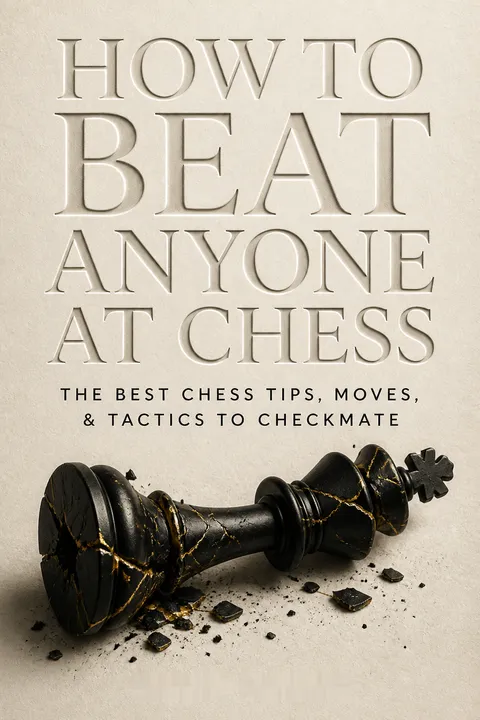
How To Beat Anyone At Chess receives generally positive reviews, with readers praising its effectiveness for beginners. Many found the explanations of basic moves and rules helpful in improving their game. The book's use of algebraic notation and game scenarios is appreciated, though some found it challenging without a board. Readers noted significant improvement in their chess skills after reading. While some felt the title was overstated, most agreed it provides a solid foundation for understanding chess strategy and tactics.
People Also Read




Glossary
tempo
a move's time valueA tempo is one turn or move in chess. Players speak of gaining or losing a tempo when a move forces the opponent to spend time responding, or when a player must move the same piece again instead of developing another piece. A tempo can matter when both sides race to attack or improve their positions.
Exchange
rook for minor pieceThe Exchange is the difference between a rook and a bishop or knight. A player wins the Exchange by capturing a rook while losing only a minor piece, or loses it by making the reverse trade. The term does not mean any ordinary trade of pieces, even though chess players also use exchange in that broader sense.
pawn chain
connected diagonal pawnsA pawn chain is a sequence of pawns that defend one another along forward diagonals. The pawns near the front can be difficult to capture because a pawn behind them may recapture. The supporting pawn at the base can be vulnerable, so attacking that base may weaken or break the entire formation.
passed pawn
pawn with no blockersA passed pawn has no opposing pawns ahead of it on its own file or either adjacent file. Because enemy pawns cannot stop its advance, it may reach the far end of the board and promote into a queen, rook, bishop, or knight. Opponents often try to capture it or blockade it with a piece.
fork
one piece attacks several targetsA fork occurs when one piece or pawn attacks two or more opposing targets at the same time. Since the defender may be unable to protect or move every target, the attacker can often win material. Knights are especially associated with forks because their unusual jumps let them attack pieces that cannot easily attack them back.
pin
piece restricted by a line attackA pin occurs when a long-range piece attacks an opposing piece that stands in front of a more valuable target on the same rank, file, or diagonal. The front piece may be reluctant to move because doing so exposes the more valuable piece. If moving it would expose its own king to check, the pin is absolute and the move is illegal.
skewer
valuable piece forced asideA skewer is a line attack on two opposing pieces, with the more valuable piece in front. The attacked valuable piece must move or be lost, exposing the piece behind it to capture. It resembles a pin in reverse: the front piece is compelled to leave rather than being held in place.
zwischenzug
an intervening threatA zwischenzug is a German term for an in-between move. Instead of answering an immediate threat directly, a player makes a more urgent move, often a check or an attack on the queen. After the opponent responds, the player can return to the original issue, sometimes with a better result.
opposition
kings contesting key squaresOpposition describes a position in which the two kings face one another along a rank or file with a square between them. The player who does not have to move is often said to have the opposition. In king-and-pawn endings, this can let that player control the route the opposing king can take.
zugzwang
every move worsens the positionZugzwang is a position in which a player would prefer to pass, but chess rules require a move. Any legal move makes that player's position worse. It most often appears in endgames, where even a small change in king or pawn placement can decide whether a player can defend or promote.
en passant
special pawn captureEn passant is a special pawn capture available when an opponent advances a pawn two squares from its starting rank, passing an adjacent pawn. The adjacent pawn may capture it as though it had advanced only one square. The capture must be made immediately on the next move or the opportunity is lost.
Chess960
randomized chess starting positionsChess960 is a chess variant associated with Bobby Fischer. The pieces on each player's home rank begin in a randomized arrangement, subject to rules that preserve a king between the rooks and bishops on opposite-colored squares. There are 960 possible starting arrangements, which reduces reliance on memorized opening lines while retaining the usual pieces and aims.
Download PDF
Download EPUB
.epub digital book format is ideal for reading ebooks on phones, tablets, and e-readers.








