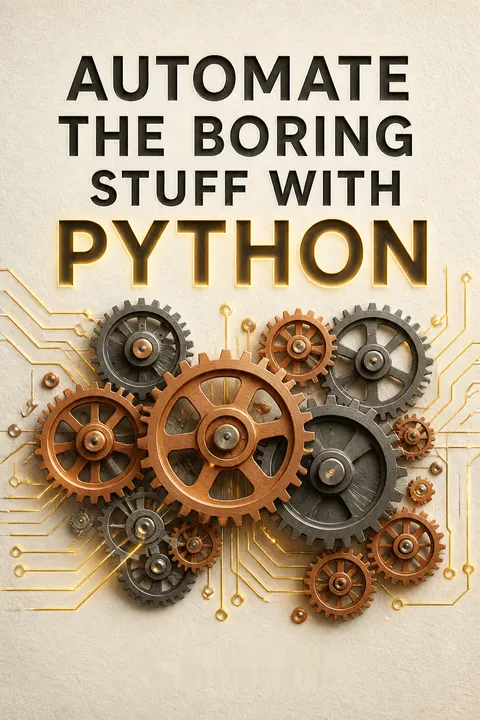


Key Takeaways
Turn a two-day clerical chore into a seconds-long program
The computer was already capable. Sweigart opens with a retail store comparing thousands of competitor prices. Three employees printed the spreadsheet, split the pages, and spent days checking prices by hand. A novice programmer wrote a short script that looked up each competitor’s price in the store’s data and flagged cheaper items. The program ran in seconds, and the staff took a long lunch. The bottleneck was not the computer or the task. It was the absence of instructions telling the computer how to do the work.
Start with repetition. The book is aimed not at aspiring software engineers, but at people who already use computers and repeatedly move files, edit spreadsheets, fill forms, or send routine messages. The practical test is simple: if a task is tedious, rule-based, and repeated, it may be a candidate for automation.
The price-checking story makes programming feel less like an exclusive technical profession and more like writing down a procedure with unusual precision. That reframing connects to process improvement: before automating a workflow, one must identify its repeatable steps and the exceptions humans currently handle. Automation can save labor, but it can also reproduce a flawed rule at machine speed. The strongest first project is therefore small enough to verify, useful enough to matter, and clear enough that its results can be checked against the original manual process.
Break a task into testable steps before writing the whole program
Code is explicit procedure. A program combines basic instructions: perform actions in order, choose a path when a condition holds, and repeat actions while needed. These are the building blocks of flow control, the rules that direct which code runs and when. A guessing game, for example, compares a guess with a secret number and reports whether the guess is too high, too low, or correct. Functions package a sequence of instructions under a name so it can be reused rather than copied.
Learn by trying. The interactive shell runs an instruction as soon as it is entered, making it a quick place to test expressions and inspect results. Programming requires little beyond basic arithmetic. Like solving Sudoku, it is chiefly about breaking a problem into smaller logical steps. Errors are ordinary feedback, not evidence that the computer or learner is broken.
This approach resembles decomposition in mathematics and experimental science: isolate a small claim, test it, and build on what is known. The interactive shell shortens the feedback loop, which is especially valuable for beginners because abstract rules become visible results. The book deliberately favors working examples over sophisticated language features. That lowers the entry cost, although simple teaching code should not be mistaken for a universal design standard. Beginners benefit most when they learn both habits: experiment freely, and make each experiment small enough to understand.
Use lists for sequences and dictionaries for labeled facts
Give information a useful shape. A list stores values in order, so a program can handle any number of cat names without creating a separate variable for each one. A dictionary instead connects keys to values, such as a person’s name to a birthday or an item to its quantity. In a tic-tac-toe model, nine labeled dictionary entries represent the board’s spaces; code can then print or update the board by location. Nested lists and dictionaries can represent more complex collections, such as guests and the food each is bringing.
Protect the boundaries. A function groups reusable work and accepts inputs through parameters. Its local variables are separate from variables in other functions, which limits where a mistake can originate. Lists are mutable, meaning their contents can change, and variables can refer to the same underlying list. Copying a list may therefore require an explicit copy rather than a second variable assignment.
Data structure choice is a form of modeling, not just syntax. A list answers, “What comes next?” A dictionary answers, “What is associated with this label?” That distinction helps programs mirror the questions people actually ask about their information. The shared-reference behavior of mutable lists is also an early lesson in aliasing, a common source of subtle bugs in many languages. Clear models make code easier to reason about, but they remain simplifications. A board represented by nine labels works for a small game; a different task may need a different representation.
Let patterns and string tools do the text searching
Text has structure. Python strings can be sliced, joined, split, normalized to upper or lower case, and checked for properties such as being numeric. These tools help validate input and transform large blocks of text without editing each line manually. The book’s clipboard example takes copied lines, adds a bullet marker to each, and puts the revised text back on the clipboard.
Describe the pattern. A regular expression is a compact description of text to find, such as a digit pattern for a phone number. Python’s regular-expression tools can find one or many matches, capture parts of a match, or replace matching text. The phone-and-email extractor searches clipboard text and returns the matches together. For complicated patterns, readable spacing and comments help prevent the pattern itself from becoming a new source of errors.
Treating text as data is a major shift: documents that look like prose to a person may contain repeated patterns a program can identify reliably. This connects programming to information retrieval and data cleaning, where normalization often precedes comparison. Regular expressions reward precision, but their compactness can hide assumptions. A pattern that catches common email addresses or phone formats is not a complete definition of every valid address or number. The best use is targeted extraction from a known class of text, followed by sensible checks on what was found.
Preview file changes before letting a script move or delete anything
Paths are part of the problem. A script needs to know where files live, whether a path is absolute or relative, and which folder is its current working directory. Python can read and write text files, save program data, copy or rename files, walk through nested folders, and create ZIP archives. These abilities turn a script into a practical file clerk for tasks such as changing date formats in many filenames or backing up a project folder.
Test before acting. File operations can overwrite or permanently delete valuable work. The book recommends first replacing destructive actions with print statements, so the program shows exactly what it would change. For deletion, a safer option is to send items to the computer’s trash rather than erase them irreversibly. Keep original files until the output has been checked.
The preview-first approach is a concrete form of a broader safety principle: separate deciding what should happen from actually changing the world. In database work, this resembles a dry run or transaction review. The same logic applies to bulk email, account updates, and data migrations. Automation magnifies both accuracy and error, so reversibility matters as much as speed. A script that confidently performs the wrong operation is not efficient. It is a fast way to create a larger cleanup job.
Make spreadsheets and common data formats answer questions automatically
Turn files into usable data. Spreadsheet libraries let a program read rows and cells, total population across thousands of census tracts, or update selected prices while leaving unrelated entries alone. A dictionary can store the revised prices, keeping the data to change separate from the logic that applies it. Saving changes to a new workbook preserves the original as a fallback.
Choose the right format. Excel files retain formulas, formatting, and multiple sheets. CSV files are simpler text spreadsheets, but commas inside a value mean they should be read with Python’s CSV tools, not split by hand. JSON represents common data such as lists and dictionaries in a format used by many web services. PDF and Word tools can extract or alter some content, though PDF text extraction may be imperfect and document libraries have format-specific limits.
The central skill here is translation between representations: a human-facing spreadsheet becomes structured values, code performs a calculation or correction, and the result becomes a new file. This is the foundation of data engineering, even in miniature. Separating update data from program logic also makes a script easier to audit and adapt. Yet file formats are not neutral containers. A CSV loses spreadsheet features, and extracted PDF text may not preserve layout or meaning. Reliable automation requires knowing not only what a library can do, but what information it discards.
Fetch web pages, parse their structure, and automate browser actions selectively
Use a web workflow. Web scraping means downloading and processing web content with a program. The book’s tools divide the work: Requests retrieves a page, Beautiful Soup parses its HTML and locates elements through selectors, and a browser-control tool can click links, fill forms, and submit them. One project follows previous-comic links to download an archive of XKCD images. Another opens a map from an address copied to the clipboard.
Match the tool to the task. For a page with accessible data, downloading and parsing is usually more direct than controlling a visible browser. Browser automation is useful when an interaction, such as logging in or submitting a form, is required. HTML should be parsed with an HTML parser rather than treated as ordinary text, because valid pages can be structured in many different ways.
The staged workflow reflects a useful separation of concerns: retrieval, interpretation, and interaction are distinct problems. That same architecture appears in modern data pipelines. The caution is that web pages are moving targets. A selector tied to a site’s current markup can stop working after a redesign, and automated access can burden a service or violate its rules. Robust scraping therefore needs clear limits, error handling, and respect for the site’s access policies, not merely code that succeeds once.
Catch mistakes close to their source with logs, assertions, and debugging
Make hidden behavior visible. An exception reports a failure; a try and except block can handle failures the program anticipates. An assertion checks a condition that the programmer expects to be true and raises an error when it is not. Assertions are suited to programmer mistakes, while recoverable situations, such as invalid user input, call for ordinary error handling.
Leave a trail. Logging records messages, variable values, and event severity, and can write them to a file. This is more useful than filling a program with temporary print statements that may be forgotten or removed by mistake. A debugger can pause execution line by line or at a chosen breakpoint, allowing the programmer to inspect variables. In the book’s faulty factorial example, tracing the loop reveals that starting at zero makes every product zero.
These techniques make debugging less like guesswork and more like diagnosis. Assertions encode expectations; logs record evidence; stepping through code reveals the actual state rather than the state the programmer assumes. This resembles observability in larger software systems, where reliable operation depends on being able to inspect what a system is doing. The important distinction is between failures worth recovering from and violated assumptions that should stop execution. Catching every error indiscriminately can hide faults, while failing fast can make the real cause easier to find.
Let clocks and external services make scripts useful beyond one session
Add time and concurrency. Timestamps measure elapsed time, while date and duration objects support readable schedules and date arithmetic. A script can pause, track stopwatch laps, or run at a chosen time through the computer’s scheduler. Threads allow parts of a program, such as several downloads, to run concurrently. They can improve throughput, but shared data can create hard-to-reproduce errors, so separate threads should avoid reading and writing the same variables.
Give programs reach. Python can launch other applications, send email through SMTP, retrieve email through IMAP, and send text alerts through a service such as Twilio. A dues-reminder project reads payment status from a spreadsheet and sends personalized messages to members who have not paid. Passwords should not be stored in source code or exposed in command history.
These capabilities shift a script from a local helper to a participant in a larger workflow. Time scheduling, external processes, and notifications connect code to organizational routines, where failures can affect other people. That makes security and reliability part of the programming task, not optional polish. Threading is particularly easy to overvalue: concurrency helps when work can overlap, but it adds coordination costs and race conditions. For beginners, a clear sequential program is often safer unless parallel execution solves a measurable bottleneck.
Put brakes on mouse-and-keyboard automation before it runs wild
The interface becomes programmable. GUI automation simulates mouse movement, clicks, key presses, and scrolling, letting Python operate software that has no convenient programming interface. A form-filling project clicks the first field, types answers, uses tabs and arrow keys to navigate, and submits repeated entries. Screenshots, pixel-color checks, and image recognition can help a script determine whether a target is where expected.
Build an exit first. GUI scripts can act faster than a person can intervene, and a misdirected click may have real consequences. The book recommends pauses between actions and a fail-safe that stops the script when the cursor is moved to the screen’s upper-left corner. Test coordinates and keystrokes on a small example before running a large batch. GUI automation is powerful precisely because it can imitate almost anything a person does, including mistakes.
GUI automation is a useful last-mile tool: it reaches applications that expose no data interface, but it is fragile because screen layout and focus are implicit. This is a human-factors problem as much as a coding problem. Pauses, visible status messages, and emergency stops create opportunities to notice and interrupt unexpected behavior. Whenever a stable API or file-based interface exists, it is usually easier to test than simulated clicking. When the interface is the only route, deliberate safeguards are part of the program’s basic design.
Analysis
The book’s deepest argument is that programming is a practical literacy for people who already have work to do. Its opening price-comparison story is not merely a celebration of speed. It demonstrates a change in perspective: a computer is not only a place where repetitive work happens, but a tool that can be instructed to perform it. The book then builds a ladder from small expressions to decisions, loops, functions, and data structures, before using those ideas to manipulate the files, websites, spreadsheets, messages, images, and interfaces people encounter every day.
Its structure is unusually effective for beginners because concepts are introduced in service of recognizable chores. Lists become useful when a fixed set of separate variables becomes restrictive. Dictionaries become useful when facts need labels. Regular expressions become useful when manual searching for phone numbers is absurd. Each chapter asks the reader to see a familiar task as data plus a procedure. The projects make this transformation concrete, and the interactive shell encourages learning through immediate feedback rather than passive memorization.
The book also exposes a tension central to automation. A small script can compress days of work into seconds, but it can also repeat a bad assumption at scale. The repeated advice to inspect results, preserve original files, handle errors, and add GUI fail-safes is therefore not housekeeping. It is the ethical and technical counterpart to efficiency. Automation should reduce drudgery without removing human judgment from consequential decisions.
The material is tied to the software ecosystem and Python version of its publication period, so specific libraries and interfaces may have changed. Its durable value lies elsewhere: decompose a task, represent its information clearly, test the parts, and only then let the machine repeat them. That method remains useful even when the tools change.
Review Summary
Automate the Boring Stuff with Python receives mostly positive reviews, praised for its practical approach and beginner-friendly content. Readers appreciate its focus on real-world applications and automating tasks. Some experienced programmers find it too basic, while others value its introduction to useful Python libraries. The book's clear explanations and engaging projects are highlighted as strengths. Critics note that it may not provide enough depth for more advanced programmers or those seeking comprehensive Python knowledge. Overall, it's recommended for beginners and those interested in practical Python applications.
People Also Read






Glossary
Interactive shell
Immediate code-testing promptA prompt where Python instructions can be entered one at a time and run immediately. The shell displays the result or an error as soon as the instruction is evaluated. Sweigart uses it as a low-friction place to test expressions, learn language behavior, and investigate error messages before assembling a complete program.
Flow control
Rules directing program executionThe mechanisms that determine which instructions run, which are skipped, and which repeat. Conditions and Boolean values guide choices, while if statements, loops, break, and continue alter the path through a program. Flow control lets a program respond to data rather than merely execute every instruction in order.
Local scope
Function-specific variable spaceThe region created when a function is called, where its parameters and assigned variables exist. These local variables are separate from variables in other function calls and are discarded when the function returns. This separation limits which parts of a program can change a value, making code easier to organize and debug.
Mutable data type
Changeable stored valueA data type whose contents can be altered after creation. Lists and dictionaries are mutable in Python. Variables assigned to them hold references, so two variables may point to the same underlying object and observe the same changes. This differs from immutable values such as strings and tuples, whose contents cannot be changed in place.
Regular expression
Pattern for matching textA compact notation for describing a pattern of characters to find or replace. Python’s regular-expression tools can locate matches, capture parts of them, find multiple occurrences, or substitute text. For example, a pattern can describe a phone number’s digit groups and separators without testing each possible character sequence by hand.
Web scraping
Programmatic web-content processingUsing a program to download web pages and process their contents. In the book’s workflow, a request retrieves a page, an HTML parser identifies relevant elements, and browser automation can handle interactions that require clicks or form submission. Scraping depends on understanding the page structure and can break when that structure changes.
CSV
Plain-text tabular dataA text format that represents spreadsheet rows, usually separating cell values with commas. CSV is widely supported and easy for programs to process, but it does not preserve spreadsheet features such as formatting, formulas, or multiple worksheets. Since commas can occur inside values, the book recommends Python’s CSV tools instead of splitting each line manually.
JSON
Text format for structured dataJavaScript Object Notation is a human-readable format for representing common structured values such as strings, numbers, lists, dictionaries, Booleans, and null. Python’s JSON tools convert between JSON text and corresponding Python values. Websites often return JSON through APIs, allowing programs to use data intended for machines rather than parse a human-oriented web page.
Epoch timestamp
Seconds since a reference dateA number representing seconds elapsed since January 1, 1970, at midnight Coordinated Universal Time. Python’s time module uses this representation to measure elapsed time and record moments. It is compact and convenient for calculations, while datetime objects are generally easier to read, format, and use for calendar arithmetic.
Thread
Concurrent execution pathA path of execution within a program. A program can start multiple threads so that tasks such as network downloads can overlap rather than occur strictly one after another. Threads can improve use of waiting time, but they can produce concurrency issues when they read and write shared variables in conflicting ways.
GUI automation
Programmatic mouse and keyboard controlUsing code to simulate a person’s mouse movements, clicks, key presses, and scrolling in graphical applications. It can automate software without a programming interface, including repetitive form entry. Because screen position and focus can change, dependable GUI automation benefits from pauses, visual checks, testing, and an emergency stop.
RGBA value
Red, green, blue, transparencyA four-part color representation used in image processing. The red, green, and blue components specify color, while alpha specifies transparency. In Pillow, each component is typically an integer from 0 to 255. RGBA values can be assigned to pixels and used when drawing, editing, or compositing images.
FAQ
What's Automate the Boring Stuff with Python about?
- Practical programming for beginners: The book is tailored for those new to programming, focusing on learning Python through practical examples and projects.
- Focus on automation: It emphasizes automating everyday tasks like file management, form filling, and web scraping, making programming useful and accessible.
- Hands-on approach: Al Sweigart uses a friendly tone and clear examples, encouraging readers to follow along with projects to solidify their understanding.
Why should I read Automate the Boring Stuff with Python?
- Time-saving skills: Learn to automate repetitive tasks, saving hours of manual work and increasing efficiency in daily routines.
- Beginner-friendly: The book is written in an engaging style, with step-by-step instructions that make programming concepts easy to grasp.
- Wide range of applications: Skills learned can be applied to various fields, from data analysis to web scraping, enhancing productivity.
What are the key takeaways of Automate the Boring Stuff with Python?
- Basic programming concepts: Gain a solid understanding of Python fundamentals, including variables, loops, and functions.
- Practical automation skills: Learn to automate tasks such as web scraping, file manipulation, and email management, applicable in personal and professional contexts.
- Problem-solving mindset: Develop a problem-solving approach to programming, breaking down tasks into manageable steps.
How does Automate the Boring Stuff with Python approach teaching Python to beginners?
- Step-by-step guidance: Complex concepts are broken down into manageable steps, making it easier for beginners to follow along.
- Interactive examples: Readers are encouraged to try out code examples in their own Python environment, reinforcing learning through practice.
- Focus on real-world applications: The emphasis on automating everyday tasks keeps the content relevant and engaging.
What programming concepts are covered in Automate the Boring Stuff with Python?
- Python basics: The book starts with data types, control flow, and functions to build a solid foundation.
- File handling: Learn to read from and write to files, crucial for automating data storage tasks.
- Regular expressions: Introduces pattern matching for tasks like data validation and text processing.
How does Automate the Boring Stuff with Python help with file manipulation?
- File handling techniques: Learn to open, read, write, and close files using Python, fundamental for automating file-related tasks.
- Practical examples: Provides examples of moving, renaming, and deleting files, applicable to personal workflows.
- Error handling: Discusses handling errors during file operations, ensuring robust script writing.
What is the significance of regular expressions in Automate the Boring Stuff with Python?
- Pattern matching: Regular expressions are introduced as a powerful tool for searching and manipulating text.
- Practical applications: Examples include finding phone numbers and email addresses, demonstrating utility in real-world scenarios.
- Simplifying code: Regular expressions allow for more concise and efficient text processing code.
What tools and libraries are introduced in Automate the Boring Stuff with Python?
- PyPDF2: Used for reading and manipulating PDF files, allowing text extraction and document merging.
- openpyxl: Enables reading and writing Excel files, automating spreadsheet tasks.
- Beautiful Soup: A powerful library for web scraping, parsing HTML, and extracting data from web pages.
What are some practical projects included in Automate the Boring Stuff with Python?
- Web scraping: Learn to extract data from websites using libraries like
requestsandBeautifulSoup. - Excel automation: Automate tasks in Excel using the
openpyxllibrary, useful for data analysis. - Email automation: Send emails programmatically using the
smtplibmodule, automating communication tasks.
How can I apply what I learn from Automate the Boring Stuff with Python in my daily life?
- Automate repetitive tasks: Use skills to automate tasks like organizing files or sending reminders, saving time.
- Enhance productivity: Implement scripts to streamline workflows, such as downloading reports or scraping data.
- Develop problem-solving skills: Apply programming concepts to solve everyday problems, fostering efficiency and innovation.
What are the best quotes from Automate the Boring Stuff with Python and what do they mean?
- "A computer is like a Swiss Army knife...": Highlights programming's versatility in solving a wide range of problems.
- "Programming isn’t brain surgery...": Encourages experimentation and learning from mistakes in coding.
- "By learning how to program...": Underscores the empowerment and innovation potential of programming skills.
What resources are available for further learning after reading Automate the Boring Stuff with Python?
- Online communities: Join forums like Stack Overflow or Reddit to ask questions and share knowledge with other learners.
- Additional books: Explore other programming books and resources recommended by the author for continued learning.
- Practice projects: Engage in personal or open-source projects to reinforce concepts and gain practical experience.
About the Author
Other books by Al Sweigart

Download PDF
Download EPUB
.epub digital book format is ideal for reading ebooks on phones, tablets, and e-readers.








