

Key Takeaways
Turn vague ambition into written targets, plans, and daily work.
A small pivot began the story. Brian Tracy left school without graduating, drifted through manual jobs, and eventually found work in commission sales. At a low point, he wrote down a goal to earn $1,000 a month. Within thirty days, after improving his sales technique, he was offered a role leading the sales team at that salary. Tracy presents this as the turning point that made goal setting central to his life, not as proof that writing alone caused the promotion.
The book's central claim is that clear goals direct attention and effort. Its simplest prescription is to write what matters, plan how to pursue it, and work on that plan regularly. Without a destination, even hard work can wander.
The story is compelling because the written goal coincides with a practical change: Tracy improves his selling and makes his value visible. That distinction matters. A target can focus attention, but it does not replace skill, opportunity, or other people's decisions. The most useful reading is not that a goal summons a promotion, but that naming a desired result can make relevant actions easier to notice and sustain. The book's memorable promise is therefore strongest when treated as a discipline of direction rather than a guarantee of outcome.
Take responsibility for your next move without pretending to control everything.
Agency starts with ownership. Tracy recalls sitting broke in a cold apartment at twenty-one and realizing that change would have to begin with him. He argues that blaming, making excuses, and replaying old grievances keep attention fixed on what cannot be changed. His proposed reset is to identify one's part in a situation, accept it, and turn toward a useful next action.
He names four habits that sustain negative emotion: justification, rationalization, dependence on others' approval, and blaming. For instance, someone laid off because of economic conditions can spend energy prosecuting the unfairness, or recognize the loss and begin a job search. Tracy's prescription is responsibility, not passive optimism: acknowledge the facts, then act where action remains possible.
Ownership is powerful when it restores choice, especially after disappointment. It becomes less helpful if interpreted as personal blame for illness, discrimination, economic shocks, or another person's conduct. Those forces are real, and responsibility cannot erase them. A balanced application separates control over the event from influence over the response: name external conditions honestly, then locate the decisions, requests, or preparations still available. That preserves the book's forward motion without turning agency into a demand to carry fault for circumstances beyond one's reach.
Choose goals that fit your values and give the future a shape.
Values set the direction. Tracy describes personality as a chain running from values to beliefs, expectations, attitudes, and actions. The underlying point is practical: a person can reach an impressive target and still feel dissatisfied if the achievement conflicts with what matters most. He recommends examining choices under pressure, past uses of time and money, and the qualities one hopes others will remember.
Then look ahead. Tracy's idealization exercise asks readers to imagine life five years from now with work, finances, relationships, health, and community involvement going well. They picture the desired future first, then look back and ask what would need to happen. This is a way to make aspirations concrete before current limitations narrow the options too soon.
The values lens guards against a common failure of productivity: becoming efficient at pursuing a borrowed definition of success. Looking five years ahead can also reveal tradeoffs that short-term goals conceal, such as income gained at the cost of family time. The exercise is most useful when the imagined future includes ordinary days, not only status markers. A vivid vision can motivate, but values need periodic examination because priorities change with responsibilities, health, and circumstance.
Make each goal measurable, dated, challenging, and connected to a workable plan.
Replace wishes with specifications. Tracy says a useful goal is written, clear, measurable, time-bounded, and aligned with other priorities. Wanting to earn more is vague; naming an amount and a target date makes progress easier to assess. He also advises choosing a meaningful stretch, while keeping it believable enough to sustain effort.
His twelve-step method turns a desire into a project: clarify what is wanted and why, write it down, assess the starting point, set a deadline, identify obstacles, skills, and helpers, make a sequenced plan, visualize the result, and persist. The method also asks for concrete measures. A large goal becomes less intimidating when divided into steps that can be scheduled, completed, and reviewed.
This framework's strength is diagnostic: when progress stalls, it directs attention to a missing ingredient, such as knowledge, support, or an honest baseline, rather than prescribing vague determination. Its many steps are best treated as prompts, not paperwork to complete perfectly. A plan should clarify the next useful action and expose assumptions. If the process becomes more elaborate than the work itself, simplify it. The value lies in making intention testable and revisable.
Give one consequential goal priority instead of scattering effort across wishes.
Choose a central aim. Tracy calls the most important current goal a major definite purpose: a clear, personally desired outcome that can advance several other goals. His exercise is to list ten goals, then ask which one would most improve life if achieved. That answer becomes the focal point for plans and daily attention.
Keep ambition credible. At a seminar, a broke participant who had just lost her job said she planned to become a millionaire within a year. Tracy warned that a target far beyond her present circumstances might discourage rather than mobilize her. He also recounts setting an income goal ten times his prior earnings, then recognizing that he did not truly believe it was attainable. A challenging target should stretch capacity without becoming an excuse to disengage.
A focal goal reduces competition for attention and gives smaller decisions a useful test: does this help the central aim? Yet single-mindedness has costs if the chosen target crowds out health, care, or other obligations. Tracy's own framework calls for balance, so focus should mean priority, not tunnel vision. Revisiting the central aim is essential when circumstances change or when pursuing it reveals that the goal was inherited, poorly defined, or no longer worth its price.
Measure your starting point, then remove the constraint slowing progress most.
Begin with the facts. Tracy urges readers to establish a baseline before setting a route forward. For finances, calculate assets minus debts; for health, record current weight and activity; for work, identify key tasks and current skill levels. He also proposes zero-based thinking: ask whether, knowing what is known now, one would choose to continue a job, commitment, or relationship. If not, consider how to change or leave it.
Find the bottleneck. Tracy adapts the theory of constraints, the idea that one limiting factor can set the pace of a whole process. He recommends asking why a goal has not been reached, then asking what else might explain the problem. A sales shortfall, for example, could stem from too few prospects, small purchases, or weak follow-up, each requiring a different remedy.
Baseline measurement and repeated problem definition prevent energy from being spent on the wrong fix. Zero-based thinking is especially useful for distinguishing a commitment's past value from its present value. Still, the book's claim that most obstacles are internal should not be mistaken for a universal diagnosis. Resources, institutions, and other people can impose genuine limits. A good constraint analysis tests internal and external explanations against evidence before assigning responsibility or choosing an intervention.
Raise your earning power by mastering the weakest essential skill.
Excellence is built skill by skill. Tracy argues that a job usually depends on several key result areas, often five to seven. A salesperson, for example, needs to find prospects, understand needs, present solutions, address objections, close, and earn repeat business. A serious weakness in one essential area can limit the value of stronger abilities elsewhere.
Assess, then practice. Tracy recommends rating performance and asking a manager, coworker, or customer for an outside view. He describes a lawyer who decided business suited him better, earned an MBA, joined an airline in an entry-level role, and became its president within ten years. His suggested learning routine combines reading, educational audio, seminars, and immediate practice. The principle is to invest in the specific skill that most limits performance, then reassess.
The focus on a weakest essential skill is more precise than simply trying to work harder. It encourages feedback and targeted learning, while the career-change story shows that past training need not dictate a whole career. The approach also benefits from a strengths check: a person may improve faster by building on a strong ability than by trying to eliminate every weakness. The practical question is which skill materially affects results in the chosen role, not which trait seems least flattering.
Treat financial independence as a plan, not a lucky break.
Make money measurable. Tracy recommends calculating current net worth, tracking income, setting debt-reduction and savings targets, and identifying the skills that can raise earning power. He suggests saving 10 to 20 percent of income when possible. To estimate a retirement target, his book proposes multiplying comfortable monthly expenses by twelve, then by twenty. For example, $5,000 a month produces a target of $1.2 million under this rule of thumb.
Use the estimate carefully. This arithmetic is a planning prompt from the book, not a personalized financial forecast. Taxes, inflation, investment returns, health costs, and retirement timing can change the amount required. Tracy's broader advice is to establish a starting point, set dated milestones, learn about money, and seek informed guidance rather than leaving financial goals to chance.
The chapter makes an important behavioral shift: financial independence becomes a series of visible decisions rather than a distant fantasy. Tracking net worth and savings can reveal whether daily spending matches long-term priorities. The numerical shortcut is useful for opening a conversation, but its simplicity can create false confidence if treated as a complete retirement calculation. Financial targets need assumptions that fit a person's circumstances, and income growth is not equally available to everyone. Planning is valuable precisely because estimates can be updated.
Build goals around people, since progress and happiness are relational.
Achievement depends on cooperation. Tracy asks readers to identify the people whose help a goal requires, from family and coworkers to customers and suppliers. At work, he suggests asking a manager which responsibilities matter most, then prioritizing those tasks. He also advises offering useful help before seeking support, so relationships are built through contribution rather than one-way requests.
Make home life deliberate, too. Tracy proposes asking family members what they would like more of, less of, newly started, or stopped. He recounts doing this with his wife and children and changing his behavior in response. The chapter also emphasizes time together, shared plans, and learning about activities that matter to loved ones. Relationships are not a side project; they shape the quality and sustainability of achievement.
This perspective expands goal setting beyond individual willpower. Work depends on coordination, and family members experience the costs as well as the benefits of ambitious plans. Asking directly what others need can correct assumptions that good intentions alone will maintain closeness. The advice to associate with successful people is less useful if interpreted as discarding anyone who lacks status. Trust, mutual care, and shared commitments often matter more than a contact's perceived career value.
Protect high-value work with priorities, uninterrupted time, and visible measures.
Plan before the day takes over. Tracy recommends making task lists, ordering them by importance and sequence, and identifying the work with the greatest consequences. His ABCDE method labels tasks: A items matter greatly, B items matter somewhat, C items are optional, D items can be delegated, and E items can be eliminated. He advises starting with the highest-priority task and concentrating on it until complete.
Make progress visible. Break large aims into monthly, weekly, or daily tasks, set deadlines, and track relevant measures. Tracy argues that written plans improve thinking even when events force revisions. He cites a study of start-up companies in which firms that planned carefully performed better, while noting that managers often did not consult the finished plan. The process of planning, rather than a frozen document, is the point.
Prioritization and focused work protect important tasks from the steady pull of urgent interruptions. Measures also make it easier to notice whether effort is producing movement. These tools work best when the chosen metric reflects meaningful progress; a person can become highly efficient at a low-value measure. Plans should therefore be revisited against outcomes and changing conditions. Structure supports judgment, but it cannot substitute for deciding what deserves attention in the first place.
Review goals daily, but treat visualization as rehearsal, not magic.
Put intentions back in view. Tracy recommends writing ten to fifteen goals each day in positive, present-tense language, then adding possible actions. He says the repetition clarifies priorities and keeps them accessible. He also suggests carrying goal cards and reviewing them morning and evening. The book pairs this practice with visualization: imagining a desired result and mentally rehearsing the behavior needed to reach it.
Use images to prepare. Tracy describes athletes mentally practicing performances and advises picturing the actions, not only the prize. He also claims that sustained focus activates a superconscious mind, a source of intuition and breakthrough ideas. This is a spiritual explanation within the book. A grounded use of the exercise is to treat intuition as a prompt for ideas, then test those ideas against facts and take practical steps.
Repeated review can keep a distant aim connected to today's choices, while mental rehearsal can make a difficult performance feel more familiar. The distinction between rehearsal and prediction is crucial: picturing success does not establish that external events will cooperate. Tracy's superconscious language gives meaning to intuition, but it should not be confused with a demonstrated mechanism that guarantees results. Reflection is most productive when paired with planning, feedback, and willingness to revise.
Persist through setbacks while revising tactics when evidence changes.
Expect friction, not a smooth climb. Tracy presents persistence as self-discipline sustained after initial enthusiasm fades. He recounts Orison Swett Marden writing an 800-page manuscript, losing it when a fire destroyed the building, and spending another year recreating it before eventually finding a publisher. The story shows persistence as continued effort after a severe setback, not as instant success.
Turn obstacles into questions. Tracy advises identifying fears, learning what is missing, and looking for a solution rather than rehearsing the problem. Small successes can build confidence for harder challenges. His strongest practical message is to take action instead of waiting for perfect certainty. Persistence is most useful when paired with learning: retain the purpose when it still matters, while changing the route when evidence shows the current one is failing.
The Marden story gives persistence a human scale: the work had to be done again, and publication was not immediate. Commitment can carry a person through discouragement, but endurance alone does not prove that a strategy is sound. Treat setbacks as information, not automatic confirmation that a breakthrough is near. A durable approach combines resolve about the underlying purpose with flexibility about methods, costs, and stopping points.
Analysis
Goals! is a practical, framework-heavy guide organized around a simple proposition: clear aims shape attention, and repeated action turns attention into progress. Its narrative begins with Tracy's move from precarious labor to commission sales, then generalizes that experience into a repeatable program. The most useful parts are concrete: write an outcome, assess the starting point, identify obstacles and missing skills, enlist other people, schedule tasks, measure progress, and revise. The same sequence is applied to money, work, health, and family life.
The book's strength is its insistence that ambition must become operational. It refuses to treat a wish as a plan and repeatedly asks readers to specify what success would look like. Its weakness is the tendency to present personal agency as nearly unlimited and to describe contested or spiritual claims, especially the superconscious mind and attraction, with the confidence of established mechanisms. The success stories are persuasive illustrations, but they cannot show that goal writing alone caused the outcomes; they also select people who succeeded and leave less room for unsuccessful attempts or structural constraints.
A modern reading can retain the behavioral core while narrowing the promises. Specific goals, deadlines, feedback, and plans resemble implementation intentions, which connect a desired outcome to an action in a recognizable situation. Measurement can create useful feedback, but poorly chosen metrics can distort priorities. Visualization is most defensible as mental rehearsal of actions, not as a way to make external events arrive. Responsibility is empowering when it identifies choices, and harmful when it erases unequal conditions. The book's durable contribution is less a guarantee of achievement than a method for converting intention into observable work, while staying alert to whether the method is still serving the life one actually values.
Review Summary
Goals! receives mostly positive reviews, with readers praising its practical advice on goal-setting and achievement. Many find it motivational and life-changing, appreciating Tracy's clear writing style and actionable tips. Some critics note repetition and oversimplification, while others feel it focuses too heavily on material success. The book is particularly recommended for those new to self-help literature or struggling with goal-setting. Several reviewers mention rereading the book multiple times for continued inspiration and guidance.
People Also Read








Glossary
Major Definite Purpose
Central priority goalThe one goal that matters most at a particular stage and can help advance several other aims. Tracy says it should be personally important, clear, measurable, believable, and consistent with other goals and values. He recommends selecting it by asking which goal, if achieved, would have the greatest positive effect on one's life.
Twelve Steps to Set and Achieve Any Goal
Goal-to-action sequenceTracy's method for turning an ambition into a project. It asks the goal setter to clarify desire and belief, write the goal, assess a starting point, identify reasons and deadlines, find obstacles, needed skills, and helpful people, make a plan, visualize the result, and persist. The steps function as a checklist for planning and execution.
Zero-based thinking
Reassess current commitmentsA decision-making exercise that asks whether, with current knowledge, a person would choose to begin a particular job, activity, investment, or relationship today. If the answer is no, the next question is how to change or exit it. The method is intended to prevent past decisions from dictating future choices.
Key result areas
Essential job responsibilitiesThe small set of tasks that must be performed well for someone to succeed in a role. Tracy says many jobs contain roughly five to seven such areas. He recommends identifying and rating them, seeking feedback from others, and improving the weakest essential skill because it may limit overall performance.
ABCDE Method
Task-priority classificationA system for sorting tasks by importance and possible consequences. A tasks have major consequences, B tasks have milder consequences, and C tasks are optional. D tasks can be delegated, while E tasks can be eliminated. Tracy advises completing the highest-priority A task before moving to lower-priority work.
Three P Formula
Goal-writing formatA format for writing goals in positive, present, and personal language. For example, a goal is written as something the writer is doing or achieving, rather than as a distant intention. Tracy recommends adding a deadline and specific actions. The format is presented as a way to keep goals clear and mentally salient.
Law of Superconscious Activity
Claim about sustained thoughtTracy's spiritual and psychological claim that a thought, plan, or goal held continuously in conscious attention is eventually brought into reality by the superconscious mind. He connects this idea to intuition, insight, and unexpected opportunities. It is a central explanatory belief in the book, not an established scientific law.
Locus of Control Theory
Perceived control orientationA psychological concept distinguishing an internal sense that one's actions influence outcomes from an external sense that outcomes are controlled by circumstances or other people. Tracy uses the distinction to argue that accepting responsibility can increase perceived control and confidence. His discussion emphasizes agency, though external conditions can also materially shape outcomes.
FAQ
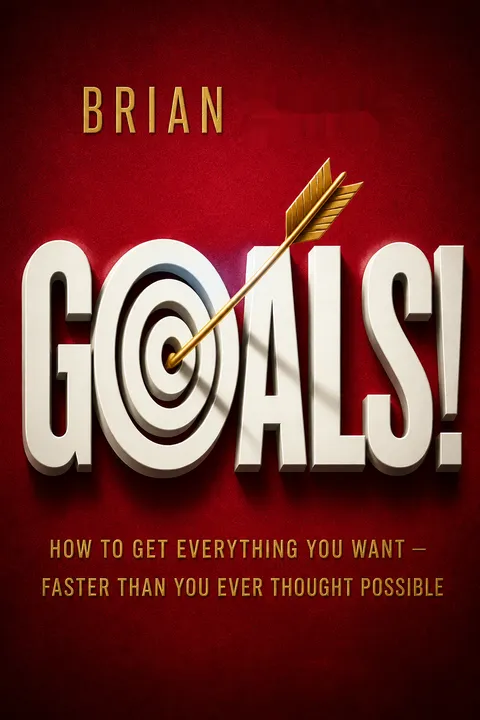
What's Goals!: How to Get Everything You Want -- Faster Than You Ever Thought Possible about?
- Focus on Goal Achievement: The book emphasizes setting clear, specific goals to achieve success in various life areas, such as health, finances, and personal development.
- Proven Strategies: Brian Tracy shares actionable strategies and techniques developed from years of research and personal experience to help individuals unlock their potential.
- Mindset and Responsibility: It discusses the impact of mindset and personal responsibility on goal achievement, encouraging readers to cultivate positive thinking and self-discipline.
Why should I read Goals! by Brian Tracy?
- Transformative Insights: The book provides insights into structuring your life around clear objectives, helping you identify and achieve what you truly want.
- Practical Framework: It offers a practical framework for setting and achieving goals, with actionable steps that can be implemented immediately.
- Inspiration and Motivation: Tracy’s motivational style and personal stories inspire readers to take action and persist through challenges.
What are the key takeaways of Goals! by Brian Tracy?
- Write Down Your Goals: Writing down goals, making plans, and working on them daily significantly increases success chances.
- Clarity and Specificity: Goals should be clear, measurable, and time-bound to be effective.
- Persistence is Key: Overcoming obstacles and maintaining focus on goals is crucial for long-term success.
What are the best quotes from Goals! by Brian Tracy and what do they mean?
- “Success is goals, and all else is commentary.”: This highlights that success is fundamentally about having clear goals, without which efforts can become aimless.
- “You become what you think about most of the time.”: Emphasizes the power of mindset and focus, suggesting that thoughts shape reality.
- “A goal or a decision without a deadline is merely a wish.”: Stresses the necessity of setting deadlines to create urgency and accountability.
What is the 12-Step Goal-Setting Methodology in Goals! by Brian Tracy?
- Desire and Belief: Start with a strong desire for your goal and believe it is achievable, which is crucial for motivation.
- Writing and Analyzing: Write down your goals, analyze your starting point, and determine why you want to achieve them for clarity.
- Planning and Persistence: Make a detailed plan, visualize success, and commit to never giving up to stay focused and motivated.
How does Goals! by Brian Tracy define a Major Definite Purpose?
- Central Focus: It is the one goal most important to you at any given time, guiding all actions and decisions.
- Clarity and Specificity: This purpose must be clear, specific, and measurable, driving daily activities.
- Alignment with Values: It should align with core values and other goals, ensuring overall satisfaction and fulfillment.
What specific methods does Brian Tracy recommend for goal setting in Goals!?
- Write It Down: Write down goals clearly and specifically to program them into your subconscious mind.
- Set Deadlines: Establish realistic deadlines for each goal to create urgency and focus.
- Visualize Success: Visualize goals as already achieved to enhance motivation and attract opportunities.
How does Goals! by Brian Tracy address the concept of self-discipline?
- Self-Discipline as Key: Identifies self-discipline as essential for achieving goals, allowing consistent action toward objectives.
- Building Habits: Discusses developing good habits through practice to strengthen self-discipline over time.
- Overcoming Procrastination: Provides strategies to combat procrastination, emphasizing immediate action on goal-related tasks.
What are the common obstacles to goal setting mentioned in Goals! by Brian Tracy?
- Lack of Awareness: Many people do not realize the importance of setting goals, leading to aimlessness.
- Fear of Failure: Fear can prevent setting ambitious goals, leading to self-sabotage and risk aversion.
- Negative Emotions: Emotions like anger and jealousy can hinder achievement; freeing oneself from these is essential for success.
How can I measure my progress according to Goals! by Brian Tracy?
- Set Clear Benchmarks: Establish specific benchmarks and milestones for each goal to track progress.
- Daily Review: Regularly review goals and progress to maintain focus and motivation.
- Celebrate Small Wins: Acknowledge and celebrate small achievements to boost morale and reinforce goal-setting habits.
What role does visualization play in achieving goals in Goals! by Brian Tracy?
- Mental Imagery: Visualization involves creating a clear mental picture of goals as if already achieved, programming the subconscious mind.
- Emotional Connection: Connecting emotionally with visualizations enhances motivation and commitment.
- Daily Practice: Regular visualization, especially before sleep and upon waking, reinforces goals in the subconscious mind.
How does Goals! by Brian Tracy suggest dealing with setbacks and failures?
- View Setbacks as Learning Opportunities: Encourages seeing failures as valuable lessons for future success.
- Maintain Persistence: Emphasizes persistence, noting that success often follows setbacks if one continues to push forward.
- Reassess and Adjust: Advises reassessing goals and strategies after setbacks to ensure they remain relevant and achievable.
About the Author
Other books by Brian Tracy








Download PDF
Download EPUB
.epub digital book format is ideal for reading ebooks on phones, tablets, and e-readers.








