

Key Takeaways
Design for human motivation, not just efficient task completion
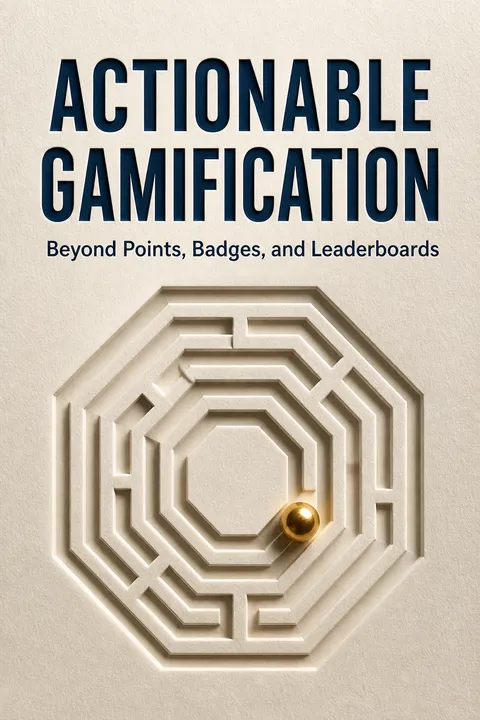
A game that ended. After spending thousands of hours in Diablo II, Yu-kai Chou quit and woke to an unsettling emptiness: his characters had advanced, but he had little to show for it in everyday life. He began treating life as a game of meaningful goals, skills, allies, and challenges. That personal shift became the book’s central design question: how can necessary work become something people want to do?
Motivation is the design. Chou calls this Human-Focused Design: building systems around people’s feelings and reasons for acting, rather than optimizing only for functional efficiency. A product can have useful features and still fail if people see no reason to use them. Points, badges, and leaderboards cannot rescue an experience whose underlying activity feels pointless.
The opening story gives the framework an unusually personal foundation: gamification is not merely a sales tactic, but an attempt to make effort feel connected to growth outside the system. That distinction matters because a game can absorb attention while producing little durable value. The design test is therefore not simply whether engagement rises, but whether the activity leaves people better equipped, more connected, or closer to an outcome they value. The book’s analogy has limits, since work and life carry obligations that games do not. Still, it usefully asks designers to earn participation rather than assume it.
Choose mechanics only after diagnosing the motives they must activate
Eight motivational families. Octalysis is Chou’s framework for asking why people act before selecting game elements. It groups motivation into eight broad sources: purpose beyond oneself, progress and mastery, creative agency, ownership, social connection, restricted access, uncertainty, and avoiding loss. A single feature may activate several at once, while a system can leave important motives untouched.
A map, not brain anatomy. The framework places some drives toward logical, reward-focused motives and others toward expressive, social, or curiosity-driven motives. It also distinguishes energizing motives that tend to feel positive from urgent motives that can feel pressuring. The left-brain and right-brain language is symbolic, not a literal claim about brain geography. The practical lesson is to ask what users should feel, then choose mechanics that fit.
The framework’s strength is diagnostic compression. A team can discuss a product in terms of progress, belonging, curiosity, or fear of loss instead of arguing vaguely about whether it needs more badges. That shared vocabulary can improve design conversations across product, marketing, and operations. Its neatness is also a risk: motives overlap, change by context, and differ between users. Octalysis works best as a prompt for hypotheses, not as a complete psychological inventory. Designers should check their interpretations against observed behavior and user accounts rather than treating an octagon diagram as proof.
Make progress feel earned, or points become decoration
Effort gives achievement meaning. The book’s second motivational drive is progress toward a goal, skill development, and overcoming a challenge. A score or badge matters only when it represents something users are proud to have done. Chou’s eBay story shows this in action: a first auction became thrilling because he felt he had won against other bidders, not merely bought an item. He later used auction timing to buy calculators cheaply and resell them for more.
Keep the next step clear. The Betty Crocker cake mix reportedly sold better after powdered eggs were removed and bakers had to add fresh ones. That small task made the result feel more like their accomplishment. LinkedIn’s profile-completion bar also raised profile completeness by 20 percent by showing users visible progress. Friction is not always bad; pointless friction is.
This account distinguishes achievement from mere completion. In education, work, and consumer products, a visible result can strengthen competence when the user understands the challenge and owns the effort. The cake example is especially revealing: convenience can strip away the feeling of authorship. Yet designers should not romanticize added effort. A meaningful step can create pride, while a needless hurdle can simply exhaust people. The useful question is whether the extra work improves the user’s sense of capability or the quality of the outcome, rather than just making a metric easier to manipulate.
Give people creative choices with feedback they can use
Agency keeps play alive. The book’s third drive concerns experimenting, making choices, seeing what happens, and adjusting. StarCraft players can spend years refining different strategies because opponents and choices keep changing. Chess likewise offers vast variation and room for distinct playing styles. By contrast, tic-tac-toe loses its appeal once players learn that competent play usually ends in a draw.
Creativity can solve real problems. Foldit turned protein-folding research into an interactive challenge. Players helped solve a structure related to an AIDS virus after researchers had struggled with it for years. A Volkswagen piano staircase, which played notes as people walked, increased stair use by 66 percent during its pilot. These examples work when people can make consequential choices and receive feedback. A single obvious route, or creativity with no response, weakens the experience.
Creative agency is valuable because it makes users contributors rather than merely compliant participants. Foldit illustrates how a well-designed interface can channel varied human intuition toward a complex task, while chess shows why a small set of rules can sustain immense variety. The principle connects naturally to autonomy in learning and work: people often invest more when their decisions visibly shape the result. But choice is not automatically empowering. Too many options overwhelm, and apparent choices that all lead to the same outcome feel manipulative. Good design makes choices both manageable and consequential.
Let users build, personalize, and care for what they own
Ownership changes value. People often value an object more once it feels like theirs. In a study described in the book, Duke basketball ticket holders demanded an average of $2,400 to sell tickets, while students who had missed the lottery would pay about $170. The difference suggests that ownership can inflate perceived value beyond what an outside buyer considers reasonable.
Investment creates attachment. Tamagotchi pets drew children into feeding and caring for a digital animal, even when the chores were repetitive. The device became compelling because users felt responsible for it. Personalizing a profile, assembling a collection, or shaping a service to individual preferences can build a similar connection. But attachment can turn into a burden: if users feel trapped by accumulated data, possessions, or commitments, ownership has stopped serving them.
Ownership is more than possession of objects. It can mean authorship, identity, or a sense that a system has learned one’s habits. That helps explain why personalization and user-created spaces can encourage sustained investment. It also exposes a design boundary: the same attachment that helps a person care for a virtual pet can make it painful to leave a service. Ethical design should give users meaningful control over what they build and retain, including practical ways to take their contributions elsewhere. Attachment is valuable when it deepens participation, not when it obstructs choice.
Use social norms to unite people, not turn coworkers into rivals
People watch what others do. Social connection, comparison, mentorship, and belonging can all shape behavior. One park sign meant to discourage theft noted that visitors were removing 14 tons of petrified wood each year. Theft rose: the message had made stealing sound normal. In a separate test, a sign that simply asked visitors not to take wood lowered theft. At hotels, messages saying most guests reused towels increased reuse, especially when the comparison referred to people who had stayed in that same room.
Competition has a cost. Leaderboards can energize top performers but discourage those who see no realistic path to catch up. In workplaces, forced ranking can encourage colleagues to undermine one another. A team measure such as assists in basketball, which tracks passes leading to scores, can reward cooperation instead of individual glory.
Social proof is potent partly because it answers a quiet question: what do people like me normally do here? That can support cooperation when the norm is specific, credible, and desirable. It can also backfire when a warning inadvertently advertises widespread misconduct, as the park example shows. The workplace lesson is equally important: the behavior a system measures may displace the behavior a team actually needs. Competition suits some tasks and settings, but collaborative goals are often better when performance depends on sharing information and complementary skills.
Use rarity and surprise for urgency, not as substitutes for value
Scarcity attracts attention. A rare reward, limited window, or delayed opportunity can make people want something more. Woot’s daily deal appeared at midnight, changed each day, and could sell out quickly, giving users a reason to return. In South Korea, a shopping center created a noon-only QR code from a statue’s shadow; the campaign reportedly increased lunchtime sales by 25 percent.
Uncertainty can hook attention. In B. F. Skinner’s lever experiments, animals kept pressing when food arrived unpredictably, even when they were no longer hungry. Variable rewards can make an action compelling, but they can also encourage compulsive checking. A useful design keeps the desired reward possible and the task proportionate. If access seems impossible, people may dismiss the offer rather than pursue it.
Scarcity and surprise explain why urgency can emerge without changing an item’s practical usefulness. The noon QR code makes timing part of the experience, while Woot turns uncertainty about the next deal into a return trigger. Yet attention is not the same as satisfaction. Variable rewards can blur the line between playful anticipation and compulsive behavior, particularly when users cannot predict their costs or control their engagement. Designers should be clear about limits and should ask whether the uncertainty serves discovery or merely exploits the human tendency to keep checking.
Use loss aversion as a nudge, never as a prison
Loss can overpower enjoyment. Farmville’s crops could wither if players failed to return in time. Chou describes his mother waking at 5 a.m. to harvest them, then arranging for a relative to tend the farm while she traveled. The design generated repeat visits, but also made a recreational activity feel like an obligation. The book calls the trap of continuing because quitting would make past effort feel wasted a Sunk Cost Prison.
Urgency needs an escape route. A limited-time offer can prompt action, but fear without a clear remedy often produces avoidance. Chou recommends keeping any actual setback small relative to a user’s investment and pairing pressure with positive motives such as competence, purpose, or connection. He also argues that ethical design requires honest disclosure and a genuine ability to opt in or out.
Loss aversion can help people act on intentions they already endorse, such as exercising or waking on time. The same mechanism can also make ordinary use feel compulsory. That difference depends on who chooses the goal, who benefits, and whether the user can leave without disproportionate penalty. A countdown that helps someone meet a self-chosen deadline is not equivalent to one designed to manufacture anxiety around a purchase. A strong ethical test is whether the system supports the user’s stated aims and preserves informed choice when the pressure is removed.
Design each stage of engagement, then test behavior against real metrics
Motivation changes over time. The book divides a user journey into Discovery, when someone first encounters an experience; Onboarding, when they learn how it works; Scaffolding, the recurring activity; and Endgame, the reason experienced users remain. A feature that attracts newcomers may bore veterans, so each phase needs its own motivational support.
Turn diagnosis into design. Chou’s Octalysis Strategy Dashboard starts with business metrics, users, desired actions, feedback mechanisms, and incentives. The Speed Camera Lottery combined a fine for speeding with a chance for compliant drivers to win the collected money, plus visible feedback. During its pilot, average speeds reportedly fell by more than 20 percent. The score on an Octalysis chart is less important than finding weak motives and testing improvements.
The journey model prevents a common design mistake: treating signup as the finish line. Users need a reason to try, guidance through first use, satisfying repeated activity, and a worthwhile role once novelty fades. The dashboard adds operational discipline by connecting motivational ideas to measurable actions. Still, a rise in a target metric does not by itself establish a good outcome. A system could increase visits while worsening stress or safety. Designers should monitor both intended results and foreseeable side effects, then revise the experience when the two diverge.
Analysis
The book’s most durable contribution is a change in the designer’s first question. Instead of asking which game elements can be added, it asks what a person should feel, why the action matters to that person, and what kind of motivation the system creates. That shift connects game design to product strategy, workplace practice, education, and personal behavior. The Octalysis model makes this shift easy to discuss: its eight motivational families provide a practical vocabulary, while the White Hat and Black Hat distinction calls attention to whether engagement feels fulfilling or coercive.
The framework is best understood as a design heuristic, not a validated map of the mind. Its categories overlap, and the left-brain and right-brain labels are explicitly symbolic. The book’s own examples support an iterative method: diagnose a likely motive, design a mechanic, observe behavior, and revise. That approach is stronger than treating a numerical score or a list of techniques as scientific certainty. Different people can respond differently to the same scarcity cue, social comparison, or reward, especially across cultures and contexts.
The text is also clearest when it distinguishes attention from value. A game can make repetitive activity absorbing, but engagement alone does not show that users benefit. Black Hat techniques can supply urgency, while creativity, mastery, meaningful purpose, and social connection can sustain more satisfying participation. Ethical evaluation therefore belongs inside the design process, not in a disclaimer at the end. Transparency and opt-in consent are useful starting points, but designers should also consider whether users can stop, recover their data, and decline without unfair loss.
The practical synthesis is simple: identify the outcome, understand the people, map the journey, and choose mechanics that make worthwhile actions feel rewarding. Then measure more than clicks. A successful human-focused system should improve its stated purpose while preserving agency and leaving participants with something more valuable than time spent inside it.
Review Summary
Actionable Gamification receives mostly positive reviews for its comprehensive framework on human motivation and gamification. Readers appreciate the practical insights and examples, finding it applicable to various fields. Some criticize the book's length, self-promotion, and lack of academic rigor. Many reviewers highlight the Octalysis framework as a valuable tool for understanding user engagement and motivation. While some question the originality of ideas, most agree the book offers a fresh perspective on gamification beyond points and badges.
People Also Read







Glossary
Octalysis
Eight-drive design frameworkA framework for analyzing and designing motivation through eight broad sources: purpose, achievement, creative agency, ownership, social connection, scarcity, uncertainty, and loss avoidance. Its octagonal layout helps designers identify which motives an experience activates and where motivation may be weak. The author presents it as a practical design tool, not a literal map of brain regions.
Human-Focused Design
Design for human motivationThe author’s term for designing systems around people’s feelings, motivations, and engagement, rather than optimizing only for functional efficiency. A function-focused service may complete a task quickly but give users little reason to care. Human-Focused Design applies lessons from games to make useful activities more compelling without assuming that features alone create participation.
Core Drives
Sources of user motivationThe eight motivational categories at the center of Octalysis. They describe why people may act, including the desire to contribute to something larger, make progress, express creativity, own or improve something, connect socially, obtain scarce rewards, discover uncertain outcomes, or avoid loss. In the framework, an experience can combine several drives, and their effects depend on context.
White Hat Gamification
Positive-feeling motivationDesign that emphasizes purpose, accomplishment, and creative empowerment, which tend to make participants feel capable and fulfilled. The author contrasts these drives with stronger urgency-based techniques that can feel uncomfortable. White Hat design can support sustained engagement, but it may lack the immediate urgency needed to prompt action in a particular moment.
Black Hat Gamification
Urgency through pressureDesign that relies on scarcity, unpredictability, or fear of loss to prompt behavior. These motives can create strong urgency and repeat action, but may leave users anxious or less in control. The term describes the emotional character of the motivation, not an automatic moral judgment: a pressure-based technique may support a user’s own goal or serve a manipulative one.
First Major Win-State
First clear success momentThe point in an experience when a new user first feels that the product is genuinely useful, rewarding, or enjoyable. The author treats it as an important moment for onboarding: users should reach it before being asked to invite friends or take other actions that benefit the provider. Delays and confusing steps before this moment can lead to abandonment.
Sunk Cost Prison
Staying to protect past effortA pattern in which someone keeps using an experience they no longer enjoy because quitting would make past investments of time, money, progress, or social connection feel wasted. The accumulated investment can make departure emotionally difficult. The author describes it as a powerful but potentially harmful form of loss avoidance.
Status Quo Sloth
Resistance to changing habitsThe author’s term for behavioral inertia: people may postpone trying a new product or activity even when they believe it could help them. Saying they will begin tomorrow often reflects the absence of sufficient motivation, not necessarily disbelief in the product. The concept highlights the challenge of moving someone from favorable intention to first action.
Evolved UI
Interface that unlocks graduallyA user-interface approach that begins with a small number of understandable options and reveals more features as users gain experience. The goal is to prevent beginners from being overwhelmed while giving experienced users the complexity they can use. In the book, staged unlocking is paired with guidance and progress so added capability follows growing skill.
Octalysis Strategy Dashboard
Five-part design planning toolA planning tool that defines business metrics, users, desired actions, feedback mechanisms, and incentives before a gamified experience is designed. These elements connect organizational goals to user behavior and the signals or rewards users encounter. The dashboard is meant to evolve as the designer learns more, rather than serve as a fixed checklist.
FAQ
What's Actionable Gamification: Beyond Points, Badges, and Leaderboards about?
- Focus on Implementation: The book emphasizes practical application of gamification principles in life, work, and products, beyond just theoretical understanding.
- Octalysis Framework: Introduces the Octalysis Framework, which consists of eight core drives that motivate human behavior, crucial for designing engaging experiences.
- Real-World Applications: Provides numerous case studies and examples from various industries to illustrate how gamification can enhance user engagement and satisfaction.
Why should I read Actionable Gamification by Yu-kai Chou?
- Practical Guidance: Offers actionable insights for harnessing gamification in projects or personal life, leading to improved engagement and motivation.
- Comprehensive Framework: Provides a deep understanding of the Octalysis Framework, applicable across fields like marketing and education for better user experiences.
- Inspiration for Change: Aims to inspire readers to create meaningful and enjoyable experiences, making a positive impact in their lives and others'.
What are the key takeaways of Actionable Gamification?
- Eight Core Drives: Identifies eight core drives that motivate behavior, essential for effective gamification design.
- Human-Focused Design: Emphasizes designing for human motivation over mere efficiency, leading to more engaging experiences.
- Beyond PBLs: Critiques the misconception that gamification is just about points, badges, and leaderboards, advocating for deeper user motivation understanding.
What is the Octalysis Framework in Actionable Gamification?
- Eight Core Drives: Categorizes human motivations into eight core drives, essential for understanding and designing engaging experiences.
- Visual Representation: Represented as an octagon, aiding in analyzing and designing user experiences effectively.
- Application in Design: Useful for evaluating existing systems or designing new experiences by activating core drives to motivate behavior.
How does Yu-kai Chou define gamification in Actionable Gamification?
- Game-Like Elements: Describes gamification as applying game-like elements to non-game contexts to boost engagement and motivation.
- Human-Focused Design: Stresses focusing on human motivations rather than superficial game mechanics for meaningful experiences.
- Historical Context: Discusses gamification's evolution, highlighting humans' innate desire to make tasks engaging.
What are the eight core drives in the Octalysis Framework?
- Epic Meaning & Calling: Connects individuals to a greater purpose, often seen in volunteer work.
- Development & Accomplishment: Focuses on progress and mastery, represented through points and levels.
- Empowerment of Creativity & Feedback: Encourages creativity and feedback, enhancing engagement.
- Ownership & Possession: Increases motivation through a sense of ownership and protection.
How can I apply the Octalysis Framework to my projects?
- Analyze Existing Systems: Evaluate current products by identifying active and lacking core drives to pinpoint improvement areas.
- Design for Engagement: Ensure at least one core drive is engaged in new experiences to motivate user behavior.
- Iterate and Test: Continuously refine designs based on user feedback and engagement metrics for sustained motivation.
What is the difference between White Hat and Black Hat gamification in Actionable Gamification?
- Positive vs. Negative Motivation: White Hat focuses on positive motivations for long-term engagement, while Black Hat relies on negative motivations for short-term results.
- User Experience: White Hat enhances user experience with enjoyment, whereas Black Hat may lead to burnout or frustration.
- Ethical Considerations: Emphasizes designing experiences that prioritize user well-being and satisfaction.
What are some examples of effective gamification in real-world applications mentioned in Actionable Gamification?
- Nike+: Gamifies exercise by tracking workouts and sharing achievements, engaging multiple core drives.
- Duolingo: Uses points and levels to motivate language learning, effectively engaging users with development and feedback.
- Waze: Incorporates community reporting for traffic conditions, creating a sense of shared purpose and immediate feedback.
What are the four experience phases in the Octalysis Framework?
- Discovery Phase: Initial user interaction, crucial for creating curiosity and interest.
- Onboarding Phase: Early user engagement, important for smooth and motivating experiences.
- Scaffolding Phase: Regular user journey, requiring ongoing challenges and rewards.
- Endgame Phase: Long-term engagement strategies to prevent user drop-off.
What are some effective game techniques mentioned in Actionable Gamification?
- Easter Eggs: Unexpected rewards that create surprise and delight, enhancing engagement.
- Countdown Timers: Create urgency by showing limited time for opportunities, leveraging scarcity.
- Glowing Choices: Highlight important options to guide users and enhance competence.
What are the best quotes from Actionable Gamification and what do they mean?
- “Life is too short to waste on playing bad games.”: Stresses designing meaningful and engaging experiences over mundane tasks.
- “Gamification is the craft of deriving fun and engaging elements found typically in games and thoughtfully applying them to real-world or productive activities.”: Highlights the need for thoughtful design prioritizing user motivation.
- “You play a game not because you have to, but because you enjoy doing so.”: Reinforces the idea that true engagement comes from intrinsic motivation.
Download PDF
Download EPUB
.epub digital book format is ideal for reading ebooks on phones, tablets, and e-readers.








