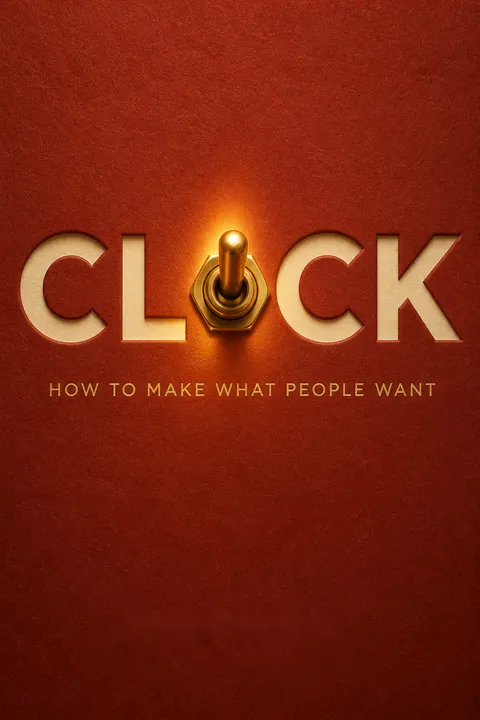


Key Takeaways
Make something customers choose over alternatives, not merely admire
Choice is the real test. As a teenager, Jake Knapp spent a year making a fantasy game. His friends quickly abandoned it for basketball. He then compared his idea with what they could actually do instead, and began testing rough game concepts at school. The maze game that finally held their attention became faster and added comic sound effects. Friends kept playing, competed for turns, and drew in their teacher.
A product must click. The book uses “click” for the fit between a product and its customers: it solves a meaningful problem, stands apart from alternatives, and makes its value easy to grasp. A clever invention is not enough. Customers must understand why it matters and prefer it to the things already competing for their time, money, or effort.
The game story makes an important distinction between quality as judged by its maker and value as experienced by its audience. Attention is a scarce resource, so an offering competes not only with similar products but with leisure, habit, and indifference. This framing discourages teams from treating compliments as proof of demand. Still, immediate excitement is not the only useful signal: products involving trust, health, or complex adoption may earn commitment slowly. Early reactions are evidence to investigate, not a final verdict.
Clear the calendar for shared focus before strategy calcifies into slides
Focus changed the work. Knapp and two colleagues spent a year and a half discussing browser-based video calls, adding ideas to a large presentation without settling on a clear product. During a week in Stockholm, they removed meetings and distractions, chose one essential promise, and built a working prototype. By Friday, colleagues understood its value and began using it. The product became Google Meet.
Make focus possible. The Foundation Sprint, the book’s two-day process for establishing a project’s strategy, depends on protected team time. The authors recommend a small team of no more than five, including the decision-maker, called the Decider. They also suggest announcing a temporary “good emergency” to clear calendars. Instead of open-ended group brainstorming, people first think and write independently, then compare their ideas together.
The Stockholm story points to a coordination problem as much as an individual productivity problem. Shared uninterrupted time lets a team build common context while producing tangible work, rather than repeatedly paying the cost of restarting. The Decider’s presence can also turn discussion into action. Yet a sprint is not automatically effective simply because it is intense. Teams need the authority to protect the time, access to relevant expertise, and a way to bring customer evidence into the room.
Identify a real customer and costly problem in words a child understands
Start with a person. In the film Big, a child in an adult’s body questions a toy executive’s elaborate case for a robot that turns into a skyscraper. The executive discusses sales projections, but cannot explain why children would enjoy playing with the toy. Knapp recognizes the same mistake in his own early video-call work: he became attached to an elaborate virtual meeting room instead of the simple difficulty of getting people in different locations together.
Use plain language. Teams should name a specific customer and a problem that person genuinely has. The authors’ Note-and-Vote method helps: participants privately write possible answers, share them anonymously, vote, briefly discuss leading options, and let the Decider choose. Simple wording exposes fuzzy thinking. “Teams with people in different locations” is clearer than a label such as “distributed enterprise organizations.”
Plain language is not just a communication preference. It is a diagnostic tool: vague descriptions can conceal that a team has defined a market category rather than a human need. Silent contributions also reduce the advantage held by people who think quickly out loud. The method cannot guarantee that the chosen customer is representative, however. A clear description can still be based on internal assumptions, so direct contact with customers remains necessary to establish whether the problem is real.
Combine rare capability, hard-won insight, and motivation that lasts
Find the team’s edge. The book describes a team’s advantage through three ingredients: capability, or what its members can do unusually well; insight, or what they understand about the problem and customers; and motivation, or why this problem matters to them. The combination helps a team find a solution that others may struggle to deliver.
Different strengths combine. Jim Gao understood data-center engineering, while Veda Panneershelvam worked on artificial intelligence. Their collaboration used deep reinforcement learning to improve cooling at a Google data center, reducing electricity use by 40 percent. They later teamed with Katie Hoffman, whose experience with industrial controls and manufacturers supplied crucial real-world insight. Their startup, Phaidra, applied AI to industrial plants. Technical skill alone would not have supplied Katie’s knowledge of how those environments actually operate.
This account shows why a team’s advantage is often relational rather than individual. Specialized knowledge becomes more valuable when paired with the people who understand deployment, customers, and operational constraints. The framework also makes motivation concrete: frustration with a stubborn problem can guide attention toward overlooked opportunities. A caution follows from the same logic. Teams can overvalue what they uniquely know and mistake rarity for usefulness. The advantage matters only where it meets a problem customers care enough to solve.
Count workarounds and inertia as competitors, including doing nothing
Competition includes habits. Direct competitors are only part of the picture. Customers may use substitutes, such as manual processes, older tools, or informal workarounds. They may also decide not to act at all. The authors recommend asking customers how they solve the problem today, and noticing whether that solution costs them time or money.
Choose a serious rival. When Slack was new, it could have compared itself with small business-chat products. Instead, it challenged email, the familiar communication tool teams already used. Its strategy addressed the real alternative customers would have to leave behind. Slack’s user base grew from 500,000 to more than two million in nine months. Sometimes doing nothing is a formidable competitor: a carbon-accounting startup discovered that small businesses were unwilling to pay simply to replace guilt with a calculation.
The useful shift here is from market maps to customer behavior. A competitor is whatever currently absorbs the need, even if nobody calls it a product. This resembles the distinction between stated preference and revealed behavior: what people say they want may differ from what they spend time or money doing. “Doing nothing” deserves particular attention because it has no purchase price and imposes no learning costs. But absence of visible alternatives does not prove absence of demand; it raises the burden of testing the problem.
Differentiate on a customer-valued advantage competitors cannot credibly match
Make the contrast matter. Differentiation means the central reason a customer should choose a new solution over the alternatives. It must matter to customers and draw on something the team can genuinely deliver. A 2x2 chart can make the contrast visible: choose two customer-relevant dimensions, plot the alternatives, and seek a credible position that is clearly distinct rather than marginally better.
Choose a focused promise. Orbital Materials initially overwhelmed chemical manufacturers with many claims about AI-designed molecules. The team concentrated on quality and reliability, benefits customers could understand and the company could support with its strengths in computing and chemistry. Similarly, the early Google Meet team could not beat established rivals on network size or video quality, so it emphasized easy, browser-based group calls. A memorable promise also gives builders a guide for what to prioritize.
A sharp contrast reduces the mental work customers must do to understand a new offering. It also connects marketing claims to product decisions, which is more powerful than treating positioning as a communications exercise. The 2x2 is useful as a forcing device, not as proof that a market belongs to the team. Axis selection can be manipulated to make a favored product look unique. A credible chart should reflect customers’ criteria and survive comparison with the strongest alternatives.
Turn differentiation into project rules, plus a safeguard against harmful success
Make the promise operational. A project principle is a practical rule that helps a team make repeated decisions in support of its chosen differentiation. General slogans such as “pursue excellence” are too vague to resolve trade-offs. The authors suggest turning each of the project’s two differentiators into a principle, then adding a third rule to guard against harmful consequences.
Keep the rules close. Google’s early emphasis on usefulness, focus, and speed gave teams criteria they could apply when making product choices. Phaidra’s safeguard was to use AI to support plant engineers rather than simply replace them. The book calls the combination of a differentiation chart and a small set of project principles a Mini Manifesto. Its purpose is not to define a company’s permanent culture, but to keep the current project’s promise visible as the work grows.
Principles are most useful when they settle costly choices, not when they decorate a wall. A safeguard adds a form of design foresight: the team asks not only whether a product can succeed, but what kind of success it should avoid. This resembles safety engineering, where teams anticipate failure modes before deployment. The danger is that a principle can become a shield for leadership preference. Its value depends on concrete examples, open disagreement, and willingness to revise it when consequences differ from expectations.
Compare several approaches before your favorite becomes an expensive commitment
Pause before building. Eglé and Stéph Cruchon imagined an app that would help tourists discover stories behind overlooked local landmarks. Their first idea used GPS to identify nearby places. Before committing, they considered other approaches: a website, physical signs, and combinations of the two. That comparison exposed weaknesses in the app: landmarks might have inaccurate coordinates, poor cell service, or visitors who had never installed it.
A less glamorous option won. The couple combined physical signs bearing QR codes with a website containing local stories, photos, and interviews. The signs helped visitors find the service, while the site avoided the friction of installing an app. The authors call this early reconsideration a “pre-pivot.” Teams can generate alternatives by imagining the first plan fails, considering different technologies, or testing a different target customer. Brief written summaries and rough sketches clarify each option before selection.
The case illustrates a quiet but important design principle: a solution must work in the conditions where customers encounter it, not only in the team’s imagined ideal setting. Comparing options surfaces dependencies that enthusiasm can hide. The less polished route may also be more robust. Still, generating alternatives has a cost, and endless exploration can become another form of delay. The practical aim is not to find every conceivable path, but to test whether a few plausible alternatives expose a major flaw in the default choice.
Make competing perspectives visible before the Decider chooses a path
Use more than one lens. Magic Lenses are a way to compare possible approaches across different perspectives, using visual charts rather than relying on memory or whoever argues most persuasively. The authors’ examples include the customer’s ideal experience, ease of building, growth potential, and financial value. Teams can add lenses for project-specific risks.
Look for a pattern. Genius Loci judged its app idea against a customer-vision lens, a practical-building lens, and a “middle of nowhere” lens that tested weak cell service and unfamiliar users. The sign-and-website combination performed well across these views. Reclaim, a scheduling-software company, used several lenses to compare product ideas. Smart scheduling links emerged as the strongest option and became its fastest-growing feature. The team’s Decider then chose a first bet and a backup, rather than pretending the choice was certain.
Visualizing alternatives makes disagreement more productive because the debate shifts from defending people’s ideas to inspecting the criteria behind them. Multiple lenses also reduce the risk of optimizing for one attractive outcome while ignoring feasibility or customer experience. Yet a chart can create an illusion of precision: placements often reflect judgment, not measurement. The strongest use of the tool is to reveal assumptions and disagreements clearly enough to test them, not to turn subjective ratings into a mathematical answer.
Treat strategy as a revisable hypothesis, not a reputation-defending plan
Make the bet explicit. A Founding Hypothesis is a concise statement of the intended customer, problem, approach, and reason the solution should beat alternatives. It turns scattered assumptions into claims that can be examined. Knapp contrasts this with the story of Urbain Le Verrier, who correctly predicted Neptune but then spent years pursuing a nonexistent planet called Vulcan. His confidence in the idea outlasted the evidence.
Expect to be wrong. The book identifies familiar traps: attachment to the first option, self-interest, overconfidence, and seeking confirming evidence. Writing the hypothesis down makes it easier to ask whether the customer, problem, approach, and differentiators are actually right. The statement should be treated as a learning instrument, not a promise that the team must defend. When evidence contradicts it, revise the claim rather than protecting the original story.
The distinction between a hypothesis and a plan is psychologically astute. People often defend a choice because changing it threatens identity, status, or sunk effort, not because the evidence is strong. Explicit predictions create a shared object that can be challenged without making disagreement personal. This works best when teams specify what evidence would change their minds. Otherwise, “hypothesis” can become a more scientific-sounding label for an unfalsifiable belief, with every result reinterpreted as support.
Test realistic prototypes in short loops before building the costly product
Learn before full construction. A tiny loop is a short cycle of making a prototype, showing it to customers, and using their reactions to revise the idea. Phaidra used this approach to test whether industrial engineers would trust an AI system that adjusted plant controls. Its first dashboard prototype did not explain the AI’s decisions well enough, and none of four engineers agreed to a trial. The team redesigned it with a detailed timeline of past actions and upcoming forecasts.
Repeat against the risk. Four more engineers saw the revised version and were willing to test the real system. The authors recommend a Design Sprint, a five-day process for mapping a problem, sketching competing solutions, choosing one, prototyping it, and testing with customers. Prototypes can test a sales story or service as well as software. Strong reactions matter, but they are early evidence, not proof of broad market demand.
Short loops reduce the price of being wrong. A realistic simulation lets a team study how people interpret a product before engineering the complete system, much as pilots practice in a simulator before flying passengers. The Phaidra example also shows that a failed test can isolate a specific weakness instead of condemning the whole strategy. Small interviews cannot establish adoption at scale, however. They are most informative when paired with behavioral commitments, such as signing up for a trial, and followed by real-world use.
Analysis
The book’s central argument is that the expensive part of innovation is not merely building the wrong thing. It is allowing an untested story about customers, competition, and value to harden into a plan before anyone outside the team has challenged it. The Foundation Sprint addresses that risk by making strategy explicit, comparing alternatives, and assigning decision authority. Design Sprints then create short feedback cycles before full construction. Together, the methods turn product strategy from a presentation into a set of claims that can be inspected and revised.
The method’s strongest insight is its sequencing. Teams first clarify whom they serve and what they can uniquely contribute, then identify meaningful differentiation, then compare possible approaches. That order matters: choosing a product form before understanding the customer can make execution efficient in the wrong direction. Silent individual work is another subtle strength. It creates room for quieter expertise and makes initial opinions less dependent on rank or rhetorical speed.
The approach also has limits. A two-day workshop can produce shared clarity, but it cannot produce customer knowledge that the team does not possess. A polished hypothesis may still be wrong, and a 2x2 chart can disguise guesses as facts. Prototype reactions from a handful of interviewees are useful for discovering confusion and testing plausibility, but they do not establish repeat purchase, market size, or long-term retention. Those require evidence from actual behavior over time.
The Decider model trades consensus for speed and accountability. That can prevent endless debate, but it places unusual weight on the leader’s judgment. Silent proposals, transparent criteria, and explicit dissent help counterbalance that power; without them, the process may simply make hierarchy more efficient. The book is most convincing when read as a disciplined way to reduce uncertainty, not a formula that guarantees success. Its durable principle is to make assumptions visible early, then expose them to customers before the cost of changing course becomes prohibitive.
Review Summary
Click is a concise guide for product development, focusing on testing and validating minimal viable products. Readers find it practical and easy to apply, though some note it lacks groundbreaking insights. The book offers a structured framework for early-stage product development, which some appreciate for its simplicity and efficiency. While not revolutionary, it provides useful formats for collaboration and ideation. The book's storytelling, examples, and visual elements are praised, making it an engaging read for founders and product developers.
People Also Read




Glossary
Click
Product and customer fitThe book’s term for a product that fits its customers well: it solves an important problem, stands apart from alternatives, and communicates its value clearly. A product clicks when people understand why it matters and choose it over existing options. It describes customer response, not simply technical quality or the maker’s enthusiasm.
Foundation Sprint
Two-day strategy workshopA focused, two-day process for establishing a project’s foundations before substantial building begins. The team defines its customer, problem, strengths, and competition, then chooses differentiators and evaluates possible approaches. The intended output is a clear, testable Founding Hypothesis, not a finished plan or a guarantee that the strategy is correct.
Founding Hypothesis
Testable project strategyA concise statement of a project’s central strategic assumptions: who the customer is, what problem matters to them, what approach the team will try, and why its solution should be chosen over alternatives. It makes implicit predictions visible so teams can test and revise them before committing heavily to development.
Note-and-Vote
Silent idea and decision methodA structured team process in which participants privately write possible answers, share them anonymously, review and vote silently, briefly discuss leading choices if needed, and leave the final selection to the Decider. It is designed to gather independent contributions and reduce the influence of loud voices or premature group agreement.
Magic Lenses
Visual comparison across perspectivesA method for evaluating competing project approaches through multiple perspectives, such as customer value, practicality, growth, or financial potential. Teams plot the options on simple charts for each perspective, then review the set for patterns and trade-offs. The charts organize judgment and expose assumptions; they do not turn subjective ratings into objective measurements.
Mini Manifesto
Project strategy and rulesA compact reference that combines a project’s differentiation chart with a few practical principles. The principles translate the desired customer promise into rules for making product decisions, while a safeguard principle helps the team avoid a harmful consequence of success. It is intended to guide the current project, not define permanent company culture.
Design Sprint
Five-day prototype testA five-day process for testing a proposed solution before building it fully. Teams map the customer problem, sketch competing ideas, select a direction, create a realistic prototype, and test it with customers. The method can examine software, services, sales materials, physical products, or other experiences, with the goal of learning quickly from realistic reactions.
Decider
Project decision-makerThe person with authority to make key choices for a project. In the Foundation Sprint, the Decider participates in the work, considers the team’s proposals, and chooses among them so decisions can be acted on without later reopening every debate. The role may belong to a founder, project lead, or senior executive.
Tiny loops
Short prototype learning cyclesBrief cycles in which a team builds a prototype, presents it to customers, observes their reactions, and changes its approach based on what it learns. The loops are intended to test important assumptions well before a full product is ready. They make course corrections faster and less costly than waiting for a complete launch.
FAQ
1. What is "Click: How to Make What People Want" by Jake Knapp about?
- Core Focus: The book presents a practical system for turning big ideas into products that people genuinely want, emphasizing the importance of making things "click" with customers.
- Foundation Sprint Method: It introduces the Foundation Sprint, a two-day process to clarify a project's fundamentals, differentiate from competitors, and choose the best approach.
- Real-World Experience: The advice is based on the authors’ firsthand work with hundreds of startups and successful products like Gmail, Google Meet, and Slack.
- Actionable Lessons: The book is structured around ten key lessons, each illustrated with stories and step-by-step techniques for teams and leaders.
2. Why should I read "Click: How to Make What People Want" by Jake Knapp?
- Avoid Costly Mistakes: The book helps readers avoid wasting time and resources on products that flop by providing a proven system for finding what people actually want.
- Applicable to All Teams: While designed for startups, the methods are useful for any team or organization starting a big project or seeking to innovate.
- Fast, Focused Progress: The Foundation Sprint compresses months of debate and planning into just two days, enabling teams to move quickly and confidently.
- Customer-Centric Approach: It keeps the focus on solving real customer problems, ensuring that products are meaningful and valuable.
3. What are the key takeaways from "Click: How to Make What People Want" by Jake Knapp?
- Ten Essential Lessons: The book distills its approach into ten lessons, including focusing on the customer, leveraging team advantages, differentiating from competition, and testing hypotheses quickly.
- Foundation Sprint System: A structured, step-by-step process for defining strategy, making decisions, and aligning teams at the start of a project.
- Rapid Experimentation: Emphasizes running "tiny loops"—fast, low-risk experiments—to validate ideas before investing heavily.
- Clarity and Differentiation: Success comes from making a simple, compelling promise to customers and standing out in a crowded market.
4. What is the Foundation Sprint method described in "Click" by Jake Knapp, and how does it work?
- Two-Day Workshop: The Foundation Sprint is a focused, two-day workshop for teams to define the basics, differentiate, and choose an approach for a new project.
- Day One: Teams clarify their customer, the problem to solve, their unique advantages, and the competition, then craft strong differentiation and practical principles.
- Day Two: Teams generate multiple approaches, evaluate them through various "lenses," and select the best path forward, culminating in a testable Founding Hypothesis.
- Outcome: By the end, teams have a clear, actionable strategy and are ready to run experiments to validate their ideas.
5. What is a Founding Hypothesis in "Click" by Jake Knapp, and why is it important?
- Definition: The Founding Hypothesis is a concise, testable statement that summarizes the team’s customer, problem, approach, and differentiation.
- Purpose: It distills the project’s strategy into a single sentence, making assumptions explicit and ready for validation.
- Testability: Treating the strategy as a hypothesis encourages experimentation and adjustment, rather than blind commitment.
- Foundation for Experiments: It guides the team’s next steps, ensuring that all efforts are focused on proving (or disproving) what matters most.
6. How does "Click" by Jake Knapp recommend teams identify and solve real customer problems?
- Start with the Customer: The process begins by clearly identifying the target customer and a real problem worth solving, using plain language and common sense.
- Note-and-Vote Method: Teams use a structured, silent brainstorming and voting process to surface and select the best ideas, avoiding groupthink and bias.
- Customer-Centric Mindset: The book stresses treating customers as honored guests, focusing on their needs rather than internal goals or ego.
- Continuous Validation: Teams are encouraged to test their understanding of the customer and problem through direct feedback and rapid experiments.
7. What is differentiation according to "Click" by Jake Knapp, and how can teams achieve it?
- Definition: Differentiation is what makes a product or service stand out from alternatives, offering a compelling reason for customers to switch.
- Radical Separation: The book advocates for creating clear, bold differentiation—being much better in ways that matter to customers, not just slightly better.
- 2x2 Chart Tool: Teams use 2x2 charts to visually map their position against competitors on key differentiators, aiming for the top-right quadrant.
- Customer Perception: Differentiation should be based on what customers value, not just technical features or internal strengths.
8. What are the "Note-and-Vote" and "Magic Lenses" techniques in "Click" by Jake Knapp, and how do they improve decision-making?
- Note-and-Vote: A silent, structured process where team members individually generate ideas, share them anonymously, and vote, leading to faster and higher-quality decisions.
- Avoids Groupthink: This method prevents dominant personalities from steering the conversation and ensures all voices are heard.
- Magic Lenses: A technique for evaluating options through multiple perspectives (e.g., customer, pragmatic, growth, financial), often visualized with 2x2 charts.
- Structured Arguments: Magic Lenses help teams consider conflicting opinions and make more informed, balanced decisions before committing to a path.
9. How does "Click" by Jake Knapp address the problem of cognitive biases in product development?
- Common Biases Identified: The book highlights anchoring, self-serving, overconfidence, and confirmation biases as major pitfalls in decision-making.
- Process Design: The Foundation Sprint and its tools (Note-and-Vote, Magic Lenses) are specifically designed to counteract these biases by structuring how teams generate, discuss, and select ideas.
- Hypothesis Mindset: By treating strategies as hypotheses to be tested, teams remain flexible and open to changing course based on evidence.
- Rapid Feedback Loops: Frequent, low-risk experiments help teams avoid getting stuck on flawed assumptions or first ideas.
10. What is the role of rapid experimentation and "tiny loops" in "Click" by Jake Knapp?
- Tiny Loops Defined: "Tiny loops" are short, focused cycles of prototyping and testing ideas with real customers before building the full product.
- Design Sprints: The book recommends using weeklong Design Sprints to quickly validate or invalidate hypotheses, reducing risk and speeding up learning.
- Multiple Iterations: Teams are encouraged to run several experiments, adjusting their approach based on customer reactions until the solution "clicks."
- Contrast with MVPs: Unlike traditional minimum viable products (MVPs), tiny loops allow for faster, lower-cost learning and more opportunities to pivot early.
11. Who should use the methods in "Click" by Jake Knapp, and when is the best time to apply them?
- Startups and Beyond: While the Foundation Sprint was designed for startups, the methods are applicable to any team or organization starting a big, ambitious project.
- At the Beginning: The best time to use these methods is at the very start of a project, before major resources are committed.
- Stuck Teams: Teams already underway but facing indecision, lack of clarity, or slow progress can also benefit from running a Foundation Sprint.
- Flexible Application: The techniques can be adapted for remote teams, individuals, or even as standalone exercises for specific challenges.
12. What are the most memorable quotes from "Click: How to Make What People Want" by Jake Knapp, and what do they mean?
- "Does it click?" – The central question for any product or project, emphasizing the need for a true fit between what’s offered and what customers want.
- "Drop everything and sprint on the most important challenge until it’s done." – Highlights the power of focused, uninterrupted work to achieve breakthroughs.
- "It’s just a hypothesis until you prove it." – Reminds teams to treat their strategies as testable guesses, not certainties, and to seek evidence before committing.
- "Differentiation makes products click." – Stresses that standing out in meaningful ways is essential for success, not just being incrementally better.
- "Experiment with tiny loops until your solution clicks. Then build it." – Advocates for rapid, repeated testing and learning before investing in full-scale development.
About the Author


Download PDF
Download EPUB
.epub digital book format is ideal for reading ebooks on phones, tablets, and e-readers.








