

Key Takeaways
Stop fighting the moment, then act from clearer ground
Effort is not struggle. Housden distinguishes useful effort, which moves a chosen intention forward, from struggle, an extra push fueled by fear and the urge to control life. Surrender does not mean quitting. It means acknowledging what is happening before deciding how to respond. Rick Hanson learned this underwater: trapped in kelp and panicking, he thrashed until the seaweed tightened around him. When he stopped fighting it, he could disentangle himself. Polar explorer Ben Saunders similarly described accepting the punishing conditions of his Arctic journey as a release, not defeat.
A pause changes the response. Housden links these stories to research suggesting strenuous exertion can temporarily quiet parts of the brain involved in deliberate control. He does not present surrender as a trick to force calm. It is a way of making room for a less reactive intelligence, so the next action fits the situation rather than the fear.
The distinction between effort and struggle resembles a useful distinction in psychology: accepting an emotion is not the same as obeying it. A person can acknowledge fear, grief, or frustration and still choose a purposeful action. The kelp story makes the point unusually concrete: frantic effort can worsen a problem when it ignores how the problem works. Still, surrender must not be mistaken for passivity. In situations shaped by injustice or preventable harm, resistance may be the necessary response. The practical question is whether resistance is serving a clear purpose or simply repeating a panicked attempt to make reality disappear.
Let your identity loosen without turning humility into another badge
A life story is provisional. In Tehran, Housden was detained and threatened with years in prison or pressure to inform for the intelligence service. Waiting alone, he felt the identity he relied on, writer, traveler, Englishman, lose its authority. That loss did not erase his preferences or relationships. It showed him that the story of who he was could not guarantee safety or define his deepest sense of being. He was eventually released and put on a flight out of Iran.
Humility is not self-erasure. Housden warns that even the pose of being nobody can become an ego's new costume, as in a story about rabbis sneering at a cleaner's professed smallness. The point is not to deny talent or accept mistreatment. It is to notice how comparison, praise, and status can make a useful identity feel like the whole self. Seeing oneself in proportion can soften defensiveness without denying one's worth.
This account offers a striking contrast between a social identity and a deeper sense of self. Social roles are real in their consequences, but they are not a complete map of a person. That distinction can loosen the grip of status without requiring anyone to pretend that power differences do not matter. Humility is most useful when it makes a person more curious and accountable, not smaller or easier to exploit. The Tehran story is an extreme route to that insight. Everyday comparison, embarrassment, or a change in role can also reveal how much security has been invested in a particular self-image.
Treat imperfection as information, not proof that you are broken
Reality is not a report card. Housden uses a fragile teacup to represent the certainty that what we cherish will change or disappear. Knowing the cup will break does not spoil its use; it makes care more vivid and control less plausible. The same principle applies when plans fail. An aid worker whose clinic burned in Kosovo began again, while a teacher grieving a student's death continued tutoring others. Their work mattered beyond whether each outcome went as hoped.
Meet discomfort honestly. Housden recalls feeling inferior at a literary lecture, then trying to cover the feeling with a calmer, more spiritual state. He left his presentation materials behind and only then recognized the insecurity beneath his irritation. He describes three responses to a difficult thought: ignore it, mistake it for the whole truth, or experience it without judgment. Acceptance includes vulnerability; it does not require pretending the problem is harmless.
The teacup is a compact model of how impermanence can deepen attention rather than drain it. It also points toward a distinction between accepting an experience and approving its causes. Feeling grief or inadequacy without self-condemnation can make a response more accurate; it does not mean endorsing preventable loss or abandoning improvement. The lecture story is valuable because the author catches himself trying to use calm as an escape hatch. Spiritual language can become another form of avoidance when it asks people to rise above feelings before they have understood them.
Let purpose emerge from what you love, not only what you achieve
Meaning is more than a résumé. At fifty, Leo Tolstoy had wealth and literary success, yet could not see why those achievements made life worth living. Housden contrasts externally measured accomplishment with meaning experienced from the inside: attention, love, and the felt reality of being alive. Purpose can still involve work and service, but it need not begin as a perfect career plan.
Follow the thread, not a script. Braeda Horan left a conventional path to study clothing design, later wandered through East Africa, and then was invited to lead a London gallery for African artists. Her life took shape through interests and encounters she could not have planned. Jena Lee Nardella founded Blood: Water to bring clean water to African communities; over time, she came to understand her purpose less as changing the world than as loving it. These stories suggest purpose can develop through action while remaining open to surprise.
Purpose here is neither a fixed destiny nor a motivational slogan. It is a pattern recognized through lived attention, which leaves room for responsibility and revision. That view sits well beside the idea of a vocation as something partly discovered and partly made: interests and circumstances offer clues, while choices turn them into a life. It also guards against treating paid work as the sole measure of meaning. A limitation is that stories of serendipity can make opportunity look more available than it is. Following a calling may require resources and support, not trust alone.
Build intimacy by meeting people without making them fill your emptiness
Openness is not a dating strategy. Athena had spent years hoping for a partner, then made peace with her independent life. At the urging of a young friend, she tried an online dating site. While waiting for her scheduled date, she began an easy conversation with Rocco, a stranger in the hotel lobby. The date she expected arrived, but it was Rocco she saw again; a year later, they were building a house together. The meeting was accidental, but her willingness to be candid and engaged was real.
Love still takes work. Housden distinguishes relationship work from struggle. Work explores both people's vulnerabilities; struggle insists on being right or remaking the other person. He also recalls prioritizing his morning meditation over comforting his young son. Looking back, he sees how self-absorption can hide inside a seemingly admirable routine. Stepping back from one's own argument can make another person's needs visible.
The Athena story is memorable because openness does not guarantee a romantic outcome; it simply makes genuine contact possible. That is a useful correction to advice that turns self-development into a technique for attracting a partner. The account also resists the fantasy that love is effortless: intimacy requires attention to conflicting needs and the willingness to revise one's position. Yet surrender should never mean tolerating coercion or neglect. A healthy distinction between struggle and work depends on whether both people can speak, set boundaries, and participate in repairing the relationship.
Make room for unproductive minutes to experience time instead of merely spending it
Clock time is not lived time. Housden questions a culture that treats every minute as a unit of productivity. He recalls a poet lying in a hammock, attentive to the landscape, who ends his poem with a startling judgment about having wasted his life. The phrase turns on the contrast between a life spent chasing tasks and one filled with moments of direct awareness. A pause is not necessarily wasted simply because it produces no visible result.
Leisure can enter work. Housden uses leisure to mean reflective attention, not laziness. A cook absorbed in the smell of food or the feel of water on the hands can experience the activity itself, rather than rushing toward its completion. The past and future remain useful: memory can inform action, and plans can organize it. They become burdens when rumination or worry consumes the present. Setting aside a phone or sitting quietly can create room for attention and ideas to surface.
The distinction between clock time and lived time clarifies why an overfilled day can feel strangely empty. Attention changes the quality of an activity, whether it is rest, cooking, or paid work. This is not an argument against planning or productivity; it is a warning against making measurable output the only proof that time mattered. The recommendation also has a social limit: people with caregiving demands, insecure work, or little control over their schedules may not be able to claim leisure on demand. Even brief pauses can help, but access to unhurried time is not distributed equally.
Meet change directly, without mistaking acceptance for giving up
Loss belongs to ordinary life. Shakespeare's theater, the Globe, burned shortly after his play about everything dissolving had first been performed there. Housden reads the episode alongside Shakespeare's experience of death and political upheaval: change was not an abstract idea but part of the world he wrote about. Housden's own near-fatal complications after heart surgery brought a similar immediacy. Waiting for treatment, he found himself attending to the people around him without being consumed by fear of what came next.
Acceptance can include treatment. After Buddhist teacher Thich Nhat Hanh suffered a severe stroke, he took part in physical and speech therapy, along with other care. His students described his attention to the sky and to the people helping him. Housden presents this not as indifference to recovery but as engagement without making a particular prognosis the condition for being present. Acceptance faces what is happening; it does not forbid action.
This section makes a needed distinction between accepting reality and surrendering agency. Thich Nhat Hanh's rehabilitation is a clear example: practical effort continues, while identity and peace are not made wholly dependent on a predicted outcome. The idea can support resilience because it gives attention somewhere useful to rest in uncertainty. It also needs an ethical boundary. Calling suffering ultimately good can obscure preventable harm or pressure people to display serenity. Acceptance is most humane when it permits grief, treatment, protest, and care, rather than prescribing one noble emotional response.
When plans fail, let not-knowing create room for a truer next step
Knowledge and knowing differ. Housden uses knowing for an embodied, wordless sense of direction, distinct from information stored in memory. In Dante's story, a traveler who has lost his way sees a distant light only after admitting that his bearings have failed. Housden describes a similar crossroads at fifty-three: after months of unsuccessful planning, he woke with a clear sense that he should leave England for America. He sold his house and library, ended a long relationship, and began a new life in California.
Uncertainty is not anti-intelligence. The book values a pause in which habitual explanations loosen, making room for a fresh response. It does not deny the usefulness of knowledge, language, or planning; it argues that they cannot answer every question about identity or meaning. The invitation is to notice what becomes clear when the mind stops rehearsing its existing options, then respond to that insight in the life actually unfolding.
The contrast between stored knowledge and felt knowing captures an important feature of decision-making: not every choice can be solved by adding more information. A pause can expose priorities that noise and urgency conceal. But inner certainty is not automatically reliable; fear, desire, and bias can also feel compelling. The account is strongest when treated as a source of hypotheses, not a universal instruction to trust intuition over evidence. For consequential choices, reflection can be paired with practical checks, consultation, and attention to effects on other people.
Analysis
The book's central move is to recast surrender as a change in how a person meets experience, not a refusal to act. Across its seven themes, the same tension recurs: effort is necessary, but control over outcomes is limited; identity is useful, but it becomes constricting when mistaken for a permanent self; meaning may appear through purposeful work, but it cannot be reduced to achievement. The stories make these ideas memorable because they range from a trapped swimmer to a chance meeting, a literary crisis, and a near-fatal medical emergency. Poetry supplies a second register, one that evokes experiences prose can describe but cannot settle.
The book's strongest practical contribution is its repeated instruction to feel what is present before trying to improve or explain it. That approach can interrupt rumination and spiritual avoidance. Its greatest ambiguity is the language of a deeper intelligence that supposedly emerges beneath conscious thought. The book offers these moments as lived experience, while some of its appeals to neuroscience risk sounding more conclusive than the evidence presented can establish. A temporary change in cognitive control does not, by itself, prove a universal spiritual interpretation.
Read most usefully, the book is not a case against agency, therapy, medicine, justice, or ambition. It is a critique of making any of them the price of being whole. Acceptance can create better contact with facts, while effort can address those facts. The two are not rivals. The practical test is whether a proposed surrender increases clarity, care, and capacity to respond, or instead excuses resignation. Housden's examples are most persuasive when they hold both sides together: take the next step, but do not require the world to guarantee the ending first.
Review Summary
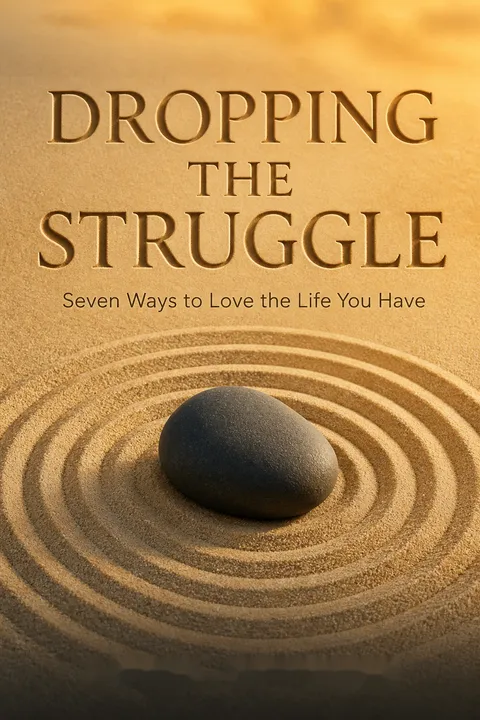
Dropping the Struggle receives mostly positive reviews, with readers appreciating Housden's blend of spirituality and poetry. Many find the book's message of accepting life as it is and letting go of struggle to be insightful and soothing. Readers praise Housden's writing style, describing it as beautiful and gentle. Some reviewers note that the book offers valuable reflections on mindfulness and acceptance, though a few mention it may not contain groundbreaking ideas. Overall, readers appreciate the book's invitation to approach life with more openness and less struggle.
People Also Read









Glossary
right effort
purposeful effort without fearHousden uses this term for the ordinary exertion needed to pursue an intention, such as learning, working, or caring for others. He distinguishes it from struggle, which adds fear-driven pressure and an attempt to force life into a preferred shape. Right effort acts toward a goal without treating control of the outcome as guaranteed.
spiritual materialism
spirituality as self-improvementA term associated in the book with teacher Chögyam Trungpa. It describes using spiritual practice as another project for acquiring status, perfection, or a more impressive self. The attempt can preserve the very self-centered striving that the practice is meant to loosen, especially when meditation or discipline is treated as a route to eliminating ordinary vulnerability.
Seeker's Disease
meaning always somewhere elseHousden's name for the habit of continually searching beyond one's present life for the fulfillment believed to be missing. The search may lead through travel, spiritual traditions, achievement, or new experiences, while ordinary relationships and circumstances seem insufficient. The term points to a shift from chasing a final answer toward noticing what is already meaningful in lived experience.
fruitful void
stillness that can nourish meaningHousden's phrase for the emptiness that appears when familiar roles and explanations no longer provide a sense of identity. Rather than treating this absence as proof that life is meaningless, he describes it as a potentially fertile ground for awareness, connection, and new understanding. It is not a plan or achievement, but an experience of being beneath the usual personal story.
I-thought
the sense of a central selfA term Housden attributes to Ramana Maharshi for the basic thought that there is a fixed, separate self at the center of experience. The book suggests that when this assumption briefly falls away, thoughts, roles, and perceptions can be experienced without treating them as the whole identity. It does not mean that practical identity or personal responsibilities cease to matter.

Download PDF
Download EPUB
.epub digital book format is ideal for reading ebooks on phones, tablets, and e-readers.








