

Key Takeaways
Treat the red pawn as a market signal, not a verdict
A small award, big reach. The Spiel des Jahres began in 1979 as an effort by German game journalists to make board games more accepted in family life. Its red pawn on a box became a powerful buying signal: a win could add as many as 500,000 sales to a title. The first winner, David Parlett’s Hare and Tortoise, had nearly been discontinued before the award and positive press helped persuade its publisher to keep it. It has since sold more than two million copies.
Influence without certainty. The award helped spotlight designers, shape publishers’ choices, and draw visitors to Essen, whose annual game fair grew into the world’s largest tabletop convention. Yet the prize reflects a jury’s judgment, not a universal ranking. Its history includes celebrated classics, overlooked titles, and choices readers may dispute.
Awards work as information shortcuts. A shopper cannot test every game in a store, so a trusted emblem reduces uncertainty and helps a product stand out. That commercial force can support experimentation by making publishers more willing to back unfamiliar designs. It can also concentrate attention on a narrow set of tastes. The prize’s influence is therefore best understood as cultural infrastructure: it shapes what gets noticed, without proving that the winner is best for every group, mood, or occasion.
Judge games by fit, not by supposedly universal rules
Fun depends on the table. The jury has resisted defining one objective formula for the best game. A title has to work for the people playing it, in their particular circumstances: children or adults, three players or five, a quiet afternoon or a lively gathering. The award’s practical standards include coherent design, understandable rules, appealing presentation, and play that engages a broad audience.
A winner can miss its audience. Enchanted Forest, the 1982 winner, is a memory game with dice-driven movement that may delight young children but offers little to older players. Scotland Yard, by contrast, asks one player to hide their movement while others coordinate a pursuit. Both are family games, but they invite different kinds of attention and suit different groups. The award’s choices make more sense when judged in context.
This view resembles user-centered design: a product succeeds not because it is elegant in the abstract, but because its demands match the abilities and expectations of its users. Games make that relationship unusually visible. A child may enjoy randomness that an adult finds empty, while a group of experienced players may value strategic friction. The caution is that “broad appeal” can become a vague defense for safe choices. Naming the intended audience and experience makes evaluation more precise, not less rigorous.
Look for old mechanics recombined into a better whole
Design grows by borrowing. Games rarely appear from nowhere. Hare and Tortoise, the 1979 winner, transformed a familiar race into a tactical puzzle: players spend carrots to move, with longer moves costing disproportionately more, and choose where to land to replenish supplies. Rummikub adapted the card-game logic of rummy to numbered tiles, then let players rearrange sets already on the table. Richard Borg’s Bluff refined the older game of liar’s dice with wild ones, public rerolls, and a board that makes bids easier to follow.
The blend matters. CATAN did not invent modular maps, trading, or resource spending. Its achievement was combining familiar ingredients into a coherent experience that felt fresh to many players. A design can be original through its balance, pacing, and interaction, even when its components have long histories.
This is close to how innovation works in engineering and music: a new result often comes from recombining established parts under new constraints. The important question is not whether an idea has a precedent, but whether the new arrangement changes what people can do or feel. There is a limit to this argument, however. Recombination alone does not guarantee quality. A game still needs internal coherence, and a familiar mechanic can feel derivative when the new combination adds little beyond a changed theme.
CATAN made German design a global language
A turning point in 1995. Klaus Teuber’s CATAN brought a distinctive German design style to wider audiences. Players collect resources from a modular island, trade with one another, and build settlements and roads. Luck still matters, but players remain involved throughout, and competition often works through positioning and blocked routes rather than direct attacks or eliminating opponents. The rules are approachable, while repeated play reveals strategic choices.
A tradition took shape. Games such as CATAN, Carcassonne, and Ticket to Ride helped define what came to be called eurogames: typically accessible, socially interactive designs with limited direct conflict and less reliance on luck than many older family games. The Spiel des Jahres amplified their visibility, while designers such as Teuber and Wolfgang Kramer helped establish the designer’s name as part of a game’s public identity.
CATAN illustrates a form of cultural translation. It did not merely export a German product; it offered players elsewhere a different model of competition, one where negotiation and spatial restraint could replace constant attack. That model broadened expectations about what a family game could be. Still, “eurogame” is a useful family resemblance, not a rigid category. The label can obscure differences among games and understate other traditions, especially when one region’s design history becomes the default account of modern tabletop gaming.
Make games easy to enter, but rewarding to revisit
The gateway test. A gateway game introduces newcomers to more involved play without making the first session feel like homework. CATAN, Carcassonne, and Ticket to Ride became prominent examples: their rules are teachable, turns offer clear choices, and experience improves a player’s judgment. Carcassonne starts with simple tile placement, then reveals tougher decisions about claiming roads, towns, and fields. Ticket to Ride asks players to collect colored cards and claim routes, while balancing visible plans against the risk of being blocked.
Different tables need different doors. Codenames, the 2016 winner, expanded the idea with team-based word clues that work for large groups and can be explained quickly. Qwirkle offers another entry point through matching colored and shaped tiles. None is effortless for every player, but each gives newcomers a usable first step and a reason to play again.
Good onboarding is a design problem, not simply a matter of reducing rules. Cognitive science distinguishes the amount of information a task contains from how the information is organized. Clear cues and meaningful choices can make a substantial system feel manageable. These games succeed when a beginner can act sensibly before understanding every strategic consequence. The qualification is that replay value often depends on the group: Codenames requires a clue-giver who can read the table, while a game’s apparent accessibility cannot erase differences in language, confidence, or experience.
Use mechanics for their effects, not their reputations
Context changes the rule. Roll-and-move is often criticized because random movement can make a player’s choices feel irrelevant. Railway Rivals shows why a mechanic cannot be judged in isolation. Players first draw rail networks across a map, planning routes and negotiating access; only afterward do they race trains using dice. The roll is uncertain, but the strategic work has already created reasons to care about the result.
Bad fit creates drag. In Auf Achse, another award winner by Kramer, the central task of moving a truck around a map can feel slow, despite worthwhile ideas in route planning and auctions. In Scotland Yard, uncertainty is productive: the detectives know Mr X’s mode of transport but not his location, so they must infer and coordinate. The right question is what a rule contributes to the whole experience.
This is a systems perspective: a component’s value depends on its relationship to the surrounding design. Randomness can create suspense when players have meaningful ways to prepare, but it frustrates when it erases agency without adding tension. The same distinction applies beyond games, from assessment systems to software interfaces. A mechanic’s reputation is a weak guide. Better evaluation asks whether it creates the intended emotion, supports the central activity, and distributes control in a way players find worthwhile.
Notice when an award changes course to keep its audience
Taste and sales push back. El Grande, the 1996 winner, rewarded deeper strategic play, but the next year’s more mainstream Mississippi Queen suggested that a demanding winner might not suit the award’s broad family audience. Torres sold fewer than 300,000 copies, while the lighter, visually striking Villa Paletti sold more than 600,000 after winning in 2002. The jury’s choices show a recurring tension between recognizing ambitious design and choosing games likely to reach many households.
The categories shifted. The Kinderspiel des Jahres became a separate children’s award in 2001, and the Kennerspiel des Jahres for expert games followed in 2011. These divisions let the main award focus more clearly on accessible titles. By 2016, Codenames signaled a further turn toward party play: easy to teach, social, and suitable for a much larger group than a conventional strategy game.
An award is also an institution that must preserve its audience. Categories are one way to manage competing goals without pretending that a children’s game, a party game, and a complex strategy title serve the same purpose. The tradeoff is institutional inertia: once buyers associate a prize with a certain style, judges may lean toward familiar choices even when the field changes. Sales are useful evidence of reach, but they do not settle artistic or design quality. The most revealing question is which audience the award chooses to serve.
Iterate toward clarity, not toward more rules
Revision is part of design. Alan R. Moon reworked Elfenroads into the more approachable Elfenland, simplifying its map and removing a currency system. Kramer’s tower-building design passed through earlier versions before becoming Torres, with Michael Kiesling contributing to its final form. These examples show that publishing a game need not mean the underlying idea has reached its best expression.
More rules can hide a weak structure. The book calls a patch added to fix a problem elsewhere a “kludge.” Barbarossa, for example, surrounds its central activity of sculpting and guessing with movement and resource rules that can feel cumbersome. By contrast, Azul joins tile selection, placement, and scoring into a series of decisions that players can learn through play. Polished components and clear presentation help, but cannot substitute for an integrated system.
Iteration resembles prototyping in other design disciplines: a working version exposes problems that speculation cannot. The strongest revision often removes friction rather than adding sophistication. This is especially important because extra rules create costs in learning, memory, and explanation, even when each rule seems individually defensible. Yet simplicity is not automatically superior. A streamlined design may remove useful texture or strategic choice. The relevant test is whether each rule earns its place by clarifying decisions, enriching interaction, or producing an experience the simpler version could not deliver.
Read the award’s omissions as carefully as its winners
A prize has boundaries. The Spiel des Jahres mainly considers games released in German-speaking markets, so its history cannot represent every kind of tabletop success. The Pokémon Trading Card Game had sold more than 43.2 billion cards, yet it did not appear on the award’s recommended list when it launched in Europe. Trivial Pursuit, Uno, Jenga, Warhammer, and Spot It! also illustrate influential or commercially successful corners of gaming that the prize did not capture.
A useful lens, not a complete map. The award helped popularize German design and identify many lasting games, but its family focus and market eligibility rules left gaps. The book’s broader history includes card games, roleplaying, crowdfunding, and game traditions from places rarely represented on the jury’s lists. Those omissions do not invalidate the prize; they clarify what kind of history it tells.
Omissions are not neutral. In cultural history, archives and awards shape the canon by making some work easier to discover and discuss than others. The comparison with Pokémon is especially instructive: commercial scale and critical recognition measure different things, and neither fully captures influence. A prize can remain valuable while its boundaries are questioned. Readers should ask whose games are eligible, which audiences are treated as central, and what kinds of success the selection process is equipped to notice.
Analysis
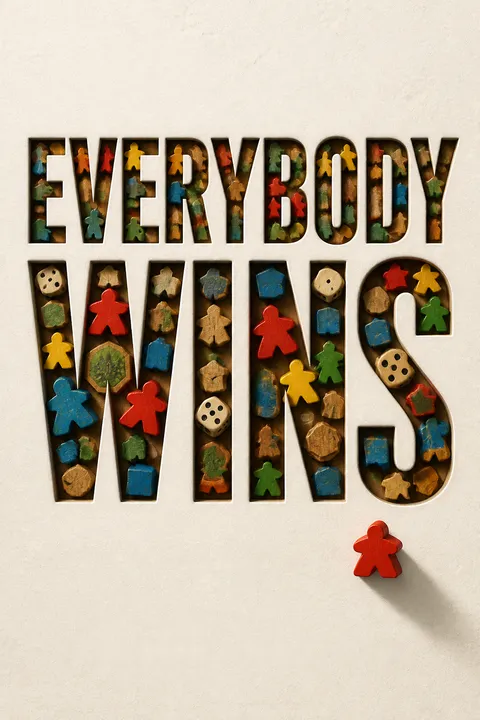
Everybody Wins is both a history of an influential award and a case study in how design cultures evolve. Its chronological structure follows the Spiel des Jahres from an initiative by a small network of German critics to a global signal for consumers and publishers. Individual game profiles make that history concrete: Hare and Tortoise demonstrates early strategic invention; CATAN marks the international breakthrough of German-style design; Dominion and Hanabi show how a new mechanism or constraint can alter the possibilities of play; and Codenames reflects the award’s turn toward group-friendly party games.
The central claim is deliberately more nuanced than “the award created modern board games.” The prize helped increase visibility, sales, and professional recognition, while designers and publishers responded to the market it helped cultivate. That is a feedback loop, not a single cause. The book also shows the limits of any canon. A prize that favors family games released in German-speaking markets will miss major successes in collectible cards, wargames, and other international traditions. Its omissions are part of its history, not merely errors to correct.
The strongest analytical thread is that games cannot be evaluated by mechanics alone. Dice movement can feel dull in one design and suspenseful in another; a low-rules game can demand demanding social judgment; a familiar mechanism can become novel through its arrangement. The profiles connect design choices to player experience, production, sales, and changing expectations. They also reveal that accessibility is not the same as simplicity: contemporary games can carry more strategic weight while becoming easier to learn through clearer rules and presentation.
The book’s critical judgments are often lively and subjective, which is a strength when treated as criticism rather than objective measurement. A disliked winner may still be historically important, and a commercially successful game is not necessarily a design triumph. The reader is left with a practical way to think about games: ask what decisions they create, for whom, under what conditions, and why their pieces and rules make those decisions pleasurable. The award’s most durable contribution may be the conversation it keeps generating about those questions.
People Also Read



Glossary
Spiel des Jahres
German game of the yearAn annual German board-game award first presented in 1979 by a jury of games journalists and critics. It recognizes titles considered especially suited to broad social and family play. Its red pawn emblem became a prominent signal for consumers, and the award helped bring attention and commercial success to games and designers.
Eurogames
Social, indirect strategy gamesA broad design style associated with German games that gained international prominence from the 1980s onward. Eurogames often emphasize strategic choices, indirect competition, limited player elimination, and relatively controlled randomness. Themes and polished components are common, though the label covers many different designs and has no single definitive rulebook.
Gateway games
Introductions to modern gamingGames that help people move from familiar mass-market titles toward more varied or strategic tabletop play. They tend to be easy to teach, offer meaningful choices, and reward repeat play as players learn their subtleties. CATAN, Carcassonne, Ticket to Ride, and Codenames are prominent examples discussed in the book.
Kramerleiste
Kramer-style scoring trackA numbered scoring track, commonly placed around the edge of a game board, where players move markers to record their points. It became associated with designer Wolfgang Kramer after its use in games including Heimlich & Co. The format is older than Kramer, but its familiarity in German game design led to the name.
Deck building
Improve a deck during playA game structure in which players acquire cards during the game and add them to the deck they will draw from in later turns. Dominion made this process the central activity of a standalone game. As a player’s deck changes, new combinations and strategies become possible, giving the game variety across sessions.
Kinderspiel des Jahres
Children’s game awardThe Spiel des Jahres organization’s separate annual award for children’s games, established as a formal category in 2001 after earlier special prizes for children’s titles. Its creation allowed the main award to focus on a different audience while recognizing games designed specifically for younger players.
Kennerspiel des Jahres
Expert game awardAn award introduced in 2011 for more demanding games aimed at experienced players and hobbyists. Its creation acknowledged the growth of complex tabletop gaming and separated those titles from the main Spiel des Jahres award, which increasingly emphasized accessibility and broad appeal.
Kludge
A patch for a design flawA rule or mechanic added to compensate for a problem created elsewhere in a game’s design. The book uses the term critically because accumulated patches can make play awkward rather than fixing the underlying structure. Redesigning the troublesome system may produce a more coherent result than adding another exception.
Download PDF
Download EPUB
.epub digital book format is ideal for reading ebooks on phones, tablets, and e-readers.








