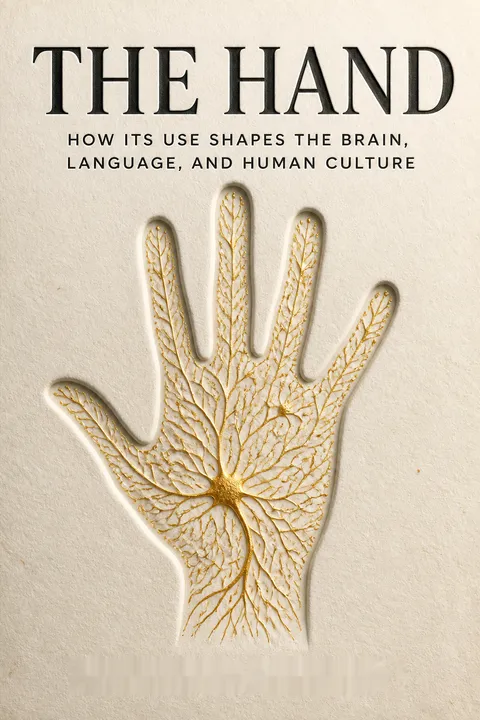


Key Takeaways
Treat the hand as part of the mind, not its obedient tool
Start with ordinary movements. Reaching for an alarm, fastening clothes, and making breakfast require finely coordinated movement that usually escapes notice. Neurologist Frank Wilson began asking how such skill works after struggling to learn piano as an adult, then treating musicians whose hands had lost abilities central to their lives. Their cases suggested that skilled movement is not a simple command sent from brain to hand. It grows through ongoing exchange among brain, arm, hand, senses, practice, and purpose.
Widen the definition. Wilson argues that the hand cannot be understood as fingers alone: its working system includes the arm, nerves, brain, and the person’s history of using them. A theory of intelligence that leaves out bodily action misses how people learn and make meaning.
The argument aligns with embodied approaches to cognition, which treat thinking as an activity shaped by perception and action rather than computation sealed inside the skull. That perspective helps explain why manipulating an object can reveal properties that looking alone cannot. It also clarifies the book’s challenge to brain-centered explanations without requiring a rejection of neuroscience. The useful distinction is between the brain as indispensable and the brain as sufficient: neural activity matters, but a person’s practical intelligence also depends on a body acting in a world.
Small changes in grip helped turn a climbing limb into a toolmaker
Follow the evolutionary sequence. Lucy, an Australopithecus afarensis who lived about 3.2 million years ago, walked upright and had a hand with some humanlike features, including a relatively long thumb. Anthropologist Mary Marzke argued that its thumb, index, and middle fingers could hold stones securely and manipulate them with greater control than an ape hand.
The little finger mattered too. Lucy could not make the human movement that draws the ring and little fingers toward the thumb. Wilson suggests that later wrist changes enabled a stronger, more versatile grip for striking with a tool and controlling small objects. Such modifications could have expanded what hands could do, but the fossil record does not show exactly when they appeared. The account is an evolutionary hypothesis, not a story of inevitable progress toward modern humans.
The evolutionary point is not that a thumb was a magic upgrade. It is that small anatomical differences can alter the range of actions an organism can reliably perform, changing the problems it can solve. This resembles the idea of affordances in design: an object or body part offers certain actions while making others difficult. The proposed link between grip, throwing, and survival is suggestive, but fossil gaps limit certainty. The strongest conclusion is about expanding functional possibilities, not proving that one grip caused language or a larger brain.
Practice teaches the nervous system timing, physics, and recovery from error
Skill is learned in the attempt. Juggler Serge Percelly described days when a trick seemed mastered, followed by days when it fell apart. Engineer Howard Austin’s analysis of juggling likewise found enormous swings between attempts, including occasional breakthroughs that sharply exceeded a learner’s previous best. Progress was not a smooth climb.
Accuracy means adapting. A beginner who expects every toss to reach exactly the same height is vulnerable to small deviations. Austin argued that jugglers improve by learning to compensate for errors, not by eliminating variation. A throw’s direction can also be wrong because its release was mistimed. Rehearsal therefore trains a practical sense of trajectory, timing, and correction. Percelly’s expert performance depended on intelligently organized practice, feedback, and years of refining the act, not repetition alone.
This account anticipates a central idea in motor learning: reliable performance comes from a system that can absorb variation, not one that works only under perfect conditions. Engineering control systems face the same problem, since real environments rarely match a flawless plan. The juggling example makes that principle tangible. It also cautions against treating practice time as a complete explanation of expertise. Instruction, motivation, physical capacity, and access to useful feedback shape what repetition can accomplish.
Look to coordinated hand action when asking how language became possible
Shared action can carry knowledge. Psychologist Merlin Donald called mimesis the ability to create intentional, meaningful actions that can be repeated and understood without words. Demonstrating how to shape a tool, for example, could let others learn a procedure without inventing it again. Wilson considers whether increasingly skilled hand use and gesture helped create conditions for language and abstract thought.
Signs are language, not pantomime. American Sign Language has conventional signs and grammar, and research discussed by Wilson found that damage to language-related brain areas can disrupt signing as well as speech. Deaf children also acquire sign on a developmental timetable comparable to spoken language. This supports the claim that language is not tied to the voice alone. It does not, by itself, prove that prehistoric language began with hand gestures.
The section’s strongest contribution is to separate language from speech: a language can use a visual and spatial channel while retaining complex grammar. That finding makes it harder to assume that vocal speech is the only natural home for linguistic thought. The proposed evolutionary role of gesture remains more speculative. Evidence that present-day sign is a full language demonstrates human capacity, but it cannot directly reveal what early hominids communicated. Keeping those claims distinct preserves both the insight and its limits.
Train both hands to divide a task, not simply duplicate it
Handedness can be cooperation. In many two-handed tasks, the hands do different jobs. Drawing or writing depends on one hand making precise, repeated movements while the other steadies and repositions the material. Researcher Yves Guiard described this as a division of labor: one hand establishes the larger working frame, and the other performs finer actions within it.
Tools made that partnership useful. Anthropologist Peter Reynolds used heterotechnic cooperation to describe people working toward a shared result through complementary roles. He contrasted this with simpler cooperation in which group members perform broadly interchangeable actions. Wilson also discusses evidence from ancient stone flakes: one collection showed a 57:43 ratio of identifiable right-oriented to left-oriented flakes, similar to the ratio among modern right-handed toolmakers. The finding suggests a preference, not a complete account of ancient handedness.
This framework shifts attention from ranking one hand above the other to examining how a task is organized across both hands. It has implications for teaching practical skills: learners may need to understand the stabilizing hand’s contribution, even when it appears inactive. The same lens also applies to teamwork, where complementary roles can outperform interchangeable effort. Still, hand roles vary by person and task. A useful model should describe common patterns without turning them into rigid rules about right- or left-handed ability.
Follow the work that makes practice feel worth repeating
Aptitude needs a setting. Anton Bachleitner saw puppetry as a child and built a life around carving and performing marionettes. George McLean discovered jewelry-making as an adult, despite losing four fingers in an accident. Earlier interests in precise models, drawing, and working with tools helped him adapt. Their paths suggest that a vocation may emerge from a developing cluster of interests rather than a ready-made talent for one job.
Adaptation has a name. Henry Plotkin’s secondary heuristic means an individual’s capacity to develop new ways of responding to an uncertain environment. It depends on inherited capacities, but the particular strategy is learned through experience, not passed down as a specific genetic program. Wilson’s cases show how sustained work can become bound up with identity, emotion, and growing independence.
These stories resist two easy explanations: that talent is fixed at birth, or that any interest can be transformed into mastery by effort alone. They instead show a person meeting a practice, developing competence, and finding reasons to persist. This fits a developmental view in which opportunities help reveal capacities that were not obvious in advance. The stories are memorable but selective: successful adults can narrate early clues in hindsight. Their lesson is to keep possibilities open, not to treat every childhood fascination as a career prediction.
Notice how culture can reward musical brilliance and punish the body
Musical skill has a social habitat. Wilson contrasts the professional concert world with community and amateur music. Since the rise of the virtuoso performer, audiences, instruments, competitions, and training systems have rewarded ever more demanding performance. The pianist Misha Dichter recalled an environment where students treated long hours of practice as essential. Such pressures can produce extraordinary skill, but Wilson’s clinical work with injured musicians shows that the pursuit can also damage the hands.
Talent is culturally shaped. Anthropologist John Blacking observed that Venda children, immersed in music as part of everyday social life, could perform and teach their musical traditions at a high level. Their experience differed from Western systems that identify a few children for specialized professional training. The contrast suggests that a culture can cultivate different forms of musical expertise without changing human biology.
The contrast makes talent look less like a hidden substance and more like a relationship among bodies, teaching, tools, and reward systems. A culture that celebrates virtuosity also sets the conditions under which musicians train, compete, and risk injury. This is a useful corrective to explanations that credit achievement solely to personal gifts. The comparison is not a controlled test of cultural systems, however. Its force is conceptual: different societies can make different kinds of musical competence ordinary, prestigious, or professionally necessary.
Teach through making so abstract ideas have something to push against
Hand knowledge is real knowledge. In Jeanne Bamberger’s Laboratory for Making Things, children built objects and then tried to explain how they worked. One boy balanced unequal weights on a mobile by relying on a bodily sense of a seesaw, although his teachers knew the related formula but struggled to connect it to what they could feel. The mismatch exposed two forms of understanding: practical knowledge gained through action, and formal knowledge expressed in symbols.
Start from the learner. Research on accomplished pianists described families and teachers responding to children’s interests with encouragement, while goals grew alongside skill. The lesson is not to abandon books or formal instruction. It is to connect explanation to experiments, objects, and questions that matter to the learner, then help learners translate between doing and describing.
Making can expose assumptions that verbal instruction leaves hidden. A learner who can balance a mobile but cannot explain the equation is not simply ignorant; the learner has a working model that needs translation into another representational form. This is a powerful teaching opportunity. It also challenges the false choice between hands-on learning and abstraction: physical experience can supply a foundation for formal reasoning. Not every concept is best taught with objects, but learners benefit when schools recognize more than one route to understanding.
Test the whole performance, not just isolated dexterity
Skill depends on what the task demands. A study of surgical trainees discussed by Wilson found that stronger performance was associated especially with the ability to organize complex visual and spatial information, rather than with manual speed alone. Surgeons still need trained hands, but their work also requires seeing relevant structures and coordinating a sequence of actions in context.
A test can miss a person’s expertise. Wilson argues that a clinician’s standard test of skilled movement may fail to detect a musician’s loss of piano technique, or a chef’s inability to perform the particular sequences required in a kitchen. The neurological term apraxia describes impaired learned, purposeful movement that cannot be explained by weakness or basic sensory loss. Understanding a skill may require observing the person do the meaningful task, not merely a generic imitation of it.
This is a strong argument for ecological assessment: performance should be examined in the setting where the skill has meaning and consequences. A short test can measure a narrow capacity while missing the integrated expertise that defines a profession or art. The same issue appears in education and hiring, where proxy measures can become mistaken for the actual ability of interest. Contextual assessment is harder to standardize, so it should complement, not replace, careful objective measurement.
Analysis
The book’s central achievement is to make the hand an explanatory hinge between biology and lived experience. Wilson moves from primate evolution to the anatomy of grip, from juggling and puppetry to language, music, medicine, and education. The recurring claim is not that hands replace brains, but that thought develops through organisms acting on objects and learning from the consequences. That claim gives the book a coherent narrative across disciplines that usually study movement, language, and learning separately.
Its most persuasive evidence comes from skilled practice. A juggler learns trajectory through repeated throws; a jeweler reads material through touch, sound, and sight; a child may understand balance in action before being able to state a formula. These cases reveal why abstract descriptions of intelligence can be incomplete. They also suggest a practical principle: to understand a competence, observe the person using it in meaningful conditions.
The evolutionary story requires more caution. Fossil hands are scarce, and the proposed links among grip, throwing, brain growth, and language cannot be treated as a settled chain of causes. Wilson often marks these as hypotheses, but the sweep of the story can make them feel more certain than the evidence allows. The stronger argument is reciprocal: bodily structure creates opportunities, cultural practices exploit them, and individual learning reshapes performance.
The educational implication follows naturally. Formal instruction should not mistake verbal fluency for intelligence or practical competence for a lesser form of knowledge. Nor should it romanticize self-directed discovery: skilled mentors, deliberate practice, and accessible opportunities matter. The book’s lasting challenge is to design learning environments that connect action with explanation while leaving room for abilities no curriculum can predict in advance.
Review Summary
The Hand receives mixed reviews, with an average rating of 3.86/5. Positive reviews praise its fascinating exploration of hand-brain connections and evolutionary biology. Critics find it dense, unfocused, and straying from its main thesis. Many appreciate the first half's discussion on hand evolution and brain development but feel the book loses focus later. Readers recommend it for those interested in neurology, anthropology, and learning theories. Some find the writing style challenging, while others appreciate the author's broad scope and intellectual stimulation.
People Also Read



Glossary
Hand-thought-language nexus
Interdependence of action and thoughtWilson’s term for the proposed mutual influence of hand use, thinking, and language in human evolution and development. Manual exploration helps people build knowledge of objects and actions, while thought and communication organize what the hands do. The term challenges explanations of mind that treat the brain as independent of the body and its experience.
Primary heuristic
Inherited survival capacitiesHenry Plotkin’s term for the evolutionary process through which genetic variation, selection, and transmission shape inherited bodily structures and behavioral tendencies. These inherited capacities provide an organism with a starting set of ways to meet recurring survival demands. They constrain what can be learned, but do not specify every behavior an individual will develop.
Secondary heuristic
Learned responses to uncertaintyPlotkin’s term for an organism’s capacity to develop new ways of responding to changing or unpredictable circumstances. Unlike a specific inherited behavior, a secondary heuristic is formed through individual experience and learning. Wilson uses it to connect intelligence with adaptable action, including culturally learned skills that can become central to a person’s life.
Mimesis
Meaningful nonverbal representationIn Merlin Donald’s account, mimesis is the ability to produce intentional, self-initiated actions that represent events or ideas without relying on formal language. A person can demonstrate and repeat a useful action so others can understand and learn it. Wilson discusses this capacity as a possible bridge between practical skill, shared knowledge, and language.
Heterotechnic cooperation
Complementary group workPeter Reynolds’s term for cooperation in which people contribute different, coordinated actions to achieve a shared technical result. Participants anticipate one another’s contributions rather than simply doing interchangeable work. Wilson applies the concept to toolmaking and manufacturing, where specialized tasks must be sequenced and assembled into a finished product.
Polylith
Mechanically joined componentsReynolds’s term for a manufactured object made from components joined so that they retain their structural or functional relation when the object is rotated. A hafted hammer is an example because its head is attached to its handle. The term distinguishes assembled tools from structures that rely on gravity to remain in place.
Polypod
Gravity-dependent assemblyReynolds’s term for a structure made from separate units whose arrangement depends on gravity for stability. A stack of stones or a house of cards can qualify. Unlike a polylith, a polypod does not have components mechanically joined into a single object, so changing its orientation can disrupt the structure.
Praxis
Learned skilled movementA neurological term for purposeful, learned movement used to carry out a skilled action. Praxis involves more than basic muscle strength: it includes organizing and executing actions such as using a tool or performing a familiar gesture. Wilson argues that complex expert skills may exceed what standard clinical tests of praxis can capture.
Apraxia
Impaired purposeful movementA neurological impairment in performing learned, purposeful movements that is not explained by elementary weakness, paralysis, sensory loss, memory problems, or failure to understand instructions. A person may struggle to perform a familiar action despite having the physical capacity to move. Wilson notes that assessments can miss difficulties specific to a profession or practiced skill.
Precision grip
Controlled finger-thumb holdJohn Napier’s term for a grip in which an object is held or manipulated between the thumb and one or more fingers, without relying on the palm as the main buttress. It supports fine control of small objects, such as a tool or needle. The exact grip depends on the demands of the task.
Power grip
Palm-supported forceful holdNapier’s term for a grip in which the fingers hold an object against the palm, with the thumb often helping secure it. This arrangement is useful when applying substantial force, as when holding a hammer. Wilson emphasizes that grip is organized around the task’s demands, not merely the shape of the object.
Download PDF
Download EPUB
.epub digital book format is ideal for reading ebooks on phones, tablets, and e-readers.








