

Key Takeaways
Move beyond Python syntax by practicing how working developers solve problems.
The next stage is different. The book is for programmers who know basic Python but feel stranded between beginner tutorials and professional work. Sweigart calls this gap the desert of despair: there is plenty to learn, but no obvious route through it. He recalls attending a programming meetup as a teenager, convinced everyone else knew far more. Studying harder did not make the field feel smaller; it made its scale clearer.
Build a way forward. The book shifts attention from memorizing syntax to practical habits: investigating errors, using tools, judging code, and making design choices. Its central promise is not instant expertise. It offers a firmer foundation for learning the next unfamiliar thing.
What's useful about this framing is that it treats uncertainty as part of professional practice, not proof of personal inadequacy. Programming knowledge is too broad to keep entirely in memory, so progress depends on developing reliable ways to locate, test, and apply information. The book's breadth can feel like another fire hose, however. Its strongest use is as a map and a set of habits to practice, rather than a demand to master every feature at once.
Read the traceback, search first, then ask with a reproducible example.
Errors contain clues. A traceback shows the sequence of calls that led to an unhandled exception and identifies where Python detected the problem. That location may not be where the bug began. A missing parenthesis on one line, for instance, may only become apparent to Python when it reads the next line. Read the error type and message, inspect the relevant code, and search the distinctive wording online rather than trying to memorize every error.
Make help easy. If searching and a linter do not resolve the issue, ask in the right forum with a specific question, your goal, the full error, and a minimum, complete, reproducible example. Include what you tried and your Python version. A helper should be able to run the example and see the same problem without reconstructing your setup.
This approach turns debugging from a test of memory into a process of reducing uncertainty. A good reproducible example is especially valuable because it separates the essential failure from the surrounding program, much as a controlled test isolates one variable. The advice also recognizes that technical communities serve future readers, not just the person who posted. One caution: a traceback is evidence about where execution failed, not a verdict about the underlying cause.
Let Black settle formatting, then spend human judgment on names and meaning.
Consistency beats style debates. Code can run while remaining difficult to read. Python's PEP 8 style guide and the Black formatter provide a shared baseline for spacing, indentation, and line layout. Black automatically applies its choices, reducing repetitive cleanup and arguments about personal preferences. A team can agree on a formatter and focus its attention elsewhere.
Meaning remains human work. A formatter cannot tell whether a variable called `payment` means a monthly bill or a customer refund. Choose names that are descriptive, searchable, and appropriate to their scope. Avoid unexplained abbreviations, jokes, and Python built-in names such as `list`, which can mask the original function. Include units when they prevent ambiguity: the book recalls a spacecraft lost after software used incompatible measurement systems.
The distinction between mechanical consistency and semantic clarity is a useful division of labor. Automated tools are good at applying rules identically; people are needed to decide what the code is about. Naming also acts as a lightweight safety mechanism: explicit units and specific identifiers expose assumptions before they turn into defects. Still, descriptive names should not become miniature essays. The best name supplies the context a reader needs at that point in the code.
Treat code smells as invitations to inspect, not commandments to obey.
A smell is a warning. A code smell is a pattern that may signal a bug or maintenance problem, but does not prove one exists. Repeated blocks can make updates inconsistent, unexplained numbers hide intent, and commented-out or unreachable code can mislead whoever reads the file next. An empty exception handler may conceal bad data instead of resolving the failure. Nested comprehensions can compress logic until the reader has to unpack it mentally.
Rules need context. The book also challenges rigid advice: multiple `return` statements, more than one `try` block, Boolean flag arguments, global variables, and comments are not automatically bad. For example, a Boolean option is sensible when it adjusts one behavior, but not when it makes a function behave like two unrelated functions. Use each smell as a prompt to ask whether the design is actually harder to understand or change.
This is a strong antidote to checklist-driven programming. A warning is useful when it directs attention to a concrete risk, but harmful when it becomes a ritual detached from consequences. The distinction matters because refactoring has a cost: replacing a clear repetition with several tiny functions may increase the reader's burden. The practical test is not whether code violates a slogan, but whether its structure makes errors, changes, or intent harder to manage.
Use Python's idioms when they clarify intent, not merely shrink code.
Prefer clear defaults. Python's idioms often remove boilerplate while making common intentions visible. Use `enumerate()` to get an item's index and value together, and a `with` statement to ensure a file closes even when an error interrupts the block. Dictionary methods such as `get()` and `setdefault()` handle missing keys directly. Use `is None` when checking for the unique `None` object, and f-strings for readable string interpolation.
Compact is not always clear. A dictionary can replace a long chain of similar conditions, but it is not automatically easier to read. The same goes for conditional expressions and comprehensions: a short expression becomes a liability when it hides several decisions. Python's idioms are best treated as tools for expressing intent, not as a contest to use the fewest lines.
Idiomatic code lowers the effort required to recognize familiar operations. In this book, the with statement does more than look tidy: it encodes a cleanup guarantee directly into the structure. That makes the idiom a reliability feature as well as a style choice. The restraint is equally important. Brevity helps only when readers can recover the logic quickly, so an explicit loop may be the more Pythonic choice in practice.
Remember assignment shares mutable objects, it does not copy them.
Variables are references. In Python, assigning one variable to another copies the reference to an object, not the object itself. If `cheese = spam` and both names point to the same list, changing that list through either name changes what both names show. A shallow copy creates a new outer list but still shares any mutable objects inside it; a deep copy recursively copies those nested objects.
Avoid mutation traps. Do not add or remove list items while iterating over that list, because new items may be revisited and deleted items can shift positions. Mutable default arguments are also reused across calls, so use `None` and create a fresh list or dictionary inside the function. For large string-building loops, collect pieces in a list and join them once. Floating-point arithmetic can also be inexact, so use integers for small units or `Decimal` when exact decimal precision matters.
The reference model explains several bugs that otherwise look unrelated: unexpected changes through aliases, shared default lists, and surprising effects of mutation during iteration. It is a compact mental model with practical reach. The book recommends deep copying as a safe default, but copying is not free and is not always necessary. The better habit is to identify which objects are shared and mutable, then copy only when independent state is actually required.
Keep functions understandable, predictable, and honest about failure.
Right-size the unit. Functions help remove duplication and give a program structure, but splitting every task into tiny functions can create a maze of names and calls. Sweigart suggests keeping functions reasonably short without forcing an arbitrary line limit. Zero to three parameters is usually manageable; a much longer parameter list may indicate that the task needs redesign. Use ` args` or ` kwargs` when a function genuinely needs variable positional or named inputs, not merely to hide an unclear interface.
Make behavior dependable. A function is easier to use when its return value has one predictable type. Prefer raising an exception for an exceptional failure instead of returning an error code that could be mistaken for ordinary data. Pure functions, which return the same result for the same inputs without changing outside state, are easier to test and reuse. Keep side effects visible when a function changes files, shared objects, or global data.
Function design is presented as a tradeoff between local simplicity and total system complexity. That is more useful than a universal rule about line counts: a function can be long because it tells one coherent story, while several short helpers can obscure the sequence. Stable return types and explicit failures also reduce the number of cases every caller must remember. Purity is valuable where practical, though real programs still need boundaries that interact with users, files, and services.
Document the why, and let type checkers catch mistakes early.
Explain intent, not syntax. Comments are most useful when they explain why code takes an unusual form, summarize a section, or preserve lessons learned during a difficult implementation. Repeating what a line already says adds little. Docstrings describe modules, classes, and functions in a format that Python's `help()` and documentation tools can retrieve.
Add optional checks. Type hints annotate expected types for variables, parameters, and return values. Python itself ignores them at runtime, but static analyzers such as Mypy can examine the source before it runs and flag possible mismatches. Hints can be introduced gradually. Together, accurate comments, useful docstrings, and type checks help future maintainers understand both the intended behavior and some of the assumptions the code relies on.
These practices make source code carry more of its own operating instructions. Comments preserve reasoning that names and syntax cannot always express, while type hints make some assumptions machine-checkable. The combination is stronger than either alone: prose can explain intent, and analysis can detect certain inconsistencies. Both can become stale, however. Documentation deserves maintenance alongside code, and a type checker warning should prompt investigation rather than automatic suppression.
Commit working changes so every experiment has a safe return point.
Save a history, not copies. Git records project snapshots called commits in a repository. Unlike a folder full of files named `project-final`, `project-final2`, and `project-final-really`, this history lets a programmer inspect or restore earlier work. The basic workflow is to initialize or clone a repository, track files, and commit coherent changes with useful messages. A `.gitignore` file excludes generated files and private information that should not enter the history.
Review before saving. Git's status and diff commands show which files changed and what the changes contain. Files can be untracked, modified, staged, or committed. The staging area selects what goes into a commit. Git can also restore earlier content, and a remote host such as GitHub provides a shared copy and backup. Commit after a working feature or fix, not after every keystroke or only after a huge batch of changes.
Version control changes the psychology of experimentation: a programmer can try a refactor without treating the current version as fragile and irreplaceable. The record is useful not only for recovery but for understanding how a project changed. Good commit messages make that history legible. The safeguard has limits, though. A remote repository is not automatically private, and sensitive data once committed may remain in history even after the visible file is edited.
Profile actual bottlenecks, then use Big O to forecast scaling.
Measure before optimizing. The `timeit` module compares small snippets by running them repeatedly; `cProfile` reports where a larger program spends its time. In one example, profiling showed that a built-in exponentiation operation consumed nearly all the runtime, making work on already-fast functions a poor target. Amdahl's Law captures the same idea: speeding up a small fraction of a program has limited effect on its total time.
Ask how growth changes cost. Big O describes how runtime grows as input size grows. Reading every item is O(n); checking every item against every other item is O(n^2); repeatedly halving a search space is O(log n). But Big O is not a stopwatch. For small inputs, a theoretically better algorithm may not matter, and profiling reveals actual bottlenecks on the program and data at hand.
The chapter usefully separates two questions that are often confused: what is slow now, and what will become costly as input grows? Profiling answers the first; complexity analysis helps answer the second. Together they prevent both premature cleverness and shortsighted fixes. Big O simplifies by ignoring constants and lower-order terms, so it should not be mistaken for a complete performance prediction, especially when datasets are small or implementation costs dominate.
Use classes to group state and behavior, but prefer composition over inheritance.
Model what the program needs. A class combines related data and methods into a type of object. In the book's tic-tac-toe example, functions that all manipulated the same board dictionary became methods of a board class. Yet a small program may be clearer with functions and simple data structures. Classes should reflect the software's purpose, not an imagined universal model of real-world things.
Reuse with care. Inheritance shares methods through an "is a" relationship, but parent changes affect child classes and can make designs tightly coupled. Composition, where one object contains another, suits "has a" relationships and often allows easier change. Python properties can validate attributes, and dunder methods let custom objects work with operators and built-ins. The Tower of Hanoi and Four-in-a-Row projects demonstrate that readable programs can use straightforward structures without forcing every idea into a class.
The book resists the tendency to treat object-oriented design as a maturity badge. Its examples show that the right structure depends on which data and operations actually belong together. Composition is often easier to adapt because it connects components without making one a permanent subtype of another. Properties and operator methods can make a class feel natural to use, but they also create implicit behavior. That convenience earns its place only when the resulting interface is clearer.
Analysis
This book is best understood as a bridge from introductory Python to the habits that make code maintainable. It is not organized around one grand technical theory. Instead, it moves from the programmer's daily friction points, such as interpreting tracebacks and configuring a shell, through style, language behavior, tools, performance, and object-oriented design. The recurring subject is judgment: a practice may be useful without being mandatory, and a suspicious pattern may be harmless in context.
That stance gives the book its coherence. Black can standardize syntax, but it cannot choose good names. A smell can expose risk, but treating every smell as a violation can produce needless abstraction. Classes can organize state, but an ordinary function may be enough. Performance analysis similarly requires two lenses: measured runtime and anticipated growth. These are not separate tips so much as repeated lessons in matching a tool to a problem.
The main challenge in compressing the book is its range. It contains a substantial command-line primer, an extensive Python vocabulary guide, two complete games, and detailed treatments of Git and object-oriented features. A short adaptation cannot preserve every command or language quirk. The most durable value lies in the mental models that transfer across projects: inspect evidence before guessing, make examples reproducible, understand references and mutation, keep interfaces predictable, preserve working history, and measure before optimizing.
The book's practical tone is also a strength for readers without formal computer science training. It defines jargon in context and uses small, concrete programs to show how design choices affect debugging and maintenance. Its advice is intentionally pragmatic rather than doctrinaire. The result is less a rulebook for perfect Python than a guide to becoming less surprised by one's own code, and more capable of improving it deliberately.
Review Summary
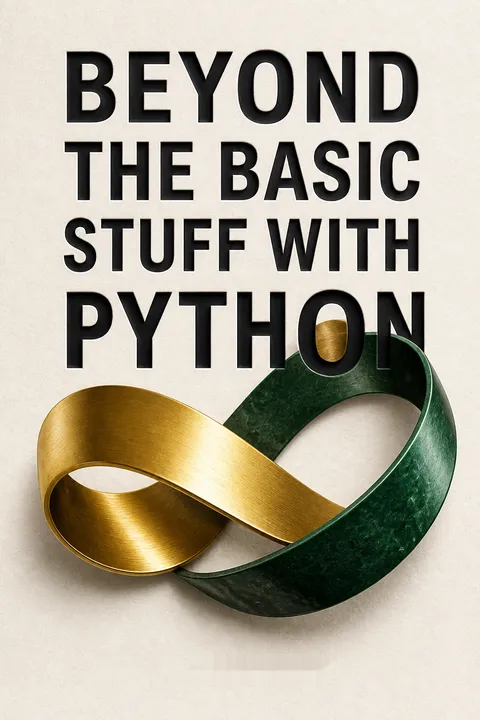
Beyond the Basic Stuff with Python is highly praised for bridging the gap between beginner and intermediate Python programming. Readers appreciate its coverage of best practices, tools, and techniques, including code formatting, naming conventions, Git usage, and object-oriented programming. The book is commended for its clear explanations, practical examples, and focus on Pythonic code. Many reviewers found it helpful in advancing their skills and understanding of software development concepts. While some felt certain topics could have been explored more deeply, the overall consensus is that it's an excellent resource for Python learners looking to progress beyond the basics.
People Also Read





Glossary
code smell
Potential design warningA code smell is a recognizable source-code pattern that may indicate a bug, unnecessary complexity, or difficulty maintaining the program. It is not proof that the code is wrong. Examples include duplicated logic, unexplained numeric values, and empty exception handlers. The programmer investigates the risk and decides whether a change is worthwhile.
Pythonic
Idiomatic Python stylePythonic describes code that uses Python's language features and conventions in ways experienced Python programmers commonly find clear and natural. Examples include using enumerate() when both an index and item are needed, and using with to manage a file. The term describes a style of expression, not a formal test of correctness.
The Zen of Python
Python design aphorismsThe Zen of Python is a set of short guidelines associated with Tim Peters that express preferences for readable, explicit, and simple Python code. It can be displayed by running import this. The guidelines are principles rather than strict rules, and some deliberately pull in different directions, leaving programmers to judge the needs of a particular program.
minimum, complete, and reproducible example
Small runnable bug reportA minimum, complete, and reproducible example is a concise piece of code that contains everything needed to demonstrate a programming problem and reliably produces that problem. It removes unrelated code without omitting necessary setup. Sharing one lets another programmer run the same case, inspect the failure, and offer a focused answer.
Big O
Input growth modelBig O notation describes how an algorithm's runtime grows as its input size grows, without specifying seconds or hardware. For example, O(n) grows roughly in proportion to input size, while O(n^2) grows with the square of that size. It helps compare scalability, but does not replace profiling real code.
Amdahl's Law
Whole-program speed limitAmdahl's Law describes how much an entire program can speed up when only one part is improved. The benefit depends on the fraction of total runtime spent in that part. Making a minor component dramatically faster has little effect on the whole, while improving a dominant bottleneck can produce a much larger overall gain.
pure function
Predictable, side-effect-free functionA pure function returns the same result whenever it receives the same arguments and does not change state outside its own local computation. It does not, for example, alter a global variable, write a file, or mutate a shared list. Pure functions are easier to test and reproduce, though programs still need code that interacts with external resources.
type hints
Optional type annotationsType hints annotate the expected types of Python variables, parameters, and return values. The Python interpreter does not enforce them while a program runs, but static analysis tools can use them to identify possible type mismatches before execution. A program can adopt hints gradually, balancing Python's dynamic flexibility with additional checking.
staging area
Changes selected for commitThe Git staging area is the intermediate place where a programmer selects changes to include in the next commit. A file can be modified in the working copy without being staged, or staged and then modified again. Understanding this distinction helps programmers review exactly what a commit will record.
composition
Objects contained in objectsComposition is a class-design technique in which an object contains an object of another class as an attribute, rather than inheriting that class's methods. It represents a "has a" relationship, such as a customer object containing a purse object. Composition can keep components more independent than inheritance and make future design changes easier.
dunder methods
Python special methodsDunder methods are special Python methods whose names begin and end with two underscores, such as __init__, __repr__, and __add__. Python calls them in response to operations such as constructing an object, representing it as text, or applying an operator. They let custom classes participate in Python's built-in conventions.
FAQ
1. What is Beyond the Basic Stuff with Python by Al Sweigart about?
- Bridges beginner to intermediate: The book is designed for readers who have completed basic Python tutorials and want to deepen their skills with best practices for writing clean, maintainable, and professional Python code.
- Covers advanced topics: It explores environment setup, code formatting, naming conventions, debugging, Pythonic idioms, object-oriented programming, performance measurement, and practical projects.
- Focus on real-world skills: The book explains programming jargon, common Python pitfalls, and introduces tools and techniques used by professional developers.
- Guides through the “desert of despair”: Al Sweigart aims to help those who feel stuck between beginner and advanced resources, providing a clear path to becoming a more capable programmer.
2. Why should I read Beyond the Basic Stuff with Python by Al Sweigart?
- Advance beyond basics: The book is ideal for those who want to move past beginner-level Python and learn industry-standard practices for writing robust, readable code.
- Gain professional confidence: It helps readers overcome impostor syndrome by teaching tools, techniques, and mindsets used by experienced developers.
- Learn essential development tools: Readers are introduced to Git for version control, project organization, and performance analysis, which are crucial for real-world programming.
- Write more predictable code: The book emphasizes returning consistent data types, using exceptions for error handling, and adopting clear documentation practices.
3. Who is the ideal reader for Beyond the Basic Stuff with Python by Al Sweigart?
- Intermediate Python learners: Those who have finished introductory books or tutorials and want to deepen their understanding of Python.
- Programmers from other languages: Developers familiar with other programming languages who want to learn Python’s best practices without rehashing basic syntax.
- Aspiring professionals: Anyone aiming to write code that is maintainable, readable, and suitable for collaborative or production environments.
- Self-taught coders: Readers who want to fill in gaps in their knowledge and learn the “why” behind Python conventions.
4. What are the key takeaways from Beyond the Basic Stuff with Python by Al Sweigart?
- Write clean, readable code: Emphasizes code formatting, naming conventions, and avoiding common code smells to improve clarity and maintainability.
- Adopt Pythonic idioms: Encourages using features like
enumerate(), f-strings, and context managers to write idiomatic Python. - Handle errors professionally: Teaches how to read tracebacks, use exceptions instead of error codes, and ask for help effectively online.
- Understand performance and organization: Introduces performance measurement tools, Big O analysis, and project organization with Git and Cookiecutter.
5. What are the best practices for writing clean Python code according to Al Sweigart?
- Consistent code formatting: Recommends using Black, an automatic code formatter, to enforce PEP 8 style and reduce debates over formatting.
- Descriptive naming conventions: Advocates for clear, concise, and consistent names, avoiding jokes, puns, or overwriting built-in names.
- Refactor code smells: Identifies issues like duplicate code, magic numbers, and poor error handling, encouraging regular refactoring for better design.
- Comment and document wisely: Stresses writing comments that explain intent, using docstrings for functions and modules, and maintaining a professional tone.
6. How does Beyond the Basic Stuff with Python by Al Sweigart teach error handling and asking for help?
- Read and interpret errors: Guides readers in understanding Python tracebacks and deciphering cryptic error messages to locate bugs efficiently.
- Effective internet searches: Suggests copying error messages into search engines with quotes to find solutions, normalizing this as a key programming skill.
- Best practices for asking questions: Details how to ask for help online by providing full error messages, complete code, setup details, and previous troubleshooting steps.
- Use exceptions, not error codes: Recommends raising exceptions instead of returning error codes or None, making error handling clearer and less bug-prone.
7. What does Al Sweigart mean by “writing Pythonic code” in Beyond the Basic Stuff with Python?
- Follow the Zen of Python: Encourages using Tim Peters’s aphorisms as guiding principles, such as “Beautiful is better than ugly” and “Explicit is better than implicit.”
- Use idiomatic constructs: Promotes using features like
enumerate(),withstatements, and f-strings for more readable and efficient code. - Leverage dictionary methods: Explains using
get(),setdefault(), andcollections.defaultdictfor concise and safe dictionary operations. - Prefer concise expressions: Advocates for Python’s ternary operator and other idioms to write clear, succinct code.
8. How does Beyond the Basic Stuff with Python by Al Sweigart explain Python programming jargon and concepts?
- Clear definitions: Provides accessible explanations of terms like objects, values, instances, literals, keywords, and containers.
- Distinguishes similar terms: Clarifies differences between statements vs. expressions, functions vs. methods, and iterable vs. iterator.
- Explains Python internals: Covers topics like garbage collection, bytecode vs. machine code, and the roles of modules and packages.
- Demystifies libraries and frameworks: Defines and contrasts libraries, frameworks, SDKs, and APIs for better conceptual understanding.
9. What are the most common Python pitfalls and “gotchas” highlighted by Al Sweigart?
- Modifying lists during iteration: Warns against changing lists while looping, which can cause skipped items or infinite loops, and suggests safer alternatives.
- Mutable default arguments: Explains why using mutable objects as default function arguments leads to unexpected behavior, recommending
Nonewith internal initialization. - Floating-point and sorting quirks: Discusses floating-point rounding errors and how Python’s
sort()method sorts by ASCII values, advising use ofkey=str.lowerfor case-insensitive sorting. - Esoteric behaviors: Covers oddities like preallocated integers, string interning, and the absence of increment/decrement operators.
10. How does Beyond the Basic Stuff with Python by Al Sweigart recommend writing effective functions?
- Descriptive, action-oriented names: Functions should have clear names, often including verbs, to indicate their purpose.
- Keep functions concise: Recommends keeping functions under 30 lines when possible, but warns against over-fragmenting code.
- Limit parameters and use defaults: Advises minimizing the number of parameters and using default arguments (carefully avoiding mutable defaults) to simplify function calls.
- Advanced features: Explains
*argsand**kwargsfor flexible argument handling, and introduces functional programming concepts like pure functions, higher-order functions, and lambda expressions.
11. What does Al Sweigart advise about comments, docstrings, and type hints in Beyond the Basic Stuff with Python?
- Intent-focused comments: Comments should explain why code is written a certain way, not just what it does, to aid future maintainers.
- Use docstrings for documentation: Docstrings provide structured, accessible documentation for functions and modules, viewable via Python’s help system.
- Consistent comment style: Recommends single-line comments with a space after
#, block comments for multi-line explanations, and sparing use of inline comments. - Type hints for clarity: Encourages gradual adoption of type hints to specify expected data types, improving code safety and enabling static analysis tools like Mypy.
12. How does Beyond the Basic Stuff with Python by Al Sweigart cover object-oriented programming (OOP) and advanced Python features?
- Classes and methods: Explains how classes group data (attributes) and behavior (methods), with
selfand__init__()for object initialization. - Properties and dunder methods: Introduces properties for controlled attribute access and dunder methods like
__add__(),__str__(), and__eq__()for operator overloading. - Favor composition over inheritance: Advises using composition (“has a” relationships) rather than inheritance (“is a” relationships) for more flexible and maintainable code.
- Functional programming tools: Covers first-class functions, lambda expressions, higher-order functions, and variadic functions to write more expressive and efficient Python code.
About the Author
Other books by Al Sweigart
Download PDF
Download EPUB
.epub digital book format is ideal for reading ebooks on phones, tablets, and e-readers.








