

Key Takeaways
Liberty needs a capable state that society can continually restrain
Two failures of liberty. A state must control violence, enforce laws, and provide services people cannot reliably secure alone. But state power without public control can become a machinery of repression. The opposite failure is state collapse: when Syria’s 2011 uprising helped unravel government authority, armed groups filled the vacuum, and freedom gave way to war and terror. Neither a strong state alone nor a weak state alone protects liberty.
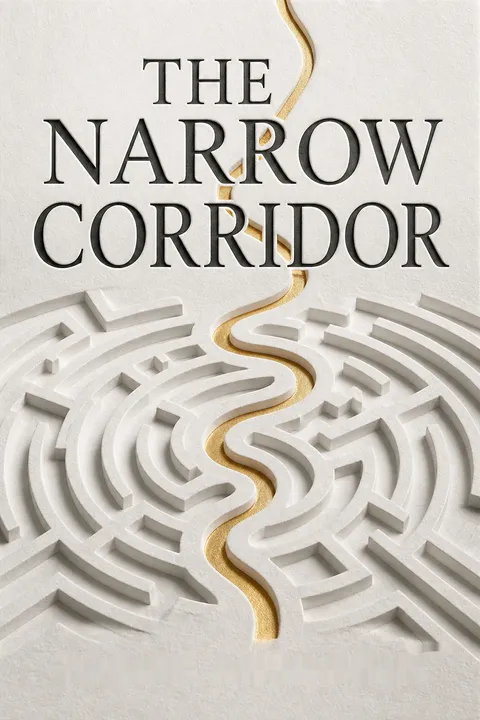
The narrow corridor. The authors call the precarious space between state domination and lawless insecurity the Narrow Corridor. Inside it, state and society are both strong: the state can protect people, while an organized public can keep state power responsive. Liberty is not a gift from rulers or a constitutional design that runs by itself. It is a continuing achievement of this balance.
The framework’s force comes from refusing the easy choice between order and freedom. It treats security and political accountability as complements, not competing luxuries. That is useful whenever debate reduces government to either a threat or a cure: the relevant question is what the state can do, and who can make it answer for doing it. The corridor metaphor also emphasizes that liberty can be lost through neglect as well as seizure. Its limit is that “society” can sound unified; in practice, some groups have far more ability to organize and be heard than others.
Judge freedom by who can interfere arbitrarily, not only who actually does
Threats shape choices. Political philosopher Philip Pettit’s idea of dominance describes living at another person’s mercy, exposed to arbitrary interference without reliable recourse. A threat need not be carried out to restrict freedom: people change their behavior when punishment could arrive at an official’s whim. Wole Soyinka’s journey through 1990s Lagos passed gangs and roadblocks where payment or submission could be demanded repeatedly. The insecurity was not just the danger of an attack, but the need to anticipate what powerful strangers might do.
Beyond state violence. The book applies this idea to violence by gangs, employers, family members, and entrenched customs, as well as by governments. A predictable law can constrain the powerful; arbitrary discretion leaves people dependent on their goodwill. Measuring liberty therefore requires asking whether people can refuse, complain, and seek redress without risking retaliation.
This account makes an important distinction between noninterference and independence. A person may be left alone today and still be unfree if another actor can impose serious costs tomorrow without explanation or appeal. That distinction helps explain why formal rights can coexist with fear in workplaces, homes, and neighborhoods. It also sharpens policy questions: accountability matters not merely after abuse, but because credible remedies change the balance of power beforehand. The concept should not erase differences in severity, however. A threat of violence, economic dependence, and social disapproval can all constrain choice, but they do not impose identical harms.
Constitutions cannot shackle power unless citizens keep using them
The Red Queen effect. The authors use this term for the ongoing race in which state and society must keep building capacity to maintain a balance. If the state grows stronger while society stands still, the state can dominate. If society can organize, contest power, and cooperate with public institutions, the state can gain capacity without escaping accountability.
Athens and America. In Athens, Solon ended debt bondage for citizens and expanded access to political participation; Cleisthenes later reorganized representation and gave citizens a way to exile a figure they feared was becoming too powerful. In the United States, the founding Constitution initially omitted a bill of rights. Public pressure during ratification helped force its addition. In both cases, written rules mattered because people had the means to demand and defend them.
The race metaphor captures why liberty needs maintenance: growing administrative, military, or economic power creates new demands for oversight. It also avoids treating state capacity as inherently oppressive. A capable state can do more for the public when citizens can monitor and influence it. The historical examples suggest that organized participation must include more than elections; protests, associations, petitions, and public scrutiny can reinforce formal institutions. Still, competition alone is not automatically virtuous. It builds shared capacity only when conflicts can be negotiated and institutions remain credible, rather than becoming weapons for one side.
Treat social norms as both protection from violence and a cage
Rules without a state. In societies with little central authority, customs can settle disputes and coordinate help. The Akan of West Africa used public village deliberation to resolve conflicts. Among the Tonga, however, a farmer’s unusually large harvest could provoke accusations of sorcery, making generosity less a free choice than protection against retaliation. Norms can restrain violence while discouraging people from standing out or accumulating wealth.
The cage can harden. The Tiv used accusations of witchcraft to cut down people who seemed too powerful, helping prevent political hierarchy but also restricting economic accumulation. India’s caste system imposes a more unequal cage: inherited status shapes occupation, social relations, and political voice. These cases differ greatly, but they show how customs that create order can also make people dependent, immobilize society, and block opportunity.
Norms are not simply informal substitutes for law. They distribute protection and obligation, and the same rule can shield a community while burdening its least powerful members. This helps explain why changing a custom is not merely an individual act of courage: people may depend on the group for safety, work, or social standing. The comparisons also warn against treating “community” as automatically humane. Yet state reform cannot simply erase shared norms and expect cooperation to appear. Durable change requires new ways to protect people and coordinate action, as well as resistance to customs that enforce subordination.
A state-builder’s useful edge can turn conflict resolution into domination
The slippery slope. A leader invited to settle disputes or provide protection may acquire enough authority to control much more. The book calls the emergence of centralized authority where little existed before pristine state formation. State-builders often have an edge, such as a compelling ideology, superior organization, or new military technology, that helps them overcome resistance to hierarchy.
From mediator to ruler. Muhammad came to Medina to help resolve conflict between clans, but religious authority, military success, and new revenues helped him build a state. Shaka used military organization to unite groups under Zulu rule, while weakening rival sources of authority. Neither story is a simple account of a villain or a liberator. Centralization can end conflict and weaken restrictive customs, but without institutions and organized social counterweights, it can replace one form of domination with another.
The concept is strongest when it explains how useful services can generate political power without a single dramatic seizure of control. Security and dispute resolution create dependence; dependence can then widen a leader’s authority. This is a warning against judging state-building only by its first results, such as fewer feuds or more predictable rules. The key issue is whether the new authority can be contested after it becomes valuable. The account also invites caution about historical analogies: religious, military, and administrative power work differently across societies, even when each can help a leader overcome barriers to centralization.
Build prosperity on broad opportunity, not a ruler’s temporary growth bargain
Order is not enough. A centralized state can protect trade and investment, as the early Islamic state did by reducing conflict and supporting commerce and irrigation. The authors call growth generated under a despotic state despotic growth. It can raise output, but its gains are fragile when rulers can seize assets, grant monopolies, or change rules at will. Ibn Khaldun described how rulers’ rising extraction can eventually weaken both economic activity and state revenue.
Opportunity changes the engine. The Italian communes offer a different model. Their laws, public services, and constrained rulers helped merchants and newcomers build businesses. Francesco Datini, born to a poor family, became a major merchant through trading across European cities. Economic dynamism depends not only on secure property, but on broad access to skills, capital, contracts, and experimentation. A ruler’s favored firms may grow; sustained innovation needs room for many people to try.
The distinction between growth and durable prosperity is central. Investment can flourish under a strong ruler when it serves the ruler’s interests, but that does not guarantee equal access or protection when priorities change. Broad opportunity matters because innovation is difficult to command: governments can fund projects, but they cannot dictate which experiments will prove valuable. This argument connects political accountability to economic discovery. It also leaves a useful question open: how much inequality can a society tolerate before formally broad opportunity becomes merely nominal? Institutions may offer access on paper while wealth and connections still decide who can use it.
Read shocks through the existing balance of power, not as universal causes
The same shock, different paths. War strengthened Switzerland’s confederation, where free communities could build shared authority, but helped Prussia create a militarized state that weakened society. In Montenegro, resistance to central rule left authority fragmented and feuding persistent. The effects of war depended on the starting relationship between state and society, not on war alone.
Coffee’s split harvest. Nineteenth-century demand for coffee encouraged state-building in Costa Rica and Guatemala. Costa Rica distributed land widely and developed a smallholder economy; Guatemala’s powerful landowners used state power to dispossess Indigenous communities and compel labor on plantations. The book calls attention to conditional effects: geography, trade, or war can shift a society in different directions depending on who already holds power and how society is organized.
This is a useful corrective to single-cause history. A shock becomes politically consequential through existing institutions, coalitions, and inequalities. The comparison also shows why economic growth or state expansion cannot be assumed to produce political liberalization: the distribution of land and the organization of labor shape who gains leverage. The framework’s strength is its attention to interaction rather than destiny. Its challenge is empirical: because many factors move together, identifying which balance of power mattered most in any one case is difficult. The model works best as a guide to questions, not a shortcut to prediction.
A paper state can repress selectively while failing at ordinary public work
The hollow Leviathan. A Paper Leviathan looks like a modern state but lacks dependable capacity to enforce laws, settle disputes, or provide services. Argentina’s welfare applicants described repeated delays, changing instructions, and officials who might or might not attend to them. Colombia’s national government struggled to build and maintain basic roads, while armed groups sometimes supplied local order and services instead.
Weakness can be strategic. Such states may remain arbitrary and repressive even as they fail to perform routine tasks. Political leaders can preserve patronage by filling offices with allies, avoid infrastructure that might connect and mobilize society, or keep laws flexible enough to reward supporters and threaten opponents. Colonial systems of indirect rule helped establish some of these conditions by leaving administrative structures without broad participation or strong bureaucracies. The result is not a harmlessly small state, but unreliable authority with little public accountability.
This category explains why visible ministries, laws, and official titles do not prove that a state can govern effectively. It also highlights a political paradox: incapacity can benefit leaders if it preserves discretionary rewards and prevents citizens from organizing around common demands. The account discourages a narrow focus on technical fixes, such as importing administrative blueprints, when political incentives favor nonperformance. At the same time, state weakness has multiple causes, and not every service failure is deliberately engineered. The important diagnostic is whether incapacity persists alongside selective coercion and patronage that advantage the governing coalition.
Keep political conflict contestable before it becomes existential
When the race turns zero-sum. In Weimar Germany, polarized parties, elite hostility to democracy, ineffective institutions, and economic crisis helped turn political competition into a struggle to destroy opponents. Traditional elites underestimated Hitler, assuming they could use him to restore their power. The Enabling Act then allowed parliament to surrender its authority. Chile followed another route: intense conflict over Allende’s reforms and elite opposition ended in a military coup. In parts of Italy, citizens facing elite domination accepted hereditary rulers over continued instability.
Institutions need trust. Elections and courts cannot contain conflict if major groups reject their legitimacy or refuse compromise. A movement claiming to represent ordinary people can deepen the danger when it treats every check on its leader as sabotage. The authors distinguish this from movements that challenge injustice while continuing to use shared institutions. Contestation can strengthen liberty only when political rivals remain possible partners, not enemies to eliminate.
The warning is not that political conflict itself is dangerous. Conflict can expose exclusion and force neglected claims onto the agenda. The danger is the loss of a shared arena in which opponents accept outcomes, negotiate, and try again. This places institutional trust at the center of democratic stability, while reminding readers that trust cannot be demanded from people who experience institutions as rigged. The framework also complicates simple accounts of populism: popular anger may reflect real failures, even as leaders exploit it to remove constraints. Diagnosing both the grievance and the institutional threat is essential.
Build broad coalitions before expanding state power, then make oversight visible
There is no single doorway. A despotic state may need a stronger society; an absent state may need more capacity; a weak Paper Leviathan may require both to grow together. South Africa’s transition combined mass mobilization with a coalition between the African National Congress, black leaders, and business interests. Black Economic Empowerment helped create economic stakes in compromise, while Nelson Mandela’s public gestures helped reduce distrust.
Make the balance real. Lagos improved services after leaders professionalized tax collection and negotiated cooperation with market associations. Bogotá’s Antanas Mockus promoted civic participation alongside stronger public administration. Sweden expanded welfare programs through a coalition of workers, farmers, and businesses, with trade unions helping monitor the state. These examples suggest practical tests for reform: who benefits, who can contest the policy, and whether oversight is public and effective. Universal rights can help different groups defend one another against arbitrary power.
These cases show that institutional reform is not just a design problem. A coalition must make expanded public capacity tolerable to those who fear it, while giving excluded groups a continuing role in oversight. Local experiments can demonstrate that better services and public accountability may reinforce each other, rather than requiring a choice between them. Universal rights can widen that coalition by connecting groups before each must confront abuse alone. The difficulty is that coalitions may protect their own members while excluding others. Their breadth and the durability of public accountability matter as much as the initial agreement.
Analysis
The book’s central achievement is to make political freedom a problem of ongoing balance rather than a prize delivered by a constitution, a benevolent ruler, or economic development. Its typology of absent, despotic, shackled, and paper states clarifies why similar-looking governments can have radically different effects: formal institutions matter, but so do administrative capacity, social organization, and the distribution of power. The comparison of Athens, China, India, Europe, the United States, and postcolonial states gives the argument unusual range while keeping a consistent question in view: who can make whom answerable?
The framework also usefully connects political participation with prosperity. A capable state can secure contracts and provide infrastructure, but broad economic opportunity and experimentation depend on protections that rulers cannot withdraw arbitrarily. This avoids both a romantic picture of markets and the opposite assumption that state expansion automatically improves welfare. The Swedish case, set beside Weimar Germany, makes the political conditions of state expansion especially legible: coalition and oversight shape whether new capacity is shared or captured.
The main analytical risk is that the two axes, state power and societal power, compress internal divisions. Society is not one actor, and a coalition can restrain the state while dominating minorities or workers. The American and Indian examples acknowledge this, but the broad typology can still obscure whose liberty is being measured. A second challenge is causal identification. Concepts such as a narrow corridor and a zero-sum Red Queen describe trajectories persuasively, but historical cases contain many overlapping causes, making the framework harder to test cleanly. These limits do not undo its contribution. They suggest a practical refinement: assess not only the balance between state and society, but also who is represented within each, who can contest decisions, and whether rights and services reach people with the least power.
Review Summary
The Narrow Corridor explores the delicate balance between state power and societal strength necessary for liberty to flourish. The authors argue that freedom thrives when both state and society are strong, creating a "shackled leviathan." Using historical examples, they demonstrate how countries enter and exit this narrow corridor of liberty. While some readers find the book insightful and thought-provoking, others criticize its length, simplification of complex issues, and occasional cherry-picking of examples to fit the theory. Despite these criticisms, many reviewers recommend the book for its ambitious scope and engaging historical analysis.
People Also Read





Glossary
Narrow Corridor
Balance enabling libertyThe Narrow Corridor is the precarious political space in which both state and society are strong. The state can control violence, enforce laws, and provide services, while an organized society can constrain and influence state power. Liberty develops inside this balance and requires ongoing effort; a state that dominates society or a society without effective public authority leaves people exposed to different forms of domination.
Red Queen effect
Mutual capacity-building raceThe Red Queen effect is the continuing contest in which state and society build their capabilities in response to one another. A more capable state can deliver security and services, but it also gives society reasons to organize and monitor it. When this competition remains open to cooperation and compromise, both sides can grow. When it becomes zero-sum, it can destabilize the political balance.
cage of norms
Customs that restrict choiceThe cage of norms refers to the customs, traditions, and social expectations that regulate behavior, often in societies with little effective state authority. These norms can coordinate cooperation, settle disputes, and reduce vulnerability to violence. They can also impose rigid roles, preserve hierarchy, restrict economic choices, and make people dependent on powerful relatives or community members.
Shackled Leviathan
Capable, accountable stateA Shackled Leviathan is a state with the capacity to enforce laws, control violence, resolve disputes, and provide public services, while remaining constrained by an organized and politically active society. Its power is not limited simply by constitutional language. Citizens must be able to monitor it, challenge it, and influence decisions, while cooperating with it when public goals require collective action.
Paper Leviathan
State with hollow capacityA Paper Leviathan has the outward features of a modern state, such as formal laws, offices, and agencies, but lacks reliable capacity to govern across its territory. It may be arbitrary or repressive in selective ways while failing to deliver ordinary services or impartial justice. Patronage, fear of social mobilization, and political advantages from discretionary rule can help preserve this weakness.
despotic growth
Growth under unaccountable ruleDespotic growth is economic expansion generated under a state that can maintain order, protect some property, and direct investment without being accountable to society. It can support trade and productivity, especially when technology is simple or state priorities align with growth. Its benefits remain vulnerable to extraction, arbitrary policy, unequal opportunity, and the limits imposed on open-ended experimentation.
dominance
Exposure to arbitrary interferenceDominance is a condition in which a person or group lives subject to another’s uncontrolled power to interfere with their choices. The interference need not occur constantly; its credible possibility can induce fear, obedience, or self-censorship. Dominance may be imposed through violence, economic dependence, political discretion, or entrenched social customs, and it can persist even without visible abuse.
FAQ
What's The Narrow Corridor about?
- Exploration of Liberty: The Narrow Corridor by Daron Acemoğlu examines how liberty can flourish when there is a balance of power between states and societies. It emphasizes the importance of both a capable state and an organized society.
- State and Society Dynamics: The book introduces the concept of the "narrow corridor," a metaphorical space where states and societies coexist in balance, allowing for the emergence of liberty.
- Historical Case Studies: Acemoğlu uses historical examples from various cultures, such as ancient Greece and modern Europe, to illustrate how different societies have navigated the balance of power.
Why should I read The Narrow Corridor?
- Understanding Governance: The book provides insights into the dynamics of political power and societal organization, making it relevant for anyone interested in political science, history, or sociology.
- Lessons for Modern Issues: It offers valuable lessons for contemporary governance and state-society relations, encouraging critical thinking about the role of government and civil society.
- Engaging Narrative: Acemoğlu presents complex ideas in an engaging manner, enriched with historical anecdotes and case studies that provide context for theoretical discussions.
What are the key takeaways of The Narrow Corridor?
- Balance is Crucial: Liberty emerges when there is a balance of power between a capable state and an organized society, allowing for accountability and freedom.
- Historical Context Matters: Historical legacies significantly influence the development of states and societies, affecting their trajectories toward or away from liberty.
- Role of Norms and Agency: Societal norms and individual agency play significant roles in shaping political outcomes, influencing the balance of power between state and society.
What is the "narrow corridor" concept in The Narrow Corridor?
- Definition of the Corridor: The "narrow corridor" is a metaphorical space where state capacity and societal power are balanced, allowing for liberty and democracy to flourish.
- Struggle for Balance: Achieving this balance requires continuous effort from both state and society to maintain their relative power and protect individual liberties.
- Implications for Governance: The corridor concept suggests that fostering a strong civil society is essential for keeping the state accountable and ensuring liberty.
How do the authors define "Leviathan" in The Narrow Corridor?
- Types of Leviathans: The authors categorize states into three types: Absent Leviathan (weak state), Despotic Leviathan (strong state with little societal input), and Shackled Leviathan (strong state with societal checks).
- Historical Context: The concept is rooted in historical examples, illustrating how different societies have organized their political structures and the balance of power.
- Implications for Liberty: The type of Leviathan a society embodies affects the level of liberty experienced by its citizens, with a Shackled Leviathan being more likely to protect individual rights.
What is the "Red Queen effect" mentioned in The Narrow Corridor?
- Dynamic Balance: The "Red Queen effect" describes the ongoing struggle between state and society, where both must continuously adapt to maintain their relative power.
- Historical Context: Derived from Lewis Carroll's Through the Looking-Glass, it captures the essence of the constant effort required to maintain liberty.
- Implications for Liberty: It emphasizes that liberty is not a static condition but a process requiring active participation from society to keep the state accountable.
How do local political experiments contribute to state building in The Narrow Corridor?
- Case Studies: The book provides examples of successful local governance initiatives, such as those in Lagos and Bogotá, that serve as blueprints for national reforms.
- Societal Cooperation: Local experiments often require cooperation among societal groups, leading to broader political engagement and trust in governance.
- Incremental Change: These experiments can lead to incremental changes that gradually strengthen state capacity, helping societies move toward the corridor of liberty.
How does The Narrow Corridor address the issue of inequality?
- Inequality and State Capacity: The authors discuss how inequality can undermine state capacity and societal cooperation, emphasizing the need for inclusive policies.
- Historical Context: Historical examples illustrate how inequality has affected political stability and governance, highlighting the need for equity-promoting policies.
- Policy Recommendations: Acemoglu and Robinson suggest that reducing inequality can strengthen state capacity and improve governance, advocating for a social contract benefiting all citizens.
What role does societal mobilization play in The Narrow Corridor?
- Empowerment of Citizens: Societal mobilization is essential for holding the state accountable and ensuring it serves the people's interests.
- Coalition Building: Mobilization often involves forming coalitions among societal groups to advocate for change and create an inclusive political environment.
- Red Queen Effect: Societies must continuously adapt and mobilize to maintain their position within the corridor, preventing the state from becoming despotic.
How do the authors suggest societies can move into the corridor?
- Building Coalitions: Forming coalitions between societal groups and the state can create a balanced power dynamic, fostering cooperation and accountability.
- Strengthening Institutions: Ensuring political institutions are responsive to societal needs and creating checks and balances are crucial for moving into the corridor.
- Encouraging Societal Mobilization: Active civil society is essential for pushing back against despotism and maintaining the balance necessary for liberty.
What are some historical examples used in The Narrow Corridor?
- Ancient Greece: The Athenian state is a prime example of a Shackled Leviathan, where strong societal norms and political engagement allowed for a flourishing democracy.
- Zapotec Civilization: The Zapotec state in ancient Mexico highlights how societal organization and state capacity interacted to create conditions for liberty.
- Costa Rica and Germany: These countries illustrate successful transitions into the corridor, emphasizing societal mobilization and state-building efforts.
What are the best quotes from The Narrow Corridor and what do they mean?
- "Where there is no law there is no freedom.": Emphasizes the necessity of a functioning state to provide laws that protect individual liberties.
- "Liberty needs a mobilized society.": Highlights that liberty must be actively pursued and defended by society, requiring a vigilant and engaged citizenry.
- "The struggle brings benefits.": Reflects the idea that the ongoing struggle between state and society can lead to positive outcomes, such as increased accountability and protection of liberties.
About the Author

Download PDF
Download EPUB
.epub digital book format is ideal for reading ebooks on phones, tablets, and e-readers.








